
Waiting for CPNRE results can feel longer than the exam itself. After months of preparation, practice questions, and exam-day focus, candidates across Canada ask the same questions: how to check CPNRE results and when CPNRE results are released?
This guide focuses on the CPNRE administrative policy in Canada for assessing results, where you can access your results, the implications of the different administrative statuses, and the subsequent actions to be taken, whether the exam is successfully completed or a different strategy must be employed. Understanding how these standards differ from other pathways, such as the CPNRE vs NCLEX, can provide helpful context during this time.
CPNRE results processing has been a significant source of stress. Hence, to simplify communication, let us provide you with the information available from the relevant regulators regarding the processing of CPNRE results.
What Is the CPNRE Result Release Process?
The release of CPNRE results is an exercise in fairness, regulatory compliance, and accuracy, rather than a focus on speed. As a non-adaptive, competency-based national licensure examination, CPNRE results must go through one of these structured post-examination reviews before being released.
When the national exam closing date arrives, there is a period in which all exam responses are analyzed and verified. This confirmation is one of the necessary steps in reviewing whether exam items are performing their intended purpose and whether the exam is scoring uniformly across all hosting provinces/territories.
Quality assurance and exam security depend on a post-exam review. Such reviews guarantee that no matter the candidate’s writing location or date, they are all measured against the same national entry-to-practice benchmarks. You can find more details on these standards in our CPNRE Exam Guide.
The CPNRE results’ processing and waiting periods are necessary parts of the licensing procedure; they are not indicators of a backlog or an issue with results retrieval. The CPNRE results processing and waiting periods are necessary facets of the licensing phases; because of these, the CPNRE exam can promote fairness, a defendable process, and public protection.
When Are CPNRE Results Released in Canada?
One of the most asked questions by nursing students is when CPNRE results are released? Most candidates receive their results four to six weeks after the exam window closes.
Why the timeline matters?
- The exam is non-adaptive
- Results are validated nationally
- Provincial regulators release results individually
This is why the CPNRE results waiting period seems long, but it is actually normal. For a deeper look at these timeframes, see our article on How long do CPNRE Results Take? If, after two weeks, you are checking daily, you are early, not late. Understanding the timeline helps reduce unneeded stress as you wait for your results.
Where to Check Your CPNRE Results
Many candidates, assuming they are to check results through the exam provider, are unaware of how the CPNRE Results access system actually works.
You can only check CPNRE results online through your nursing regulatory body of the province. In fact, results are sent directly to your regulator and are never made public.
Official sources to check CPNRE results:
- Your provincial regulator’s online portal
- Email notifications from the regulator (in some provinces)
- Your registration or applicant dashboard
The results are not available nationally. If you see a third-party website stating that it has CPNRE results, it is a non-official source. Always consult your provincial authority for the correct CPNRE results in Canada.
Step-by-Step: How to Check CPNRE Results Online
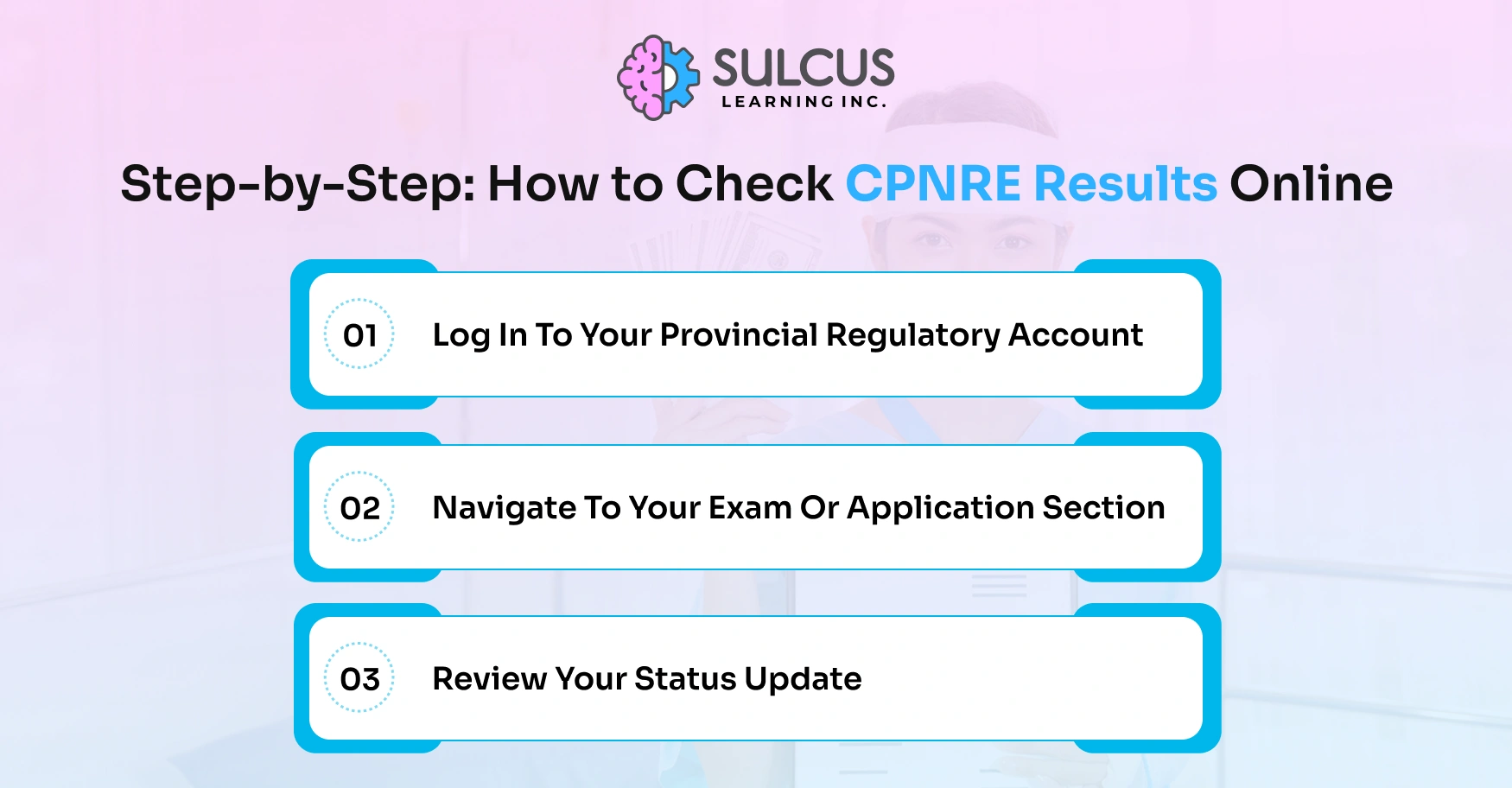
Results for the CPNRE are accessible exclusively through the provincial or territorial nursing regulatory bodies. They do not appear on third-party websites and are not released in real-time.
To access your CPNRE results, follow the steps below:
Step 1: Log in to Your Provincial Regulatory Account
To initiate access, log on to the secure online portal provided by your provincial nursing regulator. Use the credentials generated during your licensure or exam application (for instance, CLPNA, CLPNM, or CNO – RPN stream).
Step 2: Navigate to Your Exam or Application Section
Once logged in, access the portion pertaining to:
- Examination results
- Application or registration status
- Licensure decisions
(The phrases used may differ slightly by regulator.)
Step 3: Review Your Status Update
Most likely, the outcome of your CPNRE exam will be reflected in your account as a status update. It will not be in the form of a downloadable score report. The following status updates are likely:
- Exam Result
- Application Status
- Registration or Licensure Decision
Important Things to Know
Results for the CPNRE are released in batches, not in real-time. Therefore, the lack of updates does not imply that a problem exists. Because regulatory systems are not real-time, result visibility will vary by province or territory. The only authoritative body that can provide you with CPNRE results that are final and official is the nursing regulators in your province. Candidates are discouraged from using social media, email, and discussion forums pertaining to unofficial results. This information leads to anxiety and misinformation.
For unsuccessful candidates, regulators provide a downloadable competency-based performance report instead of a score. This report describes performance across the key entry-to-practice competencies and is meant to direct focused study and remediation for subsequent attempts at the examination. Some provinces provide more detail than others, but the feedback is meant to aid learning rather than reveal the individual exam questions.
Understanding Your CPNRE Result Status
The CPNRE result statuses are typically ‘Pass’ or ‘Fail’. Some nursing candidates may experience statuses such as ‘pending’ or ‘under review’ temporarily.
- Pass means you met the national competency standard
- Fail means the standard was not met
- Pending typically indicates administrative processing
If your status hasn’t changed after the expected release time for the CPNRE results, contact your regulator. If the examination provider has not received communication from you, it means that the expected CPNRE result date is likely next.
How Sulcus Learning Helps You Succeed on the CPNRE
Passing the CPNRE is not about memorization. It is about clinical judgment, decision-making, and applying knowledge within Canadian nursing practice and this is where Sulcus Learning stands out.
Sulcus Learning is developed by experienced Canadian nurses and nursing educators who understand both the structure of the CPNRE and the realities of practical nursing practice in Canada. We recognize the importance of Mock Tests & Practice Exams for Canadian Nursing Licensure in building this clinical judgment. The platform is designed to help candidates think the way the exam expects them to think.
Sulcus’s CPNRE preparation approach focuses on:
- Competency-based learning aligned with Canadian entry-to-practice standards
- Realistic, exam-style practice questions that reflect the tone, structure, and expectations of the actual CPNRE
- Clear, detailed rationales that explain not only the correct answer, but the clinical reasoning behind it
- Performance tracking and analytics that identify strengths, gaps, and overall readiness over time
Rather than guessing whether they are prepared, candidates gain structured insight into their progress, allowing them to study with purpose and confidence. By reinforcing exam-ready thinking and Canadian practice expectations, Sulcus Learning helps reduce uncertainty—so when results day arrives, there are fewer surprises and stronger outcomes.

Conclusion
Knowing how to check CPNRE results in Canada removes unnecessary stress during an already anxious waiting period. Results are released through provincial regulators, typically within 4 to 6 weeks, and are shared as pass/fail only.
Understanding the official process, timelines, and next steps keeps you focused on what matters most and helps you move forward in your nursing career with confidence, professionalism, and the right preparation strategy.
FAQ’s
Q1. When do CPNRE results get released?
Ans. CPNRE results are usually released within 4 to 6 weeks after the exam window closes, once national validation and provincial regulatory review processes are completed.
Q2. Where can I check my CPNRE results?
Ans. You can check CPNRE results online through your provincial nursing regulatory body’s official portal, not on the exam provider’s website or any third-party platforms.
Q3. Do CPNRE results show marks or percentages?
Ans. No, CPNRE exam results are released only as pass or fail, as the exam follows a competency-based evaluation model rather than numerical scoring.
Q4. What if my CPNRE results are delayed?
Ans. CPNRE result delays usually occur due to administrative verification. If results exceed six weeks, candidates should contact their provincial nursing regulator for clarification.
Q5. How do I know if I passed the CPNRE?
Ans. Your regulatory portal will clearly display a Pass or Fail status once results are released. No email or unofficial source should be relied upon.
Q6. Can employers see my CPNRE results?
Ans. Employers cannot directly view CPNRE results. They verify eligibility only through your licensure or registration status after successful exam completion.
Q7. What should I do if I fail the CPNRE?
Ans. If you are unsuccessful on the CPNRE, review any competency-based feedback provided by your provincial nursing regulator (if available) to identify areas for improvement. Create a targeted study plan focused on those competency gaps, and reapply for the exam during the next available CPNRE window in accordance with your regulator’s eligibility, timeline, and fee requirements.
Failing the CPNRE does not define your ability to become a practical nurse. With focused preparation, informed feedback, and the right study tools like Sulcus Learning, many candidates go on to successfully pass on their next attempt.

Taran Kaur
As Managing Director and Lead Instructor at Sulcus Learning, Taran helps internationally educated nurses navigate their professional journey with clarity and confidence. With qualifications including a B.Sc. (Nursing), MBA (HM), ENCC, and CMSN(C), she focuses on helping learners succeed in licensure exams and professional practice. Connect with Taran Kaur on LinkedIn.