

Passing the NCLEX exam on your first try is a great achievement because it shows that you not only have the education and background to take the exam, but also the skills to provide critical care and prioritize client safety. Preparing for the NCLEX has become increasingly strategic, as the exam is designed to assess readiness for entry-level RN practice and compliance with professional licensure requirements. With updated exam formats in 2026, the NCLEX places even greater emphasis on clinical judgment and its application in real-world nursing scenarios.
Many candidates ask how they can avoid burnout and self-doubt while preparing to pass the NCLEX exam. The solution is to focus on studying smarter, not longer. You can do this by focusing on exam related content, practice, and learning.
This guide will give you the best study strategies for the NCLEX and focus on test-taking strategies so that you can walk into the exam feeling prepared. These strategies will be especially beneficial for first-time test takers, helping them walk into the exam with confidence that they will pass on the first attempt.
Understanding the NCLEX Exam Before You Start
Before any studying begins, applicants should take time to consider what the NCLEX is designed to measure, especially in light of the 2026 NCLEX framework. The examination no longer rewards simple memorization, but evaluates whether candidates can meet regulatory expectations for safe, entry-level RN practice. Instead, they focus on whether an applicant can demonstrate appropriate clinical judgement, prioritize tasks, and make safe, evidence based, real life nursing decisions.
The NCLEX utilizes Computer Adaptive Testing (CAT) in conjunction with the Next Generation NCLEX (NGN) exam structure. While answering the questions, the difficulty level adjusts based on previous responses to determine whether the test taker is consistently meeting the clinical decision-making standards. There is no set number of questions, and there is no traditional score. An applicant passes only if their performance consistently meets the benchmark for safe, entry-level RN practice as defined by licensure requirements.
This style of testing mimics the real-life circumstances of the nursing profession, where there is a critical need to make decisions and explain their reasoning. If you are still deciding on your career path, consider the types of nursing exams, which illustrate the steps of the nursing licensure process and may help you understand the role of the NCLEX.
How to Study for NCLEX the Right Way (Not the Hard Way)
A common mistake NCLEX participants make is studying too broadly. NCLEX preparation in 2026 is less about content consumption and more about prioritizing and applying content. The exam is meant to evaluate your thought processes as a nurse, not your capacity to memorize.
Effective NCLEX preparation includes:
- A study plan that is structured and time-bound.
- An emphasis on the clinical and patient safety aspects.
- Daily engagement with NCLEX-type questions.
- Constant self-evaluation to recognize and close gaps.
Simply reading without any engagement is not going to be enough. Active learning strategies such as question practice, rationale reviews, and clinical reasoning reflections lead to greater understanding and retention. This approach enhances clinical judgment, lessens exam apprehension, and enables you to arrive at the test center confident and ready to pass the NCLEX on your first attempt.
10 Proven Strategies to Pass the NCLEX Exam on Your First Try
Passing the NCLEX exam is an important part of the nursing licensing process, enabling graduates to begin their qualified nursing careers. With the NCLEX exam changing in 2026 to require less memorization and focus on clinical thinking, judicious decision-making, and targeted practice, the exam revision means there will be new ways to achieve positive outcomes.
Understanding how the NCLEX operates and creating a custom-fit preparation plan will provide a strong foundation for success on the exam on the first attempt.
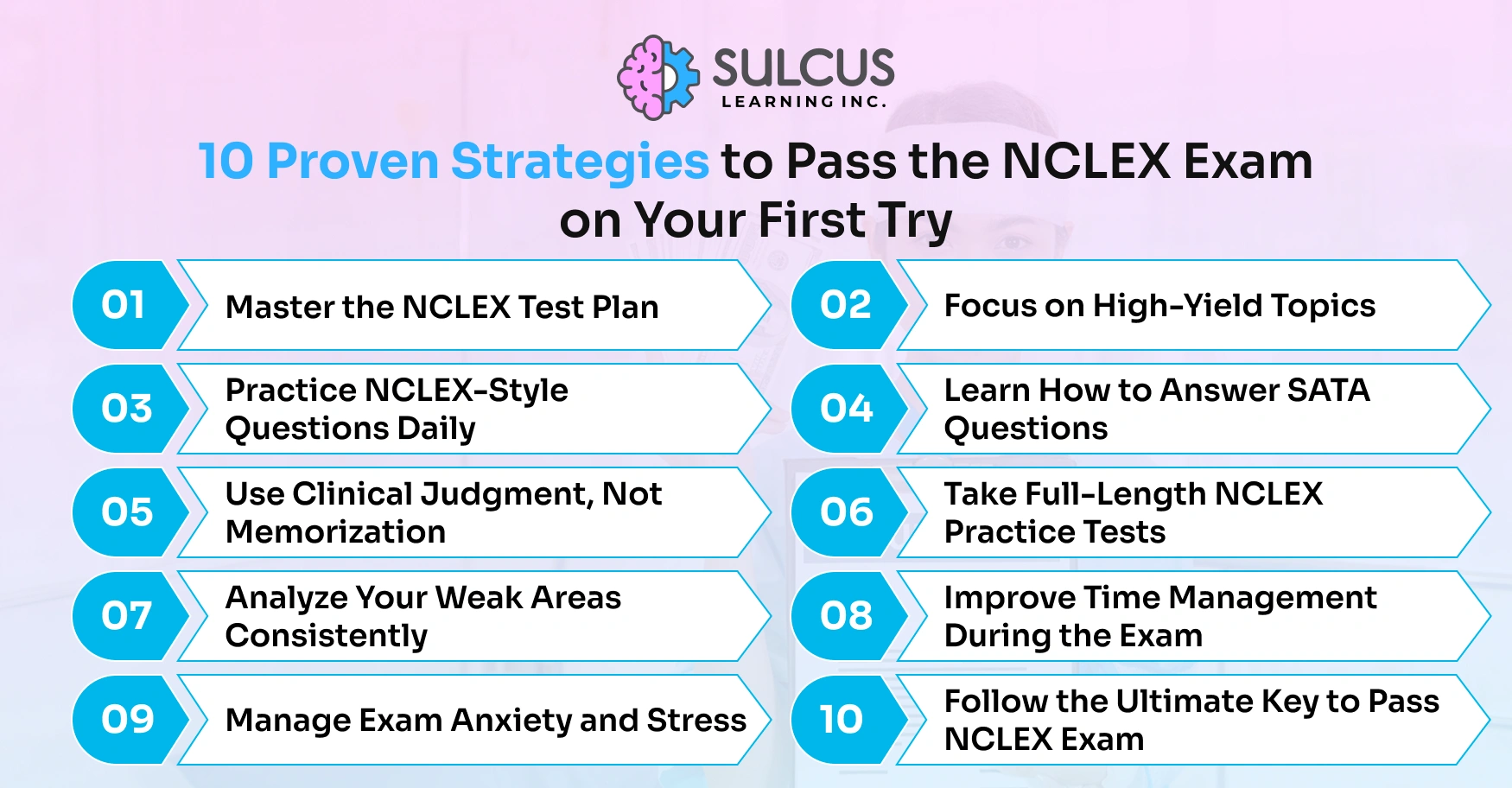
Strategy 1 – Master the NCLEX Test Plan
The NCLEX Test Plan is a blueprint designed to help individuals plan their studies. The plan aligns NCLEX benchmarks with nursing practice and organizes the competencies, categories, and question types associated with the exam. If candidates plan their studies without the Test Plan, their preparation will be misaligned.
Example:
A question may appear to test medication knowledge, but it is categorized under Safety and Infection Control. Without understanding the Test Plan, a candidate may focus on drug facts rather than identify the safest nursing action.
Strategy 2 – Focus on High-Yield Topics
The NCLEX exam is known to frequently present questions in the areas of patient safety, infection control, prioritization, delegation, and core pharmacology. Concentrating study efforts in these areas can be a more efficient use of time when preparing for the exam and advancing clinical thinking skills. These high-yield topics are known to present the greatest return when exam prep activities are completed as their focus is on clinical thinking.
Example:
When two clients appear unstable, the NCLEX often asks which one should be assessed first. Applying airway, breathing, and circulation (ABC) principles is more effective than recalling isolated disease details.
Strategy 3 – Practice NCLEX-Style Questions Daily
To develop the ability to think critically in a timed exam, incorporating practice NCLEX exam questions is necessary. Building the habit of answering 30 to 50 exam questions and thinking after each question about why the answer is correct or why other answers are incorrect is important for exam preparation. If candidates follow through with this practice they will develop their exam thinking skills, understand decision-making, and improve their knowledge of the wording used in exam questions.
Example:
After reviewing a prioritization question, a candidate recognizes that airway protection was prioritized over pain management, reinforcing a core NCLEX decision-making pattern.
Strategy 4 – Learn How to Answer SATA Questions
SATA questions assess a deeper understanding of the clinical scenario. Treat each answer choice as a singular true or false question to avoid answering them in combinations. This improves your chances of getting the right answer and demonstrates the exam’s emphasis on safe and comprehensive decisions as a nurse.
Example:
In a postoperative SATA question, infection prevention may be appropriate, while early ambulation may not be safe for that specific client. Evaluating each option individually improves accuracy.
Strategy 5 – Use Clinical Judgment, Not Memorization
The NCLEX examiners prioritize clinical judgment over memorizing a plethora of facts. Always think in terms of keeping the patient safe, prioritizing care, and reducing risks. Ask, “What do I do to keep the patient safe?” This question will keep your focus aligned with the answers the NCLEX examiners are looking for. This approach reflects the regulatory expectations placed on nurses entering professional practice.
Example:
Instead of recalling symptom lists, a candidate recognizes abnormal vital signs as a sign of deterioration and selects an immediate assessment and escalation of care.
Strategy 6 – Take Full-Length NCLEX Practice Tests
Full-length practice tests are an excellent way for you to build mental stamina and optimize your ability to do the NCLEX in a timed environment. Doing multiple full-length practice tests will allow you to identify any time management problems that you might have, as well as any problems with mental or physical endurance, and answer the questions you are most likely to avoid due to stress in order to help you maintain stamina for the long, grueling test.
Example:
A candidate notices reduced accuracy after several hours of testing and learns to incorporate brief mental resets to maintain concentration during long sessions.
Strategy 7 – Analyze Your Weak Areas Consistently
Simply tracking test scores is not enough to optimize your test-taking strategies. Look for patterns in the incorrect questions. Do you have weaknesses in prioritization, pharmacology safety, or delegation? After identifying these weaknesses, more focused reviews will lead to greater efficiency in preparation and help fill more needs and identified gaps.
Example:
A candidate consistently misses delegation questions. Focused review of RN scope of practice and delegation principles leads to measurable improvement.
Strategy 8 – Improve Time Management During the Exam
Even though the NCLEX isn’t strictly time-based, feeling time-pressured adds stress. To develop steady focus without feeling rushed, practice time management techniques. By developing consistent timing, you will reduce exhaustion and gain mental clarity during the longer sessions.
Example:
A candidate practices making confident, reasoned decisions within a consistent time frame, preserving mental energy for later questions.
Strategy 9 – Manage Exam Anxiety and Stress
Confidence is one of the most influential factors when it comes to controlling anxiety. To gain confidence, you must prepare. Practicing visualization, controlled breathing, and planning are ways to prepare for and relieve stress. The more prepared you are the more confidence you will have, and therefore, the more focus you will have.
Example:
Before beginning a practice test, a candidate uses slow breathing to calm their nerves. This habit carries over to exam day, helping them remain composed when faced with complex clinical scenarios.
Strategy 10 – Follow the Ultimate Key to Pass NCLEX Exam
Achieving NCLEX success the first time is possible, and the best way to do this is to develop good habits. The best habit is to have a routine. A routine that focuses on consistent practice for rational questions, reviews, and most importantly, rest, is the best way to build confidence and achieve success.
Example:
A candidate follows a daily routine that includes focused question practice in the morning, review in the afternoon, and scheduled rest in the evening. Over time, this consistency leads to improved confidence and steady performance on practice exams.
Best Study Guides and Resources to Pass the NCLEX
Most NCLEX aspirants utilize NCLEX study guides, which are crucial in preparing for nursing exams. However, guides vary in effectiveness. The most effective study guides provide practicing NCLEX candidates with the format, logic, and, most importantly, the critical-thinking component of the actual NCLEX exam. As the NCLEX incorporates more clinical thinking and less rote memorization, effective resources ensure that candidates are trained to apply safe knowledge and reason clinically.
Quality NCLEX study guides often include exam-type questions, thorough explanations of both correct and incorrect answers, tracking of user performance, and realistic exam simulations. These characteristics are designed to prepare candidates for the exam and improve their familiarity with NCLEX questions in terms of wording, prioritization, and reasoning. Aligned study materials reduce uncertainty and boost confidence.
When preparing for the NCLEX, aspirants must avoid study materials that focus heavily on content and rote learning. Real preparation must focus on applying knowledge in the clinical setting. The best methodologies emphasize responding to a question to pinpoint where the user is struggling most, provide suggestions, and improve critical reasoning and clinical decision-making in a way that is neither too burdensome nor overwhelming.
Why Sulcus Learning Stands Out as an NCLEX Prep Platform
Sulcus Learning has incorporated exam-aligned learning techniques to build readiness, understanding, and confidence. One of the platform’s unique features is the Readiness Predictometer, which gauges preparedness based on analytics of previous answers. It gives candidates a clear picture of where they stand before the exam.
The platform helps candidates by constantly presenting their unique strengths and weaknesses. This makes their study efforts more effective. Sulcus Learning also implements a Computerized Adaptive Testing (CAT) model, with logit scoring. This is similar to how the NCLEX is structured, and gives more focused insights into a candidate’s performance. This also helps to meet the NCLEX regulatory standards.
Guided progress, AI analytics, and motivational reinforcement allow clients to function more efficiently. It is more than a bank of questions; It helps with overall NCLEX readiness.
Last-Minute Tips to Pass the NCLEX Exam with Confidence
As the exam draws near, focus on confidence. The last two days are for consolidating your study efforts.
- Avoid New Content: Avoid studying information that will leave you feeling unfamiliar, which can increase panic and make you scatterbrained.
- Review Weak Areas Lightly: Spend more time on them to reinforce knowledge rather than going for a deep study.
- Prioritize Rest: Lack of sleep will hurt your decision making, focus, and emotional steadiness.
- Trust Your Preparation: Nothing builds more confidence than the hours put into studying. Have faith in the effort you have put in.
The aim of the NCLEX is not to achieve perfection, but to demonstrate consistent, sound clinical judgment in real-life nursing situations, an essential milestone for anyone learning how to become a nurse and to transition safely into professional practice.
Why Choose Sulcus Learning for NCLEX Exam Preparation?
From the beginning, Sulcus Learning was intended to teach NCLEX candidates how to prepare for the exam in the most realistic way possible. Sulcus Learning helps learners prepare for the NCLEX by not bombarding them with content, but rather presenting them with exam-focused preparations that are aligned to the most recent NCLEX test plans, clinical judgment, and actual nursing decision making.
Most prep platforms focus on content saturation, but the most effective NCLEX study is teaching to the test, which includes practicing patient safety, prioritization, delegation, therapeutic drug/pharmacology, and risk reduction. This way, candidates are learning and practicing the actual domains the NCLEX exam measures.
To most accurately reflect what the NCLEX will be like, Sulcus presents learners with realistic NCLEX-style questions and “why” explanations for every answer choice. Not only does this explain why an answer is correct, but it may also explain why the other answer(s) are unsafe, contrary to nursing practice, or poor clinical nursing judgment.
Ready to practice is prioritized over scores. “No Guess” pathways and adaptive analytics provide built-in, score- and readiness-based indicators, reducing exam anxiety and improving exam practice structure. This combination of practice makes Sulcus Learning the most reliable platform for NCLEX first-attempt success.
Conclusion
With the right mindset, strategy, and study aids, candidates can prepare to pass the NCLEX on the first attempt. Knowing how the exam assesses clinical judgment, employing solid prep strategies, and practicing frequently are the foundations of success.
It does not matter if you are just beginning to learn how to pass the NCLEX, figuring out how to study for the NCLEX more efficiently, or trying to understand the NCLEX-RN passing score, the one thing that is certain is that thorough preparation is always more effective than cramming.
Keep your study plan, have confidence in the clinical skills you have acquired, and go into the exam with a positive mindset. Provided that you have a good plan and a composed mindset, you will likely be able to pass the NCLEX exam and start your nursing career.
FAQ’s
Q1. How can I pass the NCLEX on my first attempt?
Ans. First-attempt success comes from structured, consistent preparation rather than last-minute studying. Candidates who follow a clear study plan, practice NCLEX-style questions daily, review rationales, and focus on clinical judgment instead of memorization are more likely to succeed.
Q2. What is the passing score for the NCLEX?
Ans. The NCLEX does not use a fixed passing mark. It uses Computerized Adaptive Testing (CAT), where candidates must consistently perform above the passing standard set by the exam authority. The test ends once competence is clearly demonstrated.
Q3. How long should I study for the NCLEX?
Ans. Most Canadian candidates prepare for 8–12 weeks. The ideal timeline depends on time since graduation, clinical exposure, and daily study availability. Consistent daily practice with regular self-assessment is more effective than prolonged but irregular study.
Q4. Is the NCLEX difficult for first-time test takers?
Ans. The NCLEX is challenging because it evaluates clinical judgment rather than factual recall. Candidates who understand the exam structure and practice decision-making often perform well on their first attempt.
Q5. Do practice tests help with NCLEX success?
Ans. Yes. Practice tests improve endurance, pacing, and confidence while reducing exam anxiety. Adaptive and full-length tests also help identify gaps in prioritization, safety, and clinical reasoning.
Q6. How should SATA (Select All That Apply) questions be approached?
Ans. Each option should be evaluated independently as true or false. Decisions should be based on client safety, priority of care, and clinical relevance, not patterns or assumptions.
Q7. Is memorization enough to pass the NCLEX?
Ans. No. While foundational knowledge is necessary, the NCLEX primarily assesses how candidates apply knowledge in clinical situations involving safety, prioritization, and risk reduction.
Q8. How many questions are on the NCLEX?
Ans. The NCLEX is adaptive. Candidates may receive as few as 85 questions or up to 150, depending on when the system reaches a confident pass-or-fail decision.
Q9. Why do candidates fail the NCLEX?
Ans. Common reasons include weak exam strategy, over-reliance on memorization, poor prioritization skills, limited practice with NCLEX-style questions, and unmanaged exam anxiety.
Q10. How can anxiety be reduced on exam day?
Ans. Anxiety decreases with preparation and familiarity. Practising under exam-like conditions, maintaining a routine, and using breathing techniques help candidates stay focused and confident.
Q11. Should I focus more on content review or practice questions?
Ans. A balanced approach is ideal, but practice questions should take priority. Reviewing rationales reinforces content through clinical application, which is more effective than passive studying.
Q12. Do adaptive testing platforms improve NCLEX readiness?
Ans. Yes. Adaptive platforms simulate the NCLEX experience by adjusting difficulty based on performance, helping candidates assess readiness and strengthen decision-making under exam conditions.

Taran Kaur
As Managing Director and Lead Instructor at Sulcus Learning, Taran helps internationally educated nurses navigate their professional journey with clarity and confidence. With qualifications including a B.Sc. (Nursing), MBA (HM), ENCC, and CMSN(C), she focuses on helping learners succeed in licensure exams and professional practice. Connect with Taran Kaur on LinkedIn.