

Becoming a licensed nurse has now become more structured and demanding. As healthcare systems throughout Canada and the United States face more complex client care, staffing shortages, and increased regulations. Licensing exams become increasingly important to ensure public safety and readiness as they roll out in 2026.
An important part of this process is the NCLEX, the final step toward licensure as a nurse. For nursing students, understanding the exam’s purpose, how it assesses clinical judgment, and the differences between the RN and PN routes is very important. This process is not about studying to memorize material, it is about thinking critically, using nursing knowledge, and applying it to real patient care situations.
No matter if you are starting your preparation or fine-tuning your final strategy for your NCLEX exam, this guide will offer you the clarity and confidence to tackle the exam.
What is the NCLEX Exam
The National Council Licensure Examination (NCLEX) is a standardized test that assesses whether a nursing graduate is prepared to practice at the entry level. The test is administered by the National Council of State Boards of Nursing (NCSBN) on behalf of nursing regulatory bodies.
In the United States, the NCLEX is required for nursing licensure. The NCLEX does not test candidates’ knowledge of facts, it tests nursing graduates’ ability to put their nursing knowledge into practice in a clinical setting. The nursing graduate is evaluated on clinical judgment, decision making, clinical prioritization, patient safety, ethics, and accountability.
The NCLEX is delivered using Computerized Adaptive Testing (CAT). This means the difficulty of questions adjusts in real time based on a candidate’s responses, allowing the exam to accurately determine competence relative to the required passing standard. Because the exam focuses on application and judgment rather than recall, it remains challenging even for graduates of accredited nursing programs.
Types of NCLEX Exams (United States)
In the United States, there are two kinds of NCLEX exams.
- NCLEX-RN: This is required to obtain a license as a Registered Nurse (RN).
- NCLEX-PN: This is part of the process to become licensed as a Practical Nurse (PN).
Before a nurse can become licensed with a board of nursing in the United States, she/he must take the NCLEX exam.
Nursing Licensure Exams in Canada
In Canada, licensure requirements vary by profession and province, and practical nurses do not take the NCLEX-PN.
Registered Nurses (RN): Most Canadian provinces participate in licensing Canadian nurses using the NCLEX-RN.
Registered Practical Nurses (RPN) / Licensed Practical Nurses (LPN): In Canada, the NCLEX-PN is not used, but Canadian-developed licensure exams are used:
- REx-PN: It is used in most provinces
- CPNRE: It is used in some provinces, and in transitional ‘context’ phases
Candidates must complete the exam required by the regulatory body in the province in which they wish to practice before they can obtain registration and practice nursing.
NCLEX-PN vs NCLEX-RN: Key Differences Explained
Before beginning your nursing exam prep, it’s important to understand the differences between the NCLEX-PN vs NCLEX-RN exams, as they cover different scopes of nursing practice.
NCLEX-RN
The NCLEX-RN is for students who have graduated from a registered nurse program, such as a Bachelor of Science in Nursing (BScN) or an equivalent degree. This exam assesses students’ advanced clinical judgment, leadership, care coordination, and ability to handle complex and unpredictable client situations. It is designed to assess your readiness for independent practice as a registered nurse across a variety of healthcare settings.
NCLEX-PN
The NCLEX-PN is for students who have graduated from Practical Nurse programs. It emphasizes patient safety and clinical reasoning and is geared toward predictable care situations and collaborative practice. This exam is designed to test your understanding of the practical nurse role for the healthcare team and your accountability to provide safe and competent care within your scope of practice.
The Key Differences
They both use the same adaptive testing approach but differ in depth, responsibility, and the level of clinical reasoning expected.
How The NCLEX Exam Works
The NCLEX’s primary purpose is to determine whether nursing graduates can make safe, clinically appropriate decisions and perform adequate evaluations at the entry-level stage. This exam does not test candidates’ memory about facts. Instead, this test assesses candidates’ knowledge of nursing ability to prioritize care and exercise professional judgment across a wide range of clinical situations.
The examination is created using a technique called computerized adaptive testing (CAT), which allows the test to assess a candidate’s competency level at every stage.
1. Computerized Adaptive Testing (CAT)
The NCLEX exam is implemented using a computerized adaptive testing (CAT) format. In this type of nursing exam implementation, each question is selected based on the responses to previous questions. As the test goes on, the system adjusts the question difficulty based on whether the candidate is above or below the passing standard.
Every answer given by a nursing aspirant is critical and is used to evaluate their clinical judgment, decision-making, and safety. The exam algorithm determines if the candidate has a statistical chance of passing or failing the exam based on the CAT testing rules and their performance.
The goal of the NCLEX is not to achieve a figure or percentage, but to show clinical judgment over and over, as well as showcase clinical judgment and decision making across the different nursing practice areas.
2. NCLEX Exam Format & Question Types
The NCLEX is designed to reflect the actions and thought processes that nurses use during real clinical practice. This includes a mix of traditional and Next Generation NCLEX (NGN) question types designed to assess how well candidates make sound clinical judgments and recognize and mitigate clinical risks.
Since every test is adaptive, the difficulty and types of questions will change based on how the candidate is performing.
3. Common NCLEX Question Types
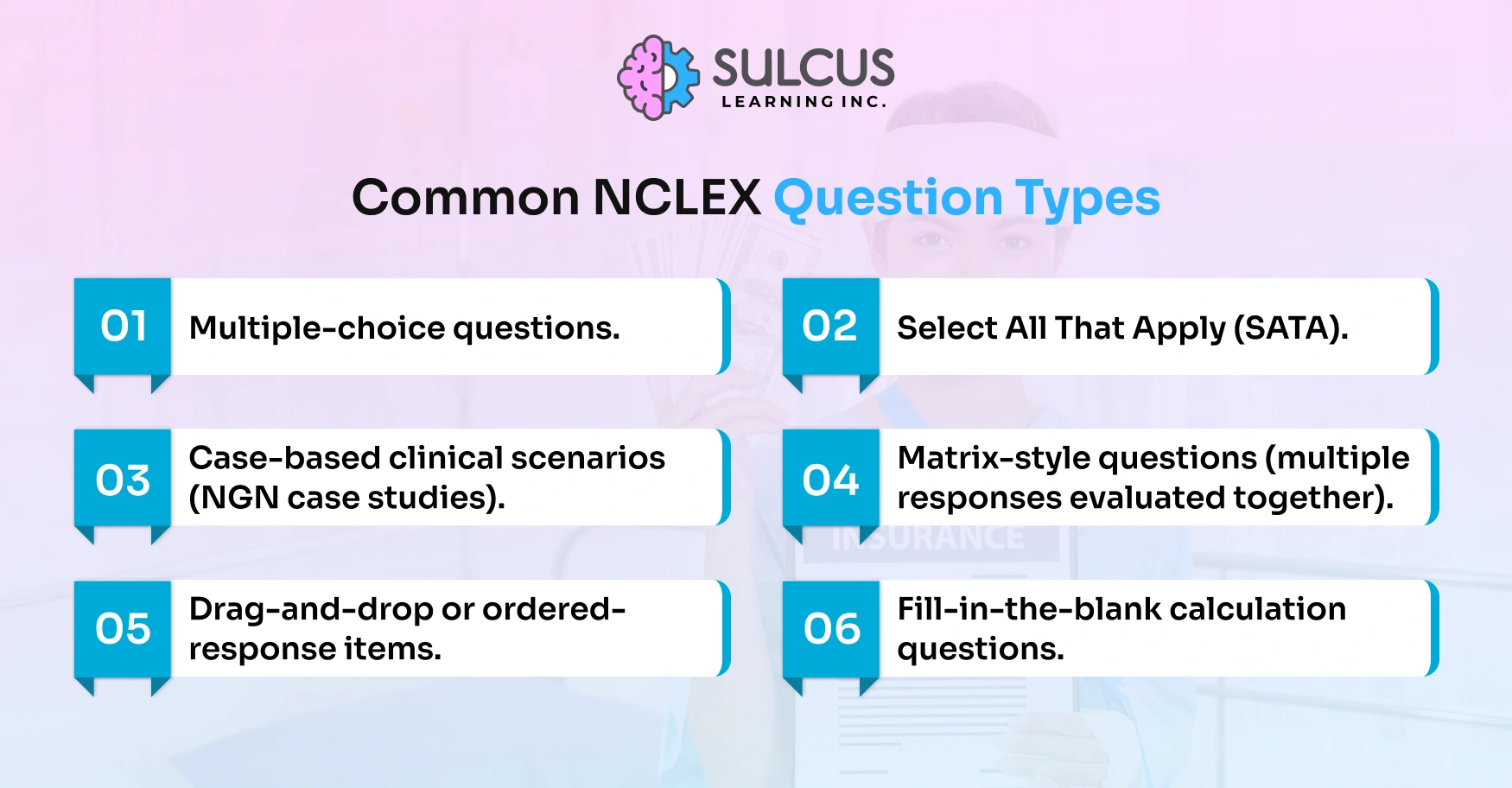
The NCLEX may include a variety of question formats, such as:
- Multiple-choice questions
- Select All That Apply (SATA)
- Case-based clinical scenarios (NGN case studies)
- Matrix-style questions (multiple responses evaluated together)
- Drag-and-drop or ordered-response items
- Fill-in-the-blank calculation questions
These NCLEX question types are designed to assess the level of clinical judgment, clinical reasoning, and clinical thinking that goes beyond rote memorization.
4. Next Generation NCLEX (NGN)
Next Generation NCLEX (NGN) is a new NCLEX product designed to assess clinical judgment and reasoning at a higher level than previous versions. Questions are constructed to mimic how a clinical nurse assesses a client, synthesizes relevant information, and makes a clinical decision as required in real-life clinical practice.
The NGN questions evaluate a candidate’s ability to:
- Analyze complex client scenarios
- Identify relevant cues and potential risks
- Prioritize nursing actions
- Make timely, evidence-based clinical decisions
- Evaluate outcomes and adjust care appropriately
This approach closely aligns with the clinical judgment model developed by the National Council of State Boards of Nursing (NCSBN) and will remain the foundation of the NCLEX.
NCLEX Exam Format & Question Types
The NCLEX intends to assess a nurse’s capability to utilize nursing knowledge and actual clinical instances as opposed to simply memorizing isolated bits of information. This nursing exam also tests clinical judgment, prioritization, and decision-making to see if the candidate is competent to engage in safe entry-level nursing practice.
Exam Structure
The NCLEX combines both traditional and Next Generation NCLEX (NGN) questions. This determines how candidates evaluate clinical information, identify potential issues, and exercise sound judgment in the nursing profession.
All questions are delivered through Computerized Adaptive Testing (CAT). This means both the difficulty and selection of questions adjust continuously based on the candidate’s responses, allowing the exam to accurately measure competence relative to the passing standard.
Common NCLEX Question Types
The NCLEX exam can consist of the following types of questions:
- Multiple-choice questions
- Select All That Apply (SATA)
- Case-based clinical scenarios (NGN case studies)
- Matrix-style questions evaluating multiple responses together
- Drag-and-drop or ordered-response items
- Fill-in-the-blank calculation questions
These formats are intentionally designed to assess higher-level cognitive skills, including analysis, application, and evaluation, rather than memorization.
Next Generation NCLEX (NGN) Focus
NGN questions place a stronger emphasis on clinical judgment, reflecting how nurses assess clients, identify cues, prioritize care, and evaluate outcomes in real clinical environments.
NGN items frequently require candidates to:
- Interpret multiple sources of client data
- Identify relevant versus irrelevant information
- Make decisions across unfolding clinical scenarios
- Evaluate the effectiveness of nursing actions
This strategy is consistent with the clinical judgement model developed by the National Council of State Boards of Nursing (NCSBN), which will remain the cornerstone of the NCLEX.
Why Practice Matters
The NCLEX’s variety of question types and adaptive format means students can’t just stick to textbooks. To develop the following, students must engage with NCLEX-type questions in exam conditions:
- Clinical reasoning and judgment skills
- Familiarity with NGN-style scenarios
- Confidence in managing complex and unfamiliar questions
- Endurance and focus for a lengthy adaptive exam
The test will involve practicing strategies to help students identify and respond to patterns. Practice will also help students use the appropriate frameworks rather than guess.
NCLEX Scoring & Passing Standard
The exam does not use percentages or nautical grades, it is a pass fail decision model. The decision model is based on the passing standards set by the National Council of State Boards of Nursing. These standards are based on empirical or psychometric research.
How NCLEX Scoring Works
Statistically, an applicant is considered competent if they consistently perform above the passing standard. The passing standard does not involve counting the number of correct answers, but rather a confidential statistical method for judging performance.
There has not been a set passing score for the NCLEX-RN or NCLEX-PN. It is either a pass or a fail based on the applicant’s estimated ability relative to the required entry-level standard. The exam ends when the CAT algorithm can make a statistically confident pass/fail decision based on the established CAT rules.
Why Preparation Quality Matters
The way questions are asked on the NCLEX and how they are scored means that memorization of answers is not enough. This is because you need the ability to:
- Apply nursing concepts in unfamiliar situations
- Demonstrate consistent clinical judgment under pressure
- Prioritize client safety and evidence-based care
- Use a clear strategy aligned with CAT and NGN-style questions
The best NCLEX preparation is about learning to think like a nurse rather than memorizing a list of facts. Focused preparation, good clinical judgment, and an organized strategy are the key components of success in the NCLEX.
How to Prepare for the NCLEX in 2026
Preparing for the 2026 NCLEX is more about building the necessary skills than about spending unlimited hours studying. To be successful, the key skills to develop are clinical judgment, decision-making, and test-taking in a realistic environment.
Key Elements of an Effective NCLEX Study Plan
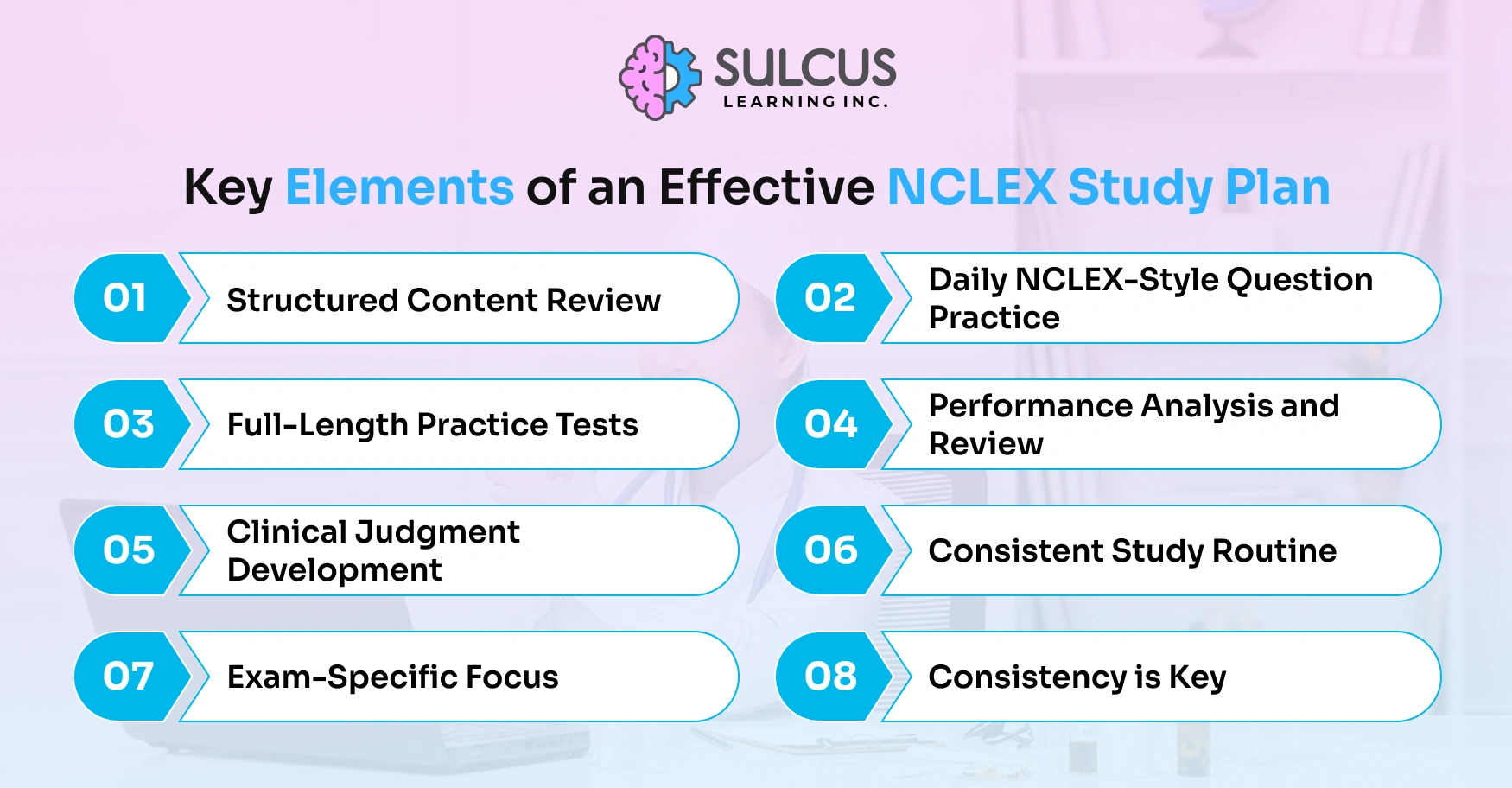
A well-designed NCLEX exam preparation plan should include:
- Structured Content Review: Clinical areas of the NCLEX need to be reviewed in an organized and clinical relevant order. Identify the areas of nursing knowledge that need to be included in the reviews. Nursing topics that are not relevant to the NCLEX should be excluded.
- Daily NCLEX-Style Question Practice: Doing NCLEX-style questions every day is the most effective way to strengthen your understanding of clinical topics and sharpen your thinking about concepts. Doing NCLEX-style questions will familiarize yourself with the types of scenarios the NCLEX will include. There most likely will not be a direct theory question.
- Full-Length Practice Tests: To learn the necessary skills and build your test-taking endurance, completing test after test is the most helpful. This NCLEX simulation will likely cause considerable apprehension. The more practice tests you complete, the more likely you are to improve your overall score.
- Performance Analysis and Review: Identifying your strengths and weaknesses in topic areas is very helpful. Look at the topics that most consistently caused you, and the most. Identify the weak and the strong and your results.
- Clinical Judgment Development: The best way to improve this aspect is by practicing realistic case questions. These questions will improve your clinical judgment and thinking skills in critical nursing scenarios.
- Consistent Study Routine: Regularly spaced study sessions help solidify learning, reduce stress, and build self-assurance and skills to reach the NCLEX benchmark.
- Exam-Specific Focus: Practical Nurse Pathway candidates should focus on NCLEX-PN practice questions, while the Registered Nurse candidates should focus on questions that require prioritization, delegation, and other advanced or multi-faceted clinical questions.
- Consistency is Key: To gain exam competence, it is vital to engage in consistent, sustained intensive study sessions rather than cramming.
Why Most Students Struggle with the NCLEX?
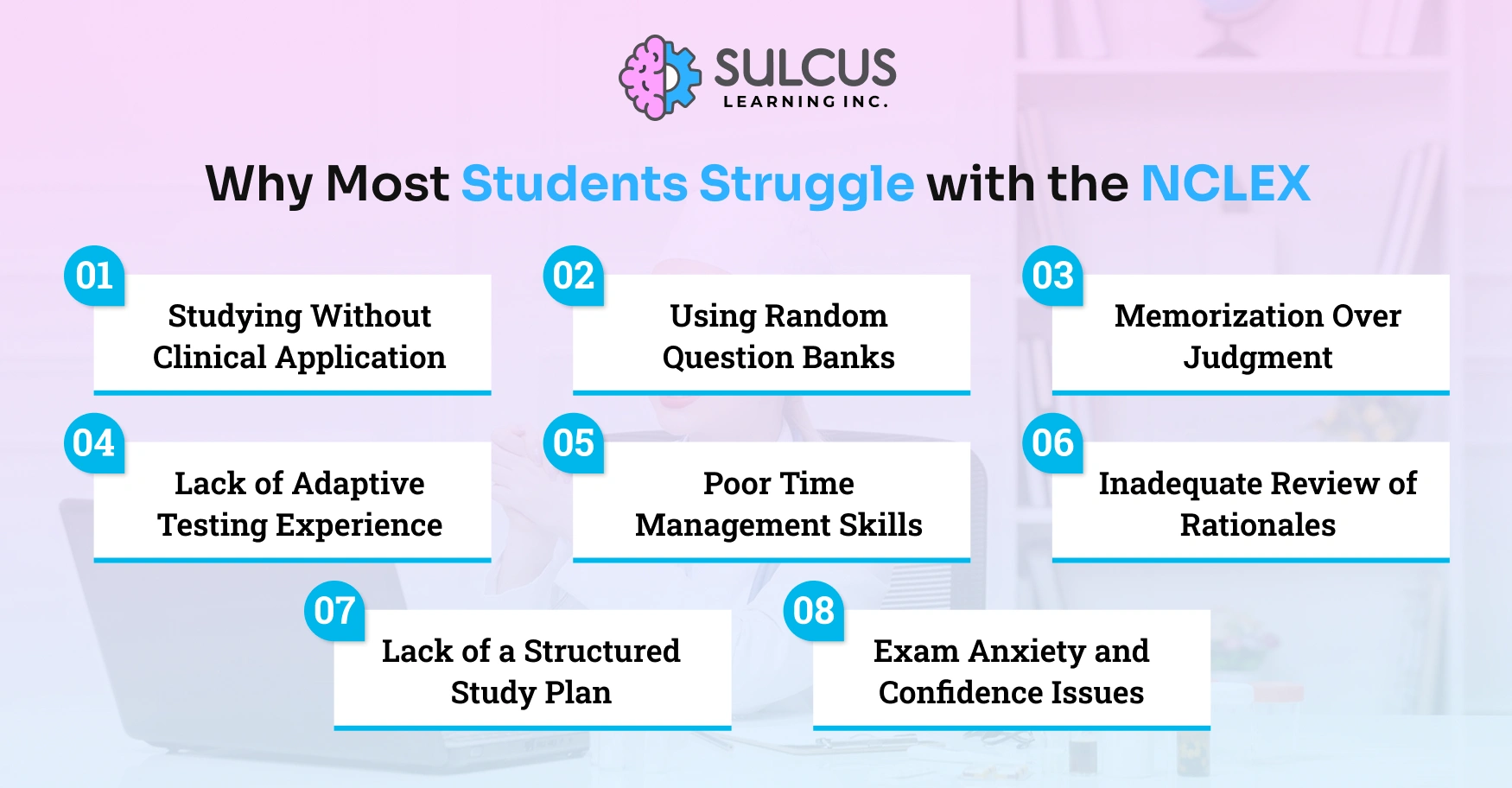
It is common for prospective nursing graduates to misinterpret the NCLEX exam’s true purpose, which often leads to underwhelming outcomes. Although it might be easy to conclude that graduates simply do not have the base knowledge to be successful on the exam, it is often the case that graduates understand that the goal of the NCLEX is to determine whether they can successfully handle nursing responsibilities at the entry level.
- Studying Without Clinical Application: Reading the materials, studying case scenarios, and passing quizzes are often meaningless without the development of the critical skill of turning knowledge into real patient and customer care scenarios.
- Using Random Question Banks: A major mistake that leads to stagnation among most students is selecting study materials and questions that are not graded to determine whether students are pre-assessed or post-assessed, and whether they are moving forward or backwards on the learning and critical thinking continuum.
- Memorization Over Judgment: Simply constructive logic in the NCLEX is a huge oversimplification of what is truly required to be successful. The exam is about care, the most difficult and highest levels of care in the protection of human lives. And the avoiding of the most detrimental clinical actions.
- Lack of Adaptive Testing Experience: Most aspiring nurses lack experience with computer-adaptive testing. If students lack experience and fail to complete practice tests that use adaptive logic to guide their test progression. An exam that requires critical thinking to answer questions at various levels is difficult to assess.
- Poor Time Management Skills: Many candidates struggle because they have not practiced managing time under exam conditions. This leads to rushed decisions, increased anxiety, and difficulty maintaining focus throughout the adaptive testing process.
- Inadequate Review of Rationales: Missing the chances to review the rationales for correct and incorrect answers means missing the chance to learn deeply. Failing to strengthen clinical judgment and reasoning by understanding why an option is correct or incorrect is a critical oversight in learning.
- Lack of a Structured Study Plan: Study activities which do not have a prioritized and sequenced plan for NCLEX preparation lead to patchy outcomes. Without an NCLEX study plan, some activities take too long while others are skipped. Studies that are overly focused or overly long on a particular subject may not cover the necessary and important topics.
- Exam Anxiety and Confidence Issues: Anxiety is a problem that frequently goes unresolved which in turn fosters a lack of confidence. Without adequate practice of artificial testing environments, especially those that are high in stress, anxiety is often the main cause of poor decision-making, which leads to poor outcomes.
Knowing how to pass the NCLEX requires more than recalling factual procedures or course content. Instead, you must exercise the reasoning and judgment of a nurse, applying these concepts in real clinical situations and making safe, rational decisions.
How Sulcus Learning Helps You Pass the NCLEX Faster
Sulcus Learning focuses on effective NCLEX pass rates through the most relevant, elegantly structured exam-aligned learning environments. Learning is not activity centered, nor is it about rote memorization and information overload. At Sulcus Learning, learning is about building the clinical reasoning, judgment, and decision-making skills necessary to pass the NCLEX and practice nursing in the real world.
The Sulcus Learning platform is designed to create a structured, competency-based learning and practice environment that mirrors the NCLEX exam. Each component is designed specifically to the parameters of the NCLEX test plans, the logic of Computerized Adaptive Testing (CAT), and the clinical judgment standards of the Next Generation NCLEX (NGN).
Learners benefit from exam-true practice questions, adaptive and non-adaptive testing modes, NGN-style case studies, detailed clinical rationales, and performance analytics that track strengths, weaknesses, and readiness progression. By practicing within authentic CAT rules, candidates build confidence, reduce exam anxiety, and prepare strategically, so they study smarter, not longer.

Conclusion
The NCLEX isn’t meant to trick or mislead candidates. It’s meant to protect the public by ensuring that entry-level nurses can provide safe and competent clinical care. With an analysis of the exam structure and a thoughtful prep plan, the prospect of passing the exam can be daunting, but it can also be realistic.
Understanding the NCLEX process and evaluating NCLEX prep resources can help candidates look beyond the exam anxiety that often accompanies the prospect of building clinical judgment and confidence. With the right resources, practice, and a prep plan, aspiring nurses will gain the confidence to move from licensure to practice.
FAQ’s
Q1. What does NCLEX-RN mean?
Ans. NCLEX-RN stands for the National Council Licensure Examination for Registered Nurses. It is the standardized licensure exam used to determine whether a nursing graduate is prepared to practice safely and competently at an entry-to-practice level. The exam evaluates clinical judgment, decision-making, prioritization, and patient safety rather than memorization of facts.
Q2. Are there nursing licensure exams other than the NCLEX?
Ans. Yes. Nursing licensure exams vary worldwide and are regulated by individual countries. In the United States, the NCLEX-RN and NCLEX-PN are used for licensure. In Canada, NCLEX-RN is used for Registered Nurses, while practical nurses write Canadian-developed exams such as REx-PN or CPNRE, depending on the province. Each exam reflects the regulatory standards of its jurisdiction.
Q3. How many NCLEX practice questions should I do each day?
Ans. There is no fixed number of questions required daily. Effective NCLEX preparation focuses on quality rather than quantity. Carefully reviewing rationales, understanding mistakes, and applying concepts consistently lead to stronger clinical judgment and better long-term performance than completing a high volume of questions without analysis.
Q4. Is the NCLEX harder in 2026?
Ans. The NCLEX is not necessarily harder in 2026, but it continues to emphasize clinical judgment through Next Generation NCLEX (NGN) question formats. These questions are designed to reflect real clinical scenarios and assess how nurses think, prioritize, and make decisions in modern healthcare environments.
Q5. What happens after I pass the NCLEX?
Ans. Passing the NCLEX does not automatically grant the right to practice. After passing, candidates must apply for registration with their provincial or state nursing regulatory body. Meet all jurisdiction-specific requirements, and receive official licensure before practicing as a nurse in approved healthcare settings.
Q6. How long does NCLEX preparation usually take?
Ans. Preparation timelines vary depending on background, education, and clinical experience. Most candidates require approximately eight to twelve weeks of structured study, consistent practice, and performance review to build confidence, clinical judgment, and readiness for the adaptive exam format.
Q7. Can I retake the NCLEX if I do not pass?
Ans. Yes. Candidates who do not pass the NCLEX may retake the exam after completing the mandatory waiting period set by the regulatory authority. Re-registration requirements and limits on attempts vary by jurisdiction, and additional preparation is strongly recommended before retesting.
Q8. Is the NCLEX the same in Canada and the United States?
Ans. The NCLEX-RN exam itself is standardized and administered using the same framework in both countries. However, licensure processes, regulatory requirements, and post-exam registration steps are varied by provincial or state nursing authority and must be followed in accordance with local regulations.

Harry Sagar
Passionate and detail-oriented leader at Sulcus Learning, dedicated to supporting internationally educated nurses in achieving their professional goals. With experience as a general practitioner, smoking cessation consultant, and licensed practical nurse, I combine clinical expertise with mentorship. Guided by the philosophy, “Your Success is Our Ambition,” I help nurses gain confidence, competence, and career-ready success.