
Having walked multiple nursing students through the processes of obtaining a license, a frequent inquiry concern right after the exam is, “What occurs if I do not succeed on the NCLEX?” This is closely followed by a second question, “Are there any indications that I have not passed my NCLEX exam?”
Is the situation stressful? The exam abruptly concludes, and a blank screen triggers overwhelming doubt. Candidates start dissecting the experience to make sense of it. Analyzing the number of practice questions answered and the perceived difficulty of the questions, or opening and closing the exam computer abruptly. Searching for ‘clues’ is understandable, as it may be a sign of passing or failing the exam.
The NCLEX exam’s intention is not to test only the candidate’s knowledge or understanding, as the exam focuses on measuring the candidate’s judgment and ability to make choices as a clinician. The test is also structured to evaluate the candidate’s ability through Computerized Adaptive Testing (CAT) methods, which analyze whether the candidate continuously meets the minimum standards to practice nursing.
It is normal to have concerns over exam failure, especially if you are not familiar with what signs indicate NCLEX exam failure, and what options are available if your exam attempts are unsuccessful.
This NCLEX guide will address what options you have if you fail the exam, what signs indicate a potential fail, the NCLEX scoring criteria, exam retake policy, and how you can better direct your study efforts in anticipation of future exam attempts.
Key Takeaways
- Adjustments to preparation and understanding of how the NCLEX exam determines clinical competency can help lower the odds of failure on the hypothesis that the exam will likely be fought again.
- Standing in the test center and receiving CPR is not rubbish, driving out the elements, components, and other parts of the areas you needed to work on to be below the standard.
- Not all fails are created equal. The NCLEX exam is based on Computerized Adaptive Testing (CAT), meaning the test is partially based on how well you are doing and does not determine failure based on the number of correct answers.
- The signs you failed the NCLEX exam may not be accurate. Questions that appear to be more difficult and numerous are not solid indicators of the results.
- If you do not pass, you must wait 45 days before you can take the exam again, and you have to re-register with Pearson VUE and your state board of nursing.
- Using exam-aligned practice tests, clinical judgment questions, and adaptive simulations will improve the preparation for your next attempt.
- The understanding of the NCLEX exam structure, scoring, and Next Generation NCLEX requirements allows candidates to approach the exam with more confidence.
- Many candidates, who have uncertainty regarding the outcome of their first NCLEX exam, focus on preparation and adopt better strategies which result in passing the NCLEX exam on a subsequent attempt.
What Happens If You Fail the NCLEX?
Continuously trying the NCLEX has its emotions and challenges, but it is also important to realize that numerous other triumphant nurses also faced this inability to pass the exam. The rationale is that the exam is designed to test not only one’s knowledge, but also one’s clinical judgment and decision-making skills as such skills are important in safeguarding one’s safety whilst practicing in entry level positions.
If you fail the NCLEX:
- You receive a Candidate Performance Report (CPR).
- The CPR tells you which of the tests components you failed to meet the passing criteria.
- You are legally bound to wait at least 45 days before you can book the exam again.
- You must reregister with Pearson VUE again and repeat the exam fee.
Although CPR’s are frustrating, they offer a blueprint as to how to structure future exam attempts. You CPR should help you organize a study strategy to increase the strength of your performance in the test.
How the NCLEX Determines Pass or Fail
Understanding how the NCLEX makes passing and failing decisions can help you better understand the signs that point towards you failing the exam.
The NCLEX uses a test model called Computerized Adaptive Testing (CAT). This testing model analyzes how well or poorly you do on the exam and changes the level of difficulty of the questions based on your performance.
When you answer each question:
- The system estimates your current ability level based on your previous responses.
- The next question is adjusted to be slightly easier or more difficult depending on your performance.
- Your ability level is constantly compared to the NCLEX passing standard, which represents the minimum competency required for safe nursing practice.
At that point, the system determines one of two outcomes:
- Your ability level is above the passing standard → Pass
- Your ability level is below the passing standard → Fail
Your exam result is not based on the total number of correct answers, therefore it is important to know that the difficulty of the questions you answer or the total number of questions you have do not determine your result.
To simplify the passing benchmark, the score you receive is directly related to the NCLEX-RN Passing Score, and that score determines whether or not you are eligible to obtain your nursing license.
Common Signs You May Have Failed the NCLEX
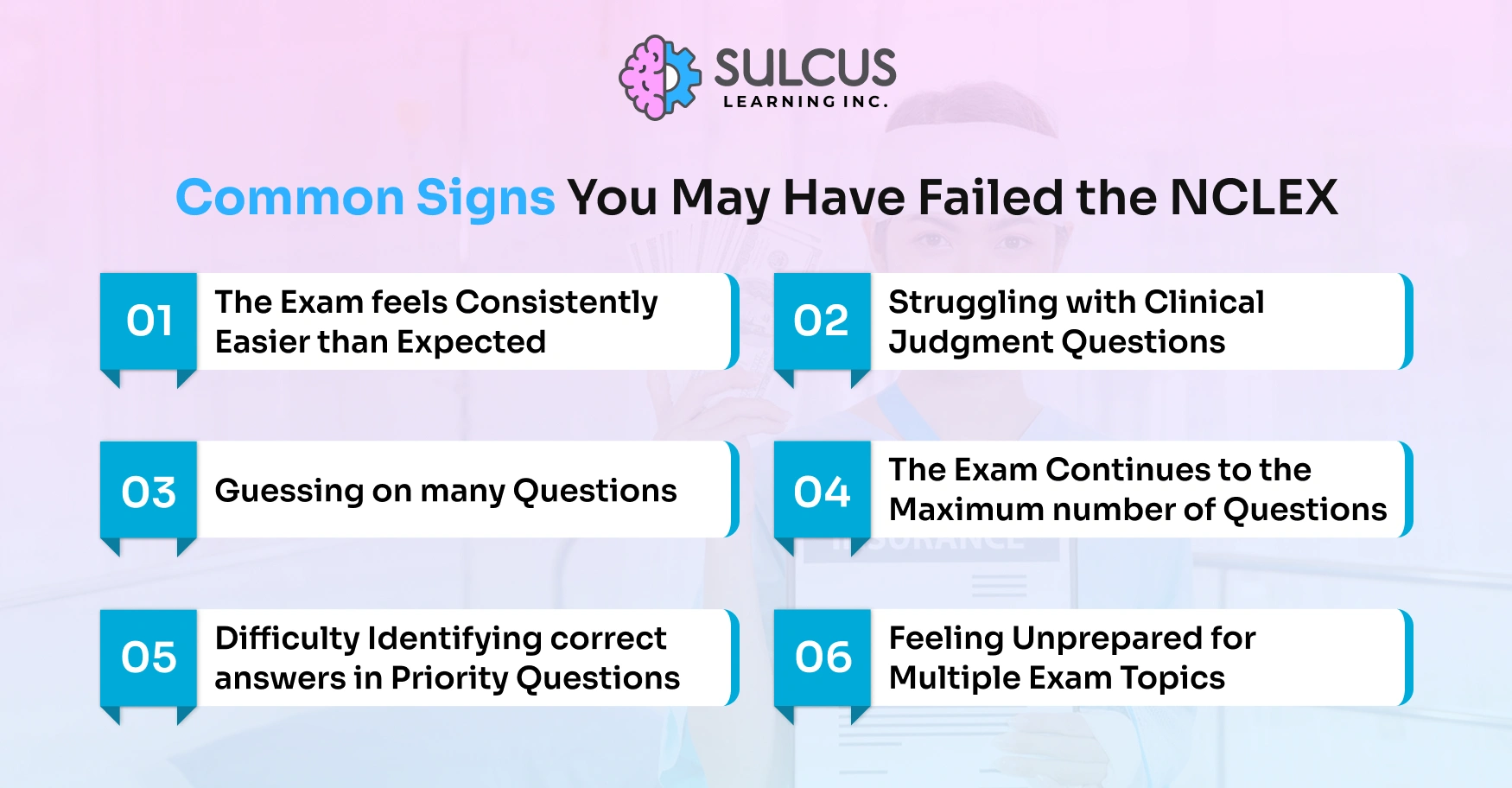
It’s common for candidates to try to pick apart signs that they failed the NCLEX immediately after completing the exam. NCLEX is a computerized adaptive exam that adjusts the questions based on the user’s correct vs incorrect responses. Because of this, no answer can be a definitive answer for success or failure. Some signs are still more detrimental than others.
1. The Exam feels Consistently Easier than Expected
Some candidates feel like they received most of the basic questions throughout the exam, and the exam is supposed to be adaptive to your current level of knowledge, so if you feel this way, the testers may be estimating your knowledge level below the passing standard.
2. Struggling with Clinical Judgment Questions
The exam puts a lot of emphasis on clinical reasoning and the safety of patients. If you have found this consistently true throughout your answer for the exam, this can a negative impact on your performance of the exam.
3. Guessing on many Questions
Feeling unsure about a few questions is normal. However, if a candidate believes they guessed on a large number of questions, it can create concern about whether their responses met the required competency level.
4. The Exam Continues to the Maximum Number of Questions
If the exam has reached the maximum limit of questions, it indicates that the system required more answers in order to make the determination of whether the candidate’s ability level was above or below the passing standard.
5. Difficulty Identifying correct answers in Priority Questions
Questions that require prioritization, delegation, and questions that deal with patient safety are some of the most important on the NCLEX and if you are having repeated difficulty with those question types, that can affect your overall performance on the exam.
6. Feeling Unprepared for Multiple Exam Topics
The NCLEX exam tests a multitude of nursing concepts, and if a candidate feels unprepared for a number of subjects on the exam, it can create a sense of doubt about whether the candidate has performed to the required standard.
When you see a pattern of these types of thoughts, it is still important to consider that these are not, as a matter of fact leading toward a conclusion that you have failed. The only conclusive evidence is found within your official NCLEX results that are provided by the state board of nursing or the Quick Results service.
Does the Number of Questions Indicate Failure?
A widely held belief amongst NCLEX candidates is that the number of questions determines the result of your exam. This is false and is not how the NCLEX works.
The Computerized Adaptive Testing (CAT) exam technology uses your performance on answering the questions at the time to evaluate how many questions you have answered correctly. Instead, the system evaluates whether your answers prove you have the above ability to meet the pass standard.
The exam concludes at the time point you have provided the system with enough data to evaluate all your responses with confidence to a set statistical degree of your ability. Some candidates may receive an early passing, while others may have to provide responses to many more questions.
In relation to how questions are answered, the exam is designed to evaluate competencies, not questions. If you’re wondering how many questions are on the NCLEX, the total can vary depending on how quickly the system determines your ability level during the exam.
What It Means If Your NCLEX Stops at 85 Questions
Many test takers fear that they could fail the NCLEX because the test stops at 85 questions. The reality is, it is possible to pass or fail the test at this point. The exam shuts off at this number of questions, usually because of one of two reasons:
- The system is confident that your level of ability is right at the passing standard or
- The system is confident that your level of ability is well below the passing standard.
As a further explanation of how this works, refer to our guide on NCLEX Shut Off at 85 Questions.
Can You Really Know If You Failed the NCLEX Immediately After the Exam?
Once test takers complete NCLEX, they begin searching for indicators of their score. Common questions include:
- How do I know if I failed the NCLEX?
- How do you know if you failed the NCLEX right after the exam?
Test takers can experience an overwhelming amount of uncertainty after completing the exam. It is important to recognize that there is no way to reliably know the result right after the exam.
The NCLEX utilizes Computerized Adaptive Testing (CAT). This means that no matter how your exam experience was, how hard the questions were, or how you felt about when the test ended, you cannot experience it again.
The only reliable ways to confirm your result are through official channels:
- The state board of nursing official results
- The NCLEX Quick Results service, which you can access 48 hours after your exam.
To learn more about potential early signs, refer to How to Know If You Passed the NCLEX Right Away to find some points that candidates notice after completing their exam.
Official Ways to Check Your NCLEX Results
For NCLEX examinees, time seems to slow to a crawl the moment they complete the exam. While looking for unofficial channels to check NCLEX results is common, the only definitive way to check and see if you passed or failed is to check the result reports provided officially.
There are two primary methods for checking your NCLEX results:
1. Quick Results Service
For the NCLEX, unofficial exam results are available approximately 48 hours after testing via a service called Quick Results. While this service is offered at a nominal fee on the Pearson VUE NCLEX website, candidates who are looking to know if they passed or failed are getting results that are considered unofficial.
2. State Board of Nursing
The State Board of Nursing for your particular State offers the NCLEX results officially. The release of results officially varies by state, however, they are officially available 2-3 days, and even up to a few weeks after testing. These results officially determine if you can get a nursing license.
These two channels listed above are the only ones that are considered true and official. NCLEX results checking unofficially provides results that are fake and should be ignored.
What to Do If You Fail the NCLEX
The first thing you need to do is remain calm. It is understandable to be disappointed but many novices often go into the exam unprepared. Research shows that after revising their preparation methods many candidates were able to pass the exam.
Focus on the future. There is nothing wrong with failing the exam. Critically examine the situation and adjust your strategies to give yourself a realistic chance.
Your next steps should include:
- Review Your Candidate Performance Report (CPR): This report shows the areas where your performance was below the passing standard and helps identify topics that require more attention.
- Identify Your Weak Areas: Focus on specific content categories or clinical judgment skills that need improvement.
- Adjust Your Study Plan: Create a structured study schedule that prioritizes your weaker topics while reinforcing your strengths.
- Practice Clinical Judgment Questions: Since the exam emphasizes patient safety and decision-making, practicing scenario-based questions can significantly improve readiness.
- Take Full-Length Practice Exams: Simulated exams help you build confidence, improve time management, and become comfortable with the NCLEX format.
Furthermore, resources such as What Is the NCLEX Exam can provide an understanding of the exam’s comprehensive structure and assist you in better preparation and approaching your next attempt with more confidence.
NCLEX Retake Rules and Waiting Period
Knowing the rules and restrictions for the NCLEX retake helps provides assistant when planning the attempt.
- How Many Times Can You Take NCLEX Exam?
- If you fail the NCLEX, when can you take it again?
Understanding the retake rules can help you plan your next attempt with clarity and confidence.
In general, the NCLEX follows these guidelines:
- Take 45 days before retaking the exam. The NCLEX usage the 45 aftermath time for candidates to review and understand their performance before the retake.
- Most candidates are allowed to attempt to retake the NCLEX eight times within a year. Some circumstances may apply depending on which state you select for the box.
- Each state has its own rules and restrictions about licensing. Because of that, it is very Important to know how many times you can attempt the NCLEX exam and the individual state’s prerequisites.
Because licensing regulations are managed by individual state boards, the exact requirements can differ. For this reason, it’s important to review your state’s specific guidelines if you’re wondering how many times you can take the NCLEX exam and what steps are required before scheduling another attempt.
How to Prepare Better for Your Next NCLEX Attempt
Failing the NCLEX precludes the candidate from entering the nursing profession, however, many individuals do go on to become successful nurses, even after multiple attempts, as NCLEX failures are not uncommon. Candidates must adjust their study approaches to better fit the test’s unique evaluative mechanisms.
Utilizing evaluative metrics that are NCLEX test aligned, along with exam-designed practice simulations are a good way to prepare for the NCLEX as they provide practice opportunities similar to the test environment.
Sulcus Learning is a top-rated nursing exam preparation service that aligns test prep with the methodologies the NCLEX employs to evaluate test takers. It is the only service that provides a simulation of the Computerized Adaptive Testing (CAT) model, which means students will replicate the actual exam that modifies the questions based on the students’ responses.
The platform offers several advanced preparation tools, including:
- Practice test simulations that are adaptive (and non-adaptive) based on the actual NCLEX exam conditions
- The ability to answer clinical judgment questions that are of the Next Generation NCLEX variety.
- Tools that measure exam preparedness
- Test analytics that measure areas of strength and areas needing improvement
- Competency-based performance tracking aligned with exam standards
These tools will target and close knowledge gaps to optimize the candidate’s chance for success on their next NCLEX attempt.
You can also enhance your preparation by utilizing resources like How to Pass the NCLEX and reviewing the NCLEX Changes 2026 so you can remain updated with the new changes on the exam structure and expectations.
Common Mistakes That Lead to NCLEX Failure
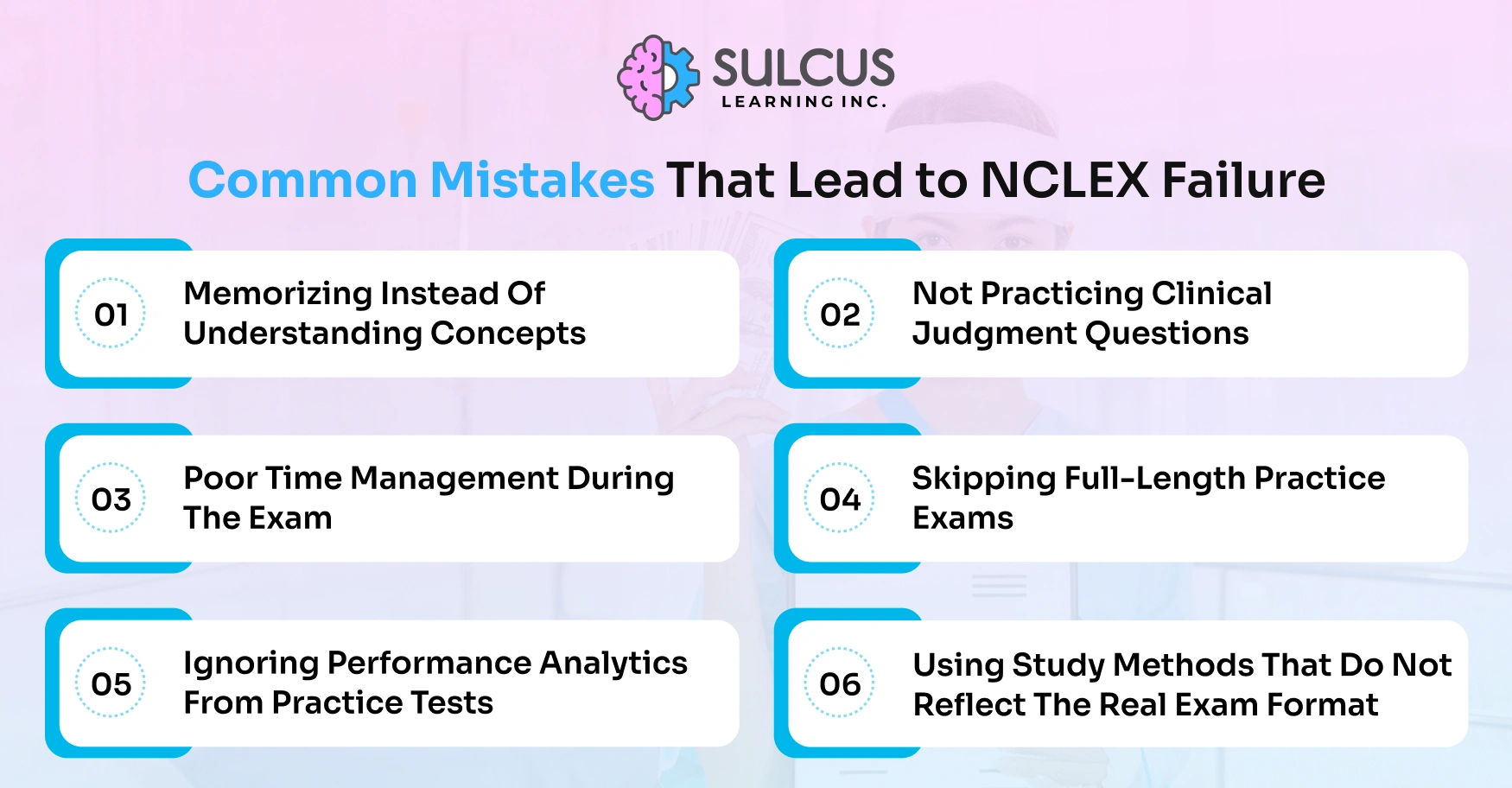
Over the years, several patterns have emerged among candidates who struggle to pass the NCLEX. Understanding these mistakes can help you adjust your preparation strategy and improve your chances on the next attempt.
Some of the most common mistakes include:
1. Memorizing Instead of Understanding Concepts
This is arguably the most pressing concern. It’s not uncommon to find licensure candidates to be competent in memorizing content. However, this orientation produces lazy students who fail to internalize the principles underpinning concepts. More often than not, these students will fail to appreciate the application of clinical nursing principles in a given scenario. Decision-making is not the simple act of recalling information, and the NCLEX is about determining your clinical judgment and ambiguity.
2. Not Practicing Clinical Judgment Questions
This is the core of the Next Gen NCLEX. Most of the students who struggle in this area are often the same ones who failed to practice this area. Failing to adequately prepare for this type of instructional strategy will be detrimental to you.
3. Poor Time Management during the Exam
This especially applies to the more challenging questions. It is normal to find a scenario question or a clinical situation one and ask questions to assist in determining to which patient the question pertains. If you don’t regularly practice your pacing, you will likely find yourself spending all of your time on the more challenging questions.
4. Skipping full-length Practice Exams
In this regard, students are short-sighted and ultimately setting themselves up for failure. In most, if not all, full practice attempts, students will find themselves tested on content and skill areas that have previously been tested on the short quizzes. NCLEX practice attempts are a necessary and integral part of NCLEX study prep.
5. Ignoring Performance Analytics from Practice Tests
Each practice exam has an analytics report that shows your strengths and weaknesses and the areas that are the most challenging for you. It is a mistake to ignore these reports.
6. Using Study methods that do not Reflect the Real Exam Format
If the materials you are studying from are not aligned with the NCLEX format, you are likely to experience a lot of confusion when you actually sit the test. Your test readiness is likely to increase substantially if you practice using exam aligned simulations and specific adaptive testing mechanisms.
Systematic studying along the lines of the suggestions provided is likely to increase your chances of success on the NCLEX exam.

Conclusion
It is understandable that failing the NCLEX can be disheartening. However, that is not a true reflection of your potential as a nurse. It is a fact that a lot of very successful nurses have had the same experience. Eventually, they were able to pass the NCLEX exam after successful revision and after they had a better working knowledge of the exam.
It is important to note that the NCLEX exam is a means of ensuring that all licensed nurses possess the requisite clinical judgment and decision-making abilities crucial for safeguarding the wellbeing of patients. Therefore, it is likely that you would get success on your subsequent attempts if you are able to reorient your revision to the exam.
Having focused on the Candidate Performance Report, you can be more confident for the next try. Many nurses, after failing the NCLEX, ponder over the next step. However, if the preparation is right, this worry turns into starting the first successful nursing career.
FAQ’s
Q1. What happens if you fail the NCLEX?
Ans. If you fail the NCLEX, you will receive a Candidate Performance Report highlighting areas below the passing standard. You must wait at least 45 days before retaking the exam and complete the registration process again.
Q2. Can you fail the NCLEX in 85 questions?
Ans. Yes, it is possible to fail the NCLEX in 85 questions. When the exam ends at the minimum number, the system has determined with confidence that your performance is either above or below the passing standard.
Q3. How many times can you fail the NCLEX?
Ans. Most candidates can take the NCLEX up to eight times per year. However, exact limits may vary by state board regulations, so it’s important to check your state’s specific licensure and retake policies.
Q4. If you fail the NCLEX when can you take it again?
Ans. You can usually retake the NCLEX 45 days after your previous attempt. Before scheduling another exam, you must re-register with Pearson VUE and receive authorization from your state nursing board.
Q5. How do you know if you failed the NCLEX?
Ans. The only reliable way to confirm if you failed the NCLEX is through official results from your state board of nursing or the Quick Results service available approximately 48 hours after the exam.
Q6. What happens if you fail NCLEX three times?
Ans. If you fail the NCLEX three times, you can still retake the exam as long as you meet your state board requirements. Some states may require additional coursework or remediation before another attempt.

Harry Sagar
Passionate and detail-oriented leader at Sulcus Learning, dedicated to supporting internationally educated nurses in achieving their professional goals. With experience as a general practitioner, smoking cessation consultant, and licensed practical nurse, I combine clinical expertise with mentorship. Guided by the philosophy, “Your Success is Our Ambition,” I help nurses gain confidence, competence, and career-ready success.