
As Canada continues to need more nurses who are practice ready, NCLEX-RN is an essential exam for starting a professional nursing career. With the NCLEX examination for RN (NCLEX-RN) being the most significant examination for that purpose, it is critical that Canadian Graduates and Internationals Educated Nurses (IENs) grasp the importance of the NCLEX exam, especially considering there are two types of NCLEX exams: NCLEX-RN and NCLEX-PN.
Although the NCLEX examination for RN (NCLEX-RN) has many candidate who do not pass, they do receive feedback from the National Council of State Boards of Nursing. This feedback comes in the form of a Candidate Performance Report, or CPR, which is an NCLEX-RN specific report some candidates will receive and is a great opportunity to receive constructive feedback.
The CPR report is unique in that it does not give the candidate a specific score or range, instead describing the candidate’s performance in comparison to the NCLEX-RN Test Plan for Safe, Entry-Level Nursing Practice Canadian Version. Each of the defined categories of NEEDS of a client are defined in the report as “Above the Passing Standard,” “Near the Passing Standard,” and “Below the Passing Standard.” This clear design gives candidates a way to understanding the thresholds they need to hit for future examination.
Instead of a simple pass or fail, the CPR offers valuable information regarding the distribution of the candidate’s performance in the different clinical judgment domains and client care categories. It helps identify strengths, gaps, and enables the candidate to prepare in a more focused, competency-based way.
This guide will show you how to read your Candidate Performance Report strategically and incorporate it with NCLEX-RN prep materials. Your clinical judgment will be strengthened, performance gaps will be bridged, and you will be better prepared for the next strike on the Canadian Nursing licensure ladder.
What Is the NCLEX Candidate Performance Report (CPR)?
Only candidates who fail the NCLEX exam receive the Candidate Performance Report (CPR). It is created to provide feedback in a clear and organized manner and detail where the candidate’s exam performance could be improved.
Typically, candidates receive their official results from their provincial or territorial regulatory body within a few days. CPR reports are usually shared via email shortly after the candidate receives an official report from the exam.
What to Expect
- The CPR is not issued to candidates who pass the exam
- It is generally delivered within a few days of receiving your result
- The report presents a category-based summary of your performance
Candidates often find value in the report and the reason for the unsuccessful attempt. Candidates often find value in the report as it explains the reason for the unsuccessful attempt, and the CPR assists candidates in preparing for the next attempt.
Who Receives the NCLEX Candidate Performance Report (CPR) and When?
The CPR is a performance summary provided by the National Council of State Boards of Nursing to help candidates prep for the NCLEX again.
CPRs are offered to candidates who do not pass the NCLEX exam. Candidates who pass this exam do not receive this document and bypass this process because the purpose of the CPR is to identify areas needing improvement.
Candidates usually take the NCLEX and get their final test results from their provincial/territorial regulatory body. Depending on the jurisdiction, this may take a few days. CPRs are available shortly after official results are released, so candidates can get started on test prep as soon as they receive the results.
What to Expect from the CPR
- The CPR is not sent to candidates who are successful in the NCLEX.
- It usually opens up in the system a few days after the official results are released.
- It is designed to state areas of the exam framework in which the candidate was successful.
- The examinee achieves success in each of the areas, in accordance with the NCLEX Test Plan.
The CPR is accompanied with summaries of the performance of the candidates grouped by the needs of the clients and reflecting the knowledge and skills that are essential for a nurse to practice safely and at the beginning level, which are:
- Safe and Effective Care Environment
- Health Promotion and Maintenance
- Psychosocial Integrity
- Physiological Integrity
Each category is evaluated as:
- Above the Passing Standard
- Near the Passing Standard
- Below the Passing Standard
The above classifications show where your performance is in relation to the expected level of minimum competency for entry-level nursing practice in the context of Canada.
Why the CPR Matters
The CPR is no ordinary performance summary. It is a tool to prepare for the NCLEX test. It shows how you performed in a certain area and tells you where you could improve most to help you study for the NCLEX in a more focused way
Using the CPR properly gives you the ability to improve your preparedness for the test as well as the proficiency of the areas that you could improve on to help you pass the NCLEX on your next try.
What Does the NCLEX Candidate Performance Report (CPR) Include?
The Candidate Performance Report (CPR) gives a detailed breakdown of how a candidate has scored in the NCLEX-RN examination in relation to the competencies needed to demonstrate safe and effective nursing practice at an entry-level position in Canada.
The CPR has been designed by the National Council of State Boards of Nursing and it is reflective of the NCLEX-RN Test Plan and how it incorporates the day-to-day realities of clinical practice and the main priorities of the patients.
Your report will not focus on an individual score like a traditional NCLEX-RN passing score. Instead, it will indicate your standing in relation to the benchmark in the key areas.
Key Components of the CPR
- Performance within the primary categories of the NCLEX Test Plan of client needs
- Your performance in relation to the passing standard
- The CPR will include a graphical representation of your performance as:
a). Above the Passing Standard
b). Near the Passing Standard
c). Below the Passing Standard
This method places your performance evaluation in context to clinical competency rather than in relation to score.
Understanding the Structure
The NCLEX exam format is different from traditional exams that depend on grades or percentages. Instead, the CPR organizes performance by the core areas of nursing practice.
- Safe and Effective Care Environment
- Health Promotion and Maintenance
- Psychosocial Integrity
- Physiological Integrity
Each of these categories aligned with the critical competencies of a newly licensed nurse. Your CPR shows performance in comparison to the minimum standard needed for safe practice.
How to Interpret Your CPR
The CPR is meant to focus on performance patterns, not on isolated outcomes, and it assists you with
- Recognizing strengths, where your performance is at or above the expectation
- Recognizing areas that need focus and support
- Developing a competency based focused study plan
With the CPR, candidates have the opportunity to narrow areas of focus to improve clinical judgment, decision-making and overall preparedness for another attempt at the NCLEX within the Canadian nursing licensure system.
NCLEX Performance Levels Explained
The Candidate Performance Report or CPR, breaks down your performance by using a set of standards and levels related to the NCLEX passing standard. Performance levels determine an individual’s ability to safely demonstrate entry-level clinical reasoning and judgment for the purposes of the test.
Understanding CPR performance levels is critical to determining a more productive and targeted approach for subsequent NCLEX attempts.
Above the Passing Standard
This specific level is achieved by an individual whose performance, in the comprehensive judgment and decision making, and in understanding nursing knowledge areas, is at or above the level of safe entry level nursing practice.
Owning these strengths is an asset, but for long-term retention and practice, it is suggested that periodic revision and practice be done.
Near the Passing Standard
The lack of consistency in scoring in some of the areas reflected is a result of the chances and episodes of clinically relevant peripheral understanding exhibited.
The performance areas and categories at this level require directed focus to practice, the clinically relevant application, and the improvement of decision-making ability for the purpose of raising the performance to above the passing standard.
Below the Passing Standard
This means your performance does not demonstrate the minimal competence necessary for safe entry-level nursing practice. These areas indicate severe deficits in both your knowledge and clinical judgment.
Factors such as the consistency of your performance and even situations like the NCLEX shutting off at 85 questions depend on how you perform in relation to the passing standard.
How Performance Levels Impact the Exam Outcome
The NCLEX uses Computer Adaptive Testing (CAT), which was created by the National Council of State Boards of Nursing. This means the NCLEX exam will gauge your performance in relation to the passing standard and adjust the questions.
Your exam performance is affected by your consistent performance and the accuracy of your decisions. For example, if the exam is confident that your performance is consistently above the passing standard, or on the contrary, the exam may finish at the minimum number of questions (e.g. 85).
Identifying your CPR performance levels will help you to meet the expectations of the exam, prioritize your preparation in the areas that will yield the most significant results, and increase the likelihood of obtaining a passing result in the NCLEX as part of the Canadian nursing licensing process.
How to Read and Interpret Your NCLEX CPR
Reading your Candidate Performance Report (CPR) means looking deeper than just the labels, but finding meaningful patterns in your performance. It is helpful to see the divisions across categories in the CPR, but the overarching goal should be identifying multiple gaps and understanding how they correlate to your overall readiness. Since the exam follows an adaptive format, it does not rely on a fixed structure like how many questions are on the NCLEX, making performance patterns more important than totals.
Step-by-Step Approach
- Take time to carefully assess each category to frame your performance within that category.
- Identify the categories marked near or below the passing standard.
- Identify the categories that have the same repeated weakness.
- Focus on the categories that you believe have the highest potential impact, should gains be made.
What to Focus On
While it may be desirable to try to address every concern that the CPR raises, it is more effective to take a more focused approach.
- Identify the most significant potential gains that can be achieved and focus your efforts in that space
- Attend to the categories that have common themes and activities.
- Focus on and improve your ability to use knowledge in the answer space of a scenario-based question; it should not be only the case that you can do this theoretically.
Having a focused review of the CPR will assist you in creating an effective study plan to alleviate the chances of repeating the same occurrences in your next attempt.
Common Mistakes Students Make While Analyzing CPR
The Candidate Performance Report (CPR) is often misunderstood by numerous candidates, resulting in an ineffective and unfocused study plan. Many candidates miss using the CPR as a road map over a report and instead, fall into the same study habits over and over, which leads to no improvement.
Common Pitfalls
- Ignoring strengths and focusing only on weaknesses that still require improvement.
- Working on all the topics simultaneously instead of focusing on the ones that are more impactful first.
- Misunderstanding the term ‘near passing’ and thinking that achieving it takes little effort.
- Sticking to the same study plan without the impact it is supposed to bring.
A focused study plan based on your CPR results will help you study more of the content that will be tested in the future, and this will help you to be more effective in your preparation. This structured approach is one of the most effective ways to understand how to pass the NCLEX on your next attempt.
What Your CPR Says About Your NCLEX Preparation Strategy
Your Candidate Performance Report (CPR) results and your preparation for the exam are intimately linked. Your CPR reveals the effectiveness of your study strategy.
Key Insights It Reveals
- Whether your foundational understanding of key concepts is strong enough
- How effectively you apply knowledge in clinical and scenario-based questions
- Your ability to make safe, accurate decisions under pressure
These insights highlight the importance of moving past basic, surface-level preparation. Once you are able to identify what is lacking in your attempts, you are able to plunge into more depth and refine your preparation to be more focused on your next attempts.
How to Improve Your NCLEX Score Using CPR Insights
The Candidate Performance Report is not just a report for you to have a loose study plan. Your aim should be to come up with a study plan to study the specific gap which is pinpointed on the report, so you are not spending time relearning everything.
The report should inform your study plan so that you can meet all of the NCLEX requirements for nursing in Canada.
Effective Strategies for Improvement
- Study the areas of your report that are the lowest, as it presents the best opportunity for you to make the greatest improvement.
- You should focus on application-based scenario questions rather than just knowledge recall questions.
- The aim should be to strengthen your clinical reasoning and judgment.
- Set certain timeframes to study so you can measure your improvement.
You will see the greatest improvement in your accuracy and confidence through reflection and practice.
Build a Smarter, CPR-Driven Study Plan
When integrated with a structured and dynamic prep platform, CPR insights allow you to:
- Accurately address areas that require attention
- Assess progress based on actual performance data
- Heighten exam situational decision-making skills
- Cultivate confidence through systematic and skills-based practice
Your data-based study plan will enhance your study efforts and greatly increase your chances of passing the NCLEX exam on your upcoming try.
NCLEX Retake Strategy for Canada-Based Nursing Students
If you’re planning to retake the NCLEX in Canada, a structured and well-informed approach is essential. Rather than rushing into another attempt, take the time to reassess your preparation and build a plan based on your previous performance.
Key Considerations
- Make sure to plan time to work on the areas listed in your performance report
- Adhere to the guidelines and deadlines set by the regulatory body in the province or territory you are in
- Develop a study plan that is achievable, and maintains stability and slow, consistent advancements
Careful and methodical planning regarding your retake can enhance your preparedness and boost your probability of success. Before scheduling your next attempt, make sure you understand how to register for the NCLEX-RN and review updated NCLEX exam costs in 2026.
How Adaptive Testing (CAT) Impacts Your CPR
The NCLEX follows a computerized adaptive testing (CAT) format, where each question is selected based on your previous responses. As you progress through the exam, the level of difficulty adjusts to accurately assess your competency.
What This Means for Your CPR
- Your performance is not determined by a fixed number of questions
- Evaluation happens continuously throughout the exam
- The focus is on whether you consistently meet the required standard
Because of this adaptive approach, the Candidate Performance Report (CPR) does not provide numerical scores. Instead, it reflects your performance through levels that indicate how close you were to meeting the expected standard. With evolving formats and NCLEX changes in 2026, understanding adaptive testing plays an important role in improving your overall performance.
Improve Your NCLEX Readiness with Sulcus Learning Inc.
Succeeding in the NCLEX is not just about doing practice tests but rather about building strategies based on data that will foster the development of candidates’ clinical judgement, decision-making, and overall competencies. Sulcus Learning Inc. focuses on the most impactful elements that help candidates shift the odds in their favor.
Why Sulcus Learning Inc. Stands Out
Sulcus Learning Inc. is designed to prepare you for the real NCLEX exam. We have the best Computer Adaptive Testing (CAT) technology that is compliant with the NCLEX test requirements and uses the same evaluation methods as the NCLEX exam.
This platform will develop your clinical judgment and decision-making to prepare you to excel on the NCLEX exam. This test prep will help you develop the critical thinking skills you need to do well on the NCLEX exam.
Key Features of Sulcus Learning
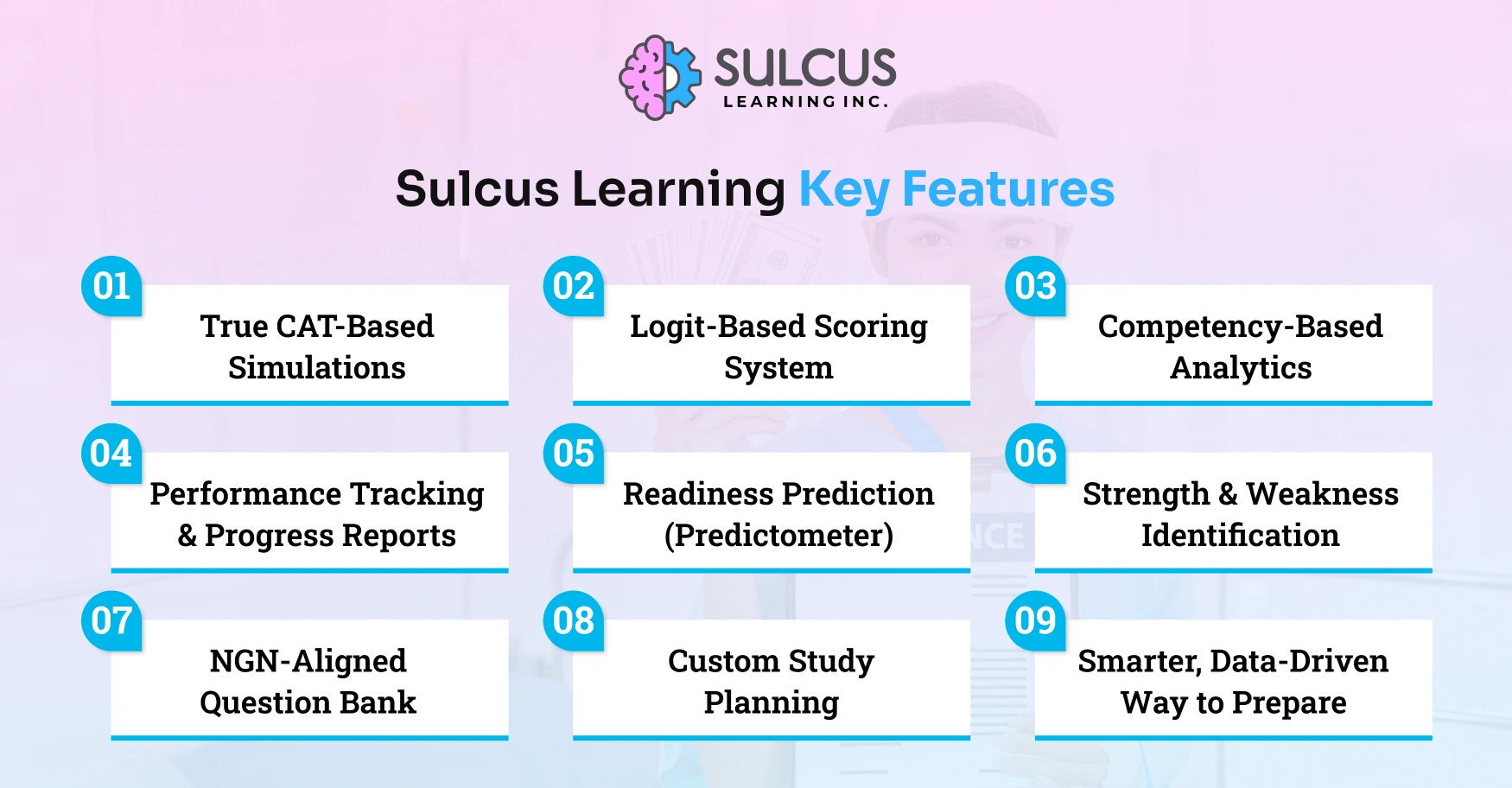
- True CAT-Based Simulations: You will have a genuine testing experience where you will receive a different question based on your performance. Each question will adjust to your ability, just like the real NCLEX exam.
- Logit-Based Scoring System: This is a sophisticated measurement of how you compare to the NCLEX pass rate, and is a lot more accurate than the typical percent based scoring system.
- Competency-Based Analytics: Understand your strengths and areas for improvement across client needs categories, subjects, and topics for targeted enhancement.
- Performance Tracking & Progress Reports: Measure your progress through organized dashboards and visual reports based on real exam performance trends.
- Readiness Prediction (Predictometer): Utilize speculative analytics to figure out your exam preparedness and your chances of success on the day of the exam.
- Strength & Weakness Identification: Optimize exam prep through pinpointing areas of the greatest priority.
- NGN-Aligned Question Bank: Strengthen your clinical judgment and decision-making by practicing case-based questions that meet the standards of the Next Generation NCLEX (NGN).
- Custom Study Planning: Personalize your study plan and exam prep by continuously refining your performance.
- A Smarter, Data-Driven Way to Prepare: NCLEX exam preparation is structured, adaptive, and focused on clinical excellence, thanks to the innovations of Sulcus Learning Inc. Candidates can study more strategically, monitor their progress, and gain confidence by real exam simulations, combined with actionable insights.
How It Helps You Succeed
For candidates who prepare after an attempt, this method provides a significant benefit. Rather than beginning your preparation from the start, you can build your strategy, drive consistency, and strengthen clinical reasoning with your performance data, especially your CPR.
This targeted, evidence-based approach provides you with the understanding, certainty, and skills needed to be successful on your next NCLEX attempt on the pathway to becoming a Licensed Nurse in Canada.

Conclusion
The CPR shouldn’t just be viewed as a document sent after the exam. It should help you understand how you performed on the exam. You can use it to identify the factors contributing to your poor performance and to identify your strengths. This should help you formulate a better, more structured preparation strategy for your next attempt.
It is always better to have a new plan and set target objectives rather than just doing the same thing repeatedly. You will also end up wasting a lot of effort. Your next attempt can be a lot more confident and strategy focused, and a lot more successful. Make sure you have the right mindset and the right strategy.
FAQ’s
Q1. What is the NCLEX Candidate Performance Report (CPR)?
Ans. The Candidate Performance Report is a detailed feedback document provided after failing the NCLEX. It highlights your performance across exam categories, helping you understand your strengths, weaknesses, and areas for improvement.
Q2. When will I receive my NCLEX CPR?
Ans. You typically receive your Candidate Performance Report a few days after your official result if you do not pass. It is usually sent by your nursing regulatory body via email.
Q3. How do I read my NCLEX CPR?
Ans. To read your CPR, review each category and identify areas marked near or below the passing standard. Focus on patterns and prioritize weak areas to build a targeted and effective study plan.
Q4. What does “below passing standard” mean in NCLEX CPR?
Ans. “Below passing standard” indicates that your performance in a specific category did not meet the required competency level. These areas should be your priority when preparing for your next NCLEX attempt.
Q5. Can I pass the NCLEX without improving CPR areas?
Ans. Improving areas identified in your CPR is essential for success. Ignoring weak areas can lead to repeated mistakes, while focused improvement increases your chances of passing on your next attempt.
Q6. How can I use my CPR to pass the NCLEX?
Ans. Use your CPR to identify weak categories, focus on clinical reasoning, and practice exam-style questions. A targeted study approach based on your report helps improve performance and builds confidence for retaking the exam.

Harry Sagar
Passionate and detail-oriented leader at Sulcus Learning, dedicated to supporting internationally educated nurses in achieving their professional goals. With experience as a general practitioner, smoking cessation consultant, and licensed practical nurse, I combine clinical expertise with mentorship. Guided by the philosophy, “Your Success is Our Ambition,” I help nurses gain confidence, competence, and career-ready success.