

If you are aiming for an LPN in Canada, then you need to crack the CPNRE, which is an essential step toward a rewarding nursing career. This nursing exam is crafted to check your knowledge, clinical skills, and decision-making abilities.
In this ultimate guide, we will discuss all the essentials you need to know, including what the CPNRE exam is, the eligibility requirements for registration, the test format, the types of questions, and more. You’ll also find proven CPNRE practice tests, study guides and resources to succeed in your Canadian nursing career.
With this detailed guide for CPNRE prep, you’ll get the skills to pass your Canadian Licensed Practical Nurse Exam on the first attempt and just think how that can change your life. Whether it’s preparing properly, knowing how to be successful on exam day, or learning what kind of questions show up when you take your LPN exam in Canada.
What Is the CPNRE Exam and Who Should Take It?
The Canadian Practical Nurse Registration Examination (CPNRE) is the official licensure exam for Licensed Practical Nurses (LPNs) in Canada. It is used in all provinces and territories except Ontario and British Columbia, which now use the REx-PN.
The CPNRE evaluates whether candidates have the knowledge, clinical judgment, and practical nursing skills needed to provide safe, competent care as entry-level LPNs.
Key points about the CPNRE exam:
- Measures your skills in the application of the nursing process to client care.
- Assess clinical judgment, critical thinking, and nursing process to deliver safe care.
- Administered by provincial regulatory bodies for LPNs across Canada, except in Ontario and British Columbia.
- As per the CPNRE exam blueprint, you need to ensure that you cover all the nursing competencies.
- Verifies candidates meet national standards to be eligible for licensure and practice.
Armed with these basic principles, you can now turn your sights to CPNRE prep and begin plotting how you will study and take the exam.
CPNRE Exam Format, Duration & Question Types
So, how does the CPNRE look? Knowing the exam structure is an integral part of your nursing exam prep and exam-day confidence.
The CPNRE is a computer-based licensure exam used in multiple Canadian provinces to assess readiness for entry-to-practice as a Licensed Practical Nurse (LPN).
- Exam Length: You have up to 4 hours to complete the exam.
- Number of Questions: The exam includes approximately 160–170 multiple-choice questions.
- Question Types: The CPNRE does not include picture or image-based items.
- All questions fall into two categories:
- Independent MCQs (stand-alone questions)
- Case-based MCQs (items linked to a short client scenario)
- All questions fall into two categories:
- What the Exam Assesses: Every question reflects realistic nursing situations and evaluates:
- Clinical reasoning
Client safety and prioritization - Ethical and professional judgment
- Practical nursing decision-making
- Clinical reasoning
CPNRE Exam Content & Blueprint Breakdown
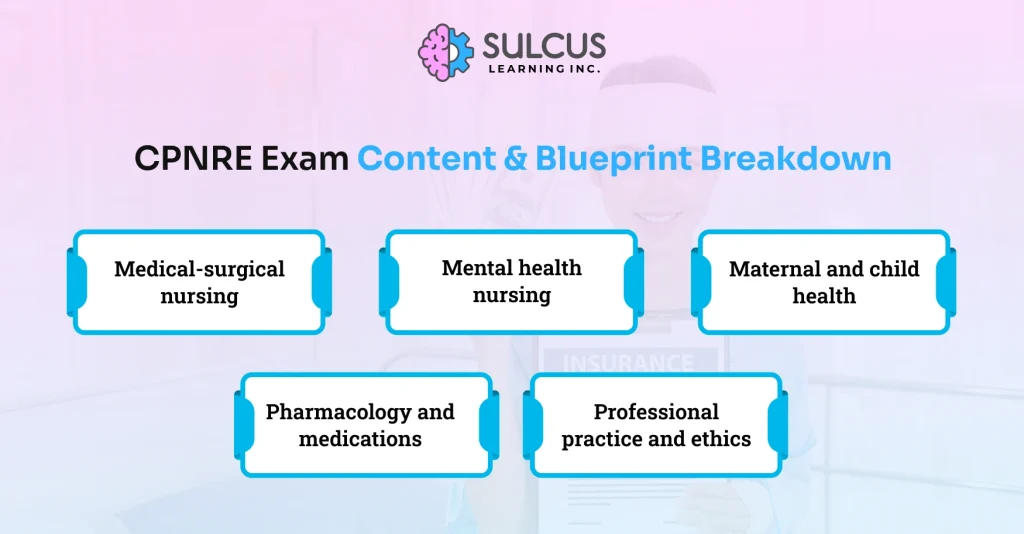
The CPNRE exam blueprint serves as a guide to the theoretical and practical content examined on the assessment. It is organised around several key nursing competency areas such as:
1. Medical-surgical nursing:
Involves providing safe, competent, and evidence-informed nursing care to individuals with medical or surgical conditions. Involves the day-to-day operational skills, clinical reasoning, and assessment of the LPN’s independent and interdependent practice.
2. Mental health nursing:
Focusing on therapeutic communication, crisis de-escalation, and mental health promotion and client care across various settings. Involves the respectful and safe support of clients while utilizing practical mental health nursing skills.
3. Maternal and child health:
Covers prenatal, intrapartum, and postpartum as well as pediatric care. Involves client safety, growth and development assessment, health teaching, and evidence-informed support to families across the lifespan.
4. Pharmacology and medications:
Evaluates the LPN’s ability to administer medications safely within the provincial scope, perform accurate dosage calculations, recognize adverse effects, and apply medication principles relevant to practical nursing, not pharmacy practice.
5. Professional practice and ethics:
Assesses knowledge of Canadian LPN standards of practice, ethical decision-making, professional accountability, confidentiality, client advocacy, and the responsibilities of a self-regulated nursing professional.
This competency-based blueprint ensures a fair and accurate assessment of both theoretical understanding and practical application, allowing candidates to focus their study efforts on the areas most relevant to safe, competent LPN practice in Canada.
Scoring, Passing Marks, and Exam Difficulty
The CPNRE assesses if a candidate shows the expected competence of an entry-level Practical Nurse in Canada. Its focus, along with the format and structure, is on safety, clinical reasoning, and professional judgment.
Passing Marks
The standard of passing the CPNRE is based on a formal standard-setting process.
This method evaluates:
- The level of difficulty of each question on the exam
- The minimum required abilities needed for safe, competent practice.
Those who demonstrate this minimum level of ability are considered to have passed the exam; those who do not are considered to have failed. There is no specific percentage required to pass.
Exam Difficulty
Is the CPNRE hard? For most candidates, the exam is considered to be moderately challenging as it assesses:
- The ability to apply clinical judgment
- To make safe decisions
- To analyze client data
- To exercise ethical and professional judgement
The exam is much easier with the studying, practice, and knowledge of the competencies.
Question Structure and Weighting
As many believe, the CPNRE does not assign different weights to subjects, such as medical-surgical nursing, maternal-child care, etc.
However, all questions receive the same weight, and they all fall into three competency categories:
- Foundations of Practice
- Collaborative Practice
- Professional, Ethical, and Legal Practice
Every question is weighted equally in terms of the overall score. The purpose is to test the extent to which you can combine, articulate, and demonstrate, in a professional manner, safe clinical judgment across multiple scenarios.
Eligibility Criteria for the CPNRE Exam
To qualify for the CPNRE exam, candidates must satisfy requirements established by Canadian regulators to ensure they are ready to practice nursing safely and competently before writing the CPNRE.
The key eligibility criteria include:
- Graduation from an Approved LPN Program: You must have successfully completed a recognized practical nursing program in Canada to be eligible for the CPNRE.
- Meeting Regulatory Requirements: Meet all the requirements of the LPN proficiency examination standards stipulated by the provincial or territorial nursing regulatory bodies.
- Proof of Education: Provide an official transcript and diploma to confirm completion of the LPN program.
- Documentation of Identity: Carry the official ID proof as prescribed by the examination officials.
- Compliance with Professional Standards: Discuss ethical, legal and professional nursing aspects of caring for this client.
- Application Submission: You must fill out all of the required application forms and pay the applicable fees before the specified CPNRE exam schedule deadlines.
When an individual meets these requirements, they are qualified and ready to apply for the CPNRE test in Canada.
How to Apply for the CPNRE Exam
The CPNRE exam application process is quick and easy, so that eligible applicants can get through the registration and scheduling process as quickly as possible.
Step 1: Complete the Online Application
Submit your CPNRE application through your provincial or territorial nursing regulatory body. Ensure you enter all the necessary personal and educational details accurately.
Step 2: Pay the Exam Fee
The cost of the CPNRE exam is different in every province, but it usually falls between 300–400 CA$. Ensure payment is completed during the application process to register
Step 3: Select Exam Location and Date
Now you can choose your desired location for the CPNRE exam and schedule date which is feasible for you.
Pro Tip: Apply early to get a spot and avoid the last-minute scheduling headache. Begin preparing early to minimize stress and facilitate the time you will have for the CPNRE exam Review.
CPNRE Exam Cost, Dates & Locations
Knowing about the CPNRE exam cost, dates, and locations is important for proper planning of your nursing exam.
Cost:
CPNRE exam fees vary from province to province; however, they typically range between 300 and 400 CA$. This charge supports administrative expenses and grants examinees access to examination materials and secure testing venues.
Dates:
The examination is administered several times each year. Candidates are able to check the CPNRE nursing exam schedule and provincial regulatory body websites for available dates that best fit their study plan. Register early to guarantee a seat and eliminate last-minute anxiety.
CPNRE Exam Windows for 2026
The CPNRE is offered several times a year through fixed testing windows. For 2026, the official exam windows are:
- January 1 – January 31, 2026
- March 1 – March 31, 2026
- May 1 – May 31, 2026
- July 1 – July 31, 2026
- September 1 – September 30, 2026
- November 1 – November 30, 2026
You can choose an exam window that works best with your study plan, work, and personal commitments. Registering early is a good practice because it lets you select the date that works best for you and avoids last-minute pressure.
Locations & Testing Options:
The CPNRE is dedicated to providing comprehensive testing options for candidates across Canada.
1. In-Person Test Centres
For many candidates, multiple testing locations across provinces provide easy access to a site within proximity to their home.
2. Online Proctored Exam (Write From Home)
Candidates also have the option to complete CPNRE in the comfort of their home environment. This option allows candidates to take the exam in a quiet, familiar environment, minimizing travel, unnecessary stress, and fatigue that may accompany the event.
Why Planning Matters
Thoughtfully selecting your testing window, location, and testing options (in-person or at home) forms a fundamental element of the CPNRE preparation strategy. Each candidate should choose the arrangements that would allow them the comfort and concentration to maximize their confidence and results.
Effective Study Strategies for the CPNRE Exam
Preparing an effective strategy for the CPNRE exam is a must, and it requires a proper strategic approach and disciplined study habits.
1. Create a Study Schedule:
Plan a detailed schedule for all parts of the exam so your studies will be balanced and you have time to review things properly.
2. Focus on Weak Areas:
Review the CPNRE examination blueprint, identify the weakest areas, and focus on mastering them to achieve greater comprehension and an edge across all domains.
3. Practice Timed Tests:
Simulate exam conditions with timed practice tests. This helps improve pacing, builds confidence, and familiarizes you with the exam format.
4. Use Active Recall and Spaced Repetition:
Employ evidence-based study techniques, such as active recall and spaced repetition, to help you retain information for the long term.
Applying these methods will enhance your LPN practice test preparation, reduce anxiety, and give you the confidence to pass the CPNRE exam in Canada!
Best Resources, Books & Practice Tests for CPNRE
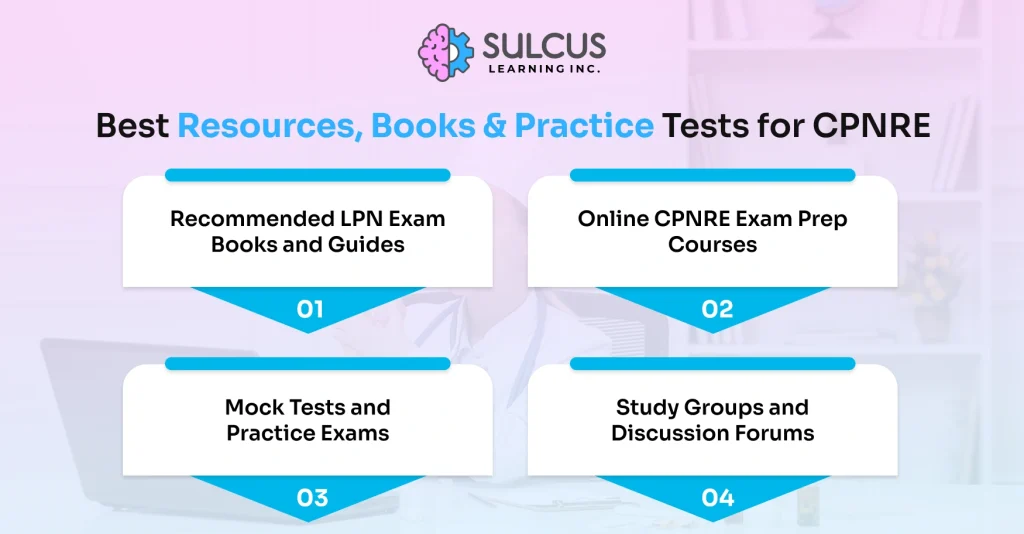
It is crucial to select the best resources for effective CPNRE exam preparation and increase your odds of success. Kick start by employing one of the resources mentioned above so that you can breeze through your nursing exam.
1. Recommended LPN Exam Books and Guides:
Use up-to-date textbooks and study guides that have been created for the Canadian LPN exam. These present a well-rounded listing of all basic nursing topics and assist in finally understanding your subject.
2. Online CPNRE Exam Prep Courses:
Enroll in expert-led online courses with structured lessons, interactive material, and tips that align with the blueprint of the CPNRE exam.
3. Mock Tests and Practice Exams:
Take mock tests for your nursing exam to simulate the real exam environment and practice timing, enhance accuracy, and boost confidence. They are crucial for you to discover how to pass CPNRE.
4. Study Groups and Discussion Forums:
Engage with peers for collaborative learning, discussion of difficult topics, and sharing strategies.
Bonus: The Ultimate Prep Tool — Sulcus Learning
For the most exam-true preparation, Sulcus Learning offers a comprehensive CPNRE prep platform featuring:
- 2,000+ exclusive RPN practice questions.
- Exam-true scenarios and rationales.
- Analytics, performance tracking, readiness predictors, and more.
It’s one of the most advanced tools to boost confidence and prepare you for real exam conditions.
When you put all these together, you have a powerful, comprehensive CPNRE study plan.
Tips on How to Prepare for The CPNRE Exam to Pass on Your First Attempt
Mastering test-taking strategies is just as crucial as knowing content in relation to passing the CPNRE examination.
1. Read Carefully and Eliminate Wrong Options:
Take your time and carefully read every question. Identify and remove clearly incorrect answers to increase your odds of getting the right one.
2. Manage Your Time:
Don’t spend too long on a single question. Watch your time and move on if necessary and come back to difficult questions.
3. Apply Clinical Reasoning:
For scenario-based questions, you need to think critically, consider the client’s care, nursing principles and ethical implications before picking your answer.
4. Stay Confident:
Believe in your preparation, be calm and focused during the exam. Your confidence can help you to enhance your performance and lower anxiety.
Utilizing these tips will help maximize scoring and be effective in assisting with LPN exam preparation.
Staying Healthy & Stress-Free While Preparing
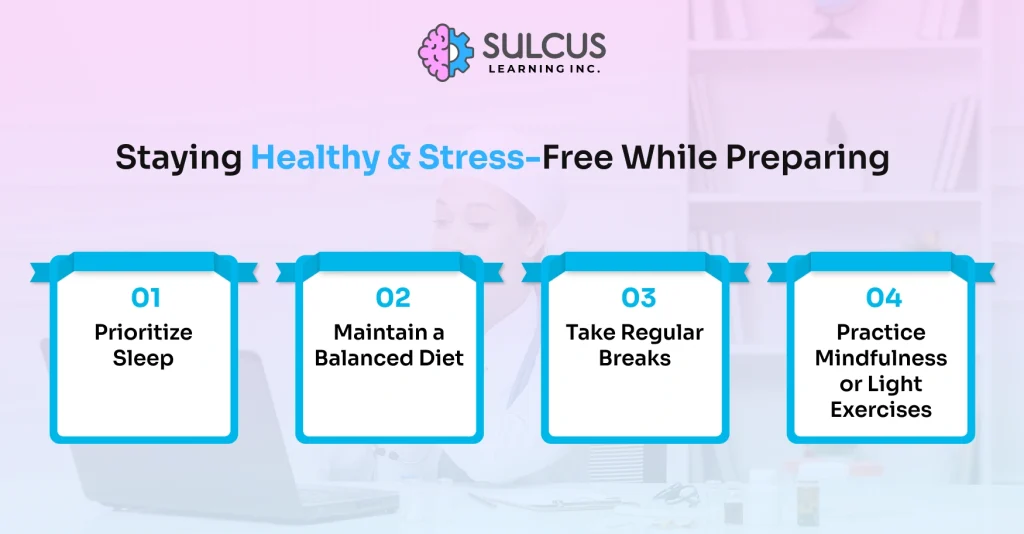
Taking care of yourself is the key to success in any nursing exam in Canada, and your health is essential when you are preparing for CPNRE. With the fresh and healthy mental and physical health your can maximiz your focus and performace for your exam preparations.
1. Prioritize Sleep:
You need to take a proper sleep of at least 7-8 hours every night. Proper rest enhance concentration, improve memory retention, and overall cognitive function.
2. Maintain a Balanced Diet:
Consume a healthy diet that includes protein, vitamins and minerals. Your brain requires good fuel to work at its best.
3. Take Regular Breaks:
Use short breaks to slow down and avoid burning out, as well as aid your brain to process information. Step away from studying to recharge.
4. Practice Mindfulness or Light Exercises:
Practice meditation, take deep breaths or do some gentle exercise, these exercise are great for stress relief, focus and to stay well.
Good habits help you create a good study schedule, and they help you remain confident on your nursing exam day.
What to Expect on CPNRE Exam Day
Being aware of what to expect on the CPNRE exam day will cut down stress and help you feel better and perform your best.
- Arrive Early: Ensure that you have reached the exam centre before the scheduled time. Early arrival allows for check-in procedures and helps you settle in calmly.
- Bring Valid ID: Carry your valid ID proof and all the other documents, as required by the exam body. You might not be able to take the test if you’re missing documents.
- Follow Exam Regulations: Ensure to follow all exam rules and guidelines given to you by the proctors in order not to be penalized or disqualified.
- Manage Your Time: Pay attention to time while you take the test. Spend the right amount of time on each section and question to get through the test knowing that you’ve answered everything possible.
- Stay Calm and Focused: Maintaining calmness and confidence, take deep breaths, focus & keep it up to be at your best during the examination.
Checking Results, Retakes & Next Steps
Once you have completed your CPNRE exam, knowing how to check your results and plan next steps is essential.
1. Check Results Online:
Candidates may obtain their scores by logging into the provincial regulatory body’s portal. Know the process to be able to track results effectively.
2. Analyze Performance:
Look at the results that mattered to you, paying attention to the good and bad. Knowing your weaknesses help to direct a study plan for a retake.
3. Retake Process:
If you do not pass, familiarize yourself with the retake policies, application process and exam dates to better strategize your next try.
4. LPN Licensing Post-Exam:
Successful candidates may then continue to get LPN licensed as they fulfill all other forms and regulations.
5. Plan Ahead:
Leverage results for focused preparation toward success on the CPNRE.
Common Mistakes to Avoid in the CPNRE Exam
To maximize your odds of passing the CPNRE exam on your first attempt, you need to know what mistakes are commonly made by other test-takers:
- Ignoring the Exam Blueprint: Skipping the CPNRE exam blueprint or focusing on low-weighted topics can leave major sections underprepared, reducing your overall score.
- Last-Minute Cramming: If you are thinking of cramming to get good scores, then it is a big NO. All of that occasional reading for studies over the years has helped to keep your memory strong and boost comprehension of complicated subjects.
- Mismanaging Time During the Test: Instead of wasting too much time on difficult questions, we lose minutes which are way more valuable than any quesition. Good pacing will allow you to give all the questions a confident shot.
- Overlooking Practice Tests and Mock Exams: Neglecting timed practice tests limits exposure to real exam conditions, reducing readiness and increasing stress on test day.
By avoiding these mistakes, you can boost confidence, maximize efficiency, and approach the LPN exam in Canada calmly.
Why Sulcus Learning Is Ideal for Your CPNRE Prep?
When it comes to preparing for the CPNRE exam, Sulcus Learning stands out as Canada’s most trusted platform for aspiring LPNs.
We offer personalized prep programs tailored to your learning style, so you’ll learn the topic by confidence. You’ll have access to realistic practice tests so you can simulate the CPNRE exam experience and receive a detailed answer key and exam description from our experts!
With proven high pass rates and expert guidance, Sulcus Learning empowers you to study smarter, not harder. From structured lessons to supportive study resources, it’s your ultimate partner in cracking the CPNRE exam in Canada on the first attempt.

Conclusion
Passing the CPNRE exam on your first attempt is absolutely achievable with the right strategy.
Focus on understanding the exam format, follow a structured study plan using the blueprint, and practice regularly to sharpen your test-taking skills.
Combine that with healthy preparation routines—balanced sleep, proper nutrition, and stress management—and you’ll walk into exam day confident, calm, and ready to succeed in your LPN career.
Frequently Asked Questions
Q1. What is the CPNRE exam?
Ans. The CPNRE exam is the official licensing test for Licensed Practical Nurses (LPNs) in Canada, assessing nursing knowledge, clinical judgment, and safe client care skills.
Q2. How long is the CPNRE exam?
Ans. The CPNRE exam typically lasts 3–4 hours, featuring adaptive multiple-choice questions designed to evaluate practical nursing competencies under real-world conditions.
Q3. How can I apply for the CPNRE exam?
Ans. You can apply online through your provincial nursing regulatory body, complete eligibility documentation, and pay the CPNRE exam cost to secure your preferred exam date.
Q4. Is the CPNRE exam hard?
Ans. The CPNRE exam is challenging but manageable with the right preparation. Regular practice tests, focused study plans, and concept understanding greatly improve success rates.
Q5. What is the passing score for the CPNRE exam?
Ans. There’s no fixed percentage. The passing mark is determined through a standard-setting process, ensuring that only competent candidates qualify for LPN licensure.
Q6. How can I check CPNRE results?
Ans. You can check your CPNRE results online through your provincial exam portal, where official notifications and performance feedback are released after the exam.
Q7. Where are the CPNRE exam locations?
Ans. The CPNRE can be written at test centres across multiple provinces in Canada or from home through secure online proctoring. Candidates can choose the option that best fits their comfort, convenience, and schedule.

Taran Kaur
As Managing Director and Lead Instructor at Sulcus Learning, Taran helps internationally educated nurses navigate their professional journey with clarity and confidence. With qualifications including a B.Sc. (Nursing), MBA (HM), ENCC, and CMSN(C), she focuses on helping learners succeed in licensure exams and professional practice. Connect with Taran Kaur on LinkedIn.