

In today’s world, the process of getting a nursing license is more competency-based, data-driven, and structured than ever before. Candidates are asked, “How many times can you take the NCLEX?” and what happens if they fail on the first attempt.
If you are preparing for the nursing exam for the first time, in the process of exam resets, or attempting the exam for any additional time, it is important to remember that NCLEX exam attempt limits are not just to ensure you comply with the requirements. Before diving into policies, it helps to clearly understand what the NCLEX Exam is and how it functions as a licensure requirement across Canada and the United States.
This guide will help you understand how retake rules, timeframes, and provincial and state differences affect your ability to move forward with renewed confidence, particularly given the updated testing standards for the 2026 NCLEX Changes.
Is There a Limit to How Many Times You Can Take the NCLEX?
Many nursing graduates preparing for licensure ask the same practical question: Is there a limit to how many times I can retake the NCLEX?
The answer requires understanding the difference between national exam administration and jurisdiction-specific regulation. While candidates often expect a single, fixed number, attempt eligibility is shaped by both general testing guidelines and the rules of the regulatory body where you apply.
Understanding Attempt Limits: At the national level, the NCLEX allows candidates to take the exam up to eight times within a 12-month period. However, there is a mandatory waiting period between attempts. Candidates must wait at least 45 days before scheduling another exam.
1. General Attempt Framework
A candidate can retake the exam after 45 days, which is designed to give them time to prepare. Although this is the case, the nursing regulatory body you apply to has the final say on eligibility. This is the overall administrative best practice, and the eligibility defaults to the state board.
2. Is There a National Lifetime Limit?
The National Council of State Boards of Nursing (NCSBN) does not have a lifetime exam limit. As such the state or provincial exam administrators have no authority to impose limits on exam takers.
In contrast, regulatory bodies have described limits on the following:
- Annual attempt limits
- Total attempts within a defined timeframe
- Remediation or refresher education requirements
- Eligibility after extended gaps from graduation
3. What Determines Your Attempt Eligibility?
Wondering how many times you can take the NCLEX? The answer is based on several factors:
- The jurisdiction where you applied
- The time elapsed since graduation
- Whether the board requires remediation
- Annual caps established by the regulatory authority
4. Jurisdictional Variations
Some jurisdictions have more lenient guidelines, allowing multiple attempts in a single year as long as the overall cap of eight attempts is not exceeded. In contrast, some have strict guidelines around attempts, and some require a course or remediation before additional attempts.
In short, while the NCLEX exam, in theory, allows for an unlimited number of attempts, your regulatory authority imposes limits to demonstrate achievement. It is essential to know the limits of your particular board, as this greatly influences when you may want to apply for your next attempt.
Who Sets the Attempt Rules: NCSBN vs State Boards
Understanding who determines retake rules is essential while planning your licensure pathway. Most NCLEX candidates think the same body that administers the exam determines retake rules, but this is not the case. In reality, authority is divided.
The National Council of State Boards of Nursing (NCSBN) develops the NCLEX exam, creates the testing framework, dictates the passing standard, and manages the computerized adaptive testing (CAT) model. However, NCSBN does not dictate how many times you can retake an exam.
Retake eligibility is governed by the nursing regulatory body (NRB) or the state board where you applied for licensure. These regulatory authorities establish:
- Initial eligibility to test
- Mandatory waiting periods between attempts
- A maximum number of attempts per year
- Remedial or refresher education
- Time limits, whether or not you have graduated
This is an important distinction. When candidates see how many times they can take the NCLEX RN, many think there is a consistent policy across jurisdictions. There is not. Each region has different rules, and the number of retakes permitted depends on the region processing your application.
You should always familiarize yourself with your board’s rules before scheduling an exam to avoid unnecessary delays in testing authorization.
How Many Times Can You Take the NCLEX?
The NCLEX lacks a national limit on the number of times you can try it, instead, it is determined by the state nursing regulatory body of the state in which you are seeking licensure.
Each state board can and often does impose their own rules regarding retesting. For example, the National Council of State Boards of Nursing (NCSBN) allows you to take the NCLEX up to 8 times in a year, but many state boards have additional requirements.
Common State-Level Restrictions
Most state boards of nursing implement one of the following rules:
- A mandatory waiting period between attempts
- A maximum number of attempts within a one-year period (commonly three to four)
- Remediation or refresher coursework after repeated unsuccessful attempts
- Graduation time limits for passing the exam
- In some cases, lifetime caps on total attempts
Because each nursing board determines the number of times you can take the NCLEX, some nursing boards are more forgiving, and others are more strict. The weaker boards of nursing reveal the ability to continuously retest within the national framework. Stronger boards of nursing demonstrate the ability to strategically implement remediation, eligibility requirements, and stricter caps on attempts.
For RN candidates inquiring about NCLEX-RN retake limits, the same limitations imposed by state boards apply. The regulatory body responsible for your RN license application determines eligibility.
NCLEX Retake Policy: Understanding the 45-Day Rule
It can be very disappointing to fail an exam. However, the process for retaking this exam is standardized, and there is a high level of consistency across legal jurisdictions.
There is a minimum 45-day waiting period between the most recent exam date and the next NCLEX exam date. Therefore, until the waiting interval has been satisfied, you will NOT be permitted to schedule the exam, nor will you be allowed to take the exam.
Many nursing candidates commonly ask:
- How long do you have to wait to retake the NCLEX?
- How soon can you retake the NCLEX?
- When can you retake the NCLEX?
You may take the exam at least 45 days after your last attempt, if the board allows it.
The Role of the Authorization to Test (ATT)
A 45-day waiting period does not automatically mean you qualify for another attempt. There are specific requirements:
- You must have re-applied to the board of nursing (if necessary)
- You must have received an eligibility confirmation
- You must have received a new Authorization to Test (ATT)
- You must have scheduled your exam through Pearson VUE
ATTs permit you to schedule exams during the board’s approval period, and they set the date by which you must take the exam.
Why the 45-Day Waiting Period Exists
The waiting period is not a punishment. Rather, it serves a purpose by offering candidates the time to:
- Analyze their Candidate Performance Report (CPR)
- Examine and address deficiencies in their knowledge or clinical judgment
- Revise their study plan
- Prepare for safe and effective clinical nursing
When used appropriately, waiting time can lead to improved results.
State-by-State Variations in Retake Policies
There are significant differences in licensure rules across North America. While the structure of the NCLEX exam is the same everywhere, eligibility criteria and the number of times a candidate may retake the exam are determined by each nursing regulatory authority.
If you are looking into how many times one can take the NCLEX, you will need to check with your state board or provincial regulator, as policies change frequently.
Below is a structured overview of several U.S. states and Canadian provinces to show how rules on exam attempts differ.
United States – Selected State Retake Policies
In the United States, NCLEX retake limits are set by individual State Boards of Nursing, not by the national board. This includes dividing retake policies by state, including retake caps, timelines, and remedial course assignments.
1. Alaska
You must pass within two years of your first attempt. If you don’t, you must first complete a board-approved remedial nursing program before you retake the exam.
2. Florida
After three failed attempts, you must complete a Florida Board of Nursing–approved remedial course prior to being eligible to take the exam again.
3. Georgia
You must pass the NCLEX exam within three years of graduating. After that, additional attempts may be limited unless you obtain assistance from the board.
4. Colorado
You can take the exam three times within a three-year window of your first attempt. After that, you must submit a formal petition to the board in order to take a fourth attempt, and approval is not guaranteed.
5. Delaware
Graduates have a five-year window from graduation to take the exam. Within that period, there is no limit on the number of attempts. After five years, you must obtain approval from the board to attempt the exam again.
6. Indiana
Each candidate has three attempts, but they must take the exam in consecutive order. If a candidate does not pass all three attempts, a Board Review may require additional coursework before the candidate can retest.
7. Kentucky
Each candidate must reapply to take the exam after being notified by the board. Reapplication may require additional background checks and waiting periods.
8. Hawaii
You can attempt the exam as many times as you would like, but in order to take the exam again after three consecutive failed attempts, you must complete a remedial course is required before another attempt can be made within six months.
9. Illinois
Candidates must pass the exam within three years of their first attempt. Candidates who do not succeed must take more coursework and reapply for their license.
10. Michigan
Candidates must attempt the exam within three years of graduation, if they do not, they must demonstrate a competency in the skills required to obtain the certification. Extensions may be granted.
11. Mississippi
Candidates have two years from their graduation date to attempt the exam up to six times. The candidate must obtain board approval to attempt additional tries.
12. Missouri
Each candidate must submit an NCLEX application for each attempt. Candidates must retest within a year of their previous attempt and pay the testing fee for each attempt.
13. Minnesota
There is no lifetime cap for attempts, however, a candidate must attempt the exam within eight months of their previous attempt, or they will not be able to do so. If a candidate does not complete this within a year, they must reapply.
14. Louisiana
- Practical Nurses (PN): Maximum four attempts within two years and must test within three years of graduation.
- Registered Nurses (RN): Must pass within four attempts over four years.
Failure beyond these limits may require repeating the nursing program.
Canada – Provincial Regulatory Variations (NCLEX-RN Attempts)
In Canada, nursing licensure is conducted at a provincial level, thus creating a patchwork system. While most provinces have adopted the NCLEX-RN as the exam for entry-to-practice, most provinces have different policies for each regulatory authority regarding:
- Retake eligibility
- Timelines after graduation
- Remediation requirements
- Competency reassessment
- Application validity periods
Unlike some U.S. states that publish strict numerical lifetime caps, Canadian regulators generally operate under an eligibility-based framework. Instead of a case-by-case eligibility approach, many provincial regulators opt for a system in which competency is assessed at the entry level and policies are responsive to regulatory changes and public perceptions of safety.
Below is an updated overview reflecting current regulatory structures.
1. Ontario – College of Nurses of Ontario (CNO)
Ontario’s regulatory authority allows applicants to retake the licensure exam as long as they have not exhausted the national exam retake policies and the application is within the exam’s expiry period. However,
- Individuals must comply with the CNO’s registration time limits.
- An individual who fails this exam multiple times is likely to undergo a competency assessment.
- Participation in the CNO registration options is voluntary.
However, in Ontario, there is no right to unlimited lifetime eligibility, as continued access to this system is governed by registration time limits.
2. British Columbia – BCCNM (British Columbia College of Nurses and Midwives)
British Columbia allows applicants to take the licensure exam multiple times, as long as their application remains active. However:
- Candidates must maintain a valid, open application.
- Repeated failure may require coursework or remediation.
- Long gaps since graduation may require reassessment of baseline entry-level competencies.
Regulatory attention is focused on verifying competencies rather than imposing a rigid numerical limit.
3. Alberta – College of Registered Nurses of Alberta (CRNA)
In Alberta, candidates may take the NCLEX-RN multiple times while their application is open. If a candidate has multiple unsuccessful attempts since:
- Additional nursing education may be required.
- A reassessment of entry-to-practice competencies may be required.
There are application limits for candidates who have multiple attempts. This means there is a waiting period before you can apply again.
4. Manitoba – College of Registered Nurses of Manitoba (CRNM)
In Manitoba, an applicant needs to obtain permission for each attempt. The following are included in most of the policies:
- Doing the examination within a limited period after graduation.
- A review of competencies after several unsuccessful attempts.
- If nursing students have not met the competencies, they may be required to complete additional coursework.
In Manitoba, eligibility is linked to the currency.
5. Saskatchewan – College of Registered Nurses of Saskatchewan (CRNS)
Saskatchewan allows candidates to retest after a specific eligibility period. For candidates who have retested multiple times unsuccessfully:
- The regulator may request remedial education.
- Supervised practice hours could be requested.
- Entry-level competency might be reassessed.
Decisions are based on competence rather than a strictly numerical framework.
6. Nova Scotia – Nova Scotia College of Nursing (NSCN)
Nova Scotia allows retakes of the exam as long as the application remains valid. There are other factors to consider:
- Ongoing assessment of registration eligibility
- Possible remediation from their regulator
- Competency standards must remain up-to-date
There is a strong focus on safety within entry-level nursing practice.
7. Newfoundland and Labrador – College of Registered Nurses of Newfoundland and Labrador (CRNNL)
Candidates can retake the NCLEX-RN as long as their application is valid. After so many attempts and standards remain unmet:
- Competency upgrading could be required.
- Depending on how long has elapsed, reinstatement processes may apply.
The currency of knowledge is always the focus of approval decisions.
8. Prince Edward Island – College of Registered Nurses of Prince Edward Island (CRNPEI)
PEI allows for retesting of candidates as long as they remain within the timeline set by their application. If candidates have multiple unsuccessful attempts, they may have to complete:
- Remediation as approved by the board
- Additional nursing education prior to being eligible for further attempts.
Regulatory approval is based on the demonstrated ability to practice nursing at a basic, safe level.
9. Quebec – Important Clarification
Quebec does not use the NCLEX-RN as its standard entry-to-practice examination for locally educated candidates.
Licensure is administered by the Ordre des infirmières et infirmiers du Québec (OIIQ), which operates under its own provincial examination and regulatory framework. Examination structure, eligibility timelines, and retake rules differ from those of other Canadian provinces.
Internationally educated nurses or applicants transferring from other jurisdictions may follow distinct assessment pathways, particularly within Quebec’s professional and language requirements.
Key Clarification for Canada (2026 Update)
- Most provinces allow multiple attempts within structured eligibility timelines.
- Fixed annual caps (such as “three attempts per year”) are not consistently published across all provinces.
- Eligibility is tied to application validity, graduation timelines, and competency currency.
- Remediation may be required after repeated failures or extended delays from graduation.
Because provincial policies are subject to regulatory updates, candidates should always verify the most current requirements directly with their provincial regulator before scheduling a retake.
What Happens After Multiple Failed Attempts?
If you go over the maximum attempts of the NCLEX exam in a year, most governing bodies stipulate at least one of the following:
- A board-approved refresher program
- Supervised clinical practice hours
- Proof of competency remediation
Failing multiple times does not define your professional future. It simply indicates a gap in preparation. The first step in improving is reviewing your Candidate Performance Report (CPR).
This is also true when knowing the NCLEX-RN Passing Score standard is vital. The exam uses computerized adaptive testing (CAT), meaning that based on how well you do, the questions posed increase or decrease in difficulty.
Step-by-Step Guide to Reapplying After a Failed Attempt
Reapplying for the NCLEX is a straightforward administrative task. Knowing what is required for each step prevents delays in your subsequent Authorization to Test.
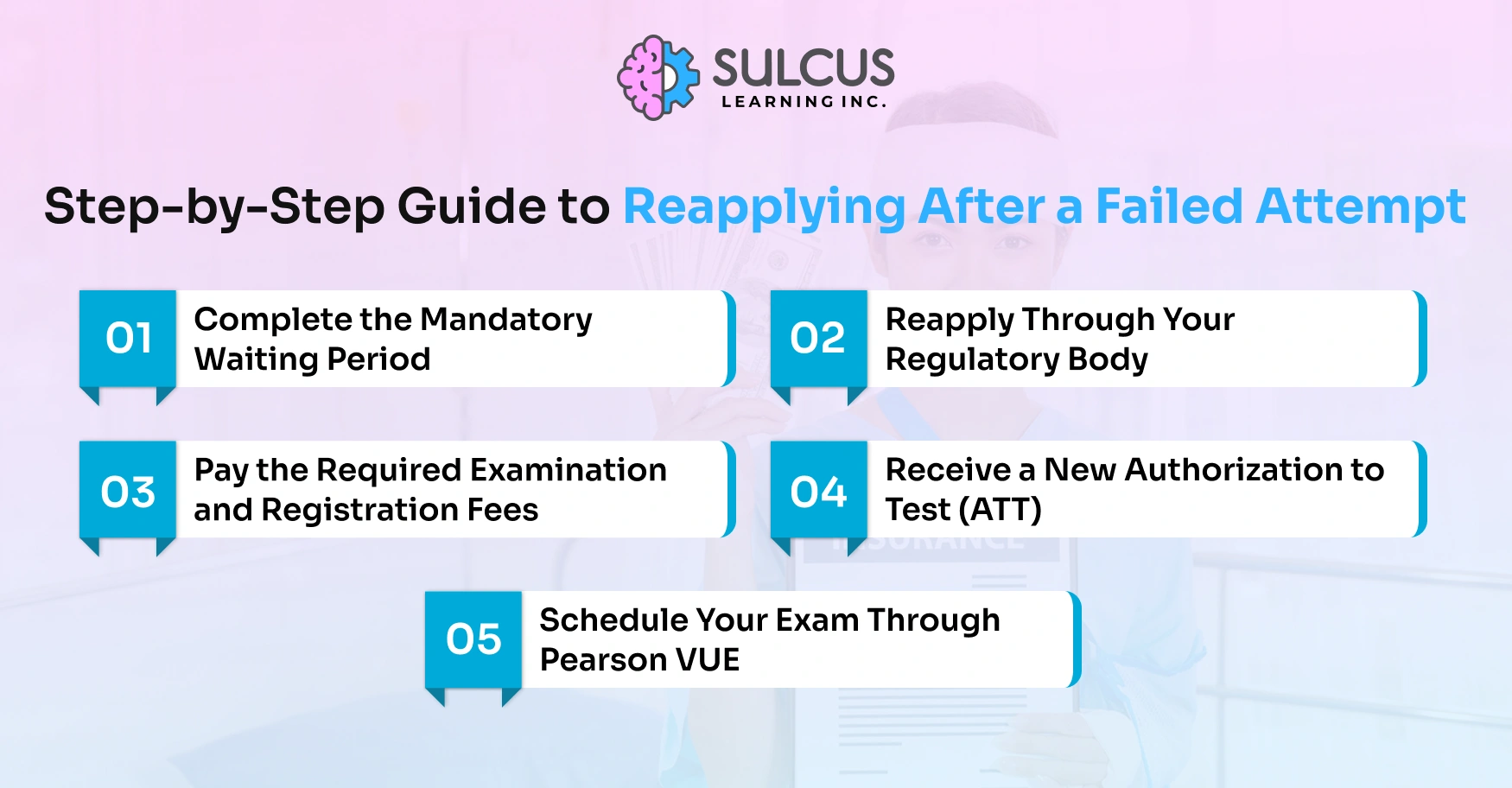
What to do to Reapply After a Failed Attempt
Step 1: Complete the Mandatory Waiting Period
You may have to wait a minimum of 45 days from your last exam date to be eligible to retake the NCLEX. This time is recommended for reviewing your exam performance and targeting remediation.
Step 2: Reapply Through Your Regulatory Body
Complete a new application for examination or licensure to your nursing regulatory authority. You must also show proof of continued eligibility and compliance with jurisdictional requirements prior to granting your testing attempt.
Step 3: Pay the Required Examination and Registration Fees
Payment is required to your regulatory body and also to Pearson VUE. A payment is required for each attempt before your Authorization to Test is given.
Step 4: Receive a New Authorization to Test (ATT)
Once your application is accepted, you will be sent a new Authorization to Test, which allows you to confirm eligibility and provides permission to book your exam.
Step 5: Schedule Your Exam Through Pearson VUE
You must log in to your Pearson VUE account to choose a testing center, date, and time. If you want a specific date, you should book your exam as soon as possible to increase your options. You should book your exam within your eligibility period.
This system will still apply in the event you are retesting after your first unsuccessful attempt or are looking to make another attempt within your eligibility period.
Does Applying in Another State Reset Your Attempts?
No, applying for a job in another state does not reset or change your NCLEX exam attempts. The NCLEX exam history is permanent and accessible by the nursing regulatory body for each state. In other words, there is a record of your NCLEX exam attempts breakdown by state. Each regulatory body can access the central database and view your exam attempts.
If you take an exam and then apply to a different state where you have not yet attempted the NCLEX, you should know that each state board of nursing looks at how many times you have attempted the exam to determine if you will be able to take the exam if your application is granted. Changing state borders will not reset your attempts, and will not reset your exam attempts if there is an annual limit.
Strategies to Improve Your Score on the Next Attempt
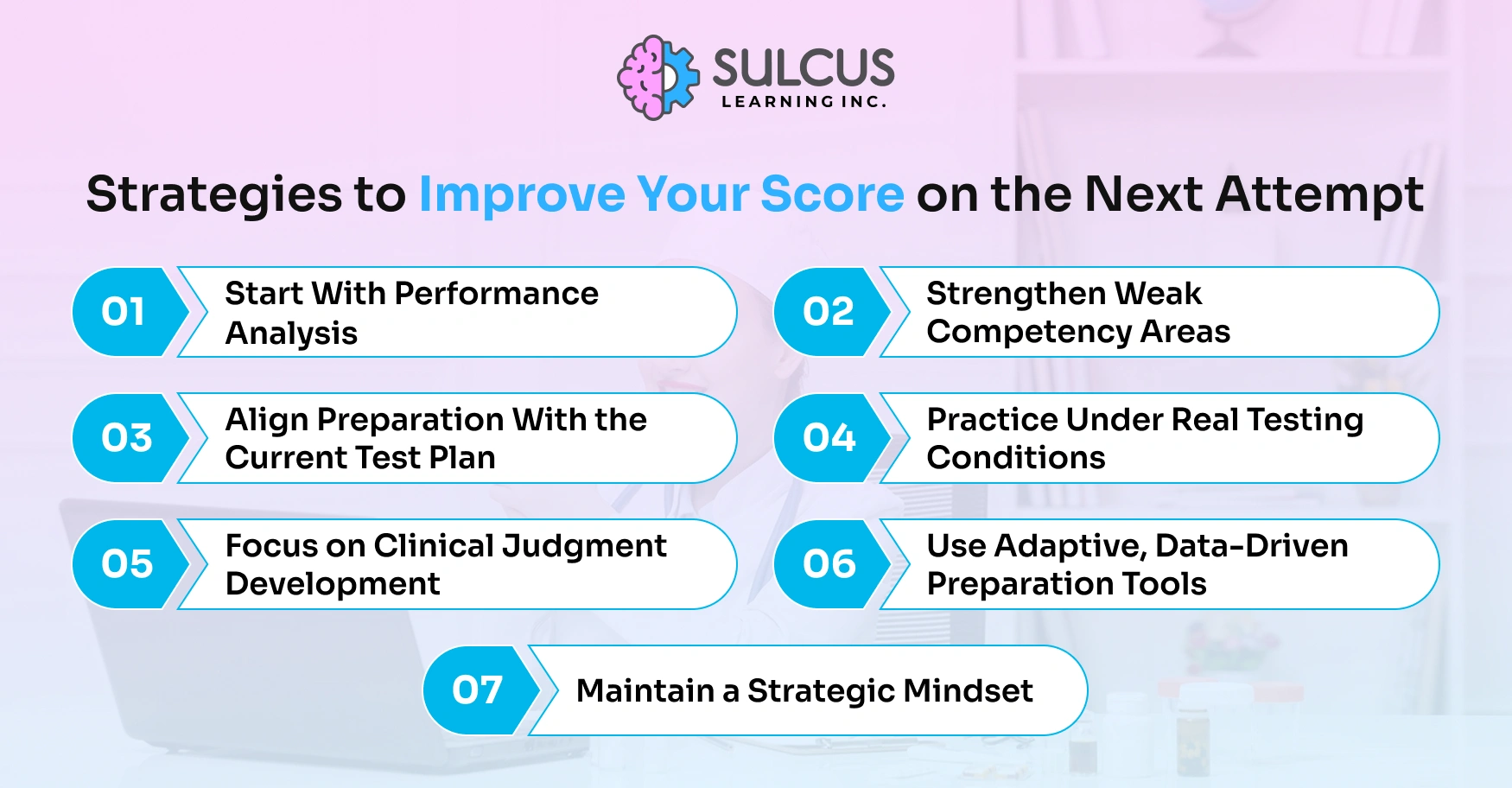
Your aim for your next exam is to improve your previous score by analyzing what you can do differently, rather than just writing down the same study goals as last time. Improvement takes time, with clear, structured goals, to analyse time quantitatively and achieve the desired result.
1. Start With Performance Analysis
The first thing you should do is analyze your own Candidate Performance Report (CPR). This shows the CP and where it falls within each major client-needs and competency category. If you have a problem with one of these categories, you will likely have an issue with your cognitive prioritisation or your clinical reasoning. This is a foundational step that will help you set a target as you prepare.
2. Strengthen Weak Competency Areas
You have to analyze your gaps and shift your focus to them instead of starting to ravel in the beginning of every competency. If your gaps are in pharmacology, delegation, or care coordination, your focused competency review should address these areas.
3. Align Preparation With the Current Test Plan
Use question banks and mock exams that reflect the current blueprint and clinical judgment framework. The exam is about decision-making, not about pure memorization. Doing old exams and questions, or questions based on pure recall, will not help you progress.
4. Practice Under Real Testing Conditions
Endurance, pacing, and decision fatigue spell the difference between the good and the great test-taker. Many candidates practice in a casual, untimed way, and test-taking strategies, gaming the system, and a practice-test attitude help many of them figure out how to achieve their goals. The use of simulated exam environments closes these gaps.
5. Focus on Clinical Judgment Development
Recognition of cues and prioritization, as well as the making and undermining of interventions and evaluations, are all hallmarks of the modern NCLEX exam. The bulleted list format of NCLEX practice questions isolates each minor testing skill, thereby requiring additional reasoning.
6. Use Adaptive, Data-Driven Preparation Tools
A structured, exam-aligned platform such as Sulcus Learning can support retake candidates through adaptive simulations, readiness tracking, NCLEX prep questions, and competency-based analytics. Instead of relying on raw percentages, candidates monitor their ability progression and identify measurable readiness trends before scheduling the next attempt.
7. Maintain a Strategic Mindset
The final outcome, being a failure to pass an exam, is not the end of the world. The first-round results, when combined with a well-thought-out study and targeted remedial exam prep, create the best chances of success in the subsequent round. The litmus test for this is Retest Prep Confidence.
The goal is not simply to become another test-taker, but to rebuild your test-taking confidence, improve your clinical judgment, and avoid relying on guesswork rather than measurable metrics when testing again.

Conclusion
There is no single lifetime cap that removes candidates from further attempts. Each board has its own retake policies to ensure each candidate is adequately prepared to be a member of the profession.
The answer to the question, “How many times can you take the NCLEX?” depends on state, time, and board requirements, as well as the most important factor: how prepared you are to take it, not how many times you have attempted it.
Because of exam-aligned practice, structured remediation, and targeted preparation, passing can be measured rather than seen as the outcome of a never-ending cycle. As an opportunity, it is available as long as it is pursued with focus and discipline.
FAQ’s
Q1. How many times can you take the NCLEX?
Ans. There is no universal lifetime limit set by the exam administrator. Most jurisdictions regulate attempts annually, often allowing multiple attempts per year, and require remediation or additional education after repeated unsuccessful attempts within defined timelines.
Q2. How many times can you take the NCLEX-RN?
Ans. The number of NCLEX-RN attempts depends on your nursing regulatory body. Many allow several attempts within a 12-month period, but extended failures may trigger board review, refresher coursework, or competency reassessment requirements.
Q3. How often is the NCLEX offered?
Ans. The NCLEX is offered year-round at authorized Pearson VUE testing centres across the United States and Canada. Appointment availability depends on location, demand, and the scheduling windows available during your active Authorization to Test period.
Q4. How long do you have to wait before retaking the NCLEX?
Ans. Candidates must wait at least 45 days from their previous exam date before retesting. Reauthorization from the nursing regulatory body and issuance of a new Authorization to Test are required.
Q5. Can I take the NCLEX 5 years after nursing school?
Ans. Eligibility after five years depends on jurisdictional rules. Some regulators impose graduation time limits or require refresher programs, competency evaluations, or updated coursework before approving examination eligibility for licensure.
Q6. Does applying in another state reset your NCLEX attempts?
Ans. No. Examination history is recorded and accessible to regulatory authorities. Most boards review prior attempts before granting eligibility, meaning transferring jurisdictions does not erase previous failures or automatically reset attempt limits.

Taran Kaur
As Managing Director and Lead Instructor at Sulcus Learning, Taran helps internationally educated nurses navigate their professional journey with clarity and confidence. With qualifications including a B.Sc. (Nursing), MBA (HM), ENCC, and CMSN(C), she focuses on helping learners succeed in licensure exams and professional practice. Connect with Taran Kaur on LinkedIn.