Walking out of the NCLEX exam is the hardest moment. After all the weeks or months of preparation, countless candidates in the nursing field at the center feel the same. How do you know if you passed the NCLEX right away? It is the biggest question. It is extremely common to think of the exam, self-evaluate, question how many questions you were asked, and look for signs of passing.
The NCLEX is the measure of whether or not you are ready to begin to practice safely as a licensed nurse. The exam uses adaptive testing, which can make it feel extremely unpredictable. The unpredictability makes candidates search for signs you passed the NCLEX right after taking the exam.
In the following details, we hope to explain exactly how the exam determines whether you pass or fail, the signs that suggest you previously succeeded, and how to determine all of this for certain. If this is your first time attempting to understand this licensure process, we hope we can assist you by starting with what the NCLEX exam is. Before we dive deeper into the workings of the results.
How the NCLEX Exam Determines Pass or Fail
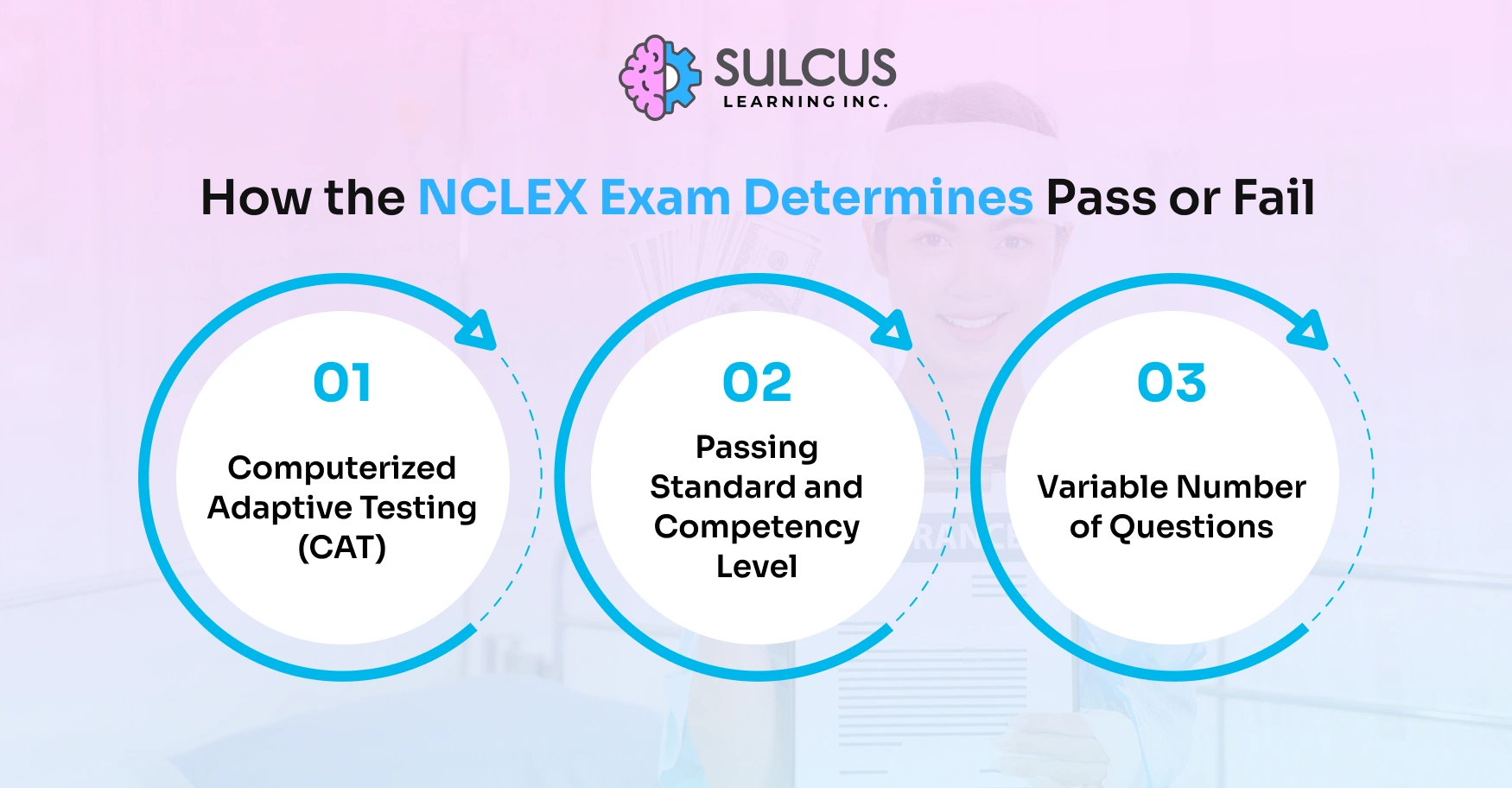
The NCLEX Exam is unlike any other test because it is not graded using a marking scheme or a percentage-based system. The NCLEX Exam uses Computerized Adaptive Testing (CAT) instead which determines if a test taker has enough clinical judgement and decision-making skills to practice nursing safely and effectively.
1. Computerized Adaptive Testing (CAT)
The NCLEX Exam uses CAT to adapt the exam based on a test candidate’s answers to the previous question. The system evaluates the answer given to the previous question for correctness and uses this to determine if the next question is going to be more or less difficult. By doing this, the NCLEX Exam aims to determine a candidate’s true level of knowledge and ability instead of looking at a candidate’s raw score.
2. Passing Standard and Competency Level
The NCLEX Exam does not release scores to candidates, leaving many candidates unsure if they have not met the passing standard of the exam. The exam, however, measures whether a candidate has sufficiently demonstrated knowledge and competency. The NCLEX-RN Passing Score reflects the minimum standard that shows a candidate is ready to practice nursing safely.
3. Variable Number of Questions
Based on how each test taker performs on the exam, the test adjusts the total number of questions, which is why knowing how many questions are on the NCLEX can explain why the exam ends at different points for different test takers.
Evolving NCLEX Exam Structure: What to Expect in 2026
The NCLEX exam must evolve continuously to address the complexities of modern health care. In the most recent revisions, the primary focus is on training entry-level nurses to prepare them to critically analyze, establish priorities, and ensure safe, clinically-based, and evidence-supported care in changing environments.
However, NCLEX changes in 2026 mean there will be an increased focus on the development of analysis, evaluation, and synthesis skills that go beyond recalling knowledge. Instead, an emphasis will be placed on candidates’ abilities to describe and interpret real-life patient situations, detect various patient trends, and make sound clinical judgments in potentially complex patient care situations.
Key Focus Areas in the Updated Structure
1. Clinical Judgment Integration
Clinical reasoning and judgement will assist nursing graduates in determining possible clinical conditions, clinical priorities, and appropriate clinical interventions.
2. Emphasis on Client Safety
The most current, evidence-based, safe nursing practice that will assist in reducing risks and preventing errors will keep nursing practice focused in a clinical setting.
3. Situational Decision-Making
Nursing graduates will be able to demonstrate their ability to read the clinical conditions of a patient and shift their clinical thinking and prioritization skills.
Why These Changes Matter
These changes will help align the NCLEX with modern-day expectations and candidates will not be evaluated based on rote recall knowledge. The preparation needed to succeed in the exam is restructured to focus on clinical judgment and reasoning.
Passed the NCLEX Right After the Exam?
Although a candidate’s passing or failing the NCLEX is a common concern, there is a long wait time before the candidate receives verification. Candidates often wonder if there is a way to know if they have passed the test.
The NCLEX is unlike most standardized tests. Candidates cannot have their results sent to them right away after the exam because the NCLEX takes several steps before finalizing results. Candidates often try to find indirect indicators suggesting they did pass based on the number of questions they answered, the perceived difficulty of the questions, or how the exam was cut off.
Without definitive proof, candidates will not know if they have passed. After registering for the exam, candidates can gain a better understanding of the process. The first step candidates will take is to apply to their nursing regulatory body before completing the testing process to ultimately register for the NCLEX-RN.
Understanding NCLEX Results: Quick Results vs Official Confirmation
After finishing the NCLEX exam, many people wonder how to get their exam results and how long it will take. Knowing how the process works for unofficial and official results reporting gives candidates something to consider while they wait and helps address some of the uncertainty.
Unofficial NCLEX Quick Results
Candidates nervously awaiting results often choose Quick Results expecting it to ease some stress. Quick Results, which show results in 48 hours, allow candidates to answer the question most on their mind, “Did I pass the NCLEX?” However, results cannot be used to alter licensing decisions.
Official Results from the Nursing Regulatory Body
The official results are issued by the candidate’s nursing regulatory authority. Though the NCLEX testing body and other organizations manage the exam, they cannot provide licensure or license confirmation. Results can take a long time to come in, some candidates receive results in days. Some receive results in weeks or even longer, depending on how verification and administrative processes go.
What Candidates Should Keep in Mind
Once an exam result is verified, a candidate’s license is posted in the public registry, which provides them with eligibility to practice. Familiarity with this process can minimize stress and improve planning. To avoid delays in transitioning to licensure, candidates should also consider the important elements of the registration process and the NCLEX exam fees for 2026.
Signs You May Have Passed the NCLEX Right Away
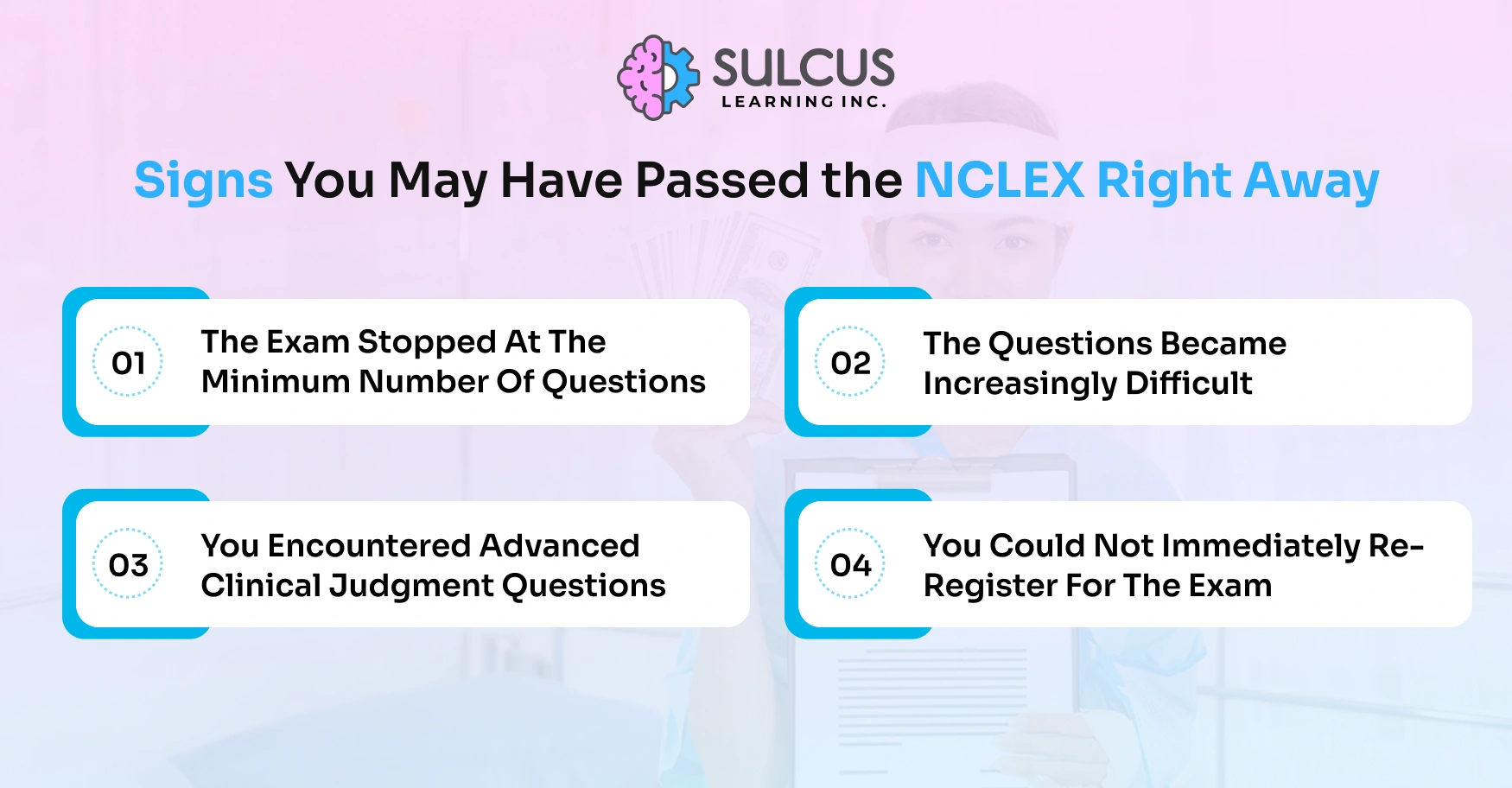
After taking the exam, the candidates start looking for signs of how they did, including how they feel about the exam experience, how questions were answered, etc. While there is no way to truly predict how you did on your exam, there are some signs that can be picked up during the exam experience. This is what many candidates are attempting to analyze when they try to identify signs you passed the NCLEX.
1. The Exam Stopped at the Minimum Number of Questions
A commonly shared experience of candidates is that the exam stops when it reaches the minimum number of questions. Many candidates find it shocking or unsettling to have their NCLEX exam shut off at 85 Questions, however, it just means the adaptive system made a confident decision regarding the candidate’s level of competency. Many times, the system decides early on that the candidate is performing above the passing level.
2. The Questions Became Increasingly Difficult
Questions of the NCLEX are arranged in a manner that reflects computerized adaptive testing. So, if you realized that the questions were becoming more challenging, questions required more clinical and deep reasoning, it is a possible indication that the system was trying to gauge you at a higher competency.
3. You Encountered Advanced Clinical Judgment Questions
The Next Generation NCLEX (NGN) exam prioritizes the testing of a candidate’s clinical judgment and decision-making ability. It places prominence on the candidate’s ability to make decisions that keep patients safe and pose clinical questions as part of a patient’s exam. When you face clinical questions and case studies, you may be experiencing the system assessing the depth of clinical knowledge you possess.
4. You Could Not Immediately Re-Register for the Exam
Candidates also note that the system has blocked them from scheduling a new exam attempt immediately after finishing. Because those who do not pass an exam have to wait a period of time before they are able to re-register for the exam, the system is designed to process candidate’s exam results and then block scheduling. Many rescheduling attempts have been observed as evidence of the candidate’s attempt to get the test results.
From this, it is clear \that while the aforementioned examples could act as potential indicators of an event, they are likely to serve as a non-expressive means. Official processes designed specifically to receive NCLEX results provide the most definitive means to receive NCLEX results except the means through which that system was designed.
What Is the Pearson Vue Trick (PVT)?
PVT is an unofficial method and is used by some NCLEX candidates as an attempt to gauge NCLEX results prior to obtaining the official results. On the day of the exam, the Pearson Vue site allows candidates to attempt to register for another exam. Some candidates gauge their results based on the responses the site gives.
In this case, the system is blocking re-registration, or as some speculate, “a good pop-up.” Others state that they received “a bad pop-up,” which allows candidates to pay for another attempt. Many candidates describe the Pearson Vue Trick in various forums, but the results are unofficial and should never replace confirmation by the governing body that regulates the practice.
How to Check Your NCLEX Quick Results
Quick Results is the quickest way of obtaining unofficial NCLEX exam results. Here is what you need to do.
- Wait at least 48 hours after completing the exam.
- Log in to your Pearson Vue NCLEX account.
- Select the Quick Results option.
- Pay the required processing fee.
- View your unofficial pass or fail result.
This technique is typically employed by candidates trying to determine how to find out if they passed the NCLEX in a timely manner, without having to wait for official confirmation from the board.
How Accurate Are NCLEX Quick Results?
For many candidates, NCLEX Quick Results provide a good level of certainty and peace of mind, as the result is usually the same as that released by the nursing regulatory body.
But keep in mind that the Quick Results are unofficial. So if your Quick Results show that you failed NCLEX, you may still pass, but you will not be able to have a nursing license until the nursing board is finished and has verified everything. They will not have a nursing license issued to a candidate until the nursing board has finished and provided the candidate with the result.
Candidates search for ways to see if they passed NCLEX. Generally, the testing system provides the fastest way to see your NCLEX result, but that does not mean that the candidate will get the result immediately. They will be able to get the Quick Results services about 48 hours after they take the NCLEX.
Once the public nursing regulatory body has processed and verified the results, a candidate’s nursing license will be available in the public registry, and they will be allowed to commence nursing practice.
What Happens After You Pass the NCLEX
The NCLEX results are a big part of a nurse’s career, and if pass/ fail results are sent to the respective nursing board, you get your nursing license! Since you will be in the nursing registry, you can start being a practicing nurse as long as your region’s board of nursing allows you to.
All of the work, including the clinical knowledge and preparation, that you already completed was essential in order to complete the NCLEX. Since this exam is adaptive, many candidates spend significant time reviewing strategies on how to pass the NCLEX to ensure they are ready for the exam’s adaptive format. Many also fail to understand the difference between the licensing boards. For instance, NCLEX-RN and NCLEX-PN are drastically different in clinical duties, scope, and even licensing criteria.
What Happens If You Fail the NCLEX
The feeling of failing the NCLEX is understandable, but it doesn’t stop your nursing journey. Many nurses find licensure success after changing preparation strategies, including passing the NCLEX after multiple attempts.
Successful candidates receive a Candidate Performance Report (CPR) which outlines the testing categories where the candidate was successful and where more study is needed. Failing the NCLEX exam can be a valuable learning experience.
What is the most common question about failing the NCLEX? Candidates are always wondering how many attempts the NCLEX allows. The answer lies in your nursing regulatory body; they determine wait periods for retakes. NCLEX strategies and clinical reasoning can be worked on and refined during wait periods, and should ultimately improve performance when the test is retaken.
Here is where choosing the correct preparation platform is crucial. Sulcus Learning is the only platform that offers a complete Computerized Adaptive Testing (CAT) platform that mirrors the NCLEX methodology. The platform provides exam-ready practice questions, clinical judgment case studies in the NGN format, readiness prediction tools, and advanced performance analytics to help candidates identify their strengths and weaknesses.
Also, before scheduling another attempt, it is helpful to review the policies regarding how many times you can take the NCLEX to clarify the retaking guidelines and eligibility.
Common Misconceptions About NCLEX Results
Numerous myths exist regarding the processing of NCLEX results, especially with respect to the internet. It is commonly believed that if a test taker gets the maximum number of questions, then they automatically fail. This is false. It means that the test needed more information to assess the test taker’s level of proficiency.
It is a common misunderstanding that if a test taker receives a lot of difficult questions on the exam, they will not pass. This is false. Even advanced questions do not guarantee a passing score. Many candidates try to analyze the questions that were asked during the exam. It is understandable that one would want to do this, but the test is designed in such a manner that one would be able to accurately predict the test result.
Tips to Manage Anxiety While Waiting for NCLEX Results
Candidates experience anxiety while waiting for results after finishing their NCLEX exams. They find themselves looking for ways to determine whether or not they passed. It is important to know that this waiting period is a challenge for all candidates. Coping with this anxiety is possible. The following can help manage anxiety while waiting:
Try to avoid nitpicking questions to determine whether or not you passed.
- Avoid overanalyzing every question you remember.
- Focus on rest and recovery after the exam.
- Spend time with supportive friends or family.
- Engage in activities that help you relax.
We believe you have the capabilities that are ‘competent’ in the practice of nursing and not ‘perfect’ in everything. It is completely natural to have uncertainty after the exam, it is not natural to have the exam and to have that result be a passing one.

Conclusion
Finishing the NCLEX is a significant achievement, and it is completely normal to wonder how to know if you passed the NCLEX right away. While certain patterns during the exam may seem like positive indicators, there is no guaranteed way to predict your result immediately after completing the test.
The most reliable way to confirm your outcome is through the Quick Results service or the official notification from your nursing regulatory body. Until then, it is important to stay patient and avoid relying on unofficial methods or assumptions.
Whether you pass on the first attempt or need additional preparation, remember that the NCLEX is only one step in your nursing journey. With persistence, the right study approach, and confidence in your skills, achieving your nursing license is absolutely within reach.
FAQ’s
Q1. How to know if you passed the NCLEX right away?
Ans. There is no official way to know immediately after finishing the exam. Candidates must wait for Quick Results after about 48 hours or receive confirmation from their nursing regulatory board.
Q2. What are the common signs that you passed the NCLEX?
Ans. Some candidates report indicators such as the exam shutting off early, increasingly difficult questions, or receiving advanced clinical judgment scenarios. However, these signs are not guaranteed proof of passing.
Q3. How to check if you passed the NCLEX quickly?
Ans. The fastest method is using the Quick Results service through the Pearson Vue NCLEX account. These unofficial results are usually available about 48 hours after completing the exam.
Q4. What score do you need to pass the NCLEX?
Ans. The NCLEX does not provide a percentage score. Instead, candidates must demonstrate competency above the passing standard set by the National Council of State Boards of Nursing.
Q5. What is the NCLEX pass rate?
Ans. The NCLEX pass rate varies by year and candidate category. First-time test takers typically have higher passing rates compared to repeat candidates.
Q6. Can you retake the NCLEX if you fail?
Ans. Yes. Candidates who fail can retake the exam after the required waiting period and must obtain a new authorization to test before scheduling another attempt.

Taran Kaur
As Managing Director and Lead Instructor at Sulcus Learning, Taran helps internationally educated nurses navigate their professional journey with clarity and confidence. With qualifications including a B.Sc. (Nursing), MBA (HM), ENCC, and CMSN(C), she focuses on helping learners succeed in licensure exams and professional practice. Connect with Taran Kaur on LinkedIn.