

The National Council of State Boards of Nursing (NCSBN) makes periodic changes to the NCLEX exam to reflect the newest and most pertinent information and guidelines in the nursing field. While the changes may seem daunting, providing information about them helps not only reduce the numbing anxiety experienced by nursing candidates but also set expectations about what the licensure process entails. Changes in the NCLEX exam revisions reflect the evolving role of newly licensed nurses in the current US healthcare system, nursing and patient safety, and employers’ real time expectations of nurses.
NCLEX exam changes may help nurses from Canada and other countries adapt to the North American Nursing Practice Standards. Each examination assesses candidates against a specific set of nursing competencies, ensuring they have the knowledge, skills, and abilities required to practice nursing successfully. Nursing candidates will gain nursing competencies by studying NCLEX exam updates strategically, as late changes may leave them unprepared.
How the NCLEX 2026 Test Plan Was Developed
The NCLEX 2026 Test Plan provides details on the process of developing it, based on documented information from real-world nursing practice. The National Council of State Boards of Nursing (NCSBN) uses a consistent methodology to ensure that the licensure requirements reflect the expectations of a newly licensed nurse in today’s healthcare practice.
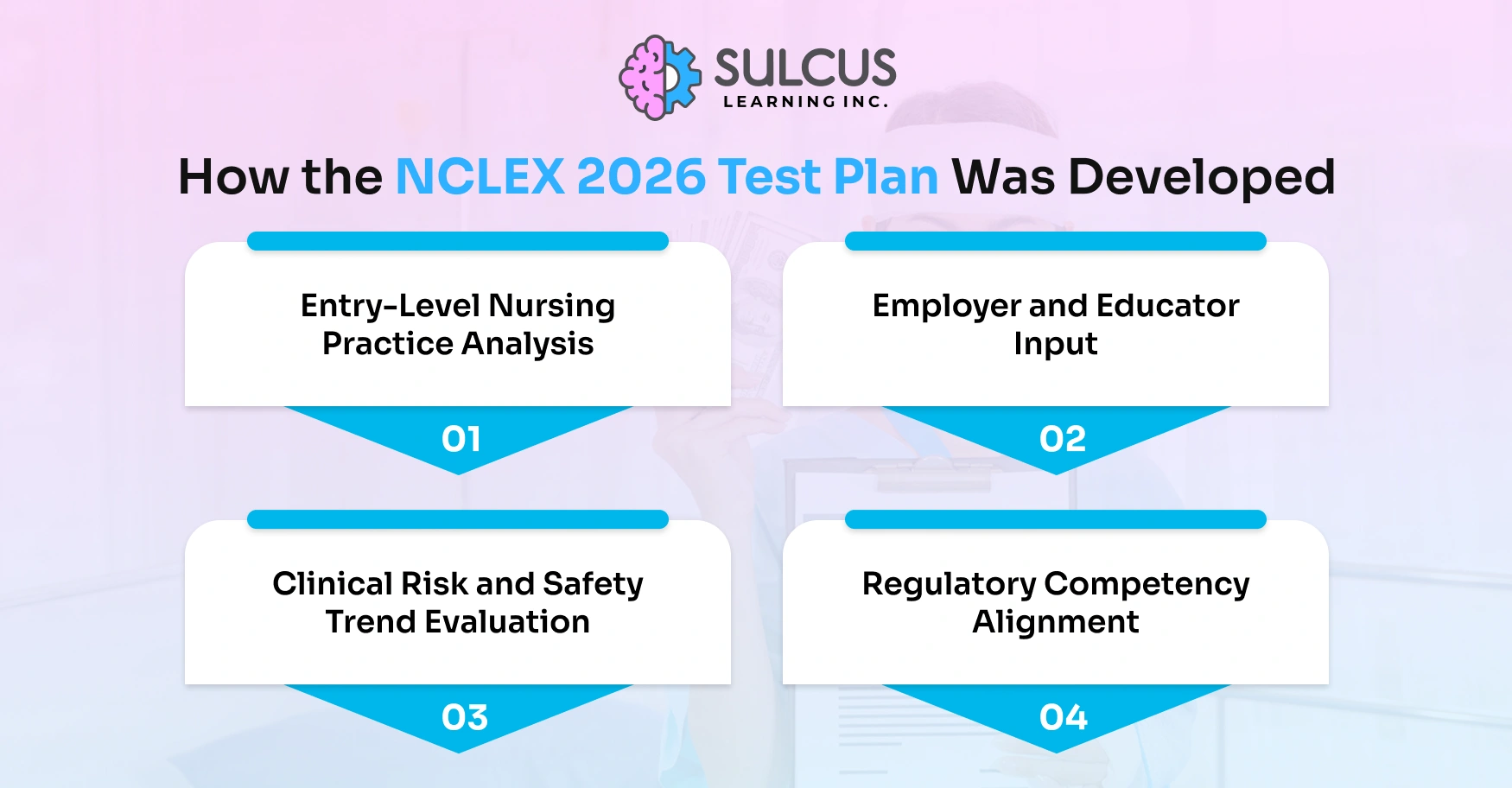
The development process includes several key components:
- Entry-Level Nursing Practice Analysis: The practice of newly licensed nurses in the United States and Canada is well documented. It outlines the most common tasks, roles, and clinical decisions made at the entry-to-practice stage.
- Employer and Educator Input: The expectations of employers in the healthcare system and of nursing educators in classroom/research/clinical settings are reflected in their feedback on the preparation of novice nurses.
- Clinical Risk and Safety Trend Evaluation: The exam’s target areas are analyzed to ensure that patient outcomes and public protection are prioritized, based on the analysis of clinical risks and safety.
- Regulatory Competency Alignment: The NCLEX test plan provides a methodology to ensure that all examiners measure the Competencies of nursing practice, specifically safe, ethical, and accountable nursing practice.
Since all the NCLEX 2026 updates are based solely on practical data, not theoretical constructs, the NCLEX remains a profession-led, evidence-based assessment. This method-structured approach allows NCLEX to maintain credibility among stakeholders as a reliable indicator of entry-level readiness.
What is Changing in the NCLEX 2026?
The NCLEX 2026 updates, introduced by the National Council of State Boards of Nursing (NCSBN) and effective April 1, 2026, focus on refining the assessment of entry-level nursing competence. The changes are intentional and focused on practice to ensure the test remains relevant to the current healthcare landscape.
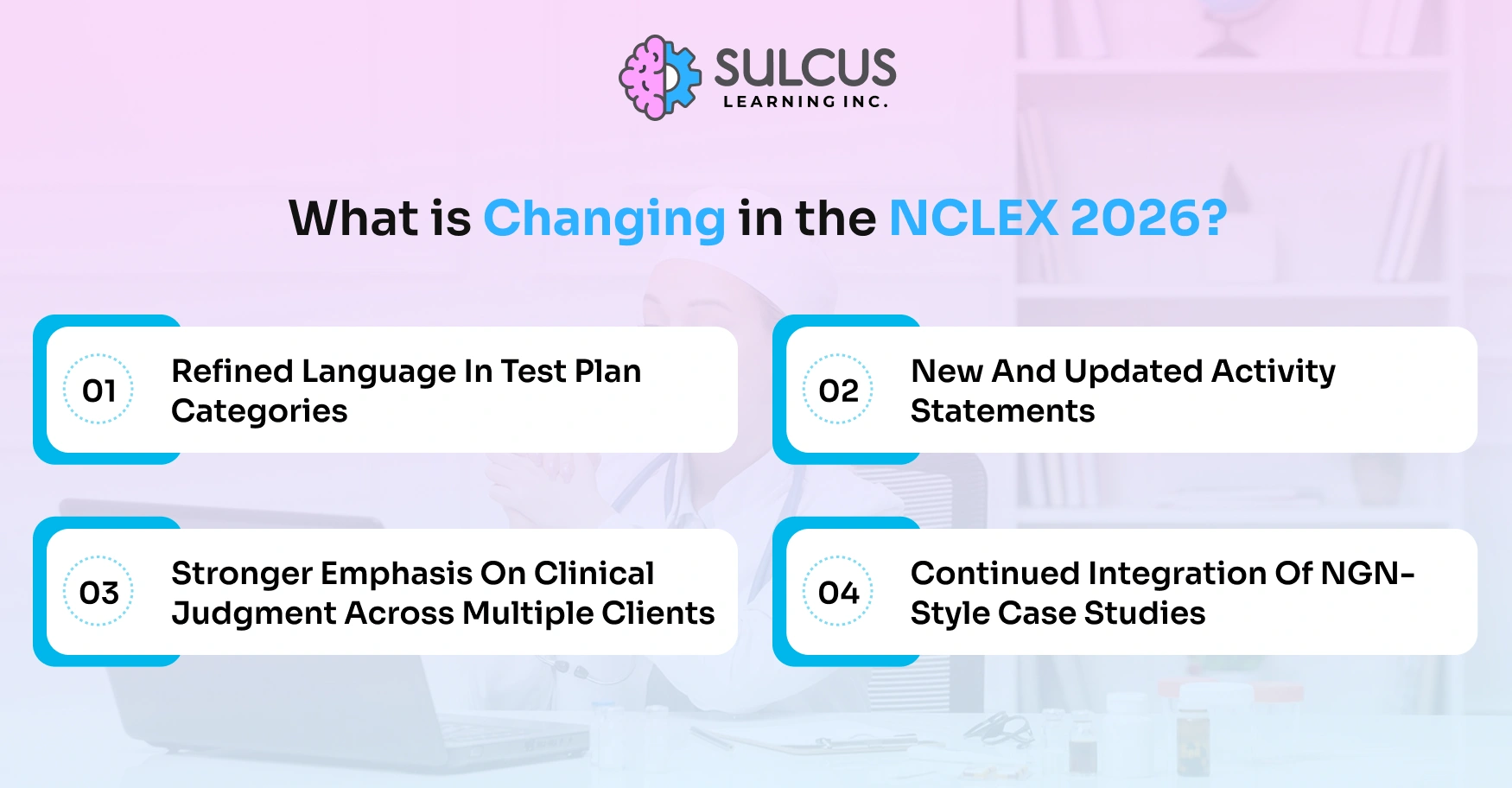
1. Refined Language in Test Plan Categories
Some titles for test plan categories and subcategories have been updated in the 2026 NCLEX plan to better align with current expectations for nursing.
- An example includes the category titled “Safety and Infection Control,” which has been updated to “Safety and Infection Prevention and Control,” to encourage a more positive, proactive approach to control infections and safety.
- Another example includes the category formerly known as Substance Abuse, which has also been updated to the more neutral and contemporary category “Substance Misuse”.
These changes above are purely terminological and do not affect the content being tested.
2. New and Updated Activity Statements
The statements that accompany the activities in the 2026 NCLEX test plan have been revised to more clearly define professional expectations rather than further define the scope of practice.
Key emphasis areas include:
- Unbiased and equitable nursing care, ensuring equal access to care regardless of background or identity
- Safe and responsible use of social media, as well as the dignity, privacy, and confidentiality of clients.
- Real acute care responsibilities, including the management of external monitoring devices, such as intracranial pressure monitoring devices.
The 2026 update will affect how candidates make judgments, not what candidates are required to learn and memorize.
3. Stronger Emphasis on Clinical Judgment Across Multiple Clients
Clinical judgment has always been central to the NCLEX, but the 2026 focus reflects a deeper expectation: nurses must think beyond isolated scenarios and manage complex, competing demands in real time.
Modern entry-level practice rarely involves caring for one stable client at a time. Instead, newly licensed nurses are expected to simultaneously:
- Prioritize care among multiple clients with varying acuity levels
- Determine appropriate delegation to assistive personnel
- Recognize when to escalate concerns to providers or rapid response teams
- Reassess and adjust plans based on evolving patient outcomes
The exam increasingly reflects this reality.
4. Continued Integration of NGN-Style Case Studies
The Next Generation NCLEX (NGN) question types will not change. However, they will be used more broadly across the test.
Candidates can expect:
- More unfolding case studies
- Scenarios involving up to four clients
- Questions spanning the clinical, interventional, and evaluative decision-making cycle.
The goal is to assess decision-making that is competent, safe, and not speed and recall.
What These Changes Mean for Candidates
The NCLEX 2026 changes do not make the exam harder. Instead, they refine expectations and ensure alignment with real-world nursing practice, patient safety, and professional accountability. Candidates preparing with updated, exam-aligned resources can approach the 2026 NCLEX with confidence and clarity.
What Doesn’t Change (So You Can Stay Calm)
The NCLEX 2026 Test Plan has only made minor refinements. You can expect the same test blueprint to be used. According to the NCSBN, this applies across the primary NCLEX types, including NCLEX-RN and NCLEX-PN, both of which continue to assess entry-level competency through computerized adaptive testing. This means that candidates can prepare for their exam and approach it with confidence.
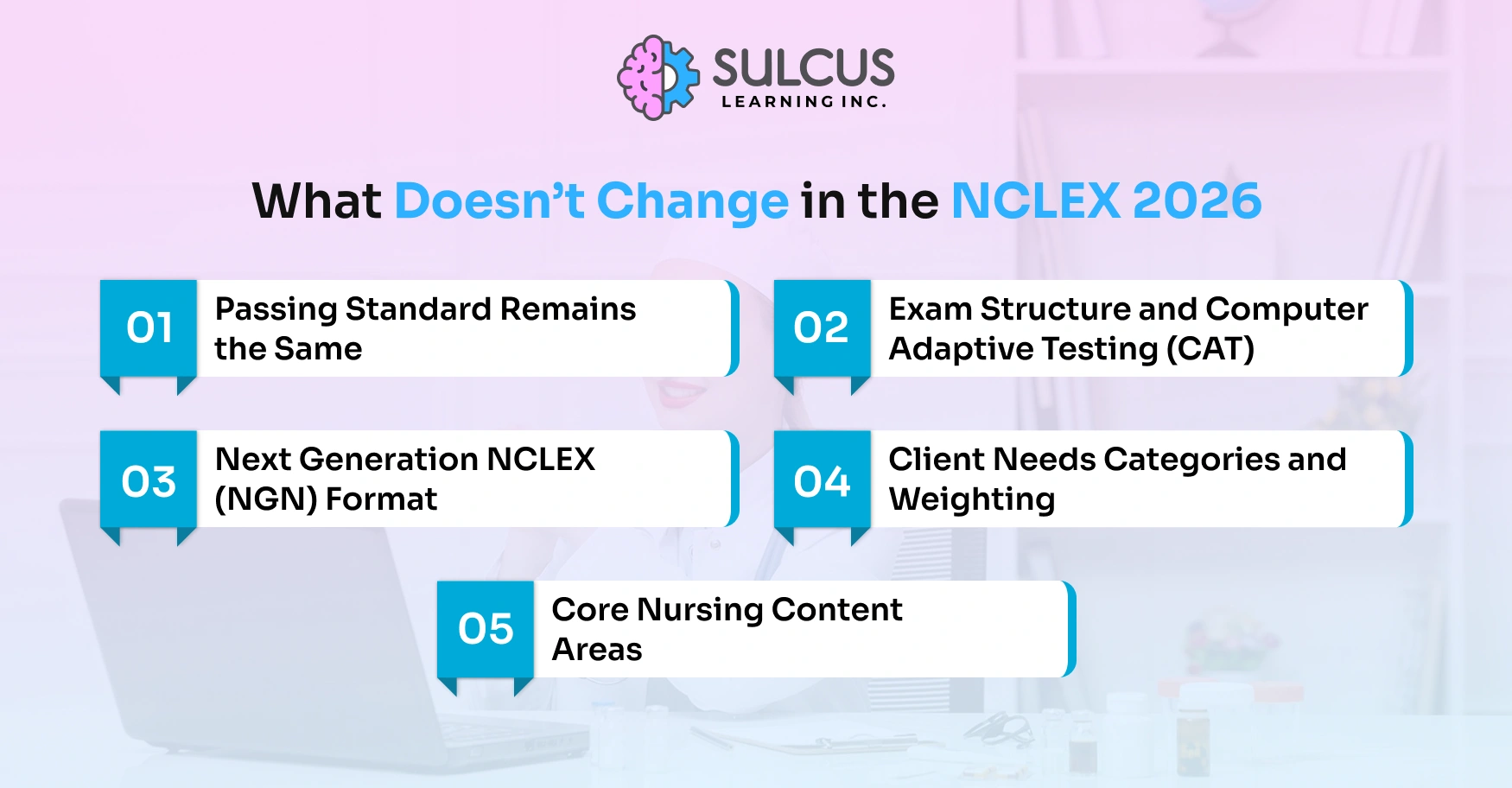
1. Passing Standard Remains the Same
As stated earlier, the NCLEX passing standard has not changed in 2026. Candidates continue to be assessed on their ability to demonstrate the minimum level of competency required to practice nursing safely in entry-level practice. This means the exam questions will not become more or less difficult.
2. Exam Structure and Computer Adaptive Testing (CAT)
The NCLEX will continue to use Computer Adaptive Testing (CAT), which adjusts question difficulty based on a candidate’s responses.
Key structural elements remain unchanged:
- Variable-length exam format
- Adaptive question delivery
- The same minimum and maximum number of questions will be enforced
3. Next Generation NCLEX (NGN) Format
The NCLEX Next Generation (NGN) framework will remain the same.
This includes:
- Case-based question sets
- Scenarios that are based on clinical judgment
- NGN question types such as matrix/grid, multiple response, and fill-in-the-blank
There will be no new-format questions in 2026.
4. Client Needs Categories and Weighting
All Client Needs categories and their percentage distributions are consistent with prior test plans.
This includes:
- Management of Care
- Safety and Infection Prevention and Control
- Health Promotion and Maintenance
- Psychosocial Integrity
- Basic Care and Comfort
- Pharmacological and Parenteral Therapies
- Reduction of Risk Potential
- Physiological Adaptation
5. Core Nursing Content Areas
There is no change to the fundamental nursing content assessed on the NCLEX.
Candidates will continue to be assessed on:
- Medical-surgical nursing
- Pharmacology
- Mental health nursing
- Obstetrics
- Pediatrics
No new subject areas or specialty disciplines have been included.
What This Means for Candidates
The NCLEX 2026 is an evolution, not a redesign. Candidates will not have to start learning nursing all over again or redesign their study approach. With exam-aligned preparation centered on clinical judgment and NGN-style questioning, the NCLEX in 2026 will be familiar, predictable, and equitable.
Key Focus Areas to Prioritize in 2026 Preparation
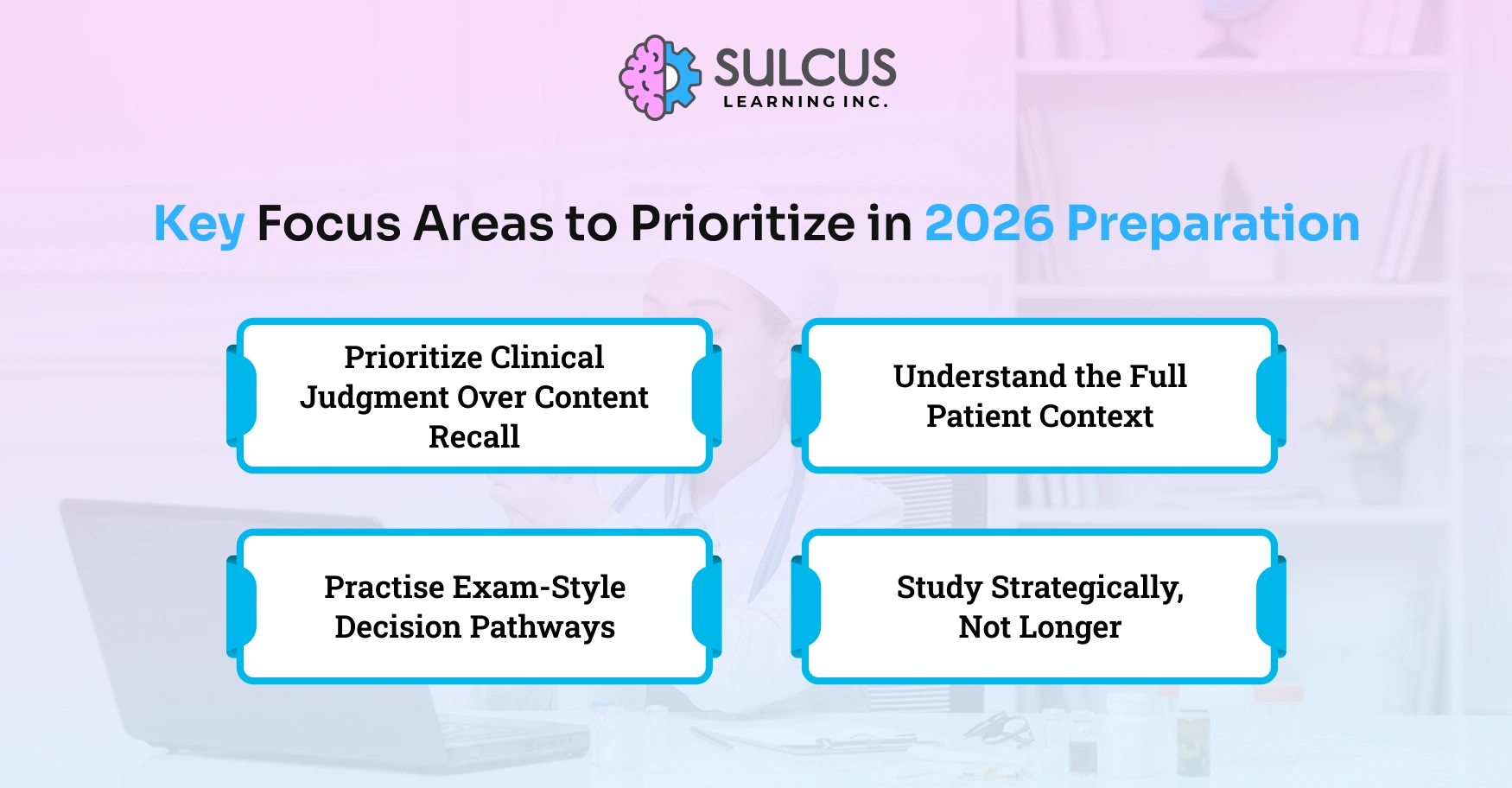
The NCLEX 2026 updates are changing how competence is measured. Effective preparation is about studying less and applying strategies. Candidates most likely to pass will focus their efforts on clinical judgement, as it will be evaluated most heavily.
1. Prioritize Clinical Judgment Over Content Recall
The new NCLEX will focus primarily on how clinical knowledge is applied in practice. Rather than studying for the exam and learning isolated facts, understanding the rationale for clinical decision making in practice as safe, appropriate, and timely will be critical.
2. Understand the Full Patient Context
The exam is moving toward multi-layered questions. Examinees will need to consider the patient as a whole and evaluate the patient’s history, risks, and changing states, and respond to questions about a single symptom in isolation.
3. Practise Exam-Style Decision Pathways
Prepare to recognize the exam techniques and NCNG case studies. Practise exam style decision pathways to evaluate the patient and to construct the path towards prioritizing care, implementing the desired pathway, and evaluating the outcome.
4. Study Strategically, Not Longer
Exam-aligned practice is essential for the 2026 NCLEX exam. Focused exam preparation will enhance your confidence and help you use your time more efficiently, reducing your day-to-day challenges.
Updated Study Tips for NCLEX Changes 2026
Preparing for the NCLEX changes 2026 requires a shift from high-volume memorization to exam-aligned clinical reasoning. With ongoing changes to the integration of Next Generation NCLEX (NGN) questions, candidates are expected to shift their focus from which answer is correct to how decisions are made.
1. Choose Case-Based Practice Over Question Volume
Emerging evidence suggests that, from 2026 onward, NCLEX exam success depends on how well one processes rolling clinical scenarios. Therefore, scaffolding your study materials with case-based practice questions that mirror the NGN style will test your ability to practice critical thinking, as well as prioritization, delegation, and outcome evaluation, in the context of multiple clients. This kind of practice will help you become exam-ready rather than exam-familiar.
2. Review Rationales and Clinical Outcomes
Each practice question should be viewed as an opportunity to practice and improve your clinical judgment. This will not come to fruition, however, if you do not take the time to read the reasoning, understand the clinical rationale, and understand why an answer is considered unsafe, inappropriate, or less appropriate. Outcomes play a critical role in clinical judgment, as it embodies a pattern of decision-making.
3. Track Readiness, Timing, and Decision Accuracy
Current NCLEX preparation requires data. Platforms like Sulcus Learning support preparation for the 2026 exams by tracking readiness levels, decision accuracy, and timing, key indicators of success on the CAT and NGN exams.
Study Smarter, Not Longer
The NCLEX 2026 framework values repetition as little as possible and instead, values properly structured clinical judgement, adaptive thinking, and strategic preparation. Success is not measured by the hours spent studying. It depends on the quality and type of study conducted. This is the shift for which Sulcus Learning was created.
Its AI-integrated adaptive system, along with logit-based scoring and state-of-the-art computerized adaptive testing, provides a new dimension to studying. To put this in perspective, the questions get easier based on ability, performance consistency, reasoning accuracy, and time efficiency. It simulates a realistic exam progression rather than delivering questions at random, which makes it the best nursing prep platform.
Along with this, Sulcus Learning also offers competency-driven case studies, multi-client prioritization simulations, adaptive mock exams, and full-length ones to help replicate pacing, decision fatigue, and performance thresholds. Students get evolving ability estimates, readiness indicators, and a breakdown of client needs. Raw scores are not merely transformed; they are literally redeveloped into measurable readiness trajectories. This structured, exam-aligned approach does more than provide practice, it systematically prepares students to confidently pass the NCLEX exam under modern 2026 testing standards.
Conclusion
The NCLEX 2026 updates are not a barrier to licensure. It’s an entrance to safe and competent nursing practice. Its emphasis on clinical judgment, patient safety, and real-world decision-making is what nurses are expected to do in the current healthcare environment. Not the abstract academic theory.
The candidates who prepare for the 2026 updates will have clarity, confidence, and control in their study approach. With exam-aligned NGN-style reasoning and strategies, test-takers will have the confidence to take the exam as nurses, not students, because they have the right tools to succeed.
FAQ’s
Q1. Does the NCLEX passing score change in 2026?
Ans. No. The NCLEX-PN and NCLEX-RN passing scores established by the National Council of State Boards of Nursing (NCSBN) remain the same. Scoring continues under a computerized adaptive testing model that determines whether candidates demonstrate consistent minimum safe-practice competency.
Q2. Do I need to completely change how I study for NCLEX 2026?
Ans. Not entirely, but preparation should prioritize clinical judgment, multi-client prioritization, delegation reasoning, and a deep review of rationale. Memorization alone is insufficient. Structured, exam-aligned practice under adaptive and timed conditions better reflects real testing expectations.
Q3. Are NGN questions mandatory in the NCLEX 2026?
Ans. Yes. NGN-style questions are fully embedded within the exam structure. They assess cue recognition, prioritization, solution generation, and outcome evaluation. Clinical reasoning is central to licensure determination and cannot be bypassed by memorization.
Q4. Does NCLEX 2026 introduce new nursing content areas?
Ans. No new content categories are added. Core subjects such as medical-surgical nursing, pharmacology, mental health, pediatrics, maternal-newborn care, and leadership remain consistent. The difference lies in integrated case-based reasoning rather than isolated factual recall.
Q5. Is the NCLEX 2026 different for Canadian or internationally educated nurses?
Ans. The structure remains the same for all candidates. However, internationally educated nurses may need additional familiarity with North American delegation standards, scope-of-practice boundaries, interprofessional communication models, and prioritization frameworks used in Canadian and U.S. healthcare systems.
Q6. Can I take the NCLEX at home in 2026?
Ans. No. The NCLEX continues to be administered in secure, in-person testing centers. Remote testing is not currently available due to strict standards for exam security, integrity, and fairness required for licensure examinations.
Q7. What is the smartest way to prepare for the NCLEX 2026?
Ans. Preparation should include blueprint-aligned question banks, adaptive difficulty progression, multi-patient case simulations, and timed full-length mock exams. Platforms like Sulcus Learning integrate AI-driven adaptive modeling and ability tracking to mirror modern licensure expectations.
Q8. What is the difference between the NCLEX-RN vs NCLEX-PN in 2026?
Ans. When comparing NCLEX-RN vs NCLEX-PN, both exams follow the same computerized adaptive testing (CAT) model and include Next Generation NCLEX (NGN) question styles. However, the NCLEX-RN focuses on broader clinical decision-making, leadership, and complex care coordination, while the NCLEX-PN emphasizes foundational nursing care and supervision within scope. The difference reflects entry-level role expectations, not exam difficulty.

Taran Kaur
As Managing Director and Lead Instructor at Sulcus Learning, Taran helps internationally educated nurses navigate their professional journey with clarity and confidence. With qualifications including a B.Sc. (Nursing), MBA (HM), ENCC, and CMSN(C), she focuses on helping learners succeed in licensure exams and professional practice. Connect with Taran Kaur on LinkedIn.