

One of the most common questions nursing graduates ask, especially among Canadian-educated nurses preparing for the RN licensure exam and learning how to become a nurse, is What is the NCLEX-RN passing score?
Yet the answer is often misunderstood, oversimplified, or explained incorrectly across blogs and forums. Unlike traditional exams, NCLEX-RN scores are not in percentages nor in raw numbers, nor are they calculable by the number of correct answers one achieves on the exam.
In this guide, we will break down the NCLEX-RN passing score in 2026, the fundamentals of score determination, and the components of passing and failing, using clear explanations, common-sense approaches, and logical exam strategies.
What Is the NCLEX-RN Passing Score?
What does the NCLEX-RN passing score entail if not a certain number of correct answers? It means the examinee has demonstrated a minimum competence level in one or more areas defined by the National Council of State Boards of Nursing (NCSBN) for the exam in question.
In essence, the exam primarily evaluates one’s clinical decision-making. It is not concerned, for example, with merely memorizing a body of content. Every question helps the system to estimate whether one’s clinical decision-making ability is above or below the passing standard.
This is why:
- Two candidates may answer different numbers of questions.
- Both can pass or fail.
- Without ever seeing a numerical score.
What Is the Passing Score for NCLEX RN 2026?
Numerous prospective nurses pose the question, “What is the passing score for NCLEX-RN 2026?”
Most candidates are surprised to learn that NCLEX-RN results are neither expressed as a percentage, raw score, nor fixed passing score, as the NCSBN’s evaluation system, in all likelihood, is establishing a new passing score system for the 2026 test, but it will remain in effect until formally amended by the NCSBN.
Also, the passing standard is updated periodically to reflect the standards discussed in CPNRE vs NCLEX regarding “safest” and “most entry-level” nursing registered competencies, and does not concern itself with the test-maker’s grade or even a classroom grade.
How the NCLEX-RN Determines Pass or Fail
The NCLEX-RN employs Computerized Adaptive Testing (CAT), which means:
- The test adapts in real time to the candidates skill level.
- New questions are chosen based on the candidates past answers.
- As the exam progresses, the system builds confidence in the candidates’ nursing knowledge.
- Candidates will receive a different number of questions and difficulty levels.
Logit Measurement and the Passing Standard
There is a logit based system the NCLEX-RN follows that most candidates do not know about:
- Each candidate’s nursing skill is estimated on a logit scale.
- The NCSBN has a national standard (cut score) on the logit scale.
- The system checks a candidate’s estimated skill against the national standard.
A candidate is considered to have passed if the system is statistically confident that the candidate’s ability exceeds the cut score, and they have failed if their ability is below the cut score. Candidates do not receive scores, and logit values are not provided.
What This Means for Candidates
- The result from an NCLEX-RN examination shows an individual’s preparedness for safe practice as an entry-level Licensed Practical Nurse vs Registered Nurse.
- The same test date passing standard will apply for all tests taken in 2026.
- The exam adapts to the candidate’s ability, not the other way around.
- Two candidates can answer differently in quantity, and yet they may both end up either passing or failing.
Because the NCLEX-RN uses an adaptive, logit-based system, the passing score is not publicly available. When an outside source provides a number, percentage, or “minimum score,” they are oversimplifying or misrepresenting the exam’s design.
Key Takeaway
The NCLEX-RN isn’t a test where you chase score thresholds. It is designed to assess if an individual can consistently show clinical judgment, and safe nursing practice, and make decisions at or above the national standard. Good preparation is defined by the quality and depth of your thinking rather than the amount of correct answers you get.
NCLEX-RN Exam Passing Score vs Traditional Exams
Traditional exams measure success by the percentage of correct answers, while the NCLEX-RN evaluates clinical ability using an adaptive model. This difference, often seen across various types of nursing exam, explains why NCLEX scoring often feels confusing to candidates.
| Traditional Exams | NCLEX-RN Exam |
|---|---|
| Fixed number of questions | Variable-length exam |
| Percentage-based scoring | Ability-based scoring |
| Same difficulty for all candidates | Adaptive difficulty based on responses |
| Focus on memorization | Focus on clinical judgment |
| Measures knowledge recall | Measures safe nursing practice |
Because of this structure, searching for a numerical passing score for the NCLEX-RN exam is confusing.
How the NCLEX-RN Passing Score Is Calculated
The NCLEX-RN employs Computer Adaptive Testing (CAT) to assess your nursing skills in real time. Instead of counting correct answers, the exam focuses on how well you handle questions at different difficulty levels.
How CAT Works
- You begin with a question of Medium Difficulty.
- Based on your answer, the system adjusts the difficulty of the next question.
- You will be given a more difficult question if you answer correctly, and a more straightforward question if you answer incorrectly.
- After each question, your ability level is recalibrated.
How the Exam Decides Pass or Fail
The test will stop when the system has enough data to support one of the following conclusions:
- Your ability is above the passing standard (pass)
- Your ability is below the passing standard (fail)
This is how the NCLEX-RN test is designed to assess your skills and nothing more. The score given is not an average or a summary; it indicates your ability.
NCLEX-RN Passing Rules Explained
The NCLEX-RN does not use a fixed score or percentage to determine whether candidates pass or fail. Instead, it uses three official decision rules built into the Computerized Adaptive Testing (CAT) system. Each rule assesses whether or not a candidate meets the national passing standards set by the National Council of State Boards of Nursing.
The rules are built into the program and work in conjunction to produce a statistically robust outcome: either a pass or a fail.
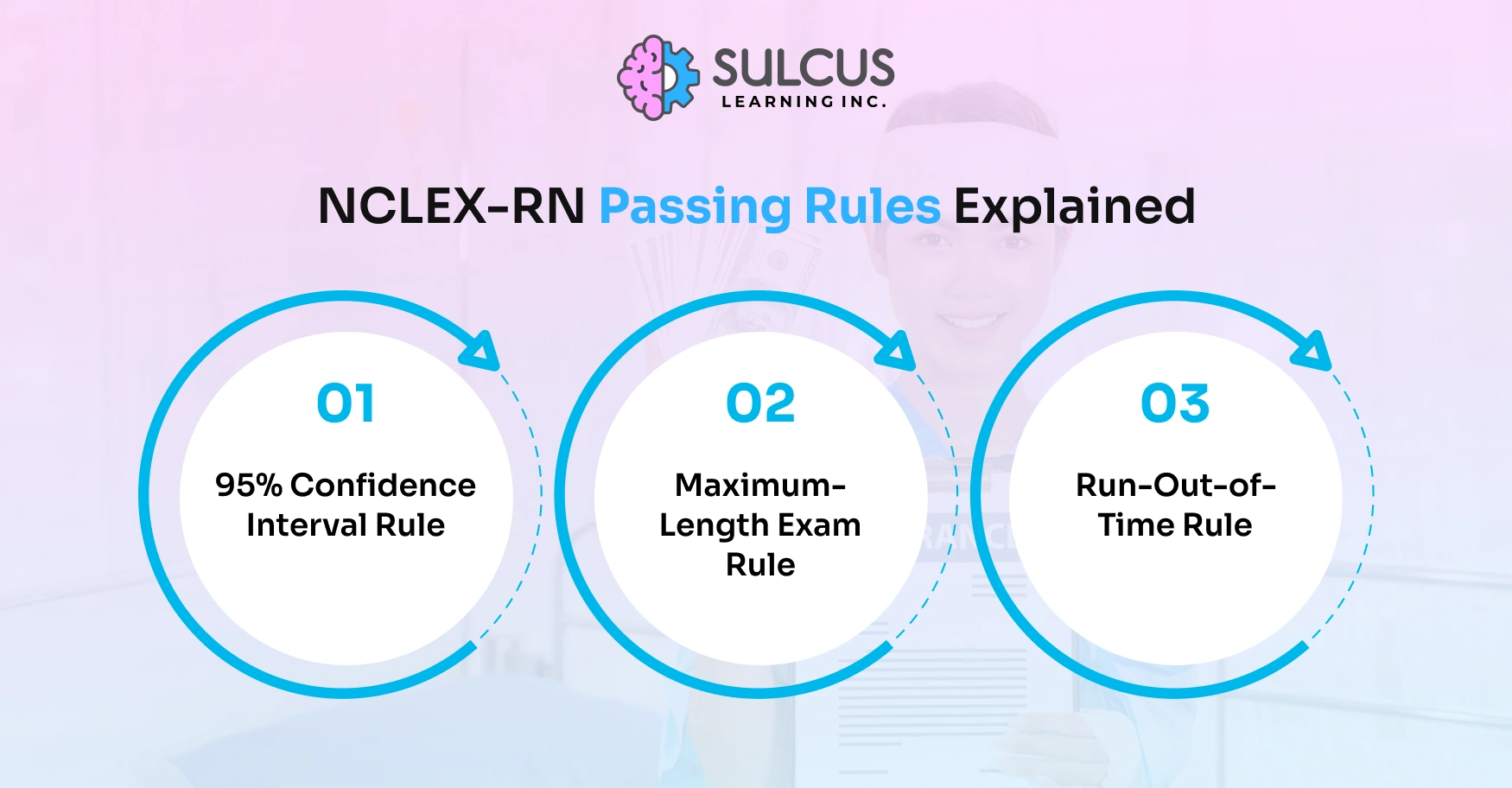
1. 95% Confidence Interval Rule
This is the most widely used rule, in which the exam ends when the testing system reaches 95% confidence in the candidate’s nursing ability, either above or below the passing standard. At this point, no further questions are needed. In layman’s terms, the exam stops when the system is confident enough to provide a pass or fail outcome.
2. Maximum-Length Exam Rule
In the case where the exam reaches the cap on the amount of questions and still does not get to 95% confidence, the exam ends. At this point, the system analyzes the candidate’s final estimated ability level with respect to the passing standard, and from there, a result is determined. Getting to the maximum number of questions does not result in failure, in fact, under this rule, many candidates pass.
3. Run-Out-of-Time Rule
If time runs out before a decision is made under the first two rules, the exam ends due to time constraints. The system then looks at the candidate’s most recent estimates of abilities, and the scoring criteria that have been pre-established to assess if the candidate was able to meet the passing standard. It is important to note that running out of time is not a failure; being consistent in performance at the end of the exam is crucial.
Why These Rules Matter
Understanding this is far more important than:
- How many items did you attempt?
- Whether you thought questions were “easy” or “hard”.
- How do you feel your performance compares to that of other people?
Every candidate has a unique testing experience. Although the exam experience is tailored to the candidate’s unique performance, the passing standard is the same for all: the NCLEX-RN.
Passing Score NCLEX-RN Exam: Common Myths vs Facts
There are many misunderstandings and confusion surrounding the NCLEX RN exam, which can be attributed to non-standardized testing conventions and expectations. Knowing what is worthwhile can reduce stress and help candidates prepare more effectively.
Common Myths vs Facts
- Myth: More questions mean you’re failing
- Fact: Question count has no direct link to outcome
- Myth: Easy questions mean failure
- Fact: Difficulty fluctuates naturally in CAT exams
- Myth: You must reach a certain percentage
- Fact: Percentages are irrelevant to the NCLEX-RN
The NCLEX-RN test score reflects clinical judgment and decision-making, showing consistent ability, not perfection, not total correct answers.
What Is the Passing Score for NCLEX-RN According to NGN?
The Next Generation NCLEX (NGN) did not alter the NCLEX-RN passing standard; it only modified how the candidate’s clinical judgment is assessed during the exam.
What NGN Introduces
- Question sets that are case-based and that include questions about actual clinical situations.
- Scoring that includes partial credit to recognize and reward positive steps in clinical decision-making.
- Increased focus on clinical reasoning rather than knowledge recall.
What Remains the Same
The NCLEX-RN passing score is still calculated using the same ability thresholds. Candidates are assessed on how they think about and process patient care, not how many facts they can recall.
How to Know If You’re Performing Above the NCLEX-RN Passing Standard
There are many dimensions to NCLEX-RN readiness, and the most reliable indicators are consistent performance levels rather than a specific score. Performing well on Computer-Adaptive Tests (CAT) is one of the best indicators. These types of assessments adapt their level of difficulty to your responses, just like the actual exam will.
Another significant dimension is the ability to confidently and accurately answer a range of questions rated medium to high in difficulty. Consistent, strong performance on NGN case studies is a strong indicator of the candidate’s clinical judgment and decision-making.
Most importantly, improvement trends over time, not singular scores, gauge readiness. This is where many examinees struggle with a dyadic overemphasis on a number rather than a more robust, meaningful, and qualitative demonstration of ability growth toward readiness to sit the exam.
How Sulcus Learning Helps You Stay Above the NCLEX-RN Passing Score
Studying for the NCLEX-RN is based on measurable outcomes, not guesswork. Your end goal should not be to achieve a specific score. Instead, focus on demonstrating nursing proficiency above the national average on the test.
Sulcus Learning focuses on how the NCLEX-RN is scored, not on how traditional examinations are scored. The platform is designed on the principles of Computerized Adaptive Testing (CAT) and the Next Generation NCLEX (NGN) frameworks. This means candidates will be practicing the same types of decision-making processes they will be faced with on the actual test.
As a best nursing exam prep platform, Sulcus Learning supports NCLEX-RN readiness through:
- Practice questions infused with NGN principles focusing on clinical judgement, prioritization, and safe nursing decision-making.
- CAT simulations and practice tests that mimic the NCLEX-RN experience by adjusting the level of difficulty based on the students’ responses to prior questions.
- Indicators of exam readiness that break out performance metrics based on concrete results versus subjective prop confidence.
- Detailed explanations about why a specific answer is passing level and others are not.
- Outstanding analytics that explain what is and is not working, and where additional effort is needed to create improvement.
Instead of relying on guesswork, answer counts, or self-appraisal of difficulty, students receive constructive feedback based on NCLEX-RN scoring principles. Thus, improving clinical judgement, and giving students a better understanding of exam readiness.
Sulcus Learning makes preparation organized, structured, and aligned with the data and exam, which helps candidates approach the exam day with confidence and clarity instead of uncertainty.

Conclusion
The NCLEX-RN passing score set for 2026 is a standard, not a number to chase. It demonstrates consistent clinical judgment. Sulcus Learning explains how to reduce exam anxiety by understanding NCLEX scoring.
It streamlines focused preparation. Instead of attempting to quantify the absolute number of questions or outcomes, candidates can refocus their efforts on developing practical nursing skills.
This includes developing decision-making skills, the ability to adjudicate in complex situations, and the self-assurance to navigate adaptive test environments successfully.
When success is based on performance rather than the number of questions, NCLEX-RN success is more likely.
FAQ’s
Q1. What is the passing score for NCLEX-RN 2026?
Ans. There is no fixed numerical score. The NCLEX-RN passing score in 2026 is based on demonstrating nursing ability above the national competency standard set by the NCSBN.
Q2. Is the NCLEX-RN passing score changing in 2026?
Ans. No. The NCLEX-RN passing score remains unchanged in 2026. The exam continues using an ability-based standard, though question formats and evaluation methods evolve.
Q3. What is the NCLEX-RN exam passing score measured on?
Ans. The NCLEX-RN exam passing score is determined by clinical judgment, not by percentages or total correct answers, and uses Computer Adaptive Testing to assess entry-level RN competence.
Q4. Can you pass the NCLEX-RN with a minimum questions?
Ans. Yes. Candidates can pass with the minimum number of questions (85) if the system determines early that their ability is consistently above the NCLEX-RN passing standard.
Q5. Can you pass the NCLEX-RN with the maximum number of questions?
Ans. Yes. Reaching the maximum number of questions (150) does not mean failure. The final ability estimate determines whether you meet the NCLEX-RN score required to pass.
Q6. Does NGN change the NCLEX-RN passing score?
Ans. No. Next Generation NCLEX does not change the passing score. It enhances the evaluation of clinical judgment through case-based questions and partial-credit scoring.
Q7. How do I know if I’m above the NCLEX-RN passing standard?
Ans. Consistent performance on CAT-style practice exams, strong NGN case responses, and stable clinical decision-making trends indicate you’re performing above the NCLEX-RN passing standard.

Harry Sagar
Passionate and detail-oriented leader at Sulcus Learning, dedicated to supporting internationally educated nurses in achieving their professional goals. With experience as a general practitioner, smoking cessation consultant, and licensed practical nurse, I combine clinical expertise with mentorship. Guided by the philosophy, “Your Success is Our Ambition,” I help nurses gain confidence, competence, and career-ready success.