
After guiding many nursing students through this process, I frequently get asked, “My NCLEX shut off at 85 questions, did I pass or fail?”
It’s an understandably terrifying situation. The exam ends, the screen turns blank, and the uncertainty kicks in. Many test takers tend to think that the NCLEX shutting off at 85 questions means they did well or poorly. It can be a complicated situation.
The NCLEX does not assess candidates based on the number of questions they answer. Rather the exam uses Computerized Adaptive Testing (CAT) to evaluate whether a candidate’s skill level meets the requirements to safely begin nursing practice. The exam continually adjusts the questions, and the test taker’s performance is calculated as the questions are answered to determine whether the candidate is above or below the passing standard.
Because of this adaptive testing structure, candidates may have their exam stopped at the 85-question minimum. In other cases, candidates may have their exams stop at a much higher question number. In both situations, the exam attempts to test the same goal. The test is designed to determine whether the candidate possesses the clinical and decision-making skills of a nurse.
Understanding what happens when the NCLEX exam shuts off at 85 questions begins with What is the NCLEX exam and how does the NCLEX exam adaptive testing system evaluate each answer given during the exam?
This guide will provide an explanation for why the NCLEX exam shuts off at 85 questions, what the CAT system is that will evaluate the NCLEX exam and what each candidate should interpret from this, given that they have completed the exam.
Key Takeaways
- The NCLEX shutting off at 85 questions can mean either a candidate passes or fails, as it is just an indication of the testing system requesting a statistical confidence level for a candidate being at a certain ability level.
- The NCLEX exam is a Computer Adaptive Testing (CAT) exam and is designed to calculate and predict your level of ability against the passing standard, based on how many questions you answered correctly.
- The exam can end early under the 95% Confidence rule, which means the system is statistically confident that you will surpass or fail to meet the required level of competence.
- Passing at 85 questions and failing at 85 is common on the exam, but the final result is based on the candidate’s overall performance, not the number of questions answered.
- The Next Generation NCLEX exam (NGN) promotes the use and understanding of clinical judgement for the examination, as candidates will be required to evaluate, prioritize and rationalize the relevant nursing practice in the scenario at hand.
- The clinical case studies of the NGN exam have the ability to evaluate and make substantial changes or adjustments to your estimated level of ability, as the scenario is designed with multiple requests in clinical reasoning.
- The Candidate Performance Report (CPR) will outline and help candidates plan focused studies in areas for improvement or strengths, as it will determine and guide which areas should be concentrated on in the next attempts.
- The most effective way to prepare for an exam is to focus on clinical judgment and adaptive practice questions. It is also important to practice exam simulations rather than trying to complete the exam within a certain number of questions.
Understanding Why the NCLEX Stops at 85 Questions
Candidates are left wondering whether the exam is good or bad when it ends with fewer questions than expected. This is a confusing part of the exam, especially on the NCLEX, which usually shuts off after 85 questions.
To understand why it happens, we’ll need to look at the NCLEX’s purpose. The purpose of the NCLEX is to evaluate a candidate’s level of competence in nursing. The exam uses an adaptive system that analyzes a candidate’s results in real-time. The NCLEX is designed to provide a different experience for each candidate and to adjust the exam length to reflect how quickly it can assess the candidate’s ability level.
The adaptive system used on the NCLEX exam is meant to determine the candidate’s level of competence and ability. The NCLEX exam is designed to stop at 85 questions. This means the system was capable of estimating and measuring the candidate’s ability level against the required passing benchmark.
The computer then considers whether it has enough data to determine your outcome with a high degree of statistical certainty. However, getting to this stage does not mean a candidate has passed or failed. The system may end the exam for one of two reasons:
- Your performance is clearly above the passing standard
- Your performance is clearly below the passing standard
This is why candidates often report different experiences when they finish at the same point. While some people pass the NCLEX-RN exam with 85 questions, others may reach the same number of questions but fail to demonstrate the required level of competency.
In other words, stopping at 85 questions gives the NCLEX enough data to assess your performance against the standard. The questions alone do not determine the result, rather, your demonstrated level of competence in nursing practice throughout the assessment does.
How Computer Adaptive Testing (CAT) Determines When the Exam Ends
The NCLEX employs Computer Adaptive Testing (CAT) to accurately and efficiently gauge candidates’ ability levels. CAT does not use the same exam structure as conventional examinations, which ask the same number of questions to each test taker. Instead, the NCLEX adjusts the difficulty of questions based on the test taker’s prior answers.
Using the current NCLEX testing framework, candidates receive an initial question that is just below the passing standard. From there, the system continues to make adjustments based on each question’s difficulty.
- Answer a question correctly? The next question will be harder.
- Get a question wrong? The following question will be easier.
Because the system can make real-time adjustments, it accurately gauges a test taker’s level of competence. The system continuously compares a candidate’s performance against the passing grade and will end the test once it can make a judgment based on its defined criteria.
There are three ways to define the criteria that a system employs to determine when to end a test.
The 95% Confidence Rule
The 95% Confidence Rule is the most common explanation when a candidate’s test ends early. The testing algorithm reaches a point at which it is 95% sure that a candidate’s level of competency is either above or below the passing standard.
When the computer feels certain enough about your ability level, the test automatically stops. This is why some test takers have their NCLEX shut off at 85 questions. That’s the minimum number of questions at which the computer can make a confident decision.
The Maximum Length Rule
If the computer does not have enough certainty about your ability level after a certain number of questions, the test will continue going up to the maximum number of questions.
The maximum number of questions is:
- 150 for NCLEX-PN (Practical Nurse)
- 150 for NCLEX-RN (Registered Nurse)
When the maximum limit is reached, the computer reassesses your ability level and sends you a pass or fail result. Knowing How Many Questions are on the NCLEX? can help candidates understand how come some tests close quickly and others go on for a long time.
The Run Out of Time Rule
If, at the end of a candidate’s time, the candidate has not completed the required number of questions, the system will evaluate the questions the candidate did answer to determine whether the candidate’s ability level meets the standard. Every candidate’s exam looks different because of the testis structure. While some candidates see the NCLEX shut off after 85 questions, others have to answer many more.
Does the NCLEX Stopping at 85 Mean You Passed?
One of the most common myths about the NCLEX is that if it stops at 85 questions, it is a guaranteed pass. While this may sometimes be the case, it is certainly not a given. An NCLEX exam that stops at 85 questions simply means that the computer evaluation system has collected sufficient data to reach 95% confidence in your level of ability and has determined enough data to make a determination.
That level of confidence could mean:
- Your ability is clearly above the passing standard
- Your ability is clearly below the passing standard
To understand the specific benchmark the test evaluates you against, it is beneficial to look at the NCLEX-RN Passing Score and how the level of competency is determined. Simply put, the most important thing to understand is that 85 questions is the minimum number needed for the test to make a determination.
Can You Fail the NCLEX at 85 Questions?
It is entirely possible to fail the NCLEX exam with only 85 questions. The NCLEX exam is designed so that if a candidate consistently answers questions below the passing standard, the exam will determine that the candidate is unlikely to ever reach the passing standard and will therefore close at the minimum number of questions.
This is why some students report failing the NCLEX exam at 85 questions, while those who pass the exam have the exact same number of questions. If you are studying for the exam, knowing the reasons why candidates fail the NCLEX exam will assist you in steering clear of the mistakes and concentrating your studying on the most important areas.
The Role of Next Generation NCLEX (NGN) Questions
The Next Generation NCLEX (NGN) has changed the candidate assessment of nursing from memorization to clinical judgment and the nurse’s decision-making skills needed in real-world patient care. With the NGN, applicants must evaluate and synthesize data from clinical scenarios and across varying levels of complexity, develop interventions, and prioritize care actions.
For NGN exam takers, being familiar with the NCLEX Changes 2026 is important, as they reflect the growing emphasis on critical thinking and the need to be more patient-centered in care strategies. NGN questions are case-study type and multi-step in nature, assessing the candidate’s ability to solve problems rather than being factually isolated.
How NGN Case Studies Affect Your Ability Estimate
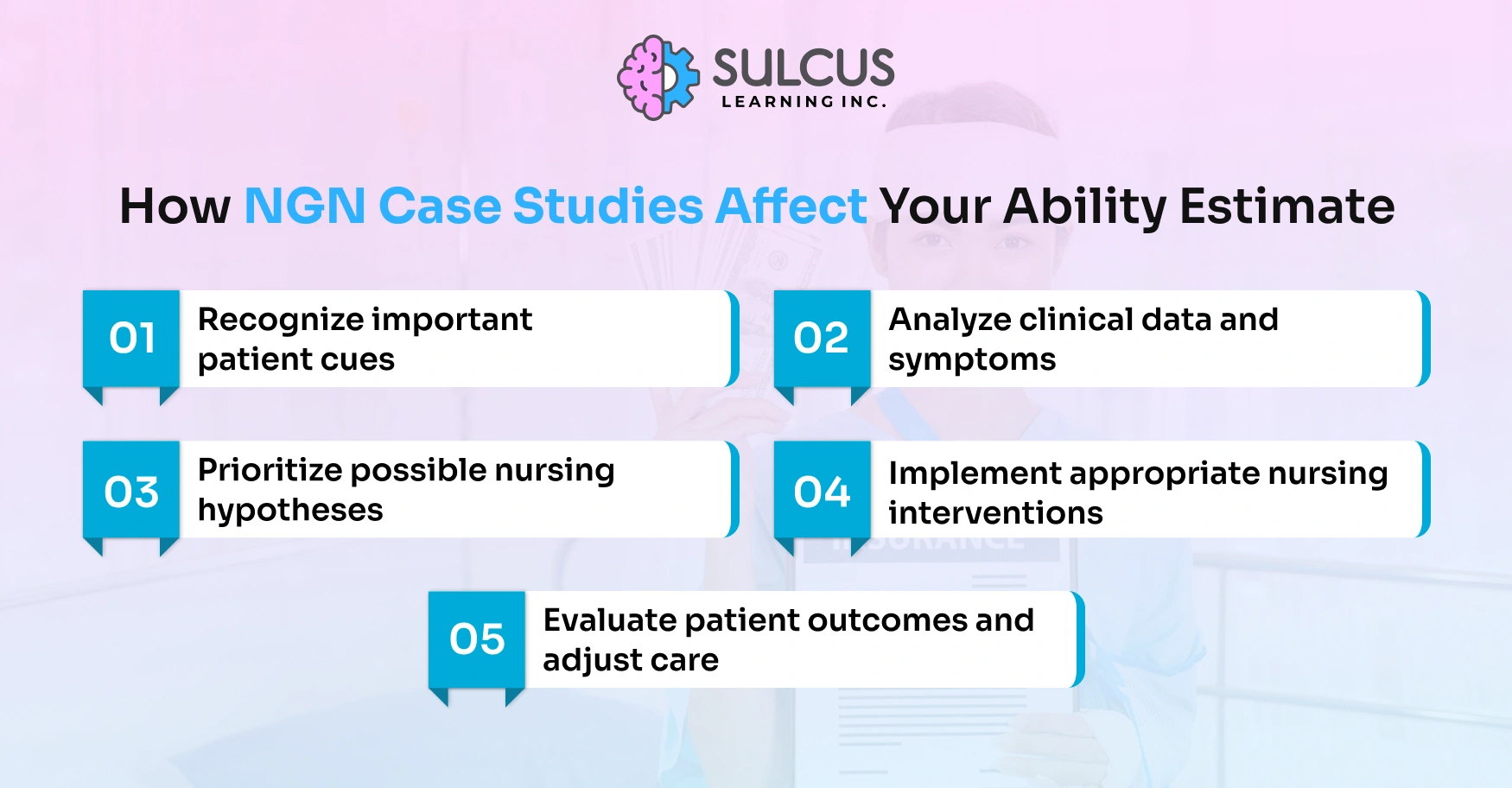
Among the NCLEX question types, NGN case studies have the greatest impact on ability scores because they assess clinical judgment in real-world situations. These types of case studies present detailed patient situations and require multiple decision-making steps.
These items often require candidates to:
- Recognize important patient cues
- Analyze clinical data and symptoms
- Prioritize possible nursing hypotheses
- Implement appropriate nursing interventions
- Evaluate patient outcomes and adjust care
Unlike conventional examinations that measure knowledge in a vacuum, NGN case studies measure clinical reasoning on multiple levels and dimensions using a single scenario. Because of the multiple components of nursing competence that these items measure, your results on these items can greatly affect the system’s determination of your ability level.
If candidates show adequate clinical reasoning on these higher-order thinking items, the system simulations can quickly reach that confidence level. In fact, this can cause the NCLEX to terminate the test after 85 questions because the system has collected sufficient evidence to determine the test taker’s level of competence.
What Happens After Your NCLEX Exam Ends
When a candidate has finished the NCLEX examination, the testing system immediately locks and finalizes the candidate’s ability estimate. This, however, does not mean exam results are ready. Candidates are required to be patient for results that are usually sent by the regulatory body/nursing board or by the Quick Results service (if that service is available for that state).
During the waiting period, candidates attempt to self evaluate to try and figure out if they passed or not, by recalling and reviewing test questions they believe they were asked. This is especially true for examinees who were stopped at 85 questions, since this is the minimum stopping criteria. Some candidates go 24–48 hours without activity and it is said this is meant for self reflection over the test, while others are said to engage in obsessive question recalling. This means it is unlikely to come to a conclusion since the official results are not available.
Overall, regulatory bodies and the Quick Results service are the only avenues for candidates to ultimately determine the outcomes of the NCLEX examination.
Understanding the Candidate Performance Report (CPR)
If a candidate fails the exam, they are issued a Candidate Performance Report (CPR). The CPR explains how far or near a candidate is to the NCLEX integration pass standard, broken into finite details across different sections of the test.
The CPR typically indicates whether your performance in each category was:
- Above the passing standard
- Near the passing standard
- Below the passing standard
The exam categories will be the major areas of nursing practice you must master. CPR is designed to help candidates find where they have knowledge and where they need to improve.
For many test-takers, this report serves as an important resource for deciding how to approach the next test. The report aids in determining how close test-takers are to the benchmark and identifies which content areas require more attention before re-attempts. This will assist test-takers in forming a more focused and efficient study plan.
Managing Anxiety When the NCLEX Stops Early
It is understandable to feel uncomfortable when your exam is shut off early. Many candidates whose NCLEX exam shuts off at 85 questions automatically assume something went wrong or start to blame themselves.
Early stopping means the testing system has made a statistical decision on your ability level relative to the questions, not a definitive yes or no.
It is common to have anxiety about waiting for the official results, and it is common to go through the questions to find the exact things that triggered the early stopping. This anxiety is about uncertainty, and it is also something that can manage to relieve the anxiety and uncertainty.
It is common for candidates to go through questions and to have early stopping at the exam and then pass at the end. The best techniques when dealing with stopping at early questions are:
Some practical ways to cope include:
- Avoid overanalyzing individual questions after the exam
- Resist comparing experiences with other test-takers, since every exam is different
- Focus on resting and resetting while waiting for your results
It’s important to remember that thousands of candidates each year see the NCLEX cut-off at 85 questions, and many ultimately pass the exam.
Why the Number of Questions Does Not Predict Your Result
There is a common yet fundamentally flawed belief that the length of the exam is directly correlated with its performance. This is not the case. This exam is about how quickly the CAT can figure out your level of competency. Some students get a passing score from answering the minimum number of questions, while others must answer all the questions to get a passing score.
Because of this, setting a specific goal of answering around 85 questions on the NCLEX-RN is not a good goal for the exam. Instead, students should focus on mastering the exam content and developing strong clinical reasoning. Knowing how the NCLEX-PN differs from the NCLEX-RN can help students understand how the level of expectations for the licensing exams can differ.
Real Examples of NCLEX Exams Ending at 85 Questions
Many of the nursing graduates have shared similar stories. One of them left the testing center feeling she had performed poorly after finishing 85 questions. The questions were very difficult, and she struggled to answer the case study questions. Two days later, she found out she had passed the exam.
Another candidate noted that the exam ended at 85 questions, but still received a failing result. His Candidate Performance Report indicated continuous deficiencies in safety and infection control. These examples illustrate an essential point: the quantity of questions does not dictate the result your performance does.
How to Prepare to Perform Above the NCLEX Passing Standard
The NCLEX tests your knowledge and understanding of the principles of nursing. You need to demonstrate your ability to analyze and synthesize information in clinical situations and make decisions to protect and improve patients’ health. In addition to knowledge of the core nursing principles and theories, you need to demonstrate judgment and reasoning skills – to go above and beyond the NCLEX pass standard.
A well-structured preparation strategy typically includes:
- Studying the NCLEX test plan and high-weight content areas to understand what the exam emphasizes.
- Practicing adaptive-style questions that reflect the behavior of Computer Adaptive Testing (CAT).
- Developing clinical judgment and prioritization skills, such as recognizing patient cues and identifying urgent interventions.
- Reviewing NGN-style case studies that simulate real patient scenarios and decision-making processes.
For candidates seeking a structured, exam-aligned preparation experience, the only platform that offers adaptive exam simulations, NGN-based case studies, and competency-focused assessments that mirror real NCLEX testing conditions is Sulcus Learning.
These tools help students strengthen clinical reasoning, build confidence, and prepare effectively, whether their exam has 85 questions or runs longer. Early preparation should also include reviewing How to Register for NCLEX-RN so candidates understand the registration process, eligibility requirements, and testing timelines before scheduling their exam.

Conclusion
It can be both surprising and stressful when your NCLEX exam is shut off after 85 questions. It is understandable to be concerned about how your exam shut off, but you have to keep in mind that the number of questions is not the only thing that determines your score. The NCLEX uses Computer Adaptive Testing to gauge if your ability levels meet the required minimum standard of safe nursing practice.
If your exam shut off at 85 questions, that means that the testing gauge is 95% certain about your performance either above or below the passing standard. The most important strategy is to focus on mastering your clinical judgment, understanding the exam format, and how to test in a simulated exam environment. Proper preparation and a positive mindset are everything, and test-takers can walk into the exam knowing that they can put their all into the exam, and that increases the likelihood of achieving the desired results.
FAQ’s
Q1. Does NCLEX shutting off at 85 questions mean you passed?
Ans. Not necessarily. When the NCLEX shuts off at 85 questions, the system has reached 95% confidence about your ability level. That decision could indicate whether a student passes or fails based on performance.
Q2. Can you fail the NCLEX in 85 questions?
Ans. Yes, failing the NCLEX at 85 questions is possible. If the testing system determines that your ability level is consistently below the passing standard, the exam may stop early at the minimum question limit.
Q3. Why did my NCLEX shut off at 85 questions?
Ans. The NCLEX shuts off after 85 questions because the adaptive testing system has gathered enough information about your performance. Once the computer reaches 95% certainty about your competency level, the exam automatically ends.
Q4. Is 85 questions the minimum number on the NCLEX?
Ans. Yes, 85 questions is the minimum number of scored questions required on both the NCLEX-RN and the NCLEX-PN exams. The test may stop at this point if the system determines your result with statistical certainty.
Q5. Does NCLEX stopping at 85 questions mean the exam was easy?
Ans. Not necessarily. Difficulty varies for every candidate because the exam adapts to your responses. Many candidates experience challenging questions even when the test stops at 85 due to adaptive testing.
Q6. How long does it take to get NCLEX results after the exam?
Ans. Official NCLEX results typically arrive within a few days through your nursing regulatory body. Some candidates can access unofficial results within 48 hours through the Quick Results service.
Q7. What happens if you fail the NCLEX at 85 questions?
Ans. If you fail the NCLEX at 85 questions, you will receive a Candidate Performance Report showing areas above, near, or below the passing standard. This helps guide your preparation for the next attempt.
Q8. Should I be worried if my NCLEX stopped at 85 questions?
Ans. You should not assume failure if the NCLEX stopped at 85 questions. Many successful candidates experience the same situation. The exam simply ended because the system confidently determined your ability level.

Harry Sagar
Passionate and detail-oriented leader at Sulcus Learning, dedicated to supporting internationally educated nurses in achieving their professional goals. With experience as a general practitioner, smoking cessation consultant, and licensed practical nurse, I combine clinical expertise with mentorship. Guided by the philosophy, “Your Success is Our Ambition,” I help nurses gain confidence, competence, and career-ready success.