

To ensure that you are ready for the most crucial step in your nursing career, the CPNRE, REx-PN, or NCLEX, you must put your best foot forward and prepare thoroughly.
During the nursing licensure interregnum, even the most prepared candidates may encounter one or more common pitfalls. These are usually consequences of a poorly constructed plan, research or strategy.
In this blog, we will outline the most common pitfalls in the Canadian nursing licensure exams and will show you how best to circumvent them.
Mistakes are a part of the learning process, and in this case, they would help refine your preparation and, through that, increase your confidence and overall exam strategy.
Understanding the Canadian Nursing Licensure Exams
Before we discuss the most common mistakes on the Canadian Nursing Licensure exams, we must clarify what the exams measure.
The CPNRE, RExPN, and NCLEX-RN are among the top Canadian nursing licensure exams. With these exams, you evaluate your readiness to practice safely and competently as a nurse in Canada.
These exams assess your clinical judgment, critical thinking, and ability to provide safe, ethical, and competent nursing care in Canada.
Understanding the requirements, framework, and statistics surrounding the Canadian nursing exam helps in strategic planning. A well-structured nursing exam preparation plan, complemented with regular practice, guarantees readiness for the exam.
Whether you’re a local graduate or an international candidate, mastering the format is your first step to avoiding costly nursing exam mistakes and achieving success. You can also explore the differences in CPNRE vs NCLEX to better understand exam expectations.
Top Common Mistakes in Canadian Nursing Licensure Exams
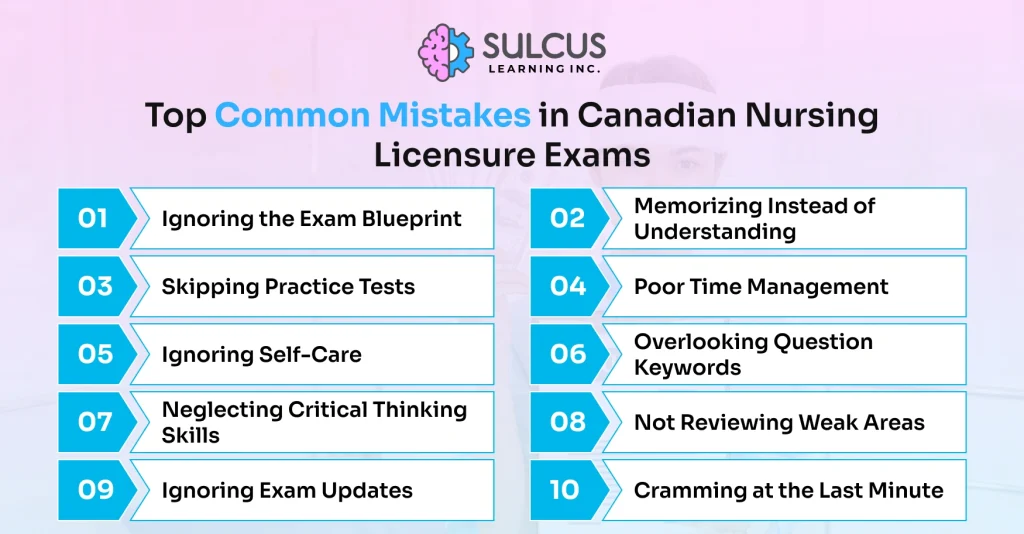
Even well-prepared nursing candidates can encounter challenges on exam day.
Here are the most common mistakes in the Canadian nursing licensure exams that you should know to enhance your confidence and overall success on the exam.
1. Ignoring the Exam Blueprint
Nursing candidates should not ignore exam blueprints before taking the exams. Each blueprint outlines what is being tested, the format of the test, and the level of clinical judgment required for each exam question.
For example, the NCLEX-RN includes the NCSBN Clinical Judgment Measurement Model; the REx-PN incorporates the Canadian practical nursing scope and regulatory expectations outlined in the RExPN Exam Guide; and the CPNRE covers the entry-level Canadian practical nursing competencies detailed in the CPNRE Exam Guide.
When blueprints are ignored, the preparation becomes off focus and sufficient impactful content is neglected. This results in suboptimal performance. Studying with the blueprints ensures clinical judgment is within the Canadian standards and is adequately prepared for the exam.
2. Memorizing Instead of Understanding
Another common mistake in nursing exams is relying only on memorization. Examinations like RExPN, CPNRE, and NCLEX-RN focus on candidates’ ability to reason rather than mere recall.
It is vital to understand nursing theories, apply logic in nursing and clinical settings, and develop critical thinking skills for real-world decision-making. Learning how to study for CPNRE effectively emphasizes understanding over memorization.
3. Skipping Practice Tests
Many nursing students in Canada forgo mock or practice tests, a decision that can significantly affect exam performance.
With the help of the practice tests, you can familiarize yourself with the structure of the exam questions, enhance precision, and decrease stress. You can read more about the importance of Mock Tests & Practice Exams for Canadian nursing licensure to understand their impact.
Consistent practice helps measure growth and reduces the likelihood of unexpected challenges on test day.
4. Poor Time Management
Nursing licensure exams and NCLEX test preparation can be stressful due to time constraints. Exam-related stress can stem from ineffective time management, resulting in unanswered exam questions.
Mock tests are one of the best ways to encourage time management for nursing candidates preparing for NCLEX-type exams. Practising under exam conditions, being realistic about time per question, and staying focused are ways to develop and reinforce time management. This will improve decision-making and overall help for a less stressful exam day.
5. Ignoring Self-Care
Even the best nursing exam prep can be undone by failing to rest, eat, and attend to mental wellness. Fatigue reduces focus and information retention.
Quality sleep, short breaks, and mindfulness activities can mitigate burnout and help you remain sharp, confident, and calm while taking the Canadian nursing licensure exam.
6. Overlooking Question Keywords
Misreading exam questions is a common mistake when taking nursing exams in Canada. Give special attention to the keywords first, the most appropriate or priority ones.
Failing to recognize these keywords alters the meaning of the questions, leading to poor, unnecessary judgment errors.
7. Neglecting Critical Thinking Skills
Licensure examinations in nursing fall under the scope of testing candidates’ ability to integrate nursing principles with clinical reasoning and not testing their ability to memorize. Relying on mere memorization, elimination strategies or taking shortcuts is likely to curtail potential performances for better outcomes.
Enhancing clinical judgement improves with frequent practice of scenario-based questions using a realistic case. Engaging with real-world clinical situations polishes the decision making, prioritization and knowledge application, which skills are requisite in passing the exam and in nursing practice.
8. Not Reviewing Weak Areas
Avoiding weaker areas is one of the most significant challenges during nursing exam preparation, such as the CPNRE or REx-PN. Progress is likely to become stagnant, and remaining competency gaps are highly likely to remain unaddressed if learners are
not willing to step out of their comfort zone.
To effectively narrow down on weak areas, nursing candidates are advised to use objective feedback from practice exams, adaptive
learning tools, and readiness indicators.
Performance feedback from practice tests, adaptive assessments, and the Sulcus readiness predictor can be used to identify areas for improvement and to enable more focused study, thereby supporting balanced preparation and better exam outcomes. This explains Sulcus’s learning approach.
9. Ignoring Exam Updates
The structure, topics, and competency standards areas of the licensure exams for Canadian nurses change frequently. Using the old study materials may lead to misunderstandings.
You need to verify your study material against official Canadian resources or reputable nursing exam prep courses to ensure it is up to date and reflects the exam structure.
10. Cramming at the Last Minute
The anxiety of a nursing exam is exacerbated by last-minute cramming, which also hinders comprehension. Instead of rushed study sessions, use a study plan that’s designed to pace exam preparation for the nursing exam over several weeks.
Systematic reviews allow for calm revisions, and ultimately, the brain needs time to retain and recall information without pressure.
Proven Strategies to Pass the Canadian Nursing Licensure Exam
To master your nursing licensure exam in Canada, use consistent, not last-minute, review. Start planning your studies, including daily study sessions, regular revision tests, and strategic recaps.
As with RExPN exam preparation strategies and RExPN exam tips, your exam vision and assessment strategies, plus review and recaps in nursing exams, improve your ability to answer NCLEX-style questions and complete priority analyses.
Control your stress with breathing exercises, a healthy diet, and enough rest. Remember, knowing how to pass the Canadian nursing licensure exam is not just about your knowledge but is also about how you strategically formulate your attempt with discipline and self-care.
How Sulcus Learning Helps You Avoid These Mistakes?
Sulcus Learning is designed with innovation and empathy for nursing students in Canada. Sulcus Learning is the best online prep platform to help you pass your CPNRE, RExPN and NCLEX RN exam with confidence on your first attempt.
With the help of the Sulcus Learning platform, you can avoid the common mistakes in nursing exam prep and make a better strategy for your nursing exam.
Sulcus Learning is your study partner and guides you through nursing exam prep and strengthens your critical skills, building your confidence and helping you achieve your career goal.

Conclusion
Having success on the Canadian nursing licensure exams begins with recognizing and avoiding the pitfalls others have encountered. Even minor adjustments in time management and the development of critical thinking skills can get you closer to the ‘pass’ result outcome you are hoping to achieve.
With guidance in nursing exam preparation and the use of resources such as Sulcus Learning, it’s possible to meet the various exam formats, including CPNRE, RExPN, and NCLEX-RN, with confidence.
Keep in mind that there is no such thing as perfect preparation; the essence of thoughtful preparation lies in progress, reflection, and growth. Remain calm, stay focused, and approach the Canadian Nursing Licensure Examination with confidence.
FAQs
Q1. What are the most common nursing exam mistakes in Canada?
Ans. Ignoring the exam blueprint, poor time management, skipping mock tests, and relying on memorization are among the top nursing exam mistakes to avoid in Canada.
Q2. How can I improve my nursing exam preparation?
Ans. Follow a structured nursing exam preparation plan, take frequent mock tests, and focus on understanding rather than memorizing concepts.
Q3. What is the best way to study for CPNRE or RExPN?
Ans. Review official resources, use nursing exam preparation courses, and practice with real-time assessments.
Q4. How can I reduce nursing exam anxiety?
Ans. Prioritize rest, take breaks, and practice mindfulness. Balanced self-care is key to maintaining focus and confidence during exams.
Q5. Why choose Sulcus Learning for exam prep?
Ans. Sulcus Learning provides AI-driven tools, Canadian nursing exam–aligned checklists, and personalized feedback to help nursing candidates reduce common exam errors, strengthen weak areas, and prepare with clarity and confidence.

Taran Kaur
As Managing Director and Lead Instructor at Sulcus Learning, Taran helps internationally educated nurses navigate their professional journey with clarity and confidence. With qualifications including a B.Sc. (Nursing), MBA (HM), ENCC, and CMSN(C), she focuses on helping learners succeed in licensure exams and professional practice. Connect with Taran Kaur on LinkedIn.