

If you’re planning to become a Licensed Practical Nurse (LPN) in Canada, passing the REx-PN (Regulatory Exam – Practical Nurse) is an essential step toward earning your licence. Whether you’re wondering what the RExPN entry exam involves, how to book the exam, what the passing standard is, or how to prepare effectively, this guide has you covered.
This comprehensive RExPN exam prep guide walks you through every stage of the process, from eligibility requirements and registration to the computerized adaptive testing (CAT) format, exam blueprint, question types, scoring, and what to expect on exam day. You’ll also learn practical strategies on how to study for the RExPN, expert RExPN exam tips, and common mistakes to avoid.
Whether you’re just starting your preparation or reviewing in the final weeks before your test, this guide is designed to help you study smarter, build confidence, and improve your chances of passing the RExPN exam in Canada on your first attempt.
Understanding the Basics of the REx-PN Exam
The REx-PN (Regulatory Exam – Practical Nurse) is a Canadian licensure exam that assesses whether aspiring Practical Nurses possess the entry-level competencies required to provide safe, effective, and compassionate nursing care.
It replaced the CPNRE in provinces Ontario and British Columbia, where it is now the mandatory exam for Practical Nurse registration.
All other Canadian provinces and territories continue to use the CPNRE as their Practical Nurse licensure examination.
Key points about the REx-PN exam:
- Assesses your capacity to offer safe and effective nursing care.
- Evaluates critical thinking, clinical judgement, and practical nursing skills.
- Administered by Canadian Practical Nurse Regulators (BCCNM and CNO).
- The RExPN uses computerized adaptive testing (CAT) to set question difficulty.
- Validates candidates’ ability to meet Canadian licensing standards.
With these basics set in mind, you can prepare effectively and reduce anxiety as exam day approaches.
Before beginning your preparation journey, it’s important to understand the differences between practical nursing and registered nursing roles in Canada. Explore our detailed guide on “RPN vs RN: What’s the Real Difference in Roles, Education & Pay?” to compare scope of practice, education requirements, and career opportunities.
REx-PN Exam Format and Structure
Knowing the RExPN exam format is key. It is a computerized adaptive test (CAT) that automatically adjusts the difficulty of questions based on your responses.
Here’s what you need to know:
Number of Questions: The REx-PN uses a Computerized Adaptive Test (CAT) format. Candidates receive between 90 and 150 scored and unscored items, including multiple-choice, select-all-that-apply (SATA), and scenario-based exhibit-style questions. The exam adapts in real time based on your performance.
Duration: You have a maximum of 4 hours to complete the exam. This total time includes a short tutorial, the test itself, and optional breaks.
Content Areas (Client Need Categories): The exam blueprint is organized under the NCSBN’s official Client Needs framework:
- Safe and Effective Care Environment
- Management of Care
- Safety and Infection Control
- Health Promotion and Maintenance
- Psychosocial Integrity
- Physiological Integrity
- Basic Care and Comfort
- Pharmacological and Parenteral Therapies
- Reduction of Risk Potential
- Physiological Adaptation
These categories reflect the core responsibilities of an entry-level Practical Nurse across diverse Canadian healthcare settings.
Scoring: The REx-PN uses adaptive logit scoring, the same NCSBN standard employed in high-stakes licensing exams. It does not assign percentages; instead, the system evaluates your ability level and determines whether you meet the passing standard.
Get to know the RExPN exam format before you ever visit the testing center—and give yourself an advantage to plan your nursing preparation.
Breaking Down the REx-PN Exam Content & Blueprint
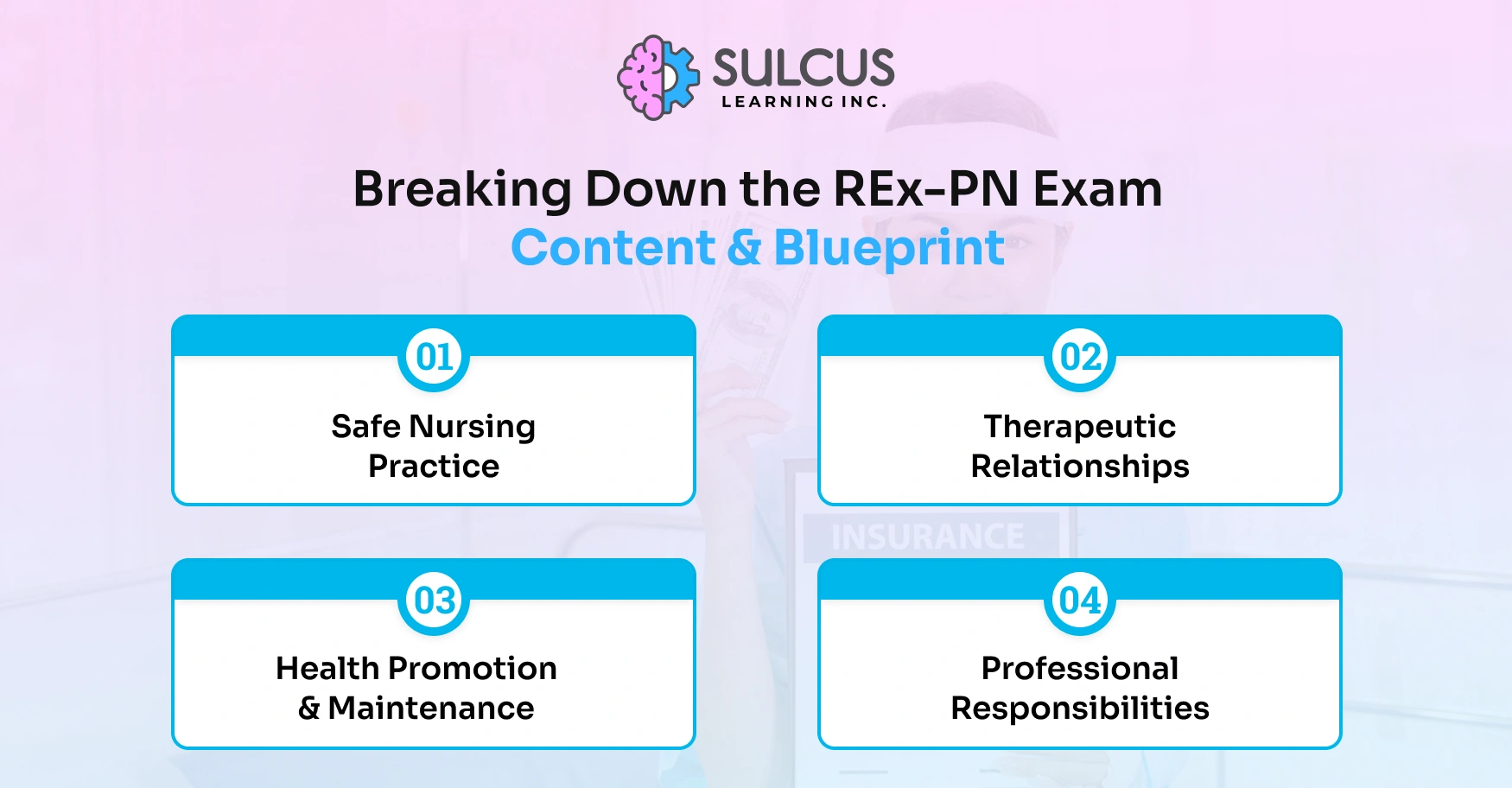
The REx-PN exam blueprint organizes the test into several categories to ensure a comprehensive evaluation.
- Safe Nursing Practice: Plans for client safety, infection control, correct administration of medication and treatment, timely verification or assessment of the client’s vital signs, and implementation of safe nursing practices within individual contexts.
- Therapeutic Relationships: Effective client and family communication, cultural competence, establishing trust and making ethical, client-centered decision-making.
- Health Promotion & Maintenance: It covers health promotion, including disease prevention, client education, promoting wellness, encouraging healthy lifestyle habits, and supporting overall community health.
- Professional Responsibilities: Emphasizes accurate documentation, compliance with legal and regulatory standards, peer relationships, adhering to ethical principles, as well as the responsibilities demonstrated in each nursing practice.
Understanding the number of questions on the REx-PN exam in each domain can also help you focus your study time.
What Is the RExPN Exam Passing Score?
One of the most common questions candidates ask is about the RExPN exam passing score, and the honest answer is that there isn’t a fixed number or percentage to memorize. The RExPN uses a logit-based Computerized Adaptive Testing (CAT) model, the same NCSBN methodology used for high-stakes licensure exams across North America.
Instead of tallying correct answers, the system continuously estimates your ability level as you respond to questions, then compares that estimate against a predetermined competency standard for safe, entry-level Practical Nurse practice. You either demonstrate that you meet this standard, or you don’t, there’s no partial credit, curve, or raw score to chase.
This is why cramming alone won’t get you far. The exam is designed to test how you think through clinical situations, not how much you’ve memorized. Understanding this scoring model early in your prep removes a lot of the guesswork (and anxiety) around “how many questions do I need to get right?”
Scoring, Question Types, and Passing Standards
Knowing how the REx-PN is scored and the types of questions you’ll be asked will help reduce test anxiety and enable you to achieve your best.
Scoring
The REx-PN uses a logit-based Computerized Adaptive Testing (CAT) model developed by the NCSBN in collaboration with the Canadian regulators (BCCNM and CNO), who use this system to ensure candidates meet the required standards for practical nurse licensure in their provinces.
A logit is a statistical value that reflects your nursing ability. As you answer questions:
- The system continually updates your ability estimate.
- It then delivers questions tailored to your current performance level—easier or harder depending on how you respond.
- The exam continues until the CAT has enough information to determine whether your ability is above or below the passing standard for safe, entry-level practice.
There is no percentage score. You either meet the standard or you don’t, based entirely on your demonstrated competence.
Question Types
The REx-PN exam consists of multiple-choice questions, as well as other question types described below:
- Clinical scenarios based questions
- Exhibit Questions.
- Questions involving interpretation, decision-making, and problem-solving.
These questions may reflect real-life situations and, as such, require the entry-level Practical Nurse to employ clinical judgment, safety concerns, and critical thinking.
CAT Passing Rules
The REx-PN exam uses three of its official decision-making rules for determining your outcome.
1. 95% Confidence Interval Rule
The exam may be stopped if the computer determines it is 95% confident of your level of ability relative to the established cut score.
- Above = Pass
- Below = Fail
2. Maximum-Length Rule
If you reach the maximum number of questions (150), the CAT may still be undecided. It will then consider your final logit score.
- Above the standard = Pass
- Below the standard = Fail
3. Run-Out-of-Time Rule (ROOT)
If your exam time has expired and no decision has been reached.
- If you have answered enough of the questions, the CAT will close the exam and use your final estimate of ability to determine if you have passed.
- If you have answered too few questions, the exam will be automatically marked as Fail.
Passing Standards
The passing standard is the lowest level of ability required to provide safe and competent Practical Nurse nursing care.
The REx-PN does not assess how much you memorized. Instead, it assesses the ability to:
- Think critically.
- Apply knowledge.
- Prioritize client safety.
- Make sound nursing decisions across varied situations
REx-PN Exam Dates 2026 and Testing Locations
Candidates planning to take the REx-PN should be aware that REx-PN exam dates 2026 vary depending on the testing location. While major testing centers offer appointments throughout the year, several temporary testing locations operate during specific testing windows. To secure your preferred exam date and location, ensure that your Authorization to Test (ATT) remains valid during the selected testing period.
| Testing Location | REx-PN Exam Dates 2026 |
|---|---|
| Vancouver | Available Year-Round |
| Burnaby | Available Year-Round |
| Surrey | Available Year-Round |
| Victoria | Available Year-Round |
| Kamloops | June 16–25, 2026 |
| Nanaimo | June 16–22, 2026 |
| Prince George | July 22–30, 2026 |
Since appointment availability can change based on demand, candidates are encouraged to schedule their exam as early as possible after receiving their ATT. Checking available REx-PN exam dates 2026 in advance can help ensure you secure a convenient testing location and avoid last-minute scheduling challenges.
Eligibility and Registration Process for REx-PN
Before applying for the RExPN exam, it is important to ensure that you have met all RPN exam eligibility requirements.
- Educational Requirement: Graduation from a recognized practical nursing (PN) program at an accredited institution.
- Required Documentation: Prepare all the materials your regulatory body will require in your province, including transcripts, a degree certificate or diploma, and a valid ID.
- Language Proficiency: If there is a language proficiency requirement, make sure you can understand and communicate well during the test.
- Exam Booking: Log in to the online portal of your provincial nursing regulator and book the REx-PN exam on your preferred date at a test center near you.
- Exam Cost: The REx-PN exam fee is CAD $350 per attempt in both Ontario and British Columbia. Testing outside Canada adds a CAD $150 international fee. Some optional administrative changes may include small service charges. Once your payment is approved, you receive an Authorization-to-Test (ATT) to schedule your exam and review test-day instructions. All RExPN exam fees are non-refundable.
Booking for the REx-PN exam is completed through your provincial nursing regulatory body’s website. The cost of the RExPN exam varies slightly by province. Register to receive test dates and locations
Preparing Efficiently for the RExPN Exam
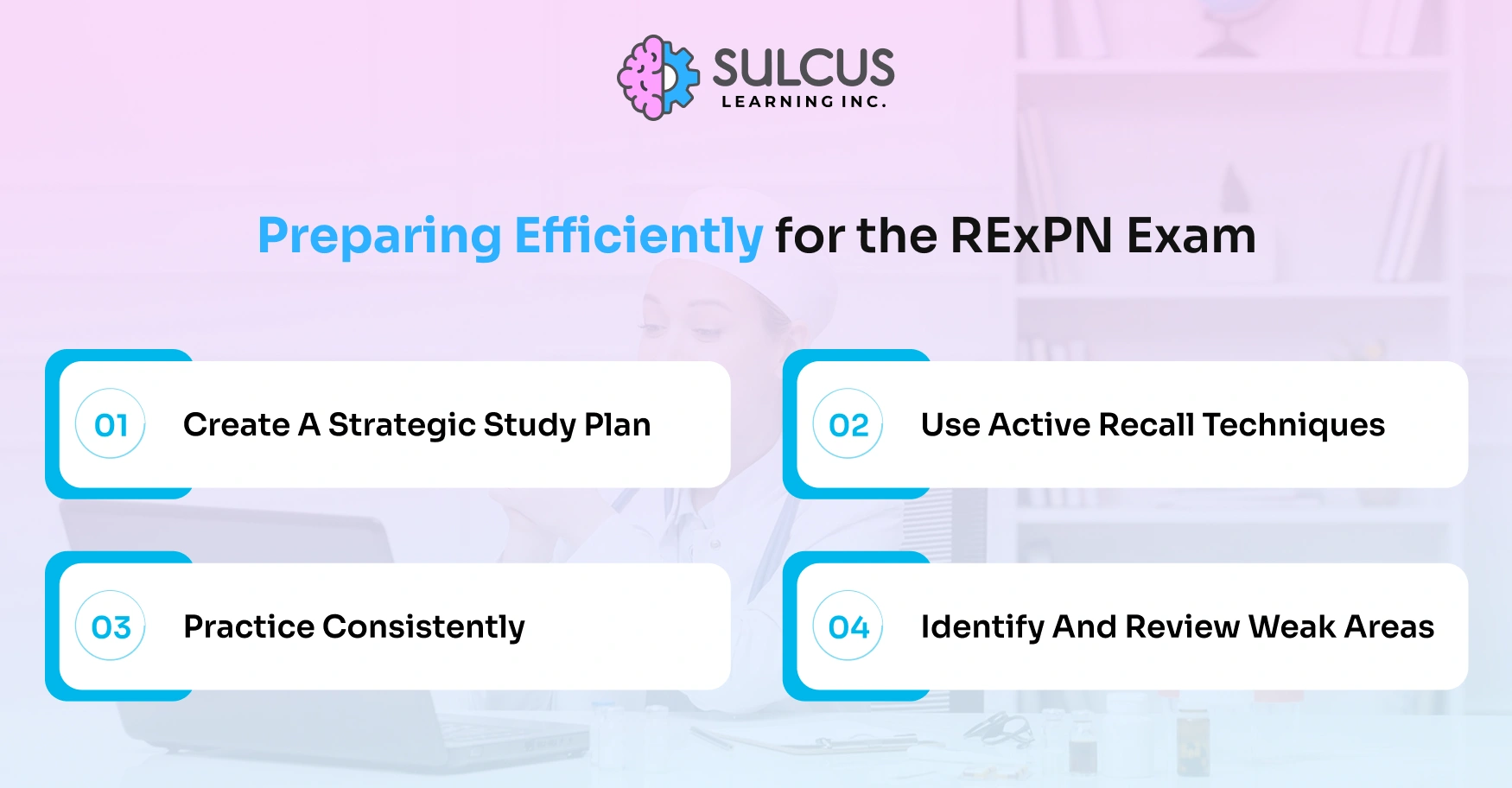
Studying hard is definitely part of it, but studying smart also matters. Here’s how to study smart to pass your RExPN exam on your first attempt:
- Create a Strategic Study Plan: Allocate your study time based on the RExPN exam blueprint, prioritizing high-impact topics while ensuring you cover all domains.
- Use Active Recall Techniques: Summarize the content in your own words, make flashcards, and discuss the subject out loud to help you remember better and understand more deeply.
- Practice Consistently: Solve as many practice questions, mock tests & scenarios as possible to enhance your speed and accuracy for the actual RExPN exam.
- Identify and Review Weak Areas: Spend more time in the areas you’re struggling with, go over challenging concepts time and again until you feel like a pro.
Strategizing for how to study for RExPN will significantly increase your confidence and performance.
How to Book the REx-PN Exam
If you’re wondering how to Book RExPN Exam, the process runs entirely through your provincial nursing regulatory body, either the College of Nurses of Ontario (CNO) or the BC College of Nurses and Midwives (BCCNM), depending on where you’re registering.
Here’s a simplified breakdown:
- Confirm eligibility, make sure your educational documents, transcripts, and identification are ready and verified.
- Submit your application through your regulator’s online portal.
- Pay the exam fee (CAD $350 for candidates testing within Canada, plus a CAD $150 international fee if testing outside Canada).
- Receive your Authorization to Test (ATT), this is your green light to schedule an appointment.
- Choose your test date and location through the official testing provider’s scheduling system, keeping in mind that your ATT has a limited validity window.
Booking early is especially important if you’re eyeing a temporary testing location (like Kamloops, Nanaimo, or Prince George), since these sites only operate during short seasonal windows. Year-round centers like Vancouver, Burnaby, Surrey, and Victoria offer more flexibility if your schedule is tight.
How to Study for the RExPN Exam Effectively
How to Study for REx PN? is really a question of working smart, not just working hard. Since the exam adapts to your performance in real time, your prep should mirror that same adaptive mindset, constantly identifying and reinforcing weak spots rather than repeating what you already know.
A strong RExPN exam prep routine typically includes:
- Blueprint-Based Planning: Align your study schedule with the Client Needs categories (Safe and Effective Care Environment, Health Promotion, Psychosocial Integrity, Physiological Integrity) so no domain gets neglected.
- Active Recall Over Passive Reading: Flashcards, self-quizzing, and explaining concepts out loud embed information far more effectively than re-reading notes.
- CAT-Style Practice Questions: Since the real exam adjusts difficulty based on your answers, practicing with adaptive or scenario-based question banks builds the right instincts.
- Regular Self-Assessment: Track which content areas consistently trip you up, and rotate extra review sessions toward those gaps.
- Simulated Full-Length Exams: Timed practice tests train your stamina and pacing for the up-to-4-hour real exam.
Consistency beats intensity here. Spacing out shorter, focused study sessions over several weeks tends to produce better retention than last-minute marathon cramming.
Top Study Resources and Practice Tests for RExPN
The key to getting high scores is ensuring you are using authentic sources. The best ones are:
- RExPN Study Guide Books: Who offers quick explanations to help you understand the concepts and apply them with rigorous practice?
- Online RExPN Prep Courses: Provide a series of structured learning modules, video demos, and practice exams to simulate the actual test experience as well as review and measure your progress.
- RExPN Questions on Quizlet: Great for rapid reviews, flashcard-style study, and active recall to learn entries effectively.
- Practice Exams and Timed Quizzes: Simulate exam-day experience, improve your time management, and identify areas to boost your confidence.
- Interactive Case Studies: Scenario-based exercises that increase critical thinking and clinical judgment, applying your study to real-life nursing situations.
Reinforce your knowledge with case-based questions for practice in simulated clinical scenarios.
Last-Minute RExPN Exam Tips
If exam day is close, these RExPN exam tips can help you make the most of your remaining time without burning out:
- Prioritize weak areas, not everything. In the final stretch, targeted review of your shakiest topics pays off more than broad re-reading.
- Do one full-time practice test. This resets your internal clock for pacing and builds familiarity with the CAT interface.
- Protect your sleep. Skipping rest to cram the night before typically backfires, memory consolidation and clear thinking depend on it.
- Pack your documents early. Confirm your ID and any required paperwork the night before so test-day morning is stress-free.
- Practice a calming technique. Simple deep-breathing or a short walk can settle nerves before you sit down at the testing center.
- Read every question fully before answering. Adaptive exams don’t allow you to skip and return, so slow, deliberate reading matters more here than on traditional tests.
Small, disciplined habits in these final days often make the difference between a good attempt and a great one.
Mastering the Art of Exam Taking
You want to do everything you can to pass the RExPN exam because who wants to re-take this all over again, but everyone’s telling you how hard it is. But no one tells you how to prepare for it.
Begin by reading each question slowly, and keep an eye on key instructions that shape your responses. Secondly, eliminate obviously incorrect options first to narrow your choices and improve accuracy.
Time management is crucial — don’t spend too much time on any one question; practice smart timing to complete the test efficiently. Keeping a cool head is just as critical; stress or anxiety may cloud your judgment, so try to practice some relaxation techniques, such as deep breathing if you are feeling pressured.
Through frequent exposure with timed quizzes and sample exams, you can replicate the test better, build confidence, hasten decision making and be in your zone on test day.
Maintaining Mental and Physical Health During Preparation
Preparing for your nursing exam is not all about focusing on your studies, but also on your healthy mind and body. Your brain works well when your body is well cared for.
- Maintain a Healthy Sleep Schedule: Consistent, high-quality sleep supports memory and attention.
- Take Regular Breaks: A small amount of scheduled time away from studies helps fight burnout and sustain focus.
- Eat Balanced Meals and Stay Hydrated: Your brain and body need a balanced diet for energy and cognitive function.
- Practice Relaxation Techniques: Deep breathing, meditation, and mindfulness can help you reduce stress and improve clarity of thought.
By prioritizing both mental and physical health, you enhance your focus, remember things and can gain the emotional reserves needed to do well on the RExPN exam day.
Exam Day Experience: What to Expect and How to Stay Calm
It’s your RExPN test day. Preparation is not about knowledge; it’s also about how well you can perform:
- Arrive Early: Give yourself plenty of time to settle in and avoid last-minute stress.
- Bring Required Documents: Be sure you bring proper ID and any paperwork required by the test center.
- Familiarize Yourself with the Test Interface: Spend a little time understanding how the computerized test works.
- Stay Calm: If you get nervous, try getting back on track with slow breathing or visualization techniques.
- Focus on What to Expect: Knowing the exam routine reduces stress and helps you concentrate fully, giving you the best chance to perform confidently.
If you know what to expect, it will reduce your stress and help you stay focused on the exam.
After the Exam: Results, Retakes & Next Steps
Once you complete your RExPN exam, your result release may take a few weeks from your provincial nursing regulator.
- If You Pass: Congratulations! If you pass the nursing exam, it’s time to move on to the following stages of obtaining your practical nursing license and starting your professional life. Celebrate your hard work, but also prepare for the responsibilities ahead.
- If You Don’t Pass: You’re not alone. Carefully review your score distribution, determine weaknesses in particular areas, change your study strategies, and plan to retake the test. A focused study would very likely lead to you passing on your next attempt.
When you spend some time thinking about what to do next, whether that means celebrating or preparing for a retake, it helps maintain motivation. It ensures continuous progress toward becoming a competent, Registered Practical Nurse.
Common Mistakes to Avoid in the RExPN Exam
To give yourself the best chance of passing the RExPN exam on your first attempt, you must know what mistakes other people have made:
- Neglecting the Exam Blueprint: Spending too much time on low-earning topics without covering the heavyweights can leave you behind.
- Relying Solely on Memorization: Understanding concepts deeply is a much more worthwhile use of time than rote learning.
- Skipping Practice Tests: Disregarding timed quizzes and mock exams reduces your exposure to time management and to using the material in stressful situations.
- Overworking and Neglecting Self-Care: Overworking can have a negative impact on focus, memory and performance.
- Ignoring Lessons from Mistakes: Reevaluating errors and adapting strategies leads to stronger preparation and less unneeded stress.
By avoiding these mistakes, you can enhance your confidence and pace the exam well.
Can You Pass the REx-PN Exam on Your First Attempt?
Yes, passing the RExPN exam in Canada on your first try is absolutely achievable, and many candidates do it every year. The key isn’t luck; it’s preparation that matches how the exam actually works.
Since the REx-PN entry exam evaluates clinical judgment and critical thinking rather than rote memorization, candidates who consistently practice scenario-based questions, understand the blueprint, and manage their study time strategically tend to perform best. Combine that with healthy sleep, stress management, and realistic timed practice, and your odds of a first-attempt pass improve significantly.
The candidates who struggle most are usually the ones who under-practice with CAT-style questions or skip self-care during prep, not necessarily the ones who “didn’t know enough.” With the right strategy, a first-attempt pass is a realistic, well-supported goal.
Why Choose Sulcus Learning for Your RExPN Prep?
Sulcus Learning is a trusted nursing exam prep platform designed to help you confidently pass your licensure exam on your first attempt.
With a personalized mock exam and the adaptive nature of this learning solution, it creates an environment similar to the real RExPN exam. At the same time, with the help of the structured study plans, you can target your strengths and weaknesses for effective learning, and also get the expert Canadian nurses’ feedback, which helps you not just to memorize the information but also ensures you understand the concept deeply.
We enhance your strength, not replace your hard work, enabling more efficient study sessions that highlight what you need to know for the exam. Many nursing candidates have used it as a confidence booster to pass their Canadian RExPN exam on their first attempt.
Conclusion
Passing the REx-PN exam is about more than memorizing facts, it requires demonstrating safe clinical judgment, critical thinking, and sound decision-making in a Computerized Adaptive Testing (CAT) environment. Understanding the exam format and blueprint helps you prepare with confidence.
A structured study plan, consistent practice with realistic questions, and regular review of weaker areas can improve your readiness. Using trusted study resources and mock exams also builds familiarity with the types of questions you’ll encounter.
With the right preparation, discipline, and mindset, you can boost your confidence and maximize your chances of passing the REx-PN exam in Canada on your first attempt while taking an important step toward your nursing career.
Frequently Asked Questions
Q1. What is RExPN?
Ans. The RExPN complete form is the Regulatory Exam – Practical Nurse, the licensure exam for practical nurses in Canada. Understanding what REx PN is helps you prepare effectively for your nursing career.
Q2. What Is the REx-PN Exam Passing Score?
Ans. The REx-PN exam passing score is not based on percentages. Instead, it uses Computerized Adaptive Testing (CAT) to assess whether candidates meet the competency standard required for safe entry-level nursing practice.
Q3. How many questions are in the RExPN exam?
Ans. The exam contains approximately 90-150 adaptive questions. Knowing how many questions are in the REx PN exam helps you plan your time and practice strategically.
Q4. How long does it take to get RExPN results?
Ans. Your provincial regulator typically releases results within a few weeks. Check the RExPN result time to track your progress.
Q5. Where Can I Find REx-PN Practice Questions?
Ans. REx-PN practice questions are essential for effective preparation. They build familiarity with CAT-style questions, improve clinical judgment, identify weak areas, and boost confidence through realistic, scenario-based nursing decision-making practice.

Taran Kaur
As Managing Director and Lead Instructor at Sulcus Learning, Taran supports aspiring nurses in building their knowledge and confidence throughout their learning journey. With qualifications including a B.Sc. (Nursing), MBA (HM), ENCC, and CMSN(C), she is dedicated to helping learners succeed in licensure exams and professional practice. Connect with her on LinkedIn for insights.