
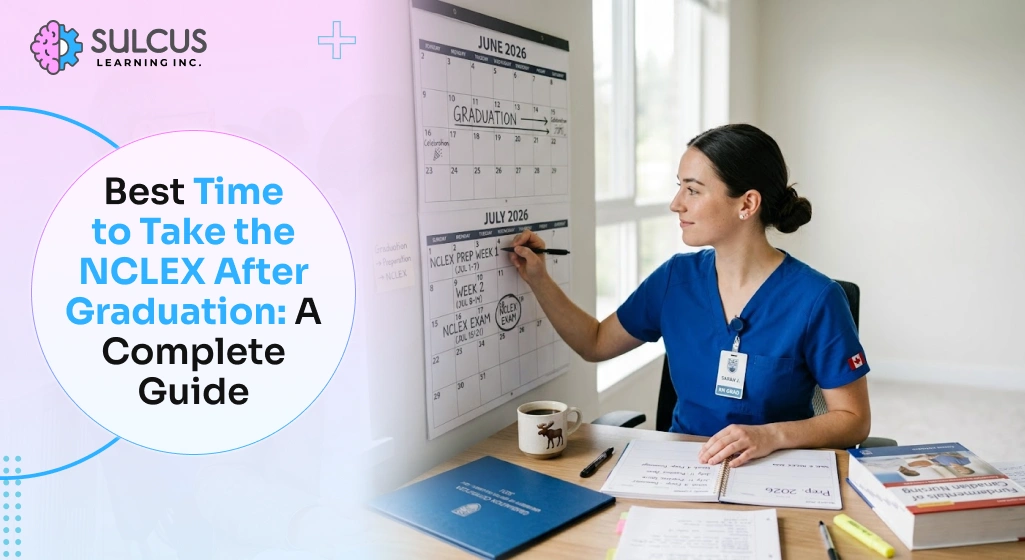
Graduating from nursing school is a major milestone, but deciding when to take the NCLEX can be just as important. Choosing the right test date means balancing your exam eligibility, preparation level, available study time, and how recently you completed your nursing coursework and clinical training.
For many Canadian nursing graduates, the goal is to take the NCLEX while your nursing knowledge and clinical judgment skills are still fresh, without rushing into the exam before you are fully prepared. Taking it too early may leave you with limited preparation time, while waiting too long can mean spending more time rebuilding knowledge and test-taking confidence.
So, when is the best time to take the NCLEX after graduation? How soon can you take it? How long should you study before scheduling your exam? This guide explains the key factors to consider when choosing your NCLEX test date and outlines a practical timeline for preparing after graduation.
You’ll learn how to plan the period between graduation and test day, assess your readiness, build an effective study schedule, and choose a testing window that fits both your preparation needs and regulatory requirements.
When Is the Best Time to Take the NCLEX Exam?
For most Canadian graduates, the best time to take the NCLEX is six to twelve weeks after graduation. This window balances two competing needs. The first is regulatory processing time, the other is knowledge retention. You cannot skip regulatory processing time, but the longer you wait, the more knowledge you lose.
During your final semester, clinical judgment patterns, pharmacology associations, and prioritization frameworks are reinforced daily through coursework and clinical rotations. That familiarity doesn’t disappear the day you graduate, but it does soften. Nursing graduates who take the NCLEX exam within this six-to-twelve-week window consistently report feeling that exam content was still “close to the surface” rather than something they had to relearn from scratch.
Testing too early, before your application has been cleared by your provincial or territorial regulatory body, isn’t an option, regardless of how ready you feel, which brings us to the next question graduates ask.
How Soon After Graduating Can You Take the NCLEX?
You cannot book an NCLEX test date the day you graduate. You are not eligible to sit for the NCLEX until your regulatory body reviews your transcripts and confirms the completion of your program, and issues an Authorization to Test (ATT). Most provinces will complete this review two to six weeks after your final transcripts and application.
This means most Canadian graduates won’t be able to take the exam for at least 3 to 4 weeks post-graduation. The best window for testing opens when both the ATT has been received and a Pearson VUE testing slot is conveniently located. The best way for graduates to shorten the time to testing is to submit their applications and all their transcripts immediately after receiving their final grades, rather than waiting until convocation.
Can You Take the NCLEX Before You Graduate?
No. You must have officially completed your nursing program and have your regulatory body confirm that completion before an Authorization to Test can be issued. Some U.S. jurisdictions allow limited early testing for students in their final semester, but Canadian pathways require confirmed graduation and transcript verification first. If you’re planning your timeline, treat your official graduation date, not your last exam or clinical shift, as day zero.
How Long After Graduating Can You Take the NCLEX-RN in Canada?
Canada does not have one statewide deadline for every nursing graduate to take the NCLEX-RN within a particular number of months following graduation. Eligibility standards are defined by the nursing regulatory organization in the province or territory where you are seeking registration. For this reason, applicants should study the criteria and application timeframes of their provincial or territorial regulator.
After the regulatory body validates your eligibility, you will be issued an Authorization to Test (ATT). You must take the NCLEX-RN within the validity period shown on the ATT. The typical ATT validity duration is about 90 days, however, the precise schedule is set by the regulatory agency and cannot be extended. If the ATT expires, you will need to re-register and pay the examination fee.
Although there may not be a uniform cutoff based merely on your graduation date, taking the NCLEX test shortly after graduation might be advantageous. Nursing knowledge, clinical reasoning, and test-taking confidence may become less accessible if not reinforced via more study or clinical experience.
Many graduates want to take the NCLEX-RN within two to six months after finishing their nursing education. However, the appropriate period is determined by regulatory permission, individual preparedness, personal circumstances, and preparatory progress, rather than the number of months following graduation.
If a long time has elapsed since graduation, start with a readiness evaluation and create a planned NCLEX study plan.
Your preparation should include:
- Review of current Canadian entry-level nursing competencies
- Practice with Next Generation NCLEX clinical-judgment questions
- Review of client safety, prioritization, delegation, and care management
- Content revision based on identified knowledge gaps
- Timed practice examinations and detailed review of rationales
A longer gap following graduation does not imply that success is beyond grasp. It implies that your preparation should be more systematic, up-to-date, and geared toward strengthening both knowledge and clinical judgment. Before enrolling, contact your provincial or territory nursing authority to ensure your eligibility and any related deadlines.
Factors That Determine Your Ideal NCLEX Timing
The ideal timing for the NCLEX depends on regulatory approval, knowledge retention, and preparation. Testing within 6–12 weeks often balances fresh knowledge with focused preparation for success.
| Timeframe | What’s Happening | Impact on Readiness |
|---|---|---|
| 0–2 weeks post-grad | Transcripts finalized, application to your provincial or territorial regulatory body submitted | Too early to test, approval pending |
| 2–6 weeks post-grad | Regulatory body review, Authorization to Test (ATT) issued | Preparation window opens |
| 6–12 weeks post-grad | Focused, targeted review using recent coursework and clinical rotations | Highest first-attempt pass probability |
| 3–6 months post-grad | Still workable, but requires more deliberate content review | Moderate risk, needs structured practice |
| 6+ months post-grad | Knowledge decay sets in for content not used clinically | Higher risk without a rebuilt study plan |
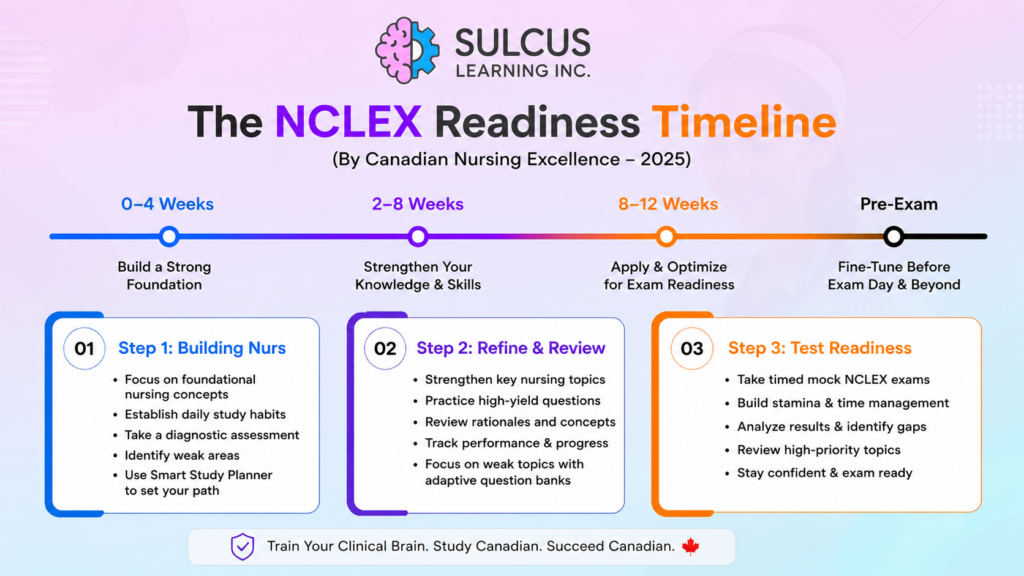
The NCLEX Readiness Timeline
The visual below maps the full sequence from graduation to test day, including where most Canadian grads see the strongest results.
Understanding NCLEX CAT Scoring and How Timing Affects Performance
The NCLEX-RN and REx-PN exams employ Computerized Adaptive Testing (CAT). After each scored answer, the algorithm adjusts its assessment of the candidate’s nursing competence and picks the next question accordingly. Correct answers may lead to more difficult questions, whilst bad responses may result in questions of lesser complexity.
It is not a guarantee that you will pass if you get challenging questions, nor is it a guarantee that you will fail if you receive simpler ones. The CAT method ensures that your test covers the necessary material areas and assesses your overall nursing skill with respect to the predetermined passing criteria.
The NCLEX exam does not base your score only on the proportion of properly answered questions. In most circumstances, the examination concludes when the computer is 95% certain that your skill is either above or below the passing requirement. Different scoring procedures apply if you obtain the maximum number of questions or run out of time.
Does Taking the NCLEX Soon After Graduation Help?
Taking the NCLEX-RN shortly after graduating does not result in a direct score advantage. Recent graduates, on the other hand, may find it simpler to retain nursing principles, identify clinical patterns, and apply clinical judgment since their academic and clinical learning is still fresh.
Candidates who wait several months after graduation may still pass the NCLEX, but they may need to follow a more complete NCLEX study tips and strategy. A longer interval may require spending more time restoring topic knowledge, clinical reasoning, confidence, and test-taking endurance.
A structured NCLEX study plan should focus on:
- Clinical judgment and decision-making
- Client safety and prioritization
- Application of nursing knowledge
- Next Generation NCLEX case studies
- Performance across all NCLEX content areas
- Accuracy and pacing under timed conditions
- Familiarity with different NCLEX question formats
REx-PN and CPNRE Question Formats
REx-PN candidates may be asked multiple-choice, multiple-response, or Select All That Apply, fill-in-the-blank computation, exhibit-based, and graphic-based questions. Because the REx-PN exam uses CAT, each applicant gets a unique mix and quantity of questions.
The CPNRE does not use computerized adaptive testing. It has roughly 160 to 170 multiple-choice questions. These questions may be given separately or as part of short healthcare scenarios. Each question is worth one mark.
On the NCLEX-RN or REx-PN, candidates cannot skip questions and come back to them at a later time. Before proceeding, each question must be addressed. Thus, memorization of data alone is not enough for effective preparedness. Candidates must comprehend the framework of the test, apply their nursing knowledge to clinical settings, carefully consider each choice, and keep a steady pace throughout.
| Exam | Question Formats You’ll See |
|---|---|
| REx-PN | Multiple Choice (MCQ), Select All That Apply (SATA), Fill in the Blank, and Exhibit-based questions |
| CPNRE | Case studies and Multiple Choice (MCQ) items built around integrated client scenarios |
Building a Study Timeline That Matches Your Test Date
Once you know your realistic test window, work backward. A graduate testing at week eight needs a tighter, more targeted review cycle than one testing at month four, and the plan should reflect that rather than following a generic countdown.
- Weeks 1–2 after graduation: submit your regulatory application and transcripts immediately; don’t wait for convocation.
- Weeks 2–4: begin a diagnostic assessment to identify weak competency areas before committing to a full review schedule.
- Weeks 4–8: run focused, NGN-aligned practice covering clinical judgment, prioritization, and pharmacology, the areas most likely to have softened since your final semester.
- Final 1–2 weeks before test day: shift from content review to timed, adaptive-style practice that mirrors CAT conditions.
Where Sulcus Learning Fits Into Your Timeline
Sulcus Learning is a Canadian-built exam-prep platform designed around exactly this kind of timing-sensitive planning. Proudly Canadian. Globally Trusted. Universally Successful. isn’t just a tagline, it reflects a platform built specifically around Canadian regulatory pathways, NGN clinical judgment models, and the REx-PN and CPNRE question formats covered above.
The Predictometer gives graduates a readiness score based on current performance data, so instead of guessing whether an eight-week or twelve-week timeline makes sense, you have an actual number to plan around.
The Competency Wheel maps strengths and gaps across every clinical judgment domain, while Strength & Limitation analytics and Exam Percentage Growth Charts show whether your review is closing those gaps fast enough for your chosen test date.
Graduates who want an additional benchmark can track their standing relative to peers through Performance Ranking and the Top 10 Student Leaderboard, a useful gut check for anyone unsure whether their pace matches their timeline.
None of this replaces a solid nursing education, it’s built to protect the knowledge you already have from fading before test day, and to flag exactly where a few focused hours will move the needle most.

Final Thoughts
The best time to take the NCLEX after graduation is a flexible window that is shaped by the regulatory processing, your clinical knowledge retention, and how you plan your time between graduation and test day. Most Canadian graduates have a window of six to twelve weeks, but your study plan can extend that window. You are more likely to be successful on the NCLEX if you match your preparation to your target test date, if you are honest about your readiness, and if you have data to support your belief in your readiness.
Frequently Asked Questions
Q1. What is the best time to take the NCLEX-RN after graduation?
Ans. There is no single best time for every Canadian nursing graduate. Many candidates choose to take the NCLEX-RN within a few months of completing their nursing program, while their nursing knowledge and clinical judgment remain familiar. The right time depends on regulatory approval, examination readiness, personal circumstances, and performance on practice assessments.
Q2. How soon after graduating can I take the NCLEX-RN in Canada?
Ans. You can take the NCLEX-RN after your provincial or territorial nursing regulatory body confirms your eligibility and Pearson issues your Authorization to Test (ATT). Processing times vary, so there is no guaranteed number of weeks between graduation and the earliest available examination date.
Q3. Can I take the NCLEX-RN before graduating from nursing school?
Ans. Generally, you cannot take the NCLEX-RN until your nursing program confirms that you have successfully completed the educational requirements and your nursing regulator declares you eligible. You may be able to begin parts of the registration process before your formal graduation ceremony, but you cannot schedule and write the examination without an active ATT.
Q4. Is there a deadline for taking the NCLEX-RN after graduation in Canada?
Ans. Canada does not have one universal NCLEX-RN deadline based solely on the date of graduation. Application and eligibility requirements are established by each provincial or territorial nursing regulator. Once an ATT is issued, however, you must take the examination within the validity dates printed on it.
Q5. How long is an NCLEX Authorization to Test valid?
Ans. The validity period is determined by the nursing regulatory body and is listed on the ATT. The average validity period is approximately 90 days, but it may vary. ATT validity dates generally cannot be extended, so candidates should schedule their examination promptly.
Q6. What happens if my NCLEX ATT expires before I take the examination?
Ans. If your ATT expires, you will generally need to register again and pay another examination fee. You may also need your nursing regulatory body to confirm your eligibility again. Always follow the instructions provided by your regulator and Pearson.
Q7. Does the NCLEX-RN become harder if I wait longer after graduation?
Ans. The examination itself does not become harder because you waited. Every candidate is assessed according to the same passing standard. However, a longer gap without active study or clinical practice may make it more difficult to recall information quickly and apply clinical judgment consistently.
Q8. Do NCLEX-RN pass rates automatically decline after six months?
Ans. A six-month gap does not automatically determine whether a candidate will pass or fail. Readiness is influenced by many factors, including the quality of preparation, familiarity with the examination format, clinical reasoning ability, study consistency, and performance on realistic practice examinations.
Q9. If I wait longer to take the NCLEX-RN, must I restart studying from the beginning?
Ans. Not necessarily. Begin with a comprehensive readiness assessment to identify your strengths and knowledge gaps. You can then create a structured NCLEX study plan focused on weaker content areas, clinical judgment, prioritization, client safety, and timed question practice.
Q10. How should I prepare for the NCLEX-RN after a long gap?
Ans. Candidates returning after an extended break should use a structured and competency-based study plan. Preparation should include current nursing content, Next Generation NCLEX case studies, clinical judgment exercises, timed practice examinations, and careful review of the rationale for every answer.

Harry Sagar
Harry is a strategic leader at Sulcus Learning, developing exam-aligned learning solutions. With expertise in adaptive testing and clinical education, he supports learners in achieving confidence, competence, and readiness.