
Consistent studies motivate NCLEX success. To reach this level, they spend hours reading textbooks, memorizing data helpers, and watching instructional films. These practices, while they encourage success, do little on their own to ensure results.
Feeling some panic prior to the NCLEX is very common, and candidates are typically not lacking knowledge. More frequently, the singular problem is the approach to preparation. The NCLEX is not like a traditional knowledge-based exam. Knowledge of the nursing profession, behavior, techniques, and skills is necessary to evaluate and make sound judgments and decisions. As a result, the ability to apply knowledge to clinical nursing judgment is critical.
NCLEX is a creation of the National Council of State Boards of Nursing, and evaluates candidates for their preparation and thinking for clinical scenarios, judgments, and prioritizing opinions to make solid clinical decisions. Success on the NCLEX exam results from a lot of practice, driving learned techniques, analyzing teaching ideas, and developing a comfort level with answering exam-type questions.
This guide focuses on evidence-based techniques and strategies for students preparing to understand what is the NCLEX Exam and ultimately learn how to pass the NCLEX. These techniques and strategies prep candidates for the NCLEX frameworks.
Regardless of whether the exam you are preparing for is NCLEX-RN/NCLEX-PN, or whether you have a few days or months, regardless of exam time, confidence levels, and comfort with developed skills, clinical judgment should be balanced with preparation.
How the NCLEX Actually Tests You
The purpose of the NCLEX is to determine if a candidate is able to make safe and appropriate nursing judgments and decisions in the clinical setting. It’s not just a test of your memory. It’s about your ability to recognize key cues, analyze patient data, identify the most concerning risk, and determine appropriate nursing interventions.
1. Computerized Adaptive Testing (CAT): What It Means for You
The NCLEX uses a computerized adaptive test (CAT) method. This means the level of difficulty of the questions changes according to how you are performing on the exam. Once you answer a question, the NCLEX system assesses the level of your ability and then serves the next question according to that answer.
This method does not mean that a right answer leads only to higher-level questions and a wrong answer leads only to lower-level questions. The NCLEX system continually adjusts the difficulty of questions to determine whether your ability is above or below the passing standard.
Candidates often ask, “How Many Questions are on the NCLEX?” especially since each NCLEX-RN or NCLEX-PN includes a minimum of 85 questions and a maximum of 150, respectively, and allows a maximum of 5 hours for exam completion, including breaks. The exam may end if the system can determine a pass/fail decision or if the maximum number of questions or the maximum time is reached.
Tip: Avoid counting questions during the exam, especially if you are worried about the NCLEX Shut Off at 85 Questions. The number of questions does not determine your result. Focus on reading carefully, recognizing client cues, and choosing the safest nursing action.
2. Clinical Judgment vs. Knowledge Recall
The biggest shift in NCLEX preparation is moving from memorization to clinical judgment.
- Knowledge recall asks: “What is the normal range for serum potassium?”
- Clinical judgment asks: “A client taking digoxin reports muscle weakness and has a potassium level of 3.1 mEq/L. What is the nurse’s priority action?”
The second question requires more than knowing a lab value. You must recognize the low potassium level, connect it to increased digoxin toxicity risk, identify the priority concern, and decide the safest nursing action.
The NCSBN uses the Clinical Judgment Measurement Model to assess clinical judgment and decision-making across the following steps: recognizing cues, analyzing cues, prioritizing hypotheses, generating solutions, taking action, and evaluating outcomes.
Why the Next Generation NCLEX (NGN) Changed Everything
The National Council of State Boards of Nursing has launched a more rigorous nursing exam, the Next Generation NCLEX (NGN), making it important to understand what NGN and the broader NCLEX Changes 2026. Now, rather than content, clinical judgment will be the main focus. This will change the way nursing candidates make decisions, as evidence shows that this skill is vital to nursing.
The NGN will also change the NCLEX-RN and NCLEX-PN examinations, as testing will now be centered on the nursing candidate. This includes real hospital questions that involve participant decision-making, along with data nursing, as a candidate who identifies potential risks, prioritizes caring, and determines subsequent actions.
New NGN Question Formats (VERY HIGH-YIELD)
To support this focus on clinical judgment, NGN introduced new item types that go beyond traditional multiple-choice questions:
- Extended drag-and-drop (ordered response and sequencing)
- Matrix/grid questions (evaluate multiple findings simultaneously)
- Bow-tie clinical reasoning items (identify condition, actions, and parameters)
- Extended multiple response (select all that apply with partial scoring)
- Trend-based questions (interpret evolving client data over time)
These new question types are aimed towards breaking down clinical decision-making in conjunction with the CJMM (Clinical Judgment Measurement Model), making as much sense as possible via the NGN.
Why This Matters for Your Preparation
If the resource was developed before 2023 and is a study resource with a strong emphasis on memorization and clinical components, it is highly likely that it is not NGN-oriented and will be of minimal value to the candidate for clinical reasoning.
To prepare effectively, candidates should use resources that:
- Include NGN-style questions and case-based scenarios
- Emphasize clinical judgment and decision-making
- Provide detailed rationales and performance analysis
Best NCLEX Study Tips That Actually Work
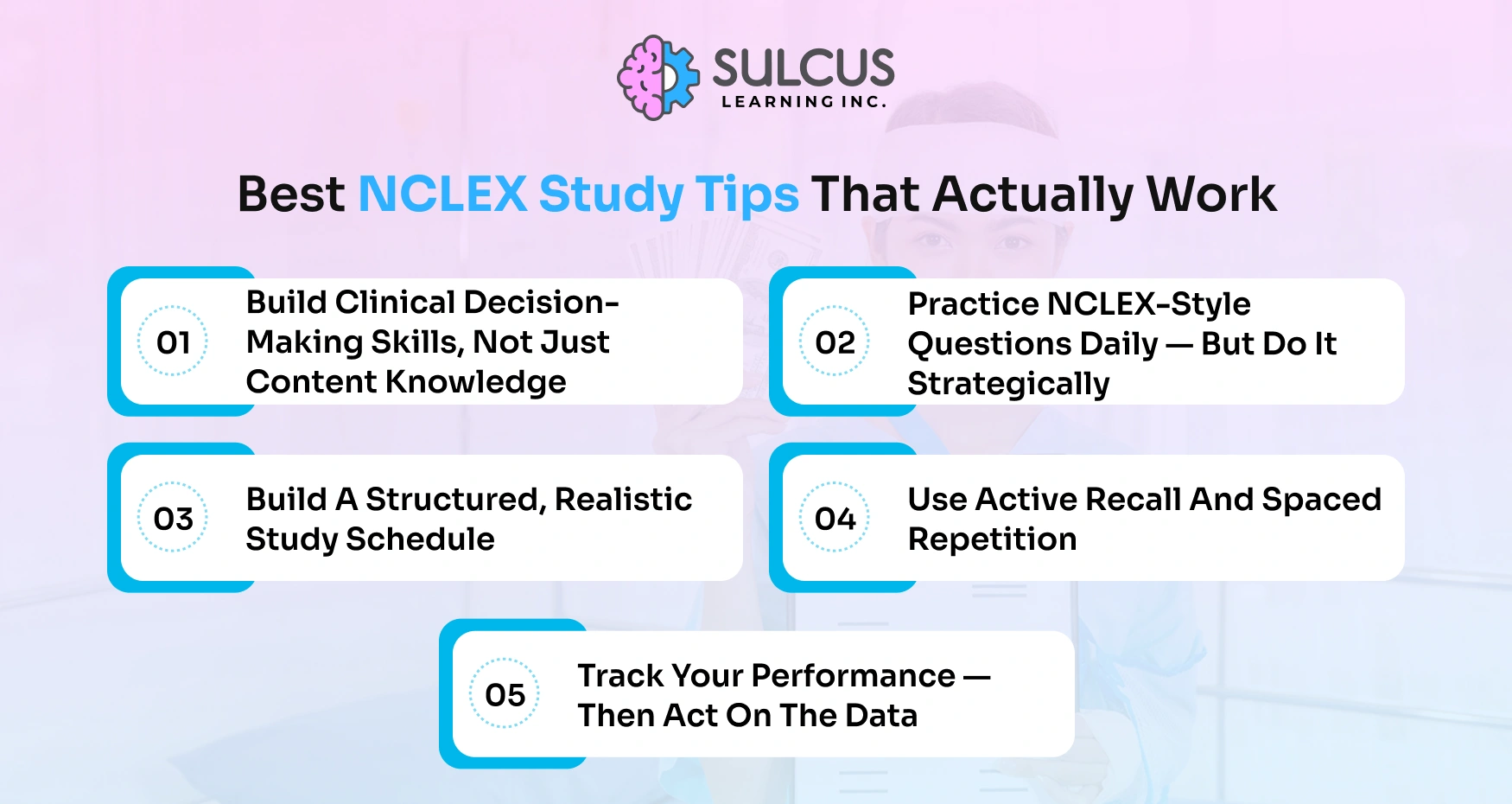
Effective NCLEX preparation centers on structured practice, building analytical skills, and employing focused study methods. Here are a few NCLEX study tips that adhere to the NCLEX framework and focus on the most efficient and effective methodologies highlighted by the National Council of State Boards of Nursing.
Tip 1: Build Clinical Decision-Making Skills, Not Just Content Knowledge
The NCLEX tests applied knowledge in the context of clinical care. Therefore, content memorization alone won’t help you prepare.
A strong approach is to consistently practice the clinical judgment process:
- What cues do I recognize in the question?
- Which findings are most clinically significant?
- What risks or complications could occur?
- What is the priority nursing action?
Utilizing this thought process while practicing clinical judgment on NCLEX-style questions will be beneficial in real nursing situations.
Tip 2: Practice NCLEX-Style Questions Daily — But Do It Strategically
Purely practicing a lot of questions without understanding the rationale behind the answer is of no big value to you. Understanding, not repetition, is the ultimate goal.
A more effective approach includes:
- Completing 75–100 high-quality NCLEX-style questions daily
- Carefully reviewing rationales for both correct and incorrect answers
- Identifying patterns in errors and decision-making
The most valuable part of clinical reasoning is understanding why something is correct and not just knowing what is correct.
Tip 3: Build a Structured, Realistic Study Schedule
Creating a structured NCLEX Study Plan that allows consistent progress is important. Good study plans could look like this:
- Content Review Blocks: Focus on high-yield systems such as cardiovascular, respiratory, neurological, and pharmacology
- Question Practice: Daily exposure to NCLEX and NGN-style questions
- Full-Length Practice Exams: At least 2–3 timed simulations before exam day
- Targeted Review: Dedicated time for areas identified as weak through performance analysis
Successful candidates typically study 4-6 hours a day for 6-8 weeks. Review and consistency typically have a greater impact than extensive studying in a short period.
Tip 4: Use Active Recall and Spaced Repetition
Among the least effective study methods is passive reading. Active learning and memory recall improve retention.
Effective strategies include:
- Testing yourself without looking at notes
- Answering practice questions from memory
- Using flashcards for key concepts and clinical priorities
The notable inclusion of spaced repetition involves adding difficult concepts at intervals to aid retention, especially those involving a rationale.
Tip 5: Track Your Performance — Then Act on the Data
Studying without performance tracking can lead to inefficient preparation. After each practice session, evaluate:
- Which content areas had the lowest accuracy?
- Which question types were most challenging?
- Are your scores improving over time?
By evaluating your performance, you can shift from passive study to active clinical practice that exercises by focusing on areas lacking in clinical judgment.
NCLEX Study Tips for RN vs. PN Candidates
Although both the NCLEX-RN and NCLEX-PN exams measure test takers’ critical thinking abilities through interactive exam questions, the exams differ in scope and the depth of critical thinking required.
NCLEX-RN Study Tips
Compared to the NCLEX-PN exam, the NCLEX-RN exam questions assume the test takers’ critical thinking to be on the complexity level of:
- Complex multi-system patient scenarios
- Management of care and delegation (a heavily tested area)
- Pharmacology with independent clinical reasoning
- Leadership in nursing: charge nurse scenarios, team communication, error prevention
RN candidates should commit to studying delegation frameworks, care management, and, especially, scenarios involving delegation to LPNs and UAPs. These questions are perennial staples and high-leverage topics.
NCLEX-PN Study Tips
The NCLEX PN exam is scoped to the practical or vocational nurse role, and is fundamentally supervised, structured, and bedside care-oriented.
Key topics include:
- Collaborative (not independent) clinical decision-making
- Medication administration and safe practice
- Recognizing changes in patient status and reporting appropriately
- Coordinating care within an RN-directed team
PN candidates need to focus on explaining the RN’s role within their own scope of practice. Again, this is a clinical judgment area on the NCLEX exam, and studying when to act on your own and when to draw the line in a clinical manner will yield the best results.
NCLEX Test-Taking Tips and Strategies
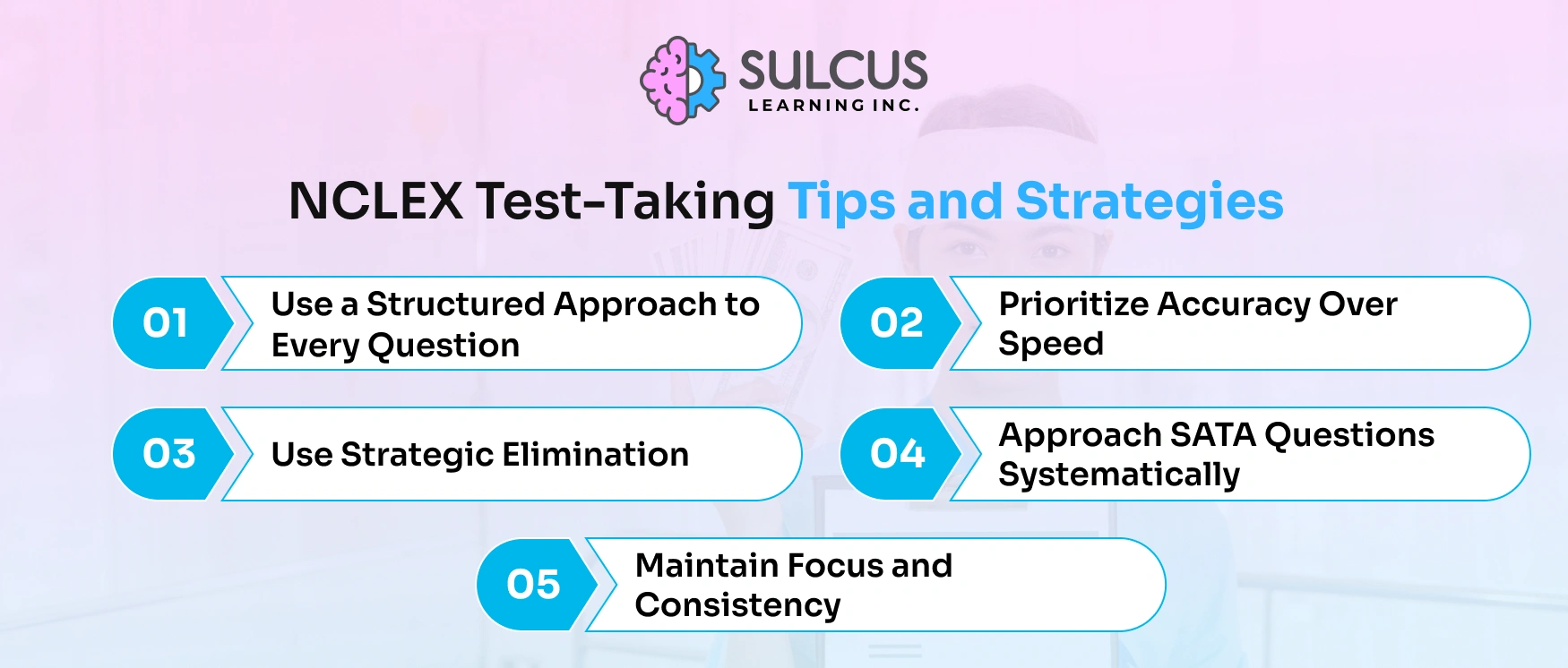
To succeed on the NCLEX-RN & PN at this time, you have to choose the right combination of knowledge, clinical reasoning, and professionalism to develop a strategy to help you answer the questions. You have to be aware of the guidelines on which the NCLEX-PN is based and developed by the National Council of State Boards of Nursing.
1. Use a Structured Approach to Every Question
A consistent method can improve both accuracy and confidence.
For each question, focus on:
- Identifying the client and the primary clinical problem
- Determining what the question is asking (assessment, intervention, or priority)
- Recognizing key cues and risks
- Selecting the safest and most appropriate nursing action
This structured thinking aligns with the clinical judgment model used in the NCLEX.
2. Prioritize Accuracy Over Speed
A common mistake is rushing through questions due to time pressure. However, the NCLEX allows up to five hours and may end as early as the minimum number of questions if the system determines competency.
Instead of trying to answer quickly, focus on answering correctly.
- Read each question carefully
- Take time to analyze clinical cues
- Avoid second-guessing without a clear reason
A slower, more deliberate approach often leads to better outcomes, especially since the exam may conclude once sufficient evidence of competence is achieved.
3. Use Strategic Elimination
When evaluating answer options:
- Eliminate clearly incorrect or unsafe choices first
- Focus on options that align with nursing priorities (safety, airway, circulation)
- Apply clinical reasoning to select the best answer
This method reduces uncertainty and improves decision-making accuracy.
4. Approach SATA Questions Systematically
For select-all-that-apply (SATA) questions:
- Treat each option as an individual true-or-false statement
- Do not rely on patterns or guessing strategies
- Base each decision on clinical knowledge and safety principles
This approach increases accuracy and aligns with how partial scoring is applied in NGN-style questions.
5. Maintain Focus and Consistency
- Avoid tracking the number of questions during the exam
- Stay focused on the current question only
- Trust your preparation and clinical reasoning
The NCLEX is not a race; it is an assessment of safe clinical decision-making that directly impacts overall NCLEX Pass Rates. Candidates who slow down, think critically, and prioritize accuracy are more likely to demonstrate the level of competence required to pass.
Tips for Answering NCLEX-Style Questions
Recognizing question types is critical for a successful NCLEX-RN. Look for prioritization phrases like, “The nurse should first.” Here, you’ll likely apply ABC, Maslow, or safety. “Which finding requires immediate intervention?” is a deterioration question. Look for abnormal or critical vitals or sudden clinical changes. The scope of delegation is a key point, while teaching questions explore a strong foundation of safe nursing practice.
For NGN case-scenario questions, always read everything before answering; these tend to be longer than average question-and-answer sets. Look for clinical cues: critical lab values, medications, and changes in vitals or staffing. Changes in clinical environments can be abrupt, so track them carefully; staffing changes can be abrupt or seem minor. Don’t forget, NGN will score each question independently.
Don’t be fooled. Options that seem “almost correct” can lead to the correct answer. You’ll find more questions preferring a nursing action over a medical one. Always listen to the patient and be deliberate with your answer; nursing assessment is the preferred first step before a nursing action.
Last-Minute NCLEX Tips (48 Hours Before Exam Day)
You should avoid cramming in the 48 hours leading up to the NCLEX. Use the time to take care of yourself and reinforce what you have learned.
What to Review (and What to Avoid)
Reviewed: Try to learn NCLEX test day test answers with quick reference materials, learning Ford Parsons, learning how to delegate, and learning major areas of pharmacology, focusing on the high-yield aspects. Reinforce the major areas of focus.
Avoided: Attempting to learn entire areas of content and practicing on NCLEX tests. These should be avoided as much as possible, especially the horror stories from previous test takers.
Mental and Physical Preparation
- Sleep: Non-negotiable! You should aim for 7 to 8 hours of sleep per night. Clinical reasoning is especially impaired when sleep-deprived and should be prioritized.
- Nutrition: Your analytical performance is neither improved nor inhibited by caffeine. Before the exam, take care of your body’s appetite, as balanced meals generally assist brain function more than hunger.
- Logistics: Exam day should be calm. Stress is avoidable. Know how to get to your testing center, bring the appropriate testing identification, and arrive 30 minutes before your scheduled testing time.
- Mindset: Remind yourself: Keeping the proper mindset is essential. The goal of the exam is not to get every answer correct, but to assess your clinical judgment to see if you are consistent yet safe.
Exam-Day Strategy
On exam day, mental preparedness meets content knowledge in the NCLEX test-taking strategy.
- Do the tutorial at the start, even if you are a pro at practice exams. It helps to bring your brain out of reality and into exam mode.
- When you feel like you are starting to have an anxiety attack. Stop. Take three long breaths, and then answer the question.
- Do not assess your performance by how difficult you perceive the question to be. If you are being pushed, the CAT (Computerized Adaptive Testing) is challenging you harder because you are performing well.
- The algorithm has made its choice, so do not think you’ve failed if an exam ends with 85 questions, as many students later search for how to know if they passed the NCLEX. Trust in your preparation.
Common NCLEX Study Mistakes to Avoid
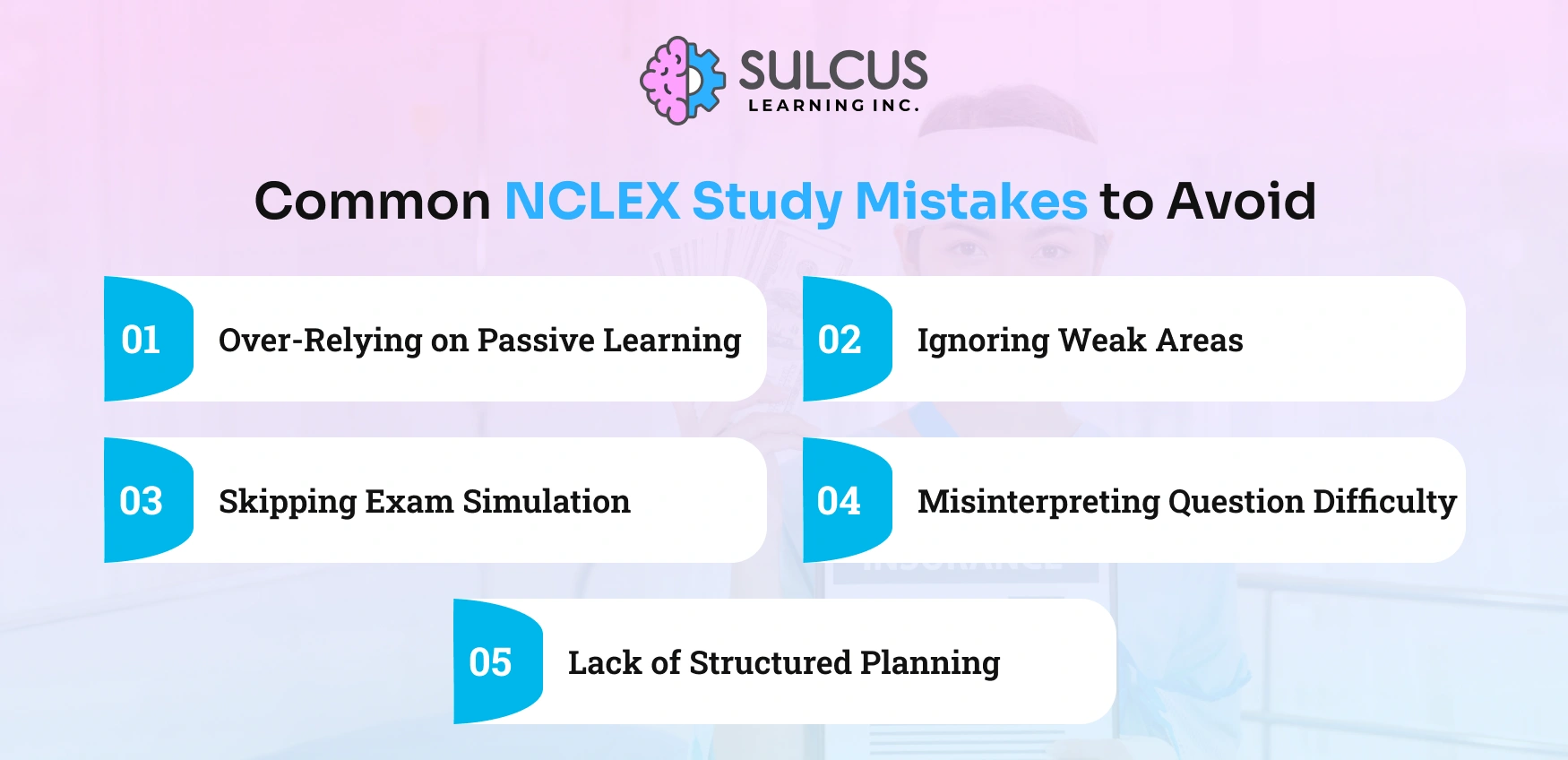
Preparing for the NCLEX-RN requires a focused, strategic effort, especially for candidates worried about what happens if they fail the NCLEX or how many times they can take the NCLEX exam. Avoid these common mistakes:
- Over-Relying on Passive Learning: Reading notes or watching lectures feels productive, but doesn’t lead to retention. Prioritize active practice, such as questions and self-testing.
- Ignoring Weak Areas: Focusing only on strengths limits progress. Build your study plan around weak topics.
- Skipping Exam Simulation: Not practicing full-length, timed tests reduces endurance and confidence on exam day.
- Misinterpreting Question Difficulty: Hard questions often indicate strong performance in CAT exams, don’t panic.
- Lack of Structured Planning: Studying without tracking progress or analyzing mistakes leads to slow improvement.
Next Generation NCLEX (NGN) Tips You Can’t Ignore
Unlike traditional NCLEX examinations that emphasize memorization, Next Generation NCLEX (NGN) will require test takers to use their critical thinking and clinical judgment.
1. Case-Based Question Strategy
NGN case studies include up to 6 linked questions about a single patient scenario.
Approach:
- Treat each case like a clinical handoff
- Identify patient context (age, diagnosis, current status)
- Keep that context in mind for every question
- Remember each question is scored independently
2. Understand the CJMM Framework
Each question tests one or more clinical judgment skills:
- Recognize Cues: Identify key data
- Analyze Cues: Interpret meaning
- Prioritize Hypotheses: Decide urgency
- Generate Solutions: Plan interventions
- Take Action: Implement care
- Evaluate Outcomes: Assess results
Match your thinking to the skill being tested.
3. How NGN Scoring Works
NGN uses partial-credit scoring, unlike the traditional model.
- You can earn points even if not fully correct
- Never leave answers blank
- Apply clinical reasoning, even when unsure
- Commit to the best-supported answer
How Sulcus Learning Helps You Pass NCLEX Faster
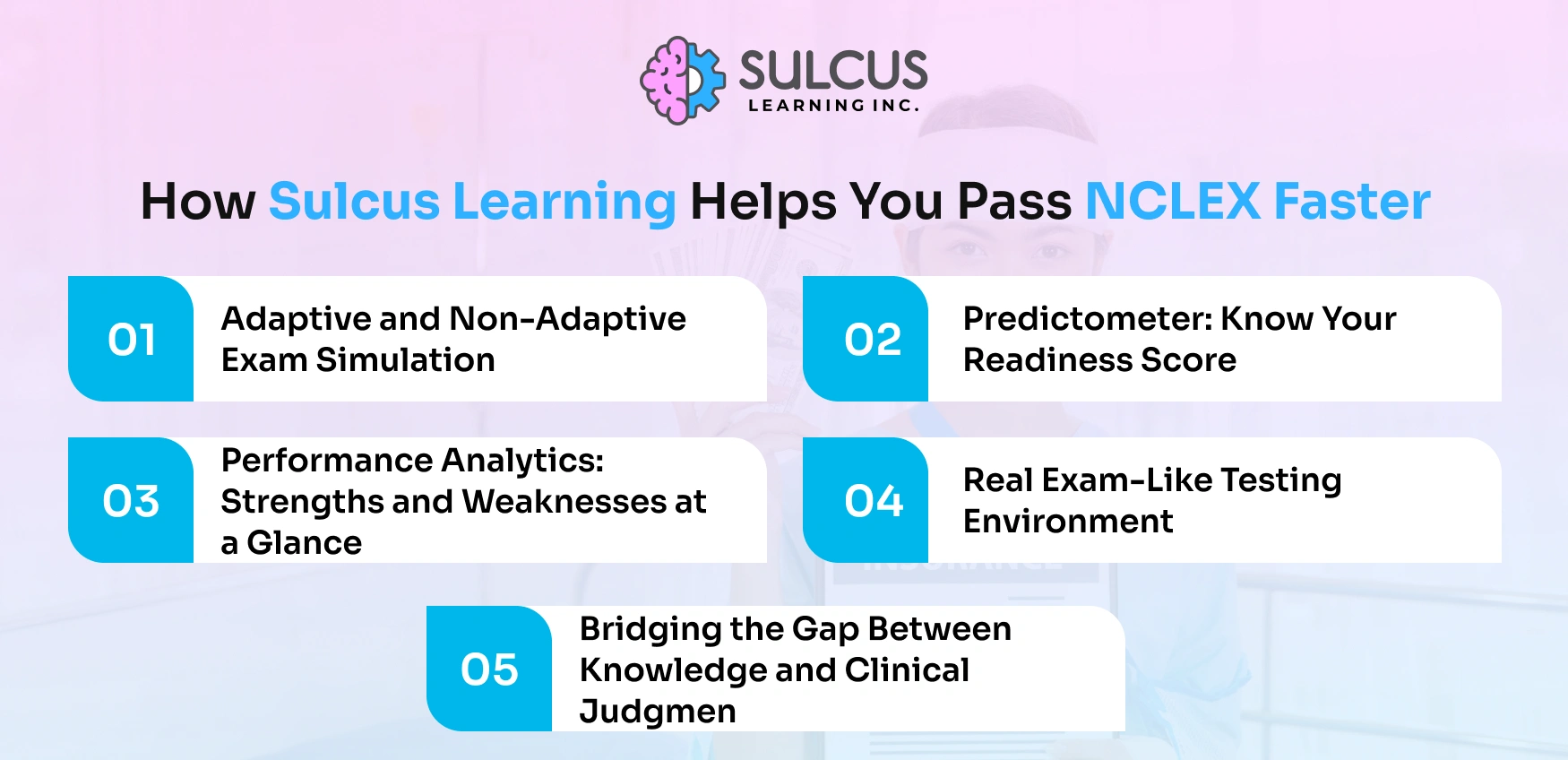
The other NCLEX prep tools ask you questions, while Sulcus Learning provides you with a system.
Sulcus Learning was created with the current NCLEX in mind, offering all NGN questions, adaptive exam simulations, and the Predictometer readiness scoring engine.
1. Adaptive and Non-Adaptive Exam Simulation
Sulcus offers both computer-adaptive testing (CAT-style) and non-adaptive (fixed-set) exam simulations, providing you the opportunity to build your clinical reasoning and content confidence. Practice in a manner similar to the NCLEX and isolate specific content areas to focus on.
2. Predictometer: Know Your Readiness Score
The Predictometer, Sulcus’s exam readiness scoring engine, processes your practice results in terms of question types, content areas, and clinical judgment to give you a real-time, “how ready are you to pass the NCLEX?”
With the Predictometer, you will have the guesswork taken out of your exam prep and can avoid the “do I have to start all over?” anxiety. You will receive the readiness score, indicating the area you are in.
3. Performance Analytics: Strengths and Weaknesses at a Glance
Each practice session contributes to your more nuanced Sulcus performance dashboard, similar to insights provided in the what is the Candidate Performance Report NCLEX process, which includes:
- Content area performance breakdown (by NCLEX client need category)
- Clinical judgment skill profiling (CJMM level performance)
- Question type accuracy trends (SATA, bow-tie, matrix, priority, etc.)
- Readiness trajectory over time
4. Real Exam-Like Testing Environment
To help familiarize users with the NCLEX testing environment, all controls, timer settings, and question formats will match those of the NCLEX. Users will likely know all controls by the time they sit for their NCLEX exam, helping reduce cognitive overload for clients.
5. Bridging the Gap Between Knowledge and Clinical Judgment
While many NCLEX practice products focus only on testing knowledge, Sulcus is engineered to judge users’ knowledge base simultaneously. Furthermore, each McQ will not only present the content in a box, but will also build users’ clinical judgment.
Sulcus can target Canadian nursing students who are taking the NCLEX for the first time, practicing in a new province, or seeking a structured, intelligent preparation framework that gives them a real competitive advantage.
Conclusion
The NCLEX is one of the most challenging and longest exams, which is why understanding the NCLEX Exam Costs in 2026 and registering for the NCLEX-RN beforehand is important.
However, it is a test that can be passed, and Canadian nursing students do pass this every day. In fact, differences in passing rates globally are very rarely related to intelligence or clinical competencies. The main factor is the preparation strategy.
Prepare wisely. Practice clinical judgment and don’t stress about what you recall. Use the NGN exam preparation materials, track your clinical and content judgment, and let the numbers plan your breaks.
The NCLEX is a test that retrospectively assesses students’ clinical and safety judgment, not about preparation. So aim to do the same.
FAQ’s
Q1. How many questions should I practice each day for the NCLEX?
Ans. Most experts recommend 75–100 quality questions per day, with a thorough rationale review for each. Volume matters less than depth of reflection. It’s far more valuable to truly understand 75 questions than to rush through 200 without retaining the reasoning.
Q2. How long should I study for the NCLEX?
Ans. Most candidates benefit from 6–8 weeks of structured preparation, studying 4–6 hours per day. Candidates with significant content gaps may need 10–12 weeks. Use a validated readiness tool like Sulcus’s Predictometer to know when you’re truly ready, don’t schedule your exam on a calendar timeline alone.
Q3. What are the best last-minute NCLEX tips?
Ans. In the final 48 hours: review priority frameworks and high-yield pharmacology, avoid new content, sleep 7–8 hours, eat well, and arrive early to your testing centre. The goal is mental clarity, not last-minute cramming.
Q4. What is the hardest part of the NCLEX?
Ans. Most candidates cite prioritization questions and NGN case studies as the most challenging. Both require clinical judgment, not just content recall, which is why traditional memorization-based prep often falls short. Practice with structured clinical reasoning frameworks (CJMM, ABC, Maslow) to build these skills before exam day.

Taran Kaur
As Managing Director and Lead Instructor at Sulcus Learning, Taran supports aspiring nurses in building their knowledge and confidence throughout their learning journey. With qualifications including a B.Sc. (Nursing), MBA (HM), ENCC, and CMSN(C), she is dedicated to helping learners succeed in licensure exams and professional practice. Connect with her on LinkedIn for insights.