
Each year, thousands of international nursing graduates take the NCLEX exam. Many of the candidates are from countries such as Canada, the U.S., and Australia, and most are from esteemed educational institutions; however, a large number still do not pass their exam on the first attempt.
This phenomenon may indicate inadequacies in developing solid knowledge bases that meet NCLEX requirements, but it may also reveal the disconnect many candidates experience between traditional/postsecondary education and the NCLEX.
Memorization and knowledge retention have been prioritized in many traditional/postsecondary education systems, but the NCLEX does not. The purpose of the NCLEX is to evaluate how candidates form safe, evidence-based judgments and, therefore, decisions.
For candidates, the NCLEX is a complex clinical scenario. The test is a computerized adaptive test that requires candidates to respond to questions required to identify, set, and prioritize a nursing need in the order of the clinical instance.
For nurses positioned to practice in the USA, Canada, or any other country, the NCLEX pass rate is an excellent benchmark of a nurse’s readiness to practice safe and high-quality care to nursing professional level.
This article analyzes the 2025–2026 NCLEX pass rate. I hope to help candidates prepare for and increase the probability of passing the exam.
Key Takeaways
- The NCLEX pass rate reflects preparation quality, not exam difficulty
- First-time candidates have the highest success probability
- Question count does not determine results
- Clinical judgment is now the core success factor
- Structured, data-driven preparation significantly improves outcomes
What Is the NCLEX Passing Rate?
The NCLEX pass rate provides public indicators to judge exam performance and graduates’ readiness for the nursing profession. It is the percentage of test-takers who pass the exam during a specified reporting period.
When candidates ask, “What is the NCLEX pass rate?”, they are typically referring to:
- The percentage of first-time test takers who pass
- The overall pass rate, including repeat candidates
- Performance benchmarks across regions, jurisdictions, or educational backgrounds
It is important to distinguish between two key concepts:
- Pass Rate: The percentage of candidates who succeed in passing the exam
- Passing Standard: The average minimum level of competence decided through the NCLEX measurement model and logit-based scoring.
The NCLEX is administered using a Computer Adaptive Testing (CAT) model, in which test takers receive a unique set of questions based on their previous answers. This advanced method measures candidates’ real-time skills and their ability to surpass a defined competence level. Analyzing test results efficiently also requires some familiarity with the Candidate Performance Report and CAT.
Latest NCLEX Pass Rates (2025–2026 Trends)
The National Council of State Boards of Nursing (NCSBN) and various nursing regulatory bodies provide data on first-time and repeat test-taker pass rates, as well as on domestically vs. internationally educated candidates.
Key Insights:
- First-time NCLEX-RN pass rate (U.S.-educated candidates): Approximately 85%–90%
- Internationally educated candidates (including those from Canada and Australia): Approximately 45%–60%
- Repeat test takers: Approximately 30%–45%
The results are the result of the reporting regulatory bodies and may vary from year to year and from jurisdiction to jurisdiction.
What These Numbers Mean
The data highlights cases, thereby creating a pattern, of first-time test takers who do not pass, and that the probability of these candidates passing on a subsequent attempt is significantly lower than that of repeat test takers in the population.
Knowledge gaps are not the only challenges to passing the exam. Therefore, the development of:
- Developing strong clinical judgment
- Understanding the NCLEX testing framework
- Practicing within a Computer Adaptive Testing environment
Repeat test takers in particular need to do a test, maturity should include preparation, readiness, and justification of the testing strategy. Once again, knowledge is important, but the path to the answer and the timing of the answer are even more critical.
NCLEX Pass Rate for First-Time Test Takers
According to the NCLEX, the National Council of State Boards of Nursing (NCSBN), first-time candidates have a higher pass rate than repeat candidates. This is a sign of the first-time candidates’ ability to meet the exam’s cognitive preparedness and maintenance requirements.
Why First-Time Candidates Perform Better
Several factors contribute to higher success rates among first-time test takers:
- Stronger retention of foundational nursing concepts immediately after graduation
- Closer alignment with current nursing curricula and clinical standards
- Higher confidence and reduced test fatigue compared to repeat attempts
The first attempt is paramount, as the candidate’s chances of success are distilled in this one attempt. It is of utmost importance for candidates to understand the Computer Adaptive Test (CAT) exam resourcing in their best strategic interest when taking the exam. Candidates are most academically and mentally prepared for this attempt at this time, which is the primary motivation for it.
This stress can be alleviated significantly with a solid understanding of several proprietary and unique exam resources, the exam’s question structure, possible reasons for the early shut-off, and resourcing.
NCLEX Pass Rates by State (US & Canada Comparison)
The following data reflects early 2026 trends and provides a benchmark for evaluating performance across different candidate groups.
NCLEX-RN Pass Rates (Q1 2026)
| Type of Candidate | Q1 2026 Pass Rate |
|---|---|
| First-time, U.S.-educated | 86.8% |
| Repeat, U.S.-educated | 52.4% |
| First-time, internationally educated | 51.6% |
| Repeat, internationally educated | 32.4% |
| Total (All Candidates) | 72.3% |
NCLEX-PN Pass Rates (Q1 2026)
| Type of Candidate | Q1 2026 Pass Rate |
|---|---|
| First-time, U.S.-educated | 86% |
| Repeat, U.S.-educated | 42.5% |
| First-time, internationally educated | 47.8% |
| Repeat, internationally educated | 22% |
| Total (All Candidates) | 76.9% |
Key Strategic Insights
- Approximately 86–87% of first-time U.S.-educated candidates pass the NCLEX, reinforcing the importance of early readiness
- Pass rates decline significantly, by approximately 30–50%, for repeat test takers, highlighting the increased difficulty of subsequent attempts
- Internationally educated candidates, including many from Canada and Australia, demonstrate moderate pass rates (approximately 47–52%), suggesting gaps in exam-specific preparation rather than foundational knowledge
What This Means for Canadian and International Candidates
For candidates educated outside the United States, these trends highlight a critical insight: success on the NCLEX is not solely dependent on academic knowledge.
Instead, performance is strongly influenced by:
- The ability to apply clinical judgment in unfamiliar scenarios
- Familiarity with the NCLEX testing model and CAT structure
- Exposure to exam-style questions that require prioritization, delegation, and decision-making
For Canadian nursing students and internationally educated nurses, this emphasizes the need to shift from traditional academic preparation toward exam-focused clinical reasoning and strategy.
NCLEX Pass Rates by State (US) and Provinces/Territories (Canada)
NCLEX pass rates are made public in the US. Because of this, many analyses have been conducted focusing on candidates, the institutions that train them, and their geographical locations. As a result, there are opportunities for candidates to competitively assess themselves.
Canada has seemingly made no such effort to institutionalize the reporting of pass rates by province and/or territory. Given the availability and value of information in the US, there are general regional and national trends in pass rates that can aid in examining candidates with varying degrees of preparation.
United States: NCLEX Pass Rate by State (Indicative Trends)
Although there are differences in reporting, there are differences in pass rates that are reflective of their approximate trends from year to year. Below are the approximate pass rate ranges by state:
| State | NCLEX Pass Rate Range |
|---|---|
| California | 85%–90% |
| Texas | 88%–92% |
| New York | 82%–88% |
| Florida | 78%–85% |
| Illinois | 85%–91% |
| Pennsylvania | 87%–92% |
The NCLEX pass rate in California is often closely monitored due to the high volume of internationally educated candidates, which can influence overall outcomes.
Canada: Provinces and Territories Context
Although province-specific pass rates are not formally published, all candidates across Canada take the same NCLEX examination administered by the National Council of State Boards of Nursing (NCSBN). This ensures consistency in exam difficulty and evaluation standards nationwide.
Major Provinces
- Ontario
- British Columbia
- Alberta
- Quebec
- Manitoba
- Saskatchewan
- Nova Scotia
- New Brunswick
- Prince Edward Island
- Newfoundland and Labrador
Canadian Territories
- Yukon
- Northwest Territories
- Nunavut
Canada NCLEX Pass Rate Insights
| Candidate Type | Column 2 |
|---|---|
| Canadian-educated candidates | 70%–85% |
| Internationally educated candidates (outside Canada) | 40%–60% |
These ranges are based on aggregated trends from regulatory reporting and should be interpreted as general benchmarks rather than exact provincial data.
What This Means for Canadian Students
For candidates in Canada, one key factor is that, as in many other professional licensure exams, a candidate’s province or territory of residence does not reflect the difficulty of the NCLEX. With the NCLEX, the testing framework is standardized (except for the unique NCLEX jurisdictional variability).
However, outcomes may still vary due to factors such as:
- Differences in educational preparation and clinical exposure
- Familiarity with the NCLEX testing model (Computer Adaptive Testing)
- Level of training in clinical judgment and decision-making
As for students in Canada specifically, another key point to be aware of is that there are more than one NCLEX pathway to licensure in the U.S., and that there are differences between NCLEX-RN and NCLEX-PN, including prerequisite and eligibility criteria.
NCLEX Pass Rate by Question Count
NCLEX exam takers are often under the impression that answering 150 questions will statistically increase their likelihood of passing the exam. Unfortunately, this belief is incorrect.
Reality
- Passing or failing is not determined by the number of questions you receive
- The exam continues until it reaches 95% confidence in assessing your ability
- The stopping point varies for each candidate based on performance
The NCLEX is meant to test candidates’ clinical knowledge and judgment, not their stamina. Candidates can pass or fail at any point within the exam limit based on the consistency and certainty of their knowledge.
So in the end, how many questions you answer is irrelevant, and how correctly you answer your questions is what matters.
What Is the Passing Standard for NCLEX?
The NCLEX uses a standard based on a measurement theory developed by the National Council of State Boards of Nursing (NCSBN). They developed a logit scale that indicates whether a candidate’s ability falls below the required baseline for practice as a nurse.
Key Points
- A candidate must answer consistently above the established passing standard.
- The exam is adjusting in real time. Answers to previous questions determine the next questions given.
- Performance on the exam is gauged as a whole, not on individual questions, so you must perform above the passing standard on the majority of the questions.
- The candidate’s behavioral assessment is particularly significant for the Next Generation NCLEX (NGN).
What This Means for Your Preparation
The NCLEX is not something that can be tested on with content alone, and studies must also focus on high level clinical judgment as well as high level clinical paradigm for candidates’ questions like those found on the actual NCLEX.
- Strengthening clinical judgment and decision-making skills
- Practicing with exam-style questions that reflect real NCLEX scenarios
- Understanding how the Computer Adaptive Testing (CAT) system evaluates performance
If you understand the structure and the studies that correlate with the NCLEX, and stop focusing on nonsensical myths like how many questions are on the NCLEX, it will help you be successful.
Factors That Influence NCLEX Passing Rates
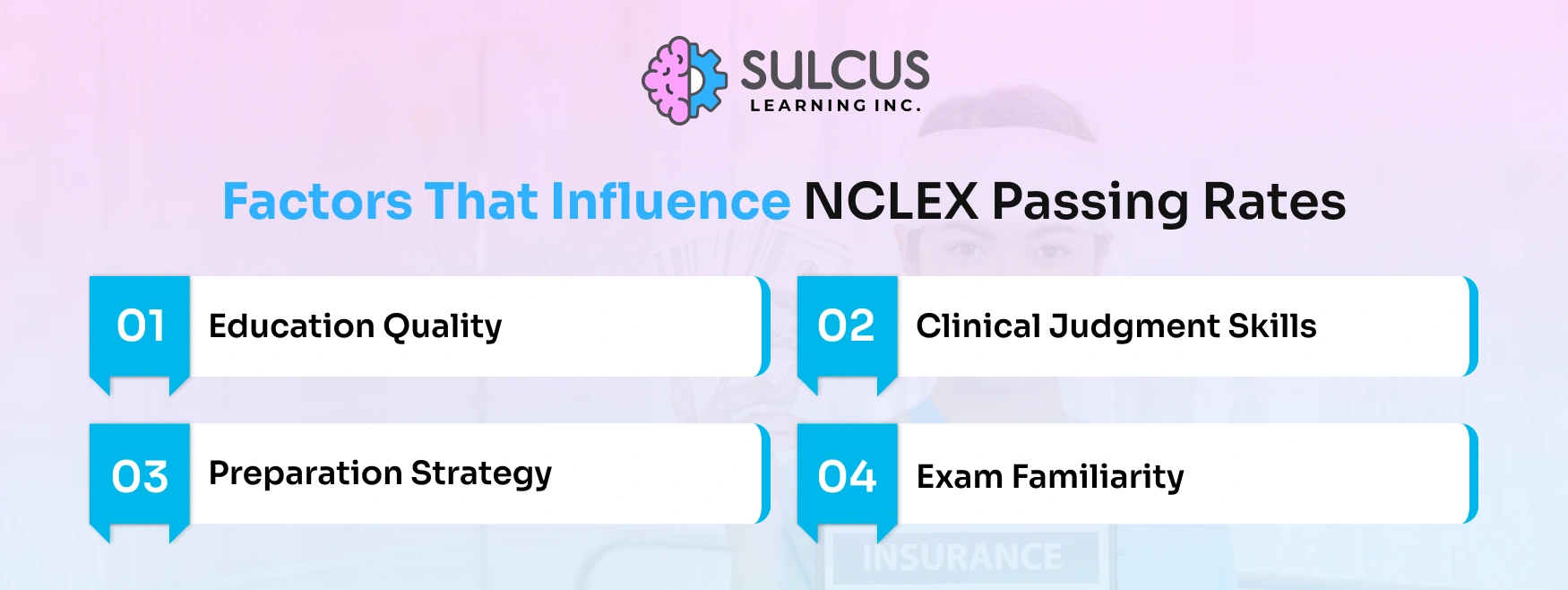
A variety of factors contribute to NCLEX passing rates. Knowing them can help candidates optimize their preparation.
1. Education Quality
Better performing nursing programs usually establish course content alongside the NCLEX. Candidates are taught to be engaged and committed to assessing themselves and the clinical data, ultimately gathering the information needed to ensure clinical decisions are implemented and carried out safely.
2. Clinical Judgment Skills
The NCLEX, particularly in its Next Generation format, emphasizes clinical judgment. Success depends on a candidate’s ability to analyze information, prioritize care, and make appropriate decisions in complex clinical scenarios. This shift reflects real-world nursing practice, where critical thinking is essential.
3. Preparation Strategy
A data-driven, targeted, and specific study framework is more advantageous for a candidate than a broader, more general one. Results are more efficient when study frameworks assess personal weaknesses and determine performance indicators.
4. Exam Familiarity
There is a direct correlation between test-day performance, the candidate’s prior knowledge, self-replacement of the assessment, and the NCLEX. Candidates who understand the NCLEX’s adapted test format, familiarize themselves with the types of questions on the NCLEX, and understand what is going to occur on the given day, tend to feel more confident and portray that on the test as well.
How to Improve Your Chances of Passing the NCLEX
Improving your chances of passing the NCLEX requires a focused, strategic approach that aligns with the exam’s design. The following methods can significantly enhance your readiness:
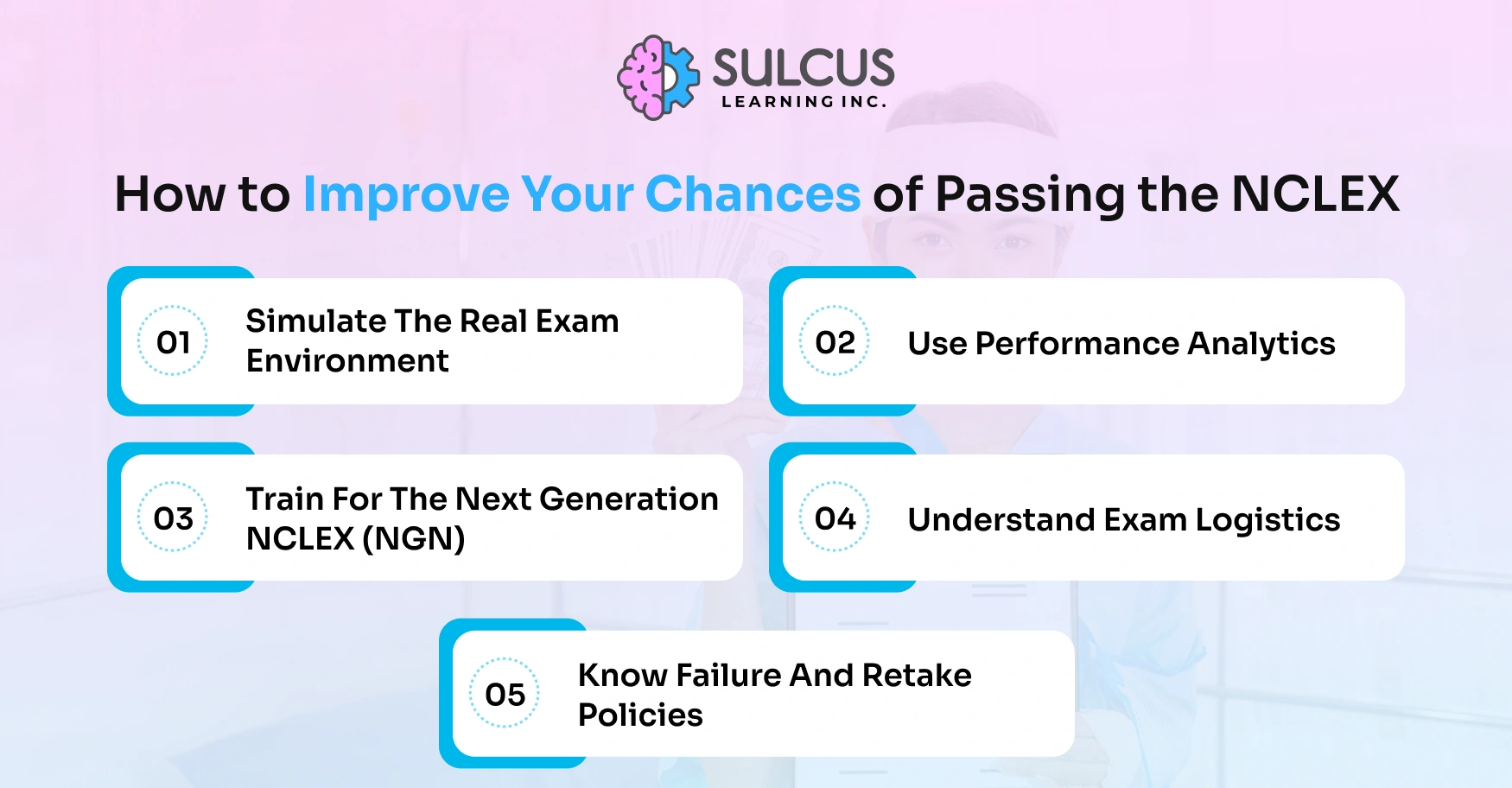
- Simulate the Real Exam Environment: Get your hands on adaptive computerized testing (CAT) mocks to get you used to how a question progresses and to familiarize you with the testing format.
- Use Performance Analytics: Quarterly and detailed reports will help you identify weaknesses to keep improving. Narrow your gap, focus your studies, and avoid extrinsic study time.
- Train for the Next Generation NCLEX (NGN): Train for the NGN by practicing both scenario and case-based questions. These will help improve your clinical judgment.
- Understand Exam Logistics: Familiarize yourself with NCLEX exam logistics including costs to take the NCLEX exam in 2026, retake policies, and NCLEX exam limits
- Know Failure and Retake Policies: Plan and be informed about both success strategies and failure strategies to be as fully prepared for NCLEX as you can, no matter the outcome.
Being informed about both success strategies and contingency planning ensures you are fully prepared for the NCLEX, regardless of the outcome.
Common Misconceptions About NCLEX Pass Rates
Understanding common myths about NCLEX pass rates can help candidates focus on what truly impacts success.
Myth 1: A high NCLEX pass rate means the exam is easy
Reality: The NCLEX maintains a fixed competency standard set by the National Council of State Boards of Nursing (NCSBN). A higher pass rate does not indicate an easier exam; rather, it reflects that candidates are better prepared and meeting the required standard for safe nursing practice.
Myth 2: Reaching 150 questions means you failed
Reality: The number of questions you receive has no direct relationship to passing or failing. The NCLEX uses a Computer Adaptive Testing (CAT) model, which continues until it reaches a confident decision about your ability. Candidates can pass or fail at any point within the question range.
Myth 3: NCLEX pass rate by state determines your success
Reality: Pass rates may vary across states in the United States, but the exam itself is standardized. Your outcome depends on your preparation, clinical judgment, and ability to meet the competency threshold, not on geographic location.
How Sulcus Learning Helps You Pass Your NCLEX Exam
Sulcus Learning bridges the gap between content knowledge and clinical judgment, as reflected in the NCLEX pass rate.
Key Advantages:
- True CAT-Based Exam Simulation: Utilizes the NCSBN’s three Computer Adaptive Testing principles and logit-based scoring for high fidelity.
- Predictometer: Offers an evidence-based readiness score that indicates the likelihood of NCLEX success on the actual exam.
- Advanced Performance Analytics: Provides precise competency analysis and identifies your primary strengths and weaknesses.
- Real Exam Simulation: Offers an NCLEX experience, including time and pressure constraints, along with clinical judgment.
Why This Matters
Unlike generic question banks, Sulcus Learning aligns directly with how the NCLEX evaluates candidates. It focuses not just on what you know, but on how consistently you perform relative to the passing standard.
This approach helps you:
- Build clinical judgment under adaptive testing conditions
- Understand your performance in terms of competency, not just percentages
- Gain confidence through measurable, data-backed progress
If your goal is to pass the NCLEX on your first attempt, this type of exam-aligned preparation becomes a strategic advantage, not just a study tool.

Conclusion
Regardless of the challenges posed by the NCLEX, preparing for the exam should be rooted in its expectations. Research shows that candidates taking the exam for the first time who concentrate on clinical judgement, adaptive testing, and organized studying perform better than the average.
For Canadian and International nursing students, there is a need of a shift in the focus of your studies from the number of resources or prep books you may have to practicing more of the understanding.
When you have a plan that is structured more towards practicing the competency the NCLEX has dozens of competencies on, you will be able to move out of the zone of unpredictability to the zone of high performance for best passing on your first attempt.
FAQ’s
Q1. What is the NCLEX pass rate?
Ans. The NCLEX pass rate varies by candidate type and educational background. First-time candidates educated in the United States typically achieve pass rates of approximately 85%–90%, while internationally educated candidates, including many from Canada, generally fall within the 45%–60% range, depending on preparation and exam readiness.
Q2. What is the passing rate for first-time NCLEX candidates?
Ans. First-time NCLEX candidates consistently demonstrate the highest success rates, often exceeding 85%. This is largely due to recent academic exposure, stronger retention of core concepts, and better alignment with current NCLEX testing standards.
Q3. What is the NCLEX pass rate for Canadian students?
Ans. Canadian-educated NCLEX candidates typically achieve pass rates of 70%–85%. Outcomes vary based on factors such as program alignment with NCLEX frameworks, clinical judgment training, and the use of structured, exam-focused preparation strategies.
Q4. Does getting 150 questions mean you failed?
Ans. No. The number of questions you receive does not determine your result. The NCLEX uses Computer Adaptive Testing (CAT), meaning the exam continues until it reaches a high level of confidence in your competency. Candidates can pass or fail at any point within the question range.
Q5. What is the NCLEX pass rate by state?
Ans. NCLEX pass rates by state in the United States generally range from approximately 78% to over 90%. These variations are influenced by factors such as the quality of education and candidate demographics; however, individual preparation remains the most important determinant of success.

Taran Kaur
As Managing Director and Lead Instructor at Sulcus Learning, Taran supports aspiring nurses in building their knowledge and confidence throughout their learning journey. With qualifications including a B.Sc. (Nursing), MBA (HM), ENCC, and CMSN(C), she is dedicated to helping learners succeed in licensure exams and professional practice. Connect with her on LinkedIn for insights.