
Healthcare is a field where decisions need to be made in seconds. The difference made in outcomes is determined by correct or incorrect decisions. For this reason, modern nursing is not defined by what information a person knows. It is defined by how a person uses that information at a given moment.
Given the dynamics of today’s clinical setting, the quality of nursing clinical judgment is pivotal to maintaining safety and ensuring that care is correct and centred on the client. Nurses have to manage complicated and multifaceted problems. Nurses have to respond to rapidly changing situations and environments. In these varying situations, the nurse needs to think, prioritize, and act without hesitation and in confidence.
This is especially true for people preparing to sit for licensing examinations and for individuals new to professional practice. For this reason, we have created this guide to help you understand what we mean by clinical judgment in nursing. Here, you will learn the definition, meaning, process, and practical examples of how to improve clinical judgment in the year 2026 and beyond.
Key Takeaways
- Clinical judgment in nursing focuses on applying knowledge, interpreting patient data, and making timely, safe care decisions.
- Modern nursing emphasizes decision-making skills over memorization, requiring nurses to think critically and act confidently in real-time scenarios.
- Clinical judgment improves patient safety, reduces errors, and ensures high-quality, evidence-based care in complex healthcare environments.
- The clinical judgment process includes cue recognition, data analysis, prioritization, solution planning, action implementation, and outcome evaluation.
- Nursing exams like NCLEX and CPNRE now assess reasoning, prioritization, and real-world decision-making instead of theoretical knowledge recall.
- Simulation-based learning and mock tests help nurses build confidence, improve accuracy, and strengthen clinical reasoning under pressure.
- Avoiding common mistakes, such as poor prioritization and insufficient analysis, significantly enhances clinical judgment and overall nursing performance.
What Is Clinical Judgment in Nursing?
Through clinical judgment, nurses provide safe, high-quality, timely care by interpreting relevant client information, understanding the client’s needs, and prioritizing them. This is a step further than having a clinical fact at one’s disposal, but it is the manifestation of a clinical fact ‘in action’.
In practice, this is what clinical judgment means to nurses:
- Evolving assessments and interpretations of the client’s condition.
- Making accurate decisions in unpredictable and time-pressured scenarios.
- Adjusting care plans according to the client’s feedback and health status.
Memorizing information, as in theoretical classes, is one of the key things clinical judgment is not about. Rather, it is the reasoning, the thinking, and the prompt action that are contextually associated. A dedicated clinician tunes into the data stream of assessments and diagnoses, leading to a determination of the condition in anticipation of its progression.
This is what changes in the content outline of the NCLEX-PN, NCLEX-RN, CPNRE, and RExPN that accurately define nursing licensure. These exams test the candidate’s ability to move beyond information recall to the wise application of clinical judgment and rational, virtuous decision-making in prompt, safe scenarios. Such clinical judgment is the next level of competency that nurses are required to achieve to practice in modern, multi-layered health care systems.
Why Clinical Judgment Is Critical in Modern Nursing (2026 Perspective)
Current nurses utilize skills beyond knowledge. With growing complexity in health conditions and nursing technologies, nurses must analyze, synthesize, make informed decisions on the spot, and adapt in context. In 2026, there are still growing expectations of clinical judgment. The complexity of today’s clinical environment has additional challenges like rapid and coordinated response.
Today’s clinical environments are increasingly complex and demand a higher level of judgment due to:
- Clients presenting with multiple, co-existing health conditions.
- Advanced technologies generating continuous streams of clinical data.
- Situations that require rapid, accurate, and coordinated decision-making.
In this setting, strong clinical judgment is essential to:
- Promote client safety and deliver high-quality, evidence-based care.
- Reduce the risk of errors in high-pressure or time-sensitive scenarios.
- Improve overall clinical outcomes and care effectiveness.
Today’s nursing licensure examinations are designed to assess the candidate’s clinical judgment. Current NCLEX-RN, NCLEX-PN, RExPN, and CPNRE examination tips to assess knowledge, data comprehension and analysis, care prioritizing, and safe decision-making in a clinical setting. These examinations are a welcome change from the traditional emphasis on memory to a focus on realistic nursing decision-making and actions.
The growing aim of modern licensing evaluations is clinical judgment. For example, understanding what the NCLEX Exam is means appreciating how contemporary testing frameworks have prioritized clinical judgment, decision-making, and real-world scenarios.
Clinical Judgment vs Clinical Thinking vs Critical Thinking
Even though clinical thinking, clinical judgment, and critical thinking are frequently used interchangeably, in modern nursing practice, there are levels of cognitive processing that must be differentiated. This differentiation is important for safe and effective client care and success in today’s licensing exams, including the NCLEX-RN, NCLEX-PN, RExPN, and CPNRE.
At the most fundamental level, critical thinking is the ability to analyze, assess, and evaluate information in an unbiased and objective manner. In nursing, critical thinking supports the understanding of complex clinical concepts and enables the nurse to reach a valid, logical conclusion based on evidence. It is the foundation for all clinical reasoning.
Clinical thinking is the next level up. This sort of thinking applies knowledge and theory to practice. It entails the ability to assess information, detect trends, and correlate clinical information with its corresponding pathophysiology. Nursing clinical thinking is the understanding of what the information means about a specific client.
Clinical judgment is the supreme level of thinking. This sort of thinking is about decisions and actions. It is the ability to discern and manage client needs appropriately, do the right thing, and act safely and effectively on the spur of the moment. In clinical judgment, one needs the knowledge, the ability to interpret, and the ability to act and assess in clinical situations.
There is a progression in understanding these three concepts. Nursing begins with analyzing the information (critical thinking), then understanding what it means in a clinical context (clinical thinking), and finally making decisions and taking action (clinical judgment). The progression describes what is expected in nursing today: safe and effective nursing is the seamless integration of knowledge and rapid, appropriate action.
| Concept | Definition | Primary Focus | Role in Nursing Practice |
|---|---|---|---|
| Critical Thinking | Objective analysis and evaluation of information | General reasoning and logic | Supports understanding of complex concepts and problem-solving |
| Critical Thinking | Application of theoretical knowledge to clinical situations | Interpretation of clinical data | Connects signs, symptoms, and pathophysiology |
| Clinical Judgment | Decision-making and action based on clinical evidence | Prioritization and intervention | Guides safe, timely, and effective client care |
In today’s nursing practice setting, clinical judgment is the most important concept. This is also true for assessment. Modern nursing exams focus on a nurse’s ability to use knowledge in a given situation to make safe decisions, and to prioritize actions, rather than assess knowledge. Nurses who appreciate the differences between the three concepts can enhance their structured thinking. This, in turn, will positively impact their exam results and clinical practice.
The Clinical Judgment Process: Step-by-Step Breakdown
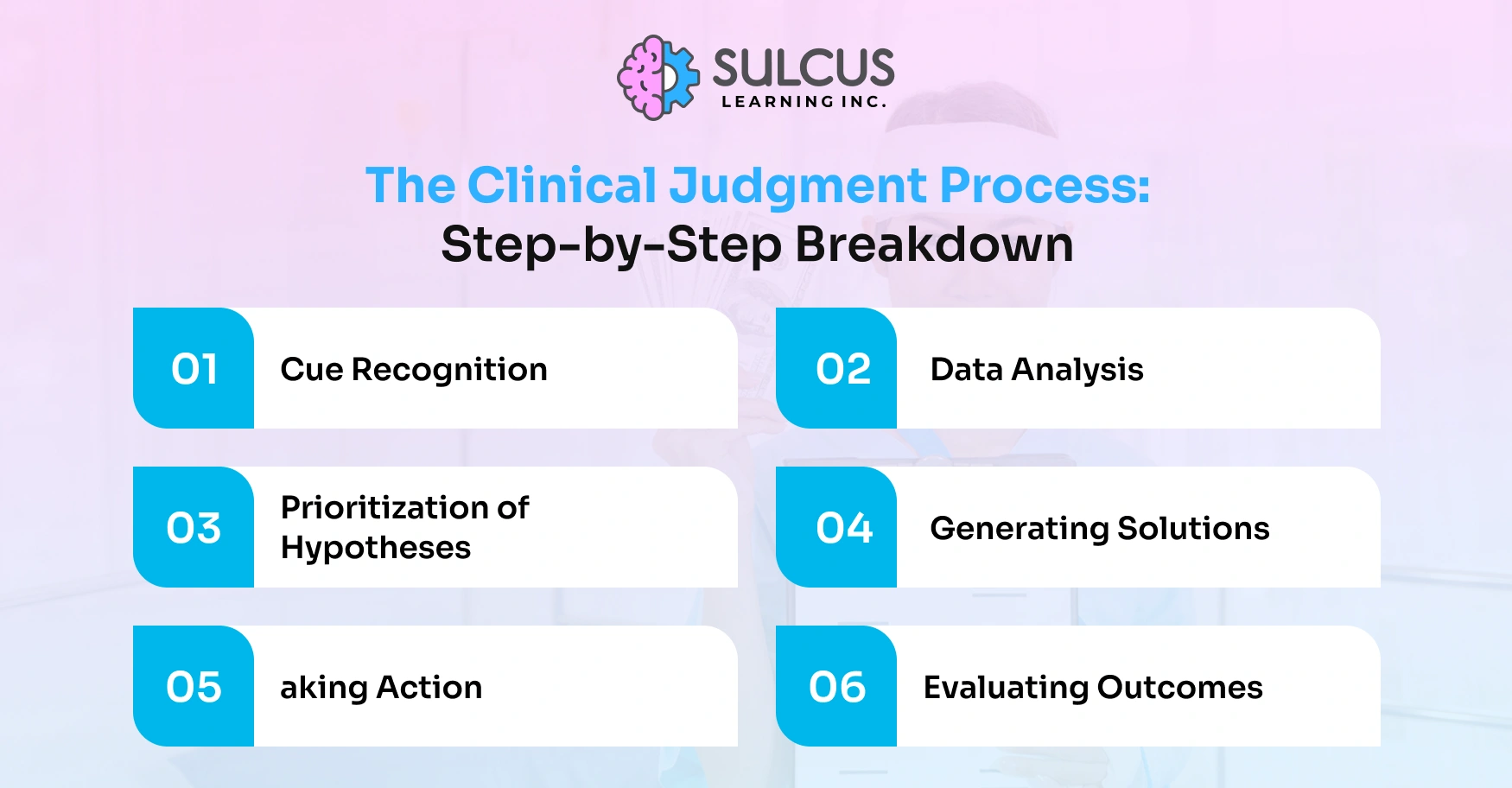
In addition to Clinical Judgment serving as a framework for the mental pathway and the sequence of tasks and steps that will take place during an encounter, Clinical Judgment involves various processes that, if applied, help nurses make safe, appropriate, and timely decisions during a clinical judgment encounter.
1. Cue Recognition
In Cue Recognition, the clinician interprets and differentiates relevant data to the client, i.e., patient’s symptoms, vitals, medical and surgical history, surroundings, etc., and determines how medical data should be processed, synthesized, and to what degree attached medical data should be filed with the patient.
2. Data Analysis
In Data Analysis, you explain the synthesized data, i.e., patterns, predispositions, and potential other negative detrimental outcomes if Clinical Judgment is absent. This is the point where Clinical Judgment is exercised.
3. Prioritization of Hypotheses
The subsequent stage is Prioritization of Hypotheses, where you, as the clinician, make an assessment of the client’s health problems, where you hypothesize and establish how severe and critical the problems could reasonably be, depending on the level of clinical care.
4. Generating Solutions
In Generating Solutions, the focus should be on planning the nursing interventions that are appropriate for the identified priority. Factoring in evidence-based practices, client’s needs, and possible outcomes, nurses choose the care approach that is the most effective and safe.
5. Taking Action
In Taking Action, the chosen nursing interventions are executed effectively and safely. Nurses are expected to take action, and when doing so, they must be confident. The care that is provided must be in accordance with the clinical guidelines and be flexible to the real-time needs.
6. Evaluating Outcomes
The final step is Evaluation of Outcome. It explains the purpose of the evaluations in terms of understanding the degree to which patient goals of care have been reached, how much of the care goals have been achieved, and how much of the care goals have been achieved.
The focus of this approach is the foundation of clinical judgment in nursing and is an essential element of contemporary licensing exams in evaluative clinical reasoning.
Key Components of Clinical Judgment in Nursing Practice
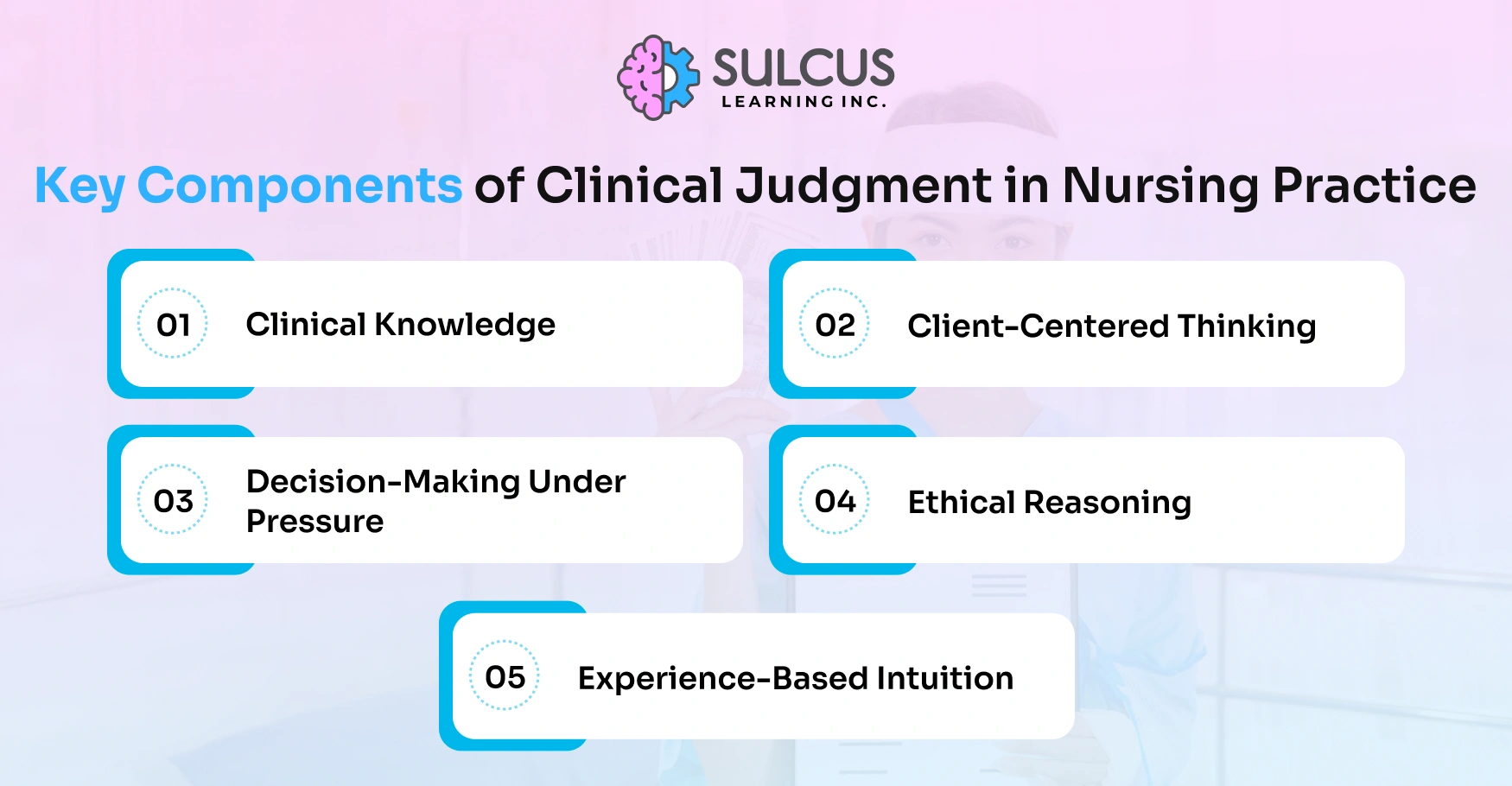
Clinical Judgment in nursing practice is an ability built on knowledge, experience, and quick-thinking skills that allows nursing professionals to practice safe, effective, and patient-focused care.
1. Clinical Knowledge
Clinical knowledge is essential to any nursing practitioner’s clinical judgment. Through experience and practice, knowledge becomes the foundation, and the more refined the knowledge is, the more evolved and complex the clinical judgment becomes.
2. Client-Centered Thinking
Client-centered thinking is the art of nursing. It reflects the entire practice, which is personalized, culturally competent, and ultimately aligned with the client’s health care objectives. It reflects the entire nursing practice.
3. Decision-Making Under Pressure
Decision-making is the ability of the clinical practitioner to make a decision, most often, in a client’s place. The practitioner should be able to make the right decision.
4. Ethical Reasoning
Ethical reasoning is the process of ensuring that choices made in nursing align with the law, nursing practice, and moral principles. This process involves considering the concepts of justice, fairness, privacy, and the client’s rights, and making justified decisions to provide care that is safe, respectful, and legally defensible.
5. Experience-Based Intuition
Nursing is a practice, and the more the knowledge is honed with experience, the better the practice becomes. It becomes refined for the practitioner to better recognize the situations. That is, it enhances the clinical practitioner to make the right judgment.
All skills mentioned above can be further improved through practice and experience. However, the practitioner must continually refine the above skills, as they are crucial for nursing practice and for future assessments.
Real Examples of Clinical Judgment in Nursing
Clinical judgment in nursing shows how nursing theory can be safely implemented in practice. In Canada’s nursing systems, nurse clinicians are required to make accurate nursing judgments and respond to changes in the client’s condition with confidence.
The following are practical examples of how clinical judgment is used:
- Early Recognition and Intervention: Improving patient outcomes in nursing depends on early response to patient changes, such as changes in breathing patterns.
- Prioritizing Care Effectively: In patient care with a large number of patients to attend to, time and resource constraints mean that a nurse chooses a patient who is rapidly deteriorating to provide care rather than a patient who is clinically stable.
- Adapting Care based on Response: When a nurse provides care, especially regarding their nursing care, and assesses the patient’s response to the treatment to alter the nursing care in such a way as to make the intervention more effective.
The examples demonstrate that clinical judgment in nursing is about knowledge, but more importantly, about timely and well-adequate prioritization of actions and the continuous evaluation of the situation at hand.
The decision-making methodologies and case-based queries reflect the practical side of the nursing examination, and these cases are assessed using clinical judgment in nursing. For nursing assessment, practice exam case scenarios are useful.
Clinical Judgment in NCLEX, REx-PN & CPNRE Exams
Much of today’s exam content is focused on clear reasoning and clinical judgment in practice – making clinical judgment in nursing a vital and principal competency considered in every major nursing exam in Canada and worldwide.
These exams evaluate your knowledge and skills in:
- Clinical scenarios and questions that reflect real clinical practice
- Critical thinking, prioritizing, and planning steps to perform a clinical intervention in a given case
- A series of complex scenarios that evaluate your reasoning rather than knowledge.
The 2026 NCLEX Changes sparked the introduction of more advanced reasoning and judgment frameworks. Candidates will be expected to have a concrete understanding of data interpretation, patient prioritization, and the ability to make clinically protected, evidence-based decisions. Similarly, practical reasoning is a significant focus in the RExPN Exam Tips rather than memorization.
Your ability to successfully use the Canadian clinical judgment model is the key to passing the exams. Therefore, practicing judgment frameworks to improve your reasoning and analytical skills is of utmost importance.
Common Mistakes That Affect Clinical Judgment
Many nursing students find clinical judgment difficult because of simple mistakes that could have been avoided with a simple solution. Avoiding these problems early in the process improves your decision-making skills and test performance.
Here are Key Mistakes to Avoid:
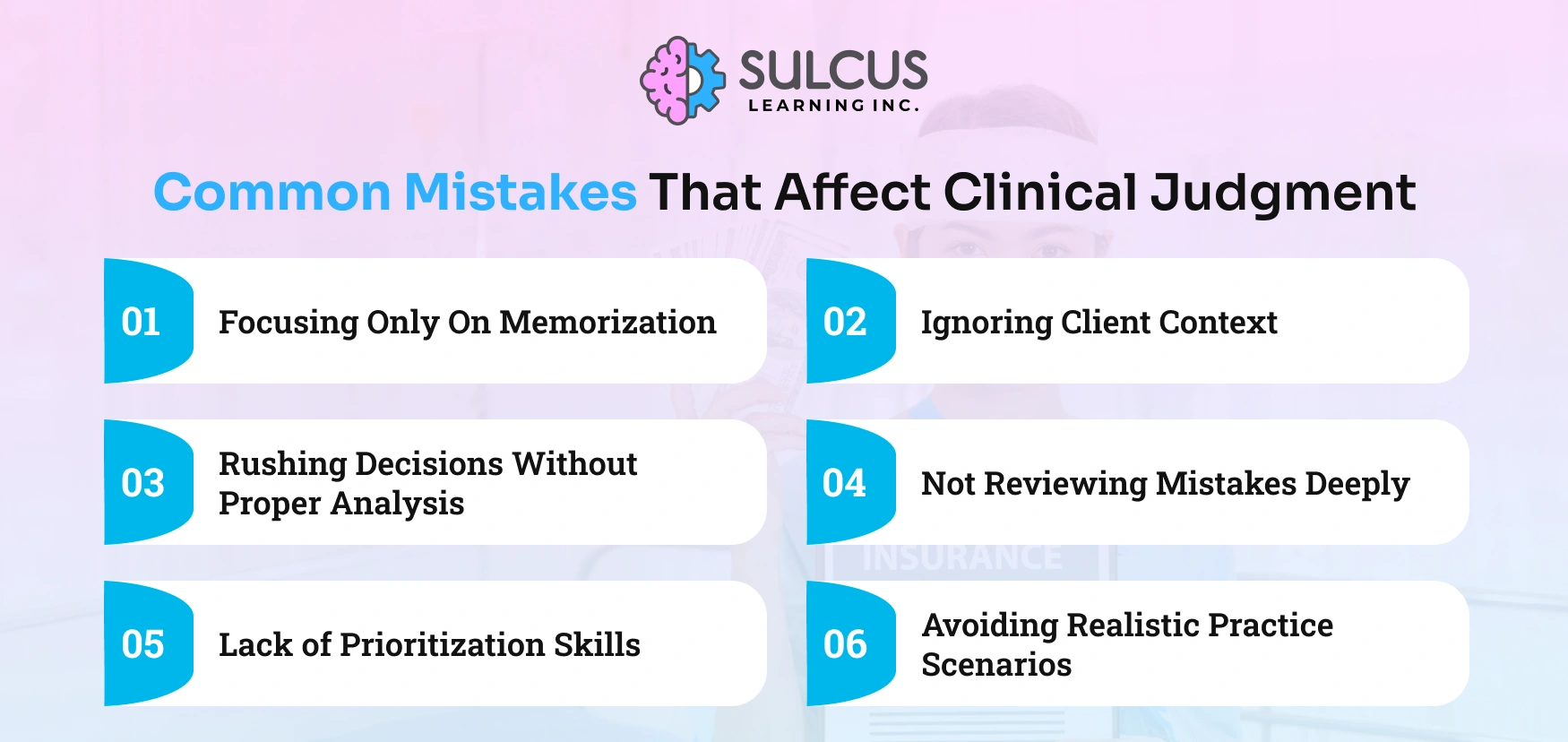
- Focusing Only On Memorization: Relying on understanding the theories and memorization as your only source of information. If you haven’t got any practical, hands-on experience, it severely limits your ability to make real time clinical decisions.
- Ignoring Client Context: Ignoring their individual circumstances, their background, and the environments in which these people exist creates a context that is either misunderstood or incomplete altogether, leading to inaccurate clinical assessments
- Rushing Decisions Without Proper Analysis: Making quick decisions without interpreting data thoroughly increases the risk of errors in care planning and prioritization.
- Not Reviewing Mistakes Deeply: Not thinking enough and failing to analyze why the answer is wrong creates a knowledge vacuum in the clinician, slowing the process of improving clinical judgment.
- Lack of Prioritization Skills: Failing to decide which client needs immediate attention can drastically compromise patient safety and clinical outcomes.
- Avoiding Realistic Practice Scenarios: If you avoid simulators and experiential practice, you limit your exposure to real-world clinical situations.
The mistakes discussed can be easily avoided and can positively improve your clinical judgment for the better; you will, in addition, be able to approach the exams and practicum clinical placements with greater confidence.
Role of Simulation & Mock Tests in Developing Clinical Judgment
The importance of strengthening one’s clinical judgment cannot be overstated in nursing. Simulation-based learning allows students to take what they’ve learned in the classroom and apply it to make decisions in highly realistic, safe scenarios. This essentially enables seamless transition from the classroom to the real world.
Importance of Mock tests, in particular, helps you:
- Experience real exam pressure and time constraints
- Apply clinical judgment frameworks in structured scenarios
- Improve accuracy, speed, and confidence in decision-making
These resources are highly useful in preparation for licensing exams because they replicate exam structure and what is expected of you. This also helps you to practicalise the goals of becoming a nurse by developing the skills needed for clinical practice and exam success.
Challenges Nurses Face While Applying Clinical Judgment
Nursing clinical judgment is a skill that is difficult to master. Indeed, even seasoned nursing professionals experience considerable challenges in their clinical judgment. When managing a fast-moving nursing care situation that carries a significant volume of clinical and managerial responsibility, the challenges can significantly affect the accuracy of nursing judgment.
Key challenges include:
- Time Pressure: The nurse managing the situation has a significant time challenge, and therefore, the decision making has to occur without the opportunity to perform a thorough analysis of the situation, and the situation is therefore prone to a significant risk of errors
- Complex Client Cases: The client being seen is an individual with multiple health challenges; therefore, the nurse’s clinical judgment must be at a higher-than-normal level of sophistication and advanced thinking to integrate and remain focused on the key clinical aspects.
- Information Overload: There is an abundance of continually updating clinically relevant data, and, in fact, the critical clinical data goes unrecognized, and decisions may be made without critical data being integrated in the decision at the clinical nursing level
- Emotional and Mental Stress: The individual nurse may be in an emotionally and mentally stressed state due to the primary nursing role responsibility balance owing the nature of the clinical situation, and this can have a significant negative impact on the focus, confidence, and clinical performance of the nurse as a clinician.
Overcoming these challenges requires consistent practice, reflective learning, and exposure to real-world scenarios that strengthen decision-making skills over time.
How Sulcus Learning Supports Clinical Judgment Development
Today’s nursing examinations and clinical practice move beyond mere memorization and require the nursing practitioner to use their knowledge, analyze information, and make safe decisions on the spot. Sulcus Learning and the like are adopting this new model of clinical judgment as a core competency to meet these standards.
Sulcus Learning is a nursing-specific preparatory platform designed to align with the latest structures and standards of the licensure examinations, namely, NCLEX-RN, NCLEX-PN, RExPN, and CPNRE. The platform is designed to move beyond rote memorization and move toward real life application, clinical reasoning, and decision making, which are fundamental not only to the safe practice of nursing, but also to the success in the examinations.
The incorporation of Computer Adaptive Testing (CAT) is a major asset of Sulcus Learning, enabling students to experience exam conditions that approximate those of actual tests. This helps students gain confidence and adapt to the rigorous nature of contemporary testing, which includes variability in question difficulty based on students’ responses.
In addition to adaptive testing, Sulcus Learning offers:
- High-quality, exam-aligned practice questions based on real clinical scenarios.
- Detailed rationales that promote deeper understanding and clinical reasoning.
- Performance analytics that identify strengths and areas for improvement.
- Readiness indicators that help students assess their exam readiness.
- Both adaptive and non-adaptive testing modes support different stages of learning.
Students can analyze their performance and identify areas that need attention and improvement. Structured feedback systems allow for the progressive strengthening of clinical judgment over the period.
Learning at Sulcus goes beyond teaching students how to pass tests. Students are trained to think clinically like nurses. As the best nursing online prep platform, Sulcus uses scenario-based questions and clinical judgment exercises to help students think critically, prioritize effectively, and apply nursing concepts in real-world situations.
Conclusion
Modern-day nursing practice integrates clinical judgement. This involves practical knowledge, client safety, and the overall effectiveness of nursing practice. The evolution of healthcare practice has made the integration of knowledge into practice crucial for success.
Nursing involves thinking critically and acting promptly and confidently in emergencies. The ability to analyze client data is pertinent, and prioritizing care is essential. Reflection and consistent improvement is necessary for better outcomes.
It is vital for all nursing students in Canada and necessary for the attainment of desirable outcomes, as it fosters professional development, supports passing the NCLEX, REx-PN, and CPNRE licensing exams, and enables quality nursing practice.
FAQ’s
Q1. What is clinical judgment in nursing?
Ans. Clinical judgment in nursing is the ability to assess patient data, interpret clinical information, prioritize needs, and take appropriate actions to ensure safe, effective, and evidence-based patient care in real healthcare settings.
Q2. Why is clinical judgment important?
Ans. Clinical judgment is important because it directly impacts patient safety, reduces medical errors, improves care outcomes, and is a core competency required to successfully pass modern nursing licensure exams like NCLEX, REx-PN, and CPNRE.
Q3. How can I improve clinical judgment in nursing?
Ans. You can improve clinical judgment in nursing by practicing case-based questions, analyzing answer rationales, taking mock tests, reflecting on mistakes, and applying theoretical knowledge to real-life clinical scenarios consistently over time.
Q4. Is clinical judgment tested in NCLEX and CPNRE?
Ans. Yes, clinical judgment is heavily tested in NCLEX, REx-PN, and CPNRE through case-based questions, clinical scenarios, and decision-making frameworks that evaluate a candidate’s ability to apply knowledge in practical patient care situations.
Q5. What are examples of clinical judgment in nursing?
Ans. Examples of clinical judgment in nursing include identifying patient deterioration early, prioritizing urgent care needs, selecting appropriate interventions, adjusting treatment plans based on responses, and ensuring patient safety through timely decisions.
Q6. What is the clinical judgment process in nursing?
Ans. The clinical judgment process in nursing includes recognizing cues, analyzing patient data, prioritizing hypotheses, generating solutions, taking appropriate actions, and evaluating outcomes to ensure effective, safe, and patient-centered clinical decision-making in practice.

Taran Kaur
As Managing Director and Lead Instructor at Sulcus Learning, Taran supports aspiring nurses in building their knowledge and confidence throughout their learning journey. With qualifications including a B.Sc. (Nursing), MBA (HM), ENCC, and CMSN(C), she is dedicated to helping learners succeed in licensure exams and professional practice. Connect with her on LinkedIn for insights.