

The nursing workforce is shrinking. The WHO has warned that nursing shortages will reach catastrophic levels if no efforts to stem the tide are implemented. The WHO estimates a global need for 9 million additional nurses by 2030. With the NCLEX in constant demand in Canada to license eligible nurses and combat the nursing workforce shortage, it has become a national healthcare imperative.
Contemplation dominates the hours after an NCLEX exam. Graduates are left to answer their questions on their own for 2 to 72 hours while results are finalized. With the exception of the NCLEX exams, the NCLEX exams are silent. Graduates use the Pearson VUE trick in preparation for the NCLEX silence.
For the last decade or so, nursing practitioners in Canada and the US have used this trick as an NCLEX score predictor. This guide draws on a blend of clinical experience and unique knowledge of the CNLS to tell you what you need to know.
We’ll cover what the Pearson VUE NCLEX trick is, how to do it correctly, what the ‘good pop-up’ and ‘bad pop-up’ actually mean, how accurate it is in 2026, and what your next steps should be regardless of what you see on the screen.
What Is the Pearson VUE NCLEX Trick?
The Pearson VUE NCLEX Trick is an unapproved technique that some nursing graduates have developed to get a preliminary idea of whether they have passed or failed the NCLEX exam. This works outside the official process for receiving results from the NCSBN or a Canadian provincial nursing regulatory body.
This trick exploits a minor flaw in Pearson VUE’s registration system. After taking the NCLEX, if the candidate tries to register again on Pearson VUE’s site, the system’s response to the request is said to reveal the candidate’s exam score.
The Pearson Vue feature is not official, at least as intended. The NCSBN (National Council of State Boards of Nursing) and Pearson Vue have neither designed nor endorsed this feature. Discovered by the community, nursing students have discussed the feature publicly and privately for some time. Though not official, it appears to be accurate.
The Historical Context
The Pearson VUE Trick was originally circulated informally and was used in conjunction with the first generation of CAT NCLEX exams. Long before social media and even RN-focused sites, nursing graduates passed on the trick via word of mouth in nursing schools and hospital break rooms.
This trick’s functionality has been confirmed by thousands of candidates over the years. First, despite the many updates Pearson VUE has made to its registration system, many candidates can still use the trick with the same effectiveness as ever in 2026.
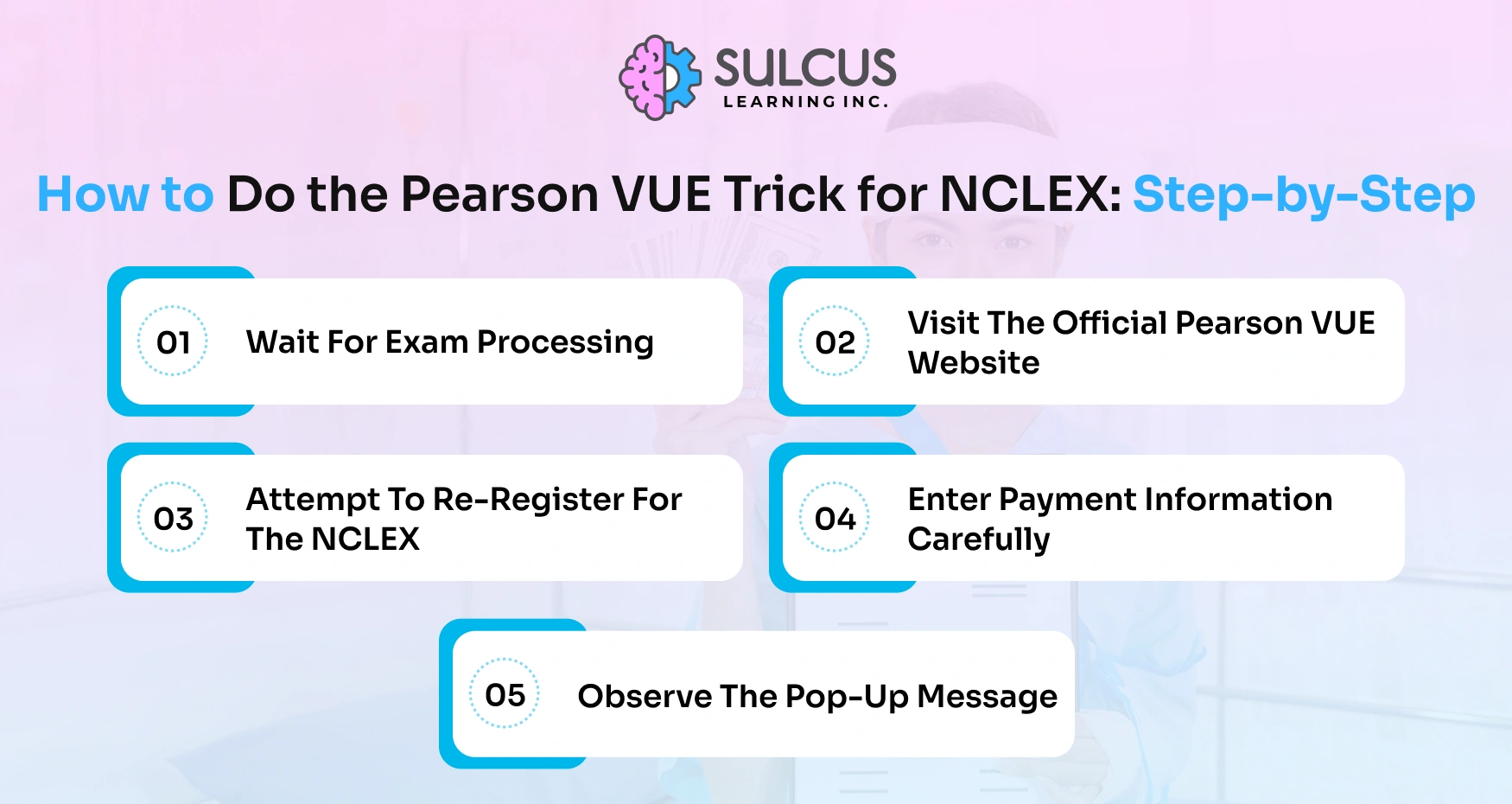
How to Do the Pearson VUE Trick for NCLEX: Step-by-Step
Before we go through the steps, we want to stress to Canadian nursing students that the NCLEX-RN and NCLEX-PN Canadian exam platforms are both Pearson VUE. There is a possibility that the trick works on both.
Step 1: Wait for Exam Processing
Most candidates recommend waiting at least 24 hours after completing the NCLEX before attempting the Pearson VUE Trick. Attempting the process too early may yield inaccurate or inconsistent results because exam data and scoring may still be being processed within the system.
Step 2: Visit the Official Pearson VUE Website
Go to the official Pearson VUE NCLEX website and log in to the same account you used to register for your exam.
Using the correct account information is important because the system checks the status of your previously completed exam registration.
Step 3: Attempt to Re-Register for the NCLEX
After logging in:
- Select the appropriate NCLEX examination.
- Proceed as though you are registering to take the exam again.
- Follow the registration prompts carefully.
Candidates who recently completed the exam often re-register for the same exam type they previously took, such as the NCLEX-RN or NCLEX-PN.
Step 4: Enter Payment Information Carefully
During registration, the system may ask for payment details. Many candidates stop before fully submitting payment because accidentally submitting a second registration could potentially result in additional charges.
For this reason, many nursing graduates prefer to avoid completing the final payment submission unless they fully intend to register again.
Step 5: Observe the Pop-Up Message
After proceeding through the registration attempt, the system may generate a message or “pop-up.” This is the part of the process candidates refer to as the Pearson VUE Trick. Generally:
- A “good pop-up” is believed by many candidates to suggest a passing result.
- A “bad pop-up” is commonly interpreted as a possible unsuccessful result.
- Occasionally, candidates may receive messages that are unclear or contradictory.
It is important to remember that these messages are unofficial indicators only and should never be treated as confirmed exam results.
Official results are released only through:
- Provincial or state nursing regulatory bodies.
- Quick Results services (where available).
- Official licensing portals and registration systems.
Because exam processing systems can change over time, the accuracy and reliability of the Pearson VUE Trick are never guaranteed.
The Good Pop-Up vs. The Bad Pop-Up
What these pop-ups are is absolutely critical to understanding what the Pearson VUE trick means for the NCLEX.
The Good Pop-Up (Positive Indicator)
The pop-up that states, “Our records indicate you have recently scheduled this exam. Please contact your Member Board for further assistance,” is considered a good pop-up by the NCLEX community.
Receiving this pop-up means your results have been processed, and you most likely passed the NCLEX. The system is not allowing you to proceed with the registration because it shows that your exam is closed and requires a NCLEX passing score.
The Bad Pop-Up (Concerning Indicator)
If you are able to proceed to the payment page and are not getting a pop-up from the system that is blocking you from completing re-registration and payment, this is the bad pop-up.
This means your exam is being seen as open and unresolved. In the Pearson VUE community, this means you likely have not passed the exam. The NCLEX community actually thinks the bad pop-up is less important than the good pop-up and this is why.
Good Pop-Up vs. Bad Pop-Up: At a Glance
Here is a quick comparison to help you understand what each outcome means and how to interpret it:
| Features | Good Pop-up | Bad Pop-up |
|---|---|---|
| What it means | Likely passed NCLEX | Likely did not pass the NCLEX |
| Registration attempt | System blocks re-registration | The system allows re-registration + payment page |
| Accuracy rate | ~97–99% (community-reported) | ~85–90% (slightly less reliable) |
| Official result? | No, unofficial indicator only | No, unofficial indicator only |
| Action to take | Wait for official NCSBN/CNO results | Wait for official results; consider next steps |
| Applies to NCLEX-RN? | Yes | Yes |
| Applies to NCLEX-PN? | Yes | Yes |
How Accurate Is the Pearson VUE Trick for NCLEX?
How reliable is the Pearson Vue NCLEX “pop-up” trick? After many years of gathering data from multiple communities on Facebook, RN forums, and the NCLEX subreddit, I found that the Pearson Vue email pop-up trick had a 97% pass prediction rate- which is surprisingly accurate for an unofficial trick.
On the other hand, a “bad pop-up” displayed an 85- 92% pass prediction. It is also important to note that many students who received a bad pop-up were cleared to re-register and successfully passed the NCLEX.
Why the discrepancy? Several factors can influence what pop-up you see:
- Processing Delays: Pearson VUE can be slow at certain times of the week, especially on weekends, which can affect connections.
- Timing Of The Attempt: Trying the trick before completing the 24-hour cycle can greatly affect what pop-up you receive.
- Technical Glitches: All systems have flaws, including Pearson. A bug could greatly affect which pop-up you received.
- Recent System Updates: Like every other system, Pearson VUE is making changes. A system change can greatly affect the trick.
Caution: As the NCLEX changes 2026, Pearson VUE’s system was updated to accommodate changes to the Next Generation NCLEX (NGN) and other NCSBN updates. Although NGN may still run, the system has become more unstable. Always have the pop-up trick be more of an example.
What Happens After You Do the Trick?
The waiting period between completing the NCLEX and receiving the results is often the longest and hardest. It is even harder to endure when you have received a good pop-up or a bad pop-up. Here is a list of what you need to know regarding results and what you do after your NCLEX results become official.
Official NCLEX Results in Canada
For Canadian students, the official NCLEX results can sometimes be released early. If you’re willing to pay a small fee, you can find out before the official results are posted.
The Quick Results are released to Pearson Vue about 48 hours after the test. Otherwise, the results of the NCLEX will be sent to the regulatory body for nursing in your province. Provincial and Territorial Nursing Regulatory Bodies in Canada
British Columbia
- British Columbia College of Nurses and Midwives
Alberta
- College of Registered Nurses of Alberta
- College of Licensed Practical Nurses of Alberta
Saskatchewan
- College of Registered Nurses of Saskatchewan
- Saskatchewan Association of Licensed Practical Nurses
Manitoba
- College of Registered Nurses of Manitoba
- College of Licensed Practical Nurses of Manitoba
Ontario
- College of Nurses of Ontario
Quebec
- Ordre des infirmières et infirmiers du Québec
- Ordre des infirmières et infirmiers auxiliaires du Québec
New Brunswick
- Nurses Association of New Brunswick
- Association of New Brunswick Licensed Practical Nurses
Nova Scotia
- Nova Scotia College of Nursing
Prince Edward Island
- College of Registered Nurses and Midwives of Prince Edward Island
- College of Licensed Practical Nurses of Prince Edward Island
Newfoundland and Labrador
- College of Registered Nurses of Newfoundland and Labrador
- College of Licensed Practical Nurses of Newfoundland and Labrador
Yukon
- Yukon Registered Nurses Association
Northwest Territories and Nunavut
- Registered Nurses Association of the Northwest Territories and Nunavut
These regulatory authorities are responsible for:
- Reviewing NCLEX results.
- Confirming eligibility and registration requirements.
- Issuing nursing licenses or permits.
- Protecting public safety and nursing standards within their jurisdictions.
If the Good Pop-Up Is Correct
If you received the good pop-up, and your results officially show that you passed, great job! After that, you have to finish the final steps for registration and certification to practice nursing in your province, complete your portal registration, set up your nursing PIN, and finalize any first-day job orientation.
If the Bad Pop-Up or a Failed Result Appears
Failing the NCLEX results is hard to take. After hearing about the journeys of many nursing graduates, failing the NCLEX is a temporary setback, and in no way speaks to your skill and promise to become a nursing professional.
According to NCSBN, you may retake the NCLEX after 45 days if you do not pass. You can take the NCLEX in Canada as many times as you want. However, some provinces may have specific rules, so you should always check with your regulatory body.
At this point, your main focus should be on what you were most deficient in. If you failed the test, you can request the Candidate Performance Report (CPR) to see your exact scores for the NCLEX content areas. If you combine the report with a good exam prep platform that is similar to the CAT-style exam and provides you with a good study plan, you should more than likely pass upon retaking the exam.
Why Canadian Nursing Students Should Approach the Trick Cautiously
Throughout my years of clinical practice and teaching nursing students in various parts of Canada, I want to say this: The Pearson VUE Trick (PVT) is a poor choice, justified by the anxiety that comes from completing the NCLEX and the anxiety that comes from waiting for the results, both of which are very justifiable.
However, there are specific reasons why Canadian students in particular should use this trick with caution:
- Provincial Processing Timelines Vary: There is no connection between state boards and Quick Results in the US, as we do here in Canada with the provincial regulatory colleges. Just because you get a good pop-up does not mean your provincial college has processed your licensing registration.
- Rex-PN Candidates Should Note: If you are writing the REx-PN (Regulatory Exam for Practical Nurses) and not the NCLEX-PN through Pearson Vue, the Pearson VUE does not apply to the trick. The REx-PN is done through a completely different system.
- CPNRE Has Been Largely Retired: As many provinces in Canada have switched to the NCLEX-RN and REx-PN, very few Canadian candidates still take the CPNRE. If you are taking the CPNRE, the Pearson VUE trick will not apply.
- Mental Health Matters: Focusing on unofficial results (especially pop-ups) is not right. If you should not be anxious, but now you are, and the unofficial results are causing you a lot of anxiety, just wait for the official results and clear your mind.
Does the Pearson VUE Trick Still Work in 2026?
Pearson VUE Trick is one of the most popular subjects searched for by Nursing Students for the 2026 NCLEX. The answer is yes, the reliability over the years has decreased.
Because of all the updates NCBSN has added to the NGN, Pearson VUE has had to make multiple back-end updates.
The trick still works; however, the results and consistency have been inconsistent over the years. The most common report concerning the inconsistency of results for the Pearson VUE Trick is the bad pop-up. Although the bad pop-up is reported as inconsistent with results, the trick is still highly reliable.
The trick is most reliable when used as a supplemental signal, not the final answer. If the result shows a good pop-up, you have a very good chance of passing. If you see a bad pop-up, please do not panic, wait, and take action on the official results.
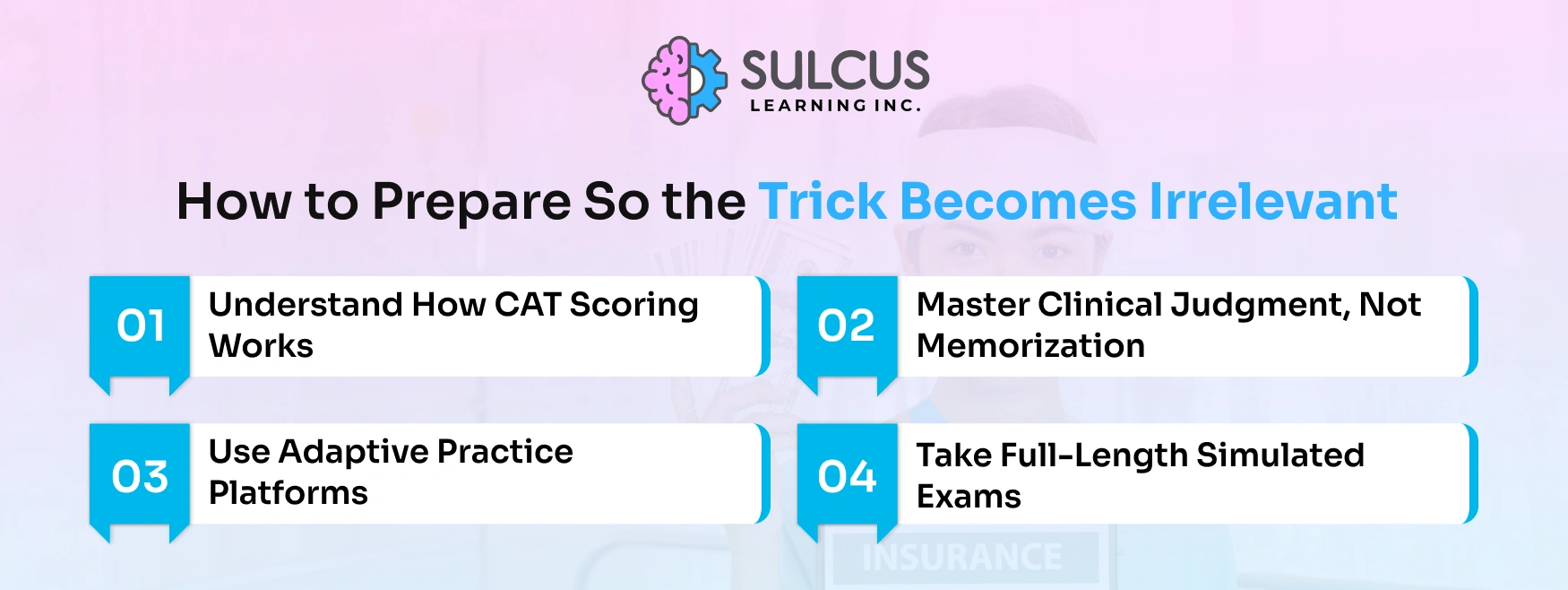
How to Prepare So the Trick Becomes Irrelevant
To eliminate the anxiety that the majority of people have when they take the Pearson VUE trick, the best situation to be in is that you leave the NCLEX exam feeling completely prepared. This is a result of a timely, organized, evidence-based study that represents what the NCLEX exam evaluates when assessing your clinical judgment.
Here are the preparation principles I have seen make the most consistent difference for Canadian nursing students:
1. Understand How CAT Scoring Works
NCLEX utilizes Computer Adaptive Testing (CAT) when administering the exam, which means that your answer to a question determines what is presented to you as the next question. With every question you answer, the CAT scoring is constantly being updated. This is an important part of a serene testing experience, as you should rely on the CAT scoring algorithm rather than the question sequence.
2. Master Clinical Judgment, Not Memorization
With the continued evolution of NGN-aligned question formats through 2026, the NCLEX is increasingly testing your ability to think like a nurse, not just recall facts. Focus your study time on case studies, clinical judgment frameworks, and scenario-based reasoning, particularly for conditions you find most challenging.
3. Use Adaptive Practice Platforms
Nurse training in 2026 is no longer as simple as passing a manual examination. Successful NCLEX test prep in 2026 requires taking adaptively structured case-type and verbal challenges spread across the domains of nursing to test and develop your competency. It is advisable to seek out the platforms that adaptively prepare you for the NGN.
4. Take Full-Length Simulated Exams
Practice full-length NCLEX exams in a simulated environment. This is ideal for gauging your comprehension of the material, but even more so for your ability to focus for extended periods and for the confidence to perform well on the actual test. Various studies show that people who practice within time limitations repetitively on simulated exams experience reduced anxiety for the actual test and experience far less often than those who rely on unofficial NCLEX exam tips.
Prepare for the NCLEX With Confidence Using Sulcus Learning
The Pearson VUE trick can provide an early, unofficial outcome to ambitious nursing students, but the goal should always be to leave the NCLEX feeling confident and ready to practice. This is where Sulcus Learning excels for Canadian nursing students and internationally educated nurses preparing for the NCLEX-RN, NCLEX-PN, REx-PN, and CPNRE exams.
Sulcus Learning goes beyond the generic sticky note question banks. We mimic the NCLEX real-world testing conditions with adaptive CAT-style simulations, real-world NGN clinical judgment questions, and competency-based practice tests. This is the first nursing exam prep course for the post-2006, post-2022 nursing exam. In 2026, modern nursing tests will emphasize critical thinking more than ever, and for the first time, Sulcus Learning is prepared to build this essential skill beyond simple memorization of answers.
Students will know their exact exam-level competency through performance assessment tools, our unique and validated competency wheel, and Sulcus Learning’s one-of-a-kind diagnostic rationales. With Sulcus Learning, you will learn structured, case-based learning, full-length practice tests, and exam-day strategies and tactics, so you can improve post-level diagnosing and develop individual strategies to improve post-level productivity.
If this is your first NCLEX exam, or you are a serial retaker, rest assured, with the research-based, expertly-designed exam prior learning framework from Sulcus, you can build revision, trick, and comfort strategies, and successfully complete the exam on your first attempt.

Final Thoughts
The Pearson VUE trick for NCLEX is an NCLEX trick used by nursing students as soon as they take the NCLEX to predict how they did. This is used because the results take several weeks to be processed, and many people want to know how they did. Depending on how Ultimate was used, there may be a connection to passing the NCLEX.
This is overall an NCLEX trick. However, I want to remind the Canadian nursing students that, regardless of how you performed on the NCLEX, the quality of a nursing professional is not determined by how many questions you answered or whether a pop-up appears on the screen. The NCLEX is just a moment in time.
The Pearson Vue screen indicates that there is either a pass or a fail score, and what is important is that if it was a fail in NCLEX, then you’d better have an NCLEX pass strategy in mind in order to be a registered nurse. You’d better have an awesome NCLEX Study plan and pass strategy to become a registered nurse.
Your nursing is more than a pop-up on a screen. This will be an NCLEX in the nursing domain. This will be coming. Don’t lose faith in yourself.
FAQ’s
Q1. What is the Pearson VUE NCLEX trick?
Ans. It is an unofficial method nursing students use to get an early indication of their NCLEX result by attempting to re-register for the exam on the Pearson VUE website after completing it. The system’s response, either blocking re-registration (good pop-up) or allowing it (bad pop-up), is interpreted as a signal of the likely outcome.
Q2. How accurate is the Pearson VUE trick for NCLEX?
Ans. Community reports suggest the good pop-up is approximately 97–99% accurate, while the bad pop-up is approximately 85–92% accurate. Neither is an official result. In 2026, system updates have made outcomes slightly less consistent than in prior years.
Q3. How do I do the Pearson VUE trick for NCLEX?
Ans. Wait at least 24 hours after your exam, log into your Pearson VUE account, and attempt to re-register for the NCLEX. Proceed to the payment screen. If the system blocks you with a message about a recent registration, that is the good pop-up. If it lets you continue to payment, that is the bad pop-up.
Q4. Does the Pearson VUE trick work for NCLEX-RN and NCLEX-PN?
Ans. Yes. The trick has been reported to work for both NCLEX-RN and NCLEX-PN candidates, as both exams are administered through the Pearson VUE platform.
Q5. What should I do if I get the bad pop-up?
Ans. Do not panic. Wait for official results before making any decisions. The bad pop-up has a higher false-positive rate than the good pop-up. If your official result does confirm a failed attempt, request your Candidate Performance Report, review your weaknesses, and build a structured study plan for your next attempt.
Q6. Does the Pearson VUE trick work in Canada?
Ans. Yes, for NCLEX-RN and NCLEX-PN candidates. It does not apply to the REx-PN (administered through a different system) or the CPNRE.

Taran Kaur
As Managing Director and Lead Instructor at Sulcus Learning, Taran supports aspiring nurses in building their knowledge and confidence throughout their learning journey. With qualifications including a B.Sc. (Nursing), MBA (HM), ENCC, and CMSN(C), she is dedicated to helping learners succeed in licensure exams and professional practice. Connect with her on LinkedIn for insights.