You may be asking about passing the NCLEX if you completed your nursing education outside of Canada or the US and have an interest in practicing in North America. The answer is more complex than it may seem and may depend on the province or state, the nursing specialization, and the licensure requirements.
Most IENs who wish to work as registered nurses in Canada or the US must also pass the NCLEX-RN. For practical nurses, NCLEX-PN, REx-PN, or CPNRE may be required, based on the local regulations. Having work experience alone does not exempt anyone from the licensing requirements.
That said, many IENs work in various capacities in the health care system while waiting to complete their RN licensing. In Canada, working as a healthcare aide, personal support worker, or in various patient support roles offers an opportunity to gain valuable clinical experience while developing an understanding of the Canadian healthcare system.
This article highlights where the NCLEX is required, the other options, and the steps internationally educated nurses can take to advance their careers.
What Is the NCLEX — and Why Does It Matter?
The NCLEX (National Council Licensure Examination) is a standardized test that measures a nursing graduate’s ability to provide safe and effective care as a beginning professional nurse. The exam is required to measure nursing graduates’ skills and knowledge for RN licensure in the United States and the majority of Canadian provinces and territories, and is developed by the NCSBN (National Council of State Boards of Nursing). The NCLEX-PN is required for licensure as a Practical/Vocational Nurse in many jurisdictions.
The NCLEX uses computer-based adaptive testing (CAT), in which questions are formulated based on the NCLEX taker’s performance, helping candidates better understand what a Computer Adaptive Test is and how adaptive exams function in modern nursing licensure. The NCLEX is designed to test a nurse’s ability to utilize clinical skills while prioritizing and making safe decisions under time constraints. This is in addition to the candidate’s memorization of the skills and knowledge.
The NCLEX implemented significantly more changes to the Next Generation of NCLEX in 2023, making it important for candidates to understand the latest NCLEX Changes 2026 and evolving exam expectations. The intent of these changes was to more accurately validate a nurse’s ability to make and execute safe clinical decisions for a patient.
The NGN places greater emphasis on:
- Clinical reasoning and nursing judgment make it essential for candidates to understand what NGN is and how it impacts modern nursing licensure exams.
- Prioritization and decision-making.
- Recognizing cues and analyzing client data.
- Applying knowledge in complex clinical scenarios.
- Safe and effective client care management.
As the exam continues to evolve in 2026 and beyond, nursing candidates, especially internationally educated nurses, should understand that the NCLEX is now a much more clinically focused exam that evaluates critical thinking rather than just factual recall.
For nurses educated outside the US, this adjustment is especially useful, as the NCLEX is vastly different from the evaluation criteria in other countries. The NCLEX expects an applicant to apply North American Tenets such as client safety, delegation, and evidence-based clinical judgment. Therefore, the NCLEX requires the candidate to practically apply various case scenarios.
Getting to know the framework and function of the NCLEX at the start of the process can help applicants avoid falling for the many misconceptions that surround the exam.
Working as a Nurse in Canada Without the NCLEX
Internationally educated nurses with previous nursing experience, years of practice, or licensure from their country of origin may still be required to pass the NCLEX-RN if they wish to register as RNs in most Canadian provinces and territories.
Provincial nursing regulatory bodies in Ontario, British Columbia, Alberta, and Manitoba use the NCLEX-RN as the entry-to-practice exam for RNs; thus, internationally educated nurses in these provinces must fulfill provincial eligibility criteria before they can be authorized to take the exam.
The licensing process may include:
- Credential assessments.
- English language proficiency testing.
- Evidence of nursing education equivalency.
- Clinical competency reviews.
- Jurisprudence or ethics requirements in some jurisdictions.
- Criminal record and background checks.
Quebec is the only province where this is not the case. Within this province, the nursing licensure is also governed by the Ordre des infirmières et infirmiers du Québec (OIIQ). Unlike most provinces in Canada, they do not recognize the NCLEX-RN.
Internationally educated nurses seeking to work in Canada must check with the nursing regulatory body in the province where they want to work to obtain the most up-to-date licensure requirements, as these are subject to change.
Additionally, prior nursing experience does not, in itself, suffice for Canadian licensure. Nursing professionals who are already practicing internationally, such as in the United States, India, the Philippines, Nigeria, or the United Kingdom, must still complete the Canadian licensing process to practice as Registered Nurses in almost all Canadian provinces.
Though international clinical experience is appreciated, Canadian nursing regulators focus on current Canadian standards for safe and competent nursing practice.
Practical Nurses (LPNs/RPNs) in Canada
The licensing process for Practical Nurses in Canada is distinct from that of Registered Nurses (RNs). The requirement for internationally educated practical nurses to complete additional licensing examinations varies by province or territory and is determined by the level of independence they can practice.
In Canada, both Licensed Practical Nurses (LPNs) and Registered Practical Nurses (RPNs) have to successfully complete at least one of the following exams:
- The REx-PN (Regulatory Exam for Practical Nurses), which is currently used in many western and central Canadian provinces and territories.
- The CPNRE (Canadian Practical Nurse Registration Examination), which is still used in certain jurisdictions.
- In limited situations or jurisdictions, some practical nurse applicants may also encounter pathways involving the NCLEX-PN examination.
The province or territory where the candidate is applying for licensure determines which exam is required. Since requirements can change with little notice, candidates should check the most current examination requirements with the appropriate provincial nursing regulatory authority.
Internationally educated practical nurses, vocational nurses, or enrolled nurses may be required to do the following to obtain licensure in Canada:
- Credential and education assessment.
- Proof of language proficiency if required.
- Verification of nursing registration from another country.
- Jurisprudence or ethics requirements in some provinces.
- Completion of the required practical nursing licensing examination.
The titles “LPN” and “RPN” can also vary by province. For example:
- Provinces such as Alberta and British Columbia commonly use the title Licensed Practical Nurse (LPN).
- Ontario uses the title Registered Practical Nurse (RPN).
Internationally educated nurses, such as those from other countries, may have lots of clinical experience. Still, Canadian nursing regulatory agencies insist that all applicants, regardless of experience, demonstrate their understanding of Canadian practical nursing standards as a prerequisite for licensure.
Temporary or Bridging Work Options in Canada
Internationally Educated Nurses (IEN) want to know if they can work in Healthcare while completing the Canadian Licensing Process. The answer is usually yes.
Most people studying for the licensing exams for NCLEX-RN, REx-PN, and CPNRE take on supportive roles in the country’s healthcare system to understand the communication and where they work, and gain work experience in the field.
Depending on the employer and province, Internationally Educated Nurses can work as:
- Healthcare Aide (HCA).
- Personal Support Worker (PSW).
- Nursing assistant or care aide positions.
- Support roles within hospitals, long-term care facilities, or community healthcare settings.
Some provinces create bridging and competency-based programs designed for Internationally Educated Nurses. These can help the candidate build their clinical knowledge and understanding of Canadian nursing standards, improving their documentation in preparation for exams or competency assessments.
In some supervised or temporary practice situations, Internationally Educated Nurses can work under special provisions while certain aspects of their licensure are still being processed. This depends on the employer and the province.
These support roles help in gaining experience, such as:
- Exposure to the Canadian healthcare system.
- Improved understanding of workplace communication and documentation.
- Familiarity with Canadian client care standards and interdisciplinary teamwork.
- Development of confidence within Canadian clinical environments.
Nevertheless, it is crucial to note that these roles are not comparable to those of a licensed Registered Nurse (RN) or a Licensed/Registered Practical Nurse (LPN/RPN). Working in a support role does not exempt an individual from fulfilling the prescribed nursing licensing process set by the province’s regulatory body.
Nurses educated outside of Canada who intend to work autonomously in Canada will continue to be obligated to complete all credential assessments, tests, and licensing prerequisites to obtain nursing registration.
Can You Work as a Nurse in the USA Without the NCLEX?
Nursing in the USA is more difficult. Each state has different standards for what is allowed to break a law, and what is allowed after successfully completing the NCLEX, but, state by state, in every state, to practice nursing, the NCLEX must be passed.
- Registered Nurses must pass the NCLEX-RN.
- Licensed Practical/Vocational Nurses must pass the NCLEX-PN.
To be a nurse in any of the 50 states/territories of the U.S., passing the NCLEX is essential. No state or territory fully waives the exam requirement because of prior nursing experience in another country.
Internationally Educated Nurses (IENs), however, can take some healthcare support roles while waiting to become licensed. However, they cannot practice independently as licensed nurses.
Canada vs. United States: Nursing Licensure Comparison
| Factor | canada (Most Provinces) | United States |
|---|---|---|
| RN Licensure Exam | NCLEX-RN (most provinces) | NCLEX-RN (all states) |
| Practical Nurse Exam | REx-PN or CPNRE (province-dependent) | NCLEX-PN (all states) |
| Can IENs work before licensure? | Support roles such as HCA or PSW | Support roles such as a CNA or a patient care technician |
| Credential Recognition Required? | Yes, through provincial regulatory bodies | Yes, through CGFNS or State Boards of Nursing |
| Is the licensing exam waived based on experience? | No | No |
When internationally educated nurses begin their application process for licensure to practice in the U.S., they typically must:
- Credential evaluations from the Commission on Graduates of Foreign Nursing Schools (CGFNS) or other equivalent credential evaluation companies.
- Application to the respective State Board of Nursing.
- Provide proof of English language proficiency.
- Submission of criminal background checks or completion of fingerprinting requirements.
- Successful completion of the NCLEX-RN or NCLEX-PN.
Depending on the country of education and background, some states in the U.S. may impose additional education, documentation, or immigration requirements beyond those outlined above.
Internationally educated nurses may work in the U.S. in healthcare support roles. However, until independent nursing roles can be assumed, these positions will be their primary occupational engagement.
Nursing Jobs Without the NCLEX: What Are Your Real Options?
International nurses often feel confused after relocating to the U.S. or Canada, as their prior nursing experience does not automatically make them eligible for nursing licensure. Although it can be discouraging, there are several worthwhile positions in healthcare available while candidates work on their credentialing assessments and licensing examinations and obtain full licensure.
While there are many roles in the healthcare space that do not require an NCLEX, here are some sample roles that help internationally educated nurses learn and develop the following skills:
- Clinical communication.
- Documentation standards.
- Client-centered care approaches.
- Interdisciplinary teamwork.
- Familiarity with healthcare technology and workflows.
This hands-on work experience will help you develop the confidence you need to take the NCLEX and be a successful nurse.
Healthcare Support Roles in Canada
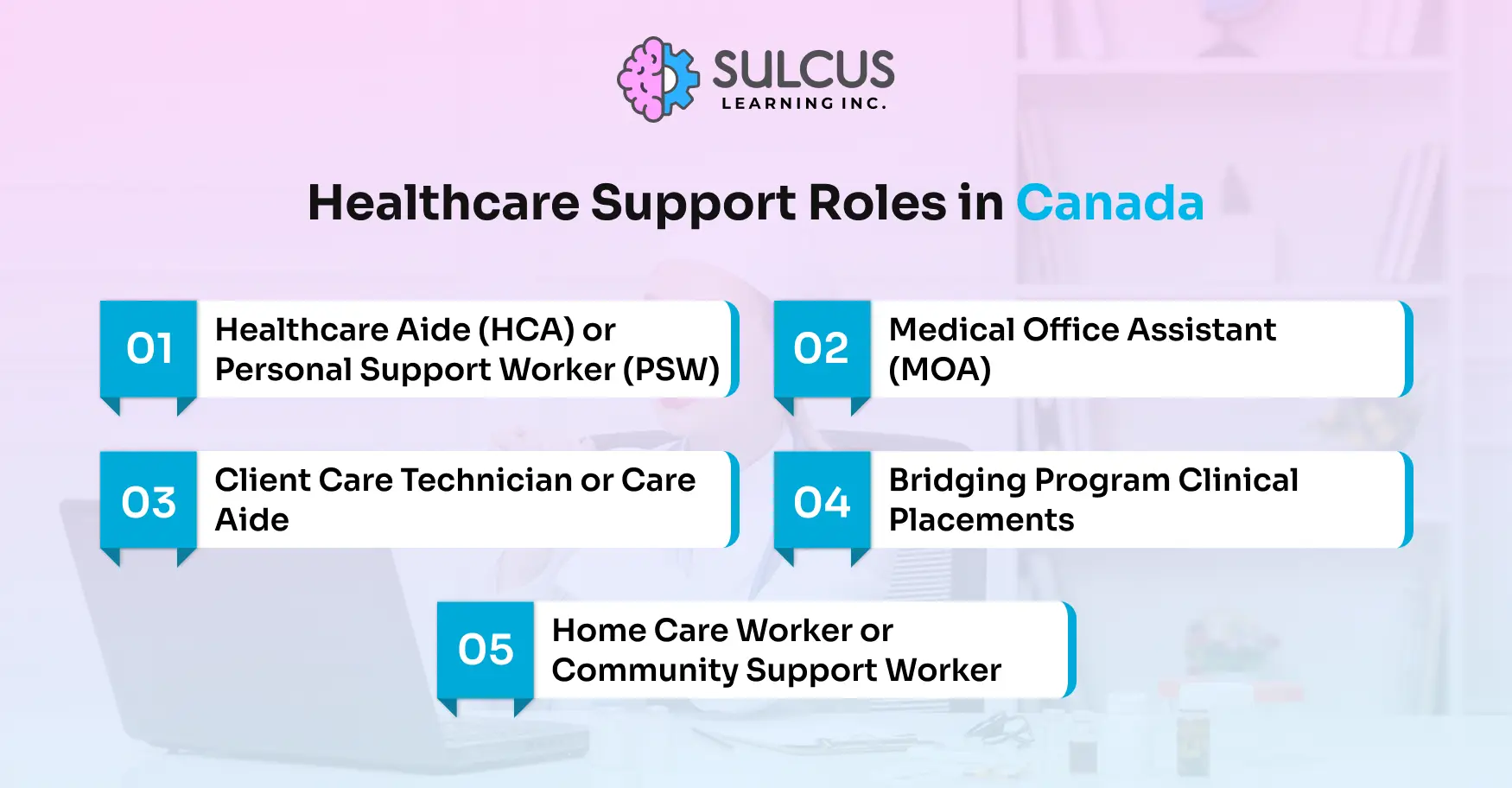
Some common healthcare-related positions available before nursing licensure include:
- Healthcare Aide (HCA) or Personal Support Worker (PSW): Provides direct client care support in long-term care, assisted living, and community healthcare environments.
- Medical Office Assistant (MOA): Supports physicians and clinics with scheduling, documentation, client communication, and administrative tasks.
- Client Care Technician or Care Aide: Assists nursing staff with monitoring vital signs, mobility support, hygiene care, and basic clinical duties.
- Bridging Program Clinical Placements: Some internationally educated nurses enrolled in bridging or competency programs may complete supervised clinical placements as part of their education pathway.
- Home Care Worker or Community Support Worker: Provides support services for clients living independently in community settings.
Healthcare Support Roles in the United States
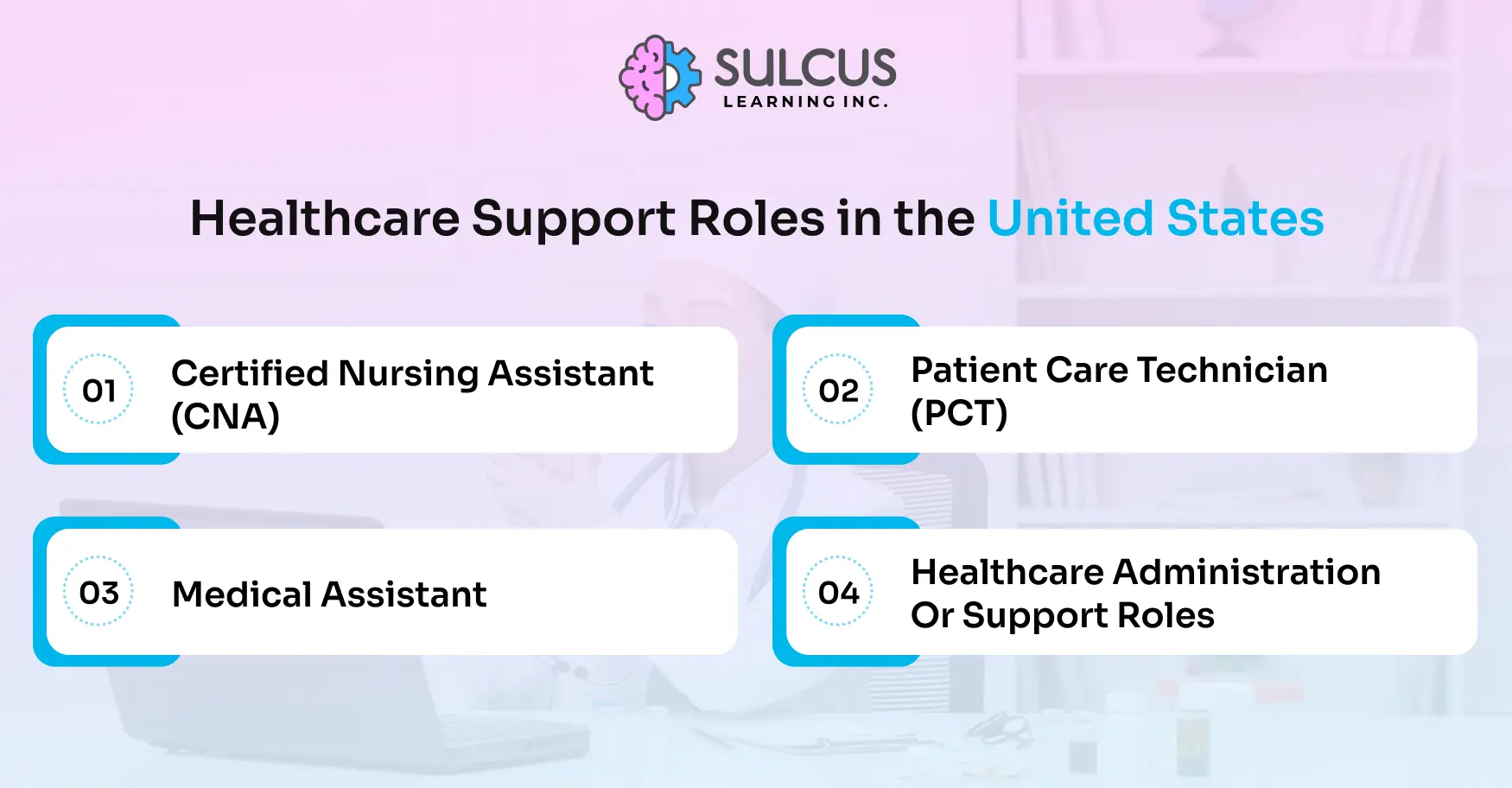
Internationally educated nurses in the United States may also pursue support positions while completing licensing requirements, including:
- Certified Nursing Assistant (CNA): Provides basic client care under nursing supervision after completing state-approved training and certification.
- Patient Care Technician (PCT): Supports hospital nursing teams with direct client care tasks, monitoring, and clinical assistance.
- Medical Assistant: Performs clinical and administrative duties in physician offices, urgent care centers, and outpatient clinics.
- Healthcare Administration or Support Roles: Candidates with prior leadership or administrative experience may find opportunities in healthcare coordination, scheduling, or management support roles.
Although these roles do not replace nursing licensure, they can provide practical healthcare experience, income stability, professional networking opportunities, and a stronger understanding of Canadian or U.S. healthcare systems while preparing for the NCLEX and regulatory requirements. For many internationally educated nurses, these temporary pathways become important stepping stones toward long-term nursing careers in North America.
“In my years working with internationally educated nurses across Canada, I have seen the most successful candidates use every opportunity available to them, including support roles like PSW or Healthcare Aide positions, to understand Canadian healthcare culture, strengthen communication skills, and prepare seriously for their licensing exam.” Taran Kaur
Can You Become a Nurse Without Going to College?
This is a common question among individuals considering nursing as a second career, as well as internationally educated nurses who completed apprenticeship-style or hospital-based nursing programs outside North America.
In Canada and the United States, becoming a licensed nurse generally requires completion of an approved post-secondary nursing education program. The exact educational requirement depends on the type of nursing license being pursued.
Registered Nurses (RNs)
In most Canadian provinces, individuals who want to become Registered Nurses (RNs) must complete an approved university-level Bachelor of Science in Nursing (BScN or BN) program. These programs are typically four years in length and include both classroom education and supervised clinical training.
Older diploma-based RN pathways once existed in parts of Canada, but most provinces have transitioned to bachelor’s degree requirements for RN entry-to-practice standards.
In the United States, RN candidates usually complete either:
- An Associate Degree in Nursing (ADN), or
- A Bachelor of Science in Nursing (BSN), followed by successful completion of the NCLEX-RN examination.
Practical Nurses (LPNs/RPNs/LVNs)
For Licensed Practical Nurses (LPNs), Registered Practical Nurses (RPNs), or Licensed Vocational Nurses (LVNs), the educational pathway is shorter but still requires formal post-secondary education.
These practical nursing programs are usually completed at colleges or vocational institutions and generally range from 1 to 2 years in length, depending on the country and program structure.
After graduation, candidates must still complete the licensing examination required by their jurisdiction before practicing independently.
Internationally Educated Nurses (IENs)
For internationally educated nurses, the licensing process involves an additional evaluation step. Nursing regulatory bodies assess international education and clinical experience to determine whether the applicant’s training is substantially equivalent to Canadian or U.S. nursing standards.
Depending on the assessment outcome, internationally educated nurses may be required to complete:
- Additional nursing education.
- Bridging or competency-based programs.
- Supplemental clinical practice hours.
- Language proficiency requirements.
- Licensing examinations such as the NCLEX-RN, NCLEX-PN, REx-PN, or CPNRE.
Although healthcare experience from another country is highly respected, nursing regulators in Canada and the United States require all applicants to meet current entry-to-practice standards before granting nursing licensure.
Can You Take the NCLEX Without a Degree?
Technically, eligibility to take the NCLEX is not based solely on holding a university degree. Instead, eligibility is determined by whether a candidate meets the educational and regulatory requirements established by the Nursing Regulatory Body or the State Board of Nursing where they are applying.
In the United States, some Licensed Practical Nurse (LPN) or Licensed Vocational Nurse (LVN) pathways are based on approved practical nursing diploma programs rather than full university degrees. Graduates of these approved programs may become eligible to take the NCLEX-PN after meeting state licensing requirements.
For Registered Nurse (RN) licensure, educational expectations are generally higher. However, the exact pathway can still vary depending on the jurisdiction and the nursing education program completed.
For internationally educated nurses, eligibility is determined during the credential assessment and application review process. Regulatory authorities evaluate whether the applicant’s nursing education is substantially equivalent to Canadian or U.S. entry-to-practice standards.
During this review, regulators may assess:
- The length and structure of the nursing program.
- Clinical practice hours completed.
- Theoretical and practical nursing content.
- Medical-surgical, maternal-child, pediatric, psychiatric, and community nursing education.
- Overall competency preparation for safe nursing practice.
In some cases, internationally educated nurses who completed diploma-based nursing education programs may still be eligible to write the NCLEX if their education and clinical preparation meet the required standards.
If gaps are identified during the review process, applicants may be required to complete:
- Additional coursework.
- Bridging or competency programs.
- Supplemental clinical hours.
- Language proficiency requirements.
- Other jurisdiction-specific licensing conditions.
Ultimately, licensing authorities focus less on the credential’s title and more on whether the nursing education meets the competencies and safety standards required for nursing practice in Canada or the United States. Eligibility decisions are made individually based on each applicant’s educational background and professional preparation.
Your Clear Pathway Forward as an Internationally Educated Nurse
For internationally educated nurses (IENs), obtaining licensure in Canada or the USA can be daunting and complex. Regulatory requirements, credential evaluations, and exam preparation across different healthcare systems can cause anxiety. There is something that can help the most, though, the power of early preparation.
Doing the preparation work before the credential review is complete helps nurses stay calm, self-assured, and ready to hit the ground running when eligibility is presented for review. Success in nursing exams is more than just simple memorization. Exams focus more on assessing a student’s critical thinking, decision-making, and prioritization, and conversations about patient safety are a big part of the exam as a whole.
To create a smoother pathway toward nursing licensure, internationally educated nurses should consider the following steps:
- Get in touch with the right provincial Nursing Regulatory Body or U.S. State Board of Nursing to initiate the credentialing process.
- Be aware of other conditions that may need to be fulfilled, such as bridging programs, competency assessments, the IELTS or other English language assessments, jurisprudence exams, or clinical hours to be completed.
- Begin preparing for the required licensing exam, whether NCLEX-RN, NCLEX-PN, REx-PN, or CPNRE, using a structured NCLEX study plan focused on clinical judgment and exam readiness.
- A study plan that targets clinical judgment and prioritization and uses case-based questions is recommended.
Whenever possible, gain experience in the Canadian or U.S. healthcare systems through support roles or supervised clinical placements. - Use exam-aligned preparation tools and adaptive practice testing designed around the CAT and NGN exam formats to strengthen your strategy on how to pass the NCLEX successfully.
- Engage with the healthcare system through scenario-based questions to build your confidence, practice for the exam, and reduce your anxiety.
- Understanding the retesting policies, timelines, and application procedures of your jurisdiction is key, especially for candidates researching how many times they can take the NCLEX Exam after an unsuccessful attempt.
For internationally educated nurses, the process can seem long, but with structured preparation, consistency, and the right guidance, the transition into Canadian or U.S. nursing practice is much easier and less daunting.
How Sulcus Learning Helps You Succeed
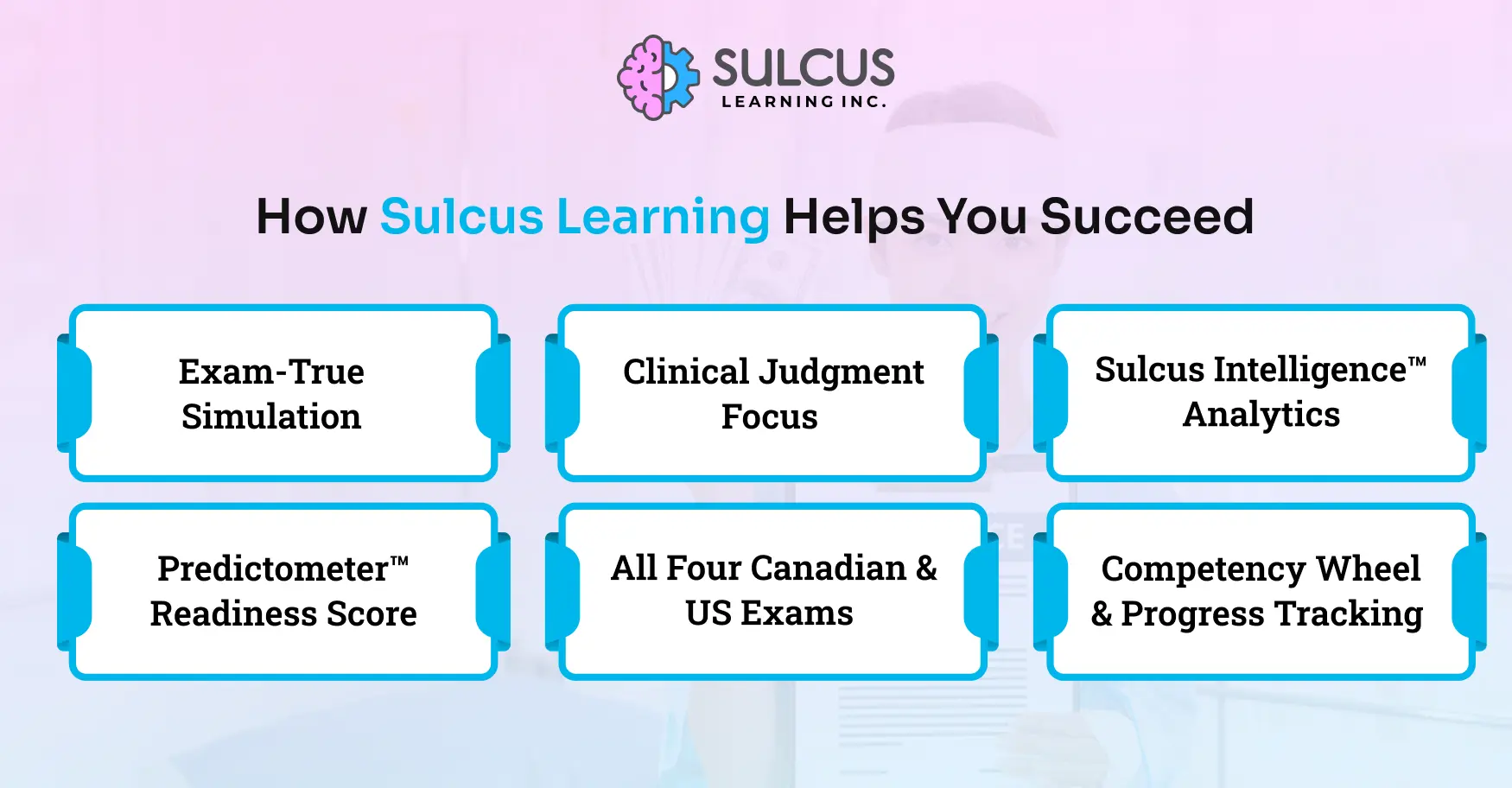
Whether you are preparing for the NCLEX-RN, NCLEX-PN, REx-PN, or CPNRE, Sulcus Learning is built specifically to meet the needs of nursing students and internationally educated nurses navigating the North American licensure system.
- Exam-True Simulation: Practice in a realistic CAT-style environment that mirrors the actual exam experience, including NGN item styles and adaptive testing patterns such as the NCLEX Shut Off at 85 Questions scenario.
- Clinical Judgment Focus: NGN-aligned case studies and scenario-based questions build the exact reasoning skills of the modern NCLEX tests.
- Sulcus Intelligence™ Analytics: Adaptive analytics identify your weak areas and personalize your study plan, so you study smarter, not longer.
- Predictometer™ Readiness Score: Helps candidates evaluate readiness levels while improving confidence through performance tracking tied to national NCLEX Pass Rates and exam expectations.
- All Four Canadian & US Exams: NCLEX-RN, NCLEX-PN, REx-PN, and CPNRE, all covered in a single, intelligent platform designed for your goals.
- Competency Wheel & Progress Tracking: Visualize your competency growth across all exam domains and benchmark yourself against peers in real time.
For internationally educated nurses, the licensing exam is not just a test, it is the gateway to the career you trained for. Sulcus Learning gives you the preparation system to walk in prepared, confident, and ready.
Final Thoughts
It’s not easy to become a nurse in Canada or the United States, especially if you’re internationally educated, but the rewards are sure to be worth it. This is the thing I wish I had been told early in my career, so take my honesty.
It’s a requirement to register for the NCLEX-RN if you want to work as a nurse in the U.S. The same goes for most Canadian provinces. There are no real shortcuts when it comes to the process, but you can become more efficient if you are willing to put effort into planning and put the right resources at your disposal. Our NCLEX prep guide is a great starting point for developing effective strategies.
Nurses who get some of the advantages are the most organized and consistent, and who don’t use the credential review step as a waiting game. The time should be used to the best. You should be the most prepared when you walk in for your exam.
Your clients are waiting. Let us get you there.
FAQ’s
Q1. Can international nurses work in Canada before passing the NCLEX?
Ans. Yes, internationally educated nurses can work in healthcare support positions, such as Healthcare Aide or Personal Support Worker, while completing credential assessments and preparing for NCLEX, REx-PN, or CPNRE licensing examinations.
Q2. Is the NCLEX mandatory for nurses in the United States?
Ans. Yes, all US states require nurses to pass the NCLEX-RN or NCLEX-PN before legally practicing independently as registered nurses or licensed practical/vocational nurses within American healthcare systems nationwide.
Q3. Can nursing experience replace the NCLEX requirement in Canada or the US?
Ans. No, professional nursing experience alone cannot replace NCLEX or provincial licensing requirements. Internationally educated nurses must still complete credential evaluations and pass the required licensing examination successfully.
Q4. What healthcare jobs can nurses do without NCLEX licensure?
Ans. Without NCLEX licensure, internationally educated nurses may work as Healthcare Aides, CNAs, Client Care Technicians, Medical Assistants, home care workers, or other supervised healthcare support professionals.
Q5. Can internationally educated nurses take the NCLEX without a degree?
Ans. Eligibility depends on whether your international nursing education meets provincial or state competency requirements. Regulatory bodies evaluate coursework, clinical hours, and training equivalency before approving NCLEX examination eligibility.
Q6. How does Sulcus Learning help international nurses prepare for licensing exams?
Ans. Sulcus Learning provides exam-true simulations, adaptive analytics, NGN-focused case studies, readiness prediction tools, competency tracking, and preparation support for NCLEX-RN, NCLEX-PN, REx-PN, and CPNRE candidates.
Taran Kaur
As Managing Director and Lead Instructor at Sulcus Learning, Taran supports aspiring nurses in building their knowledge and confidence throughout their learning journey. With qualifications including a B.Sc. (Nursing), MBA (HM), ENCC, and CMSN(C), she is dedicated to helping learners succeed in licensure exams and professional practice. Connect with her on LinkedIn for insights.