

Canadian PN candidates preparing for the RExPN in 2026 have more prep options than ever, and two names come up constantly in study groups and forums: Archer Review and Sulcus Learning. Both promise to get you exam-ready. Both talk about practice questions, rationales, and readiness scores. But if you’ve spent any time in clinical practice, and I’ve spent more than fifteen years in Canadian nursing education and exam readiness work, you know that not all prep tools are built for the exam you’re actually taking.
The RExPN isn’t the NCLEX. It’s a distinct computer-adaptive test administered by Pearson VUE trick nclex on behalf of Canadian regulatory bodies, and it draws from a different competency framework than the US-based licensure exams. That distinction matters more than most marketing pages let on. A platform built primarily for American NCLEX candidates, then retrofitted for Canadian use, behaves differently than one built around the RExPN blueprint from the ground up.
This isn’t a takedown of Archer Review, it’s a genuinely useful platform for many US-facing exams. But “useful for NCLEX” and “built for RExPN” are two different claims, and Canadian candidates deserve a clear-eyed comparison before they spend their study budget. Here’s what I’ve found comparing the two platforms feature by feature, based on how each one actually handles CAT simulation, Canadian content alignment, question banks, and readiness analytics. These things actually move the needle on exam day.
Archer Review vs. Sulcus Learning: Quick Comparison
Before comparing the details, this quick overview shows where Archer Review and Sulcus Learning differ in exam focus, Canadian relevance, and readiness support.
| Feature | Archer Review | Sulcus Learning |
|---|---|---|
| Primary exam focus | NCLEX-RN, NCLEX-PN (US-centric) | RExPN, CPNRE, NCLEX-RN, NCLEX-PN (Canada-built) |
| CAT simulation | NCLEX-style CAT logic | RExPN-specific CAT/logit modeling |
| Canadian content specificity | Limited; largely adapted US content | Built around Canadian scope of practice and regulatory bodies |
| Question bank | Large, NCLEX-oriented | Growing bank mapped to RExPN blueprint categories |
| Readiness analytics | Predictive scoring for NCLEX pass likelihood | Predictometer, Competency Wheel, and RExPN-specific readiness mapping |
| Rationales | Detailed, NCLEX-framed | Clinically grounded, written against Canadian PN competencies |
| Positioning | US exam prep leader | Proudly Canadian, purpose-built for Canadian PN licensure |
What Is Archer Review for RExPN?
Archer Review built its reputation on NCLEX-RN and NCLEX-PN prep, and it’s earned a loyal following among American candidates for its adaptive practice logic, video content, and structured study plans. Because RExPN and NCLEX-PN share some DNA, both are computer-adaptive tests assessing entry-level nursing competency, some Canadian candidates use Archer as a general practice tool.
Where this gets tricky is specificity. The RExPN follows its own blueprint, developed and maintained for Canadian regulatory requirements, with scope-of-practice content, medication naming conventions, and clinical judgment scenarios calibrated to Canadian standards of care.
Archer’s question content, built primarily around the NCLEX blueprint, doesn’t map one-to-one onto that structure. Candidates report solid general practice value but note gaps when scenarios reference US-specific drug names, scope boundaries, or regulatory bodies that don’t apply north of the border.
What Is Sulcus Learning for RExPN?
Sulcus Learning is a Canadian-built exam readiness platform designed specifically around the licensure pathways Canadian nursing candidates actually sit for: RExPN, CPNRE, NCLEX-RN, and NCLEX-PN. Rather than adapting American content for a Canadian audience, Sulcus starts from the RExPN blueprint itself, competency categories, clinical judgment models, and CAT scoring logic. It builds question banks, mock exams, and readiness tools around that structure.
The platform’s tagline, “Proudly Canadian. Globally Trusted. Universally Successful,” reflects a specific positioning choice: this is a tool built by people who understand the Canadian regulatory landscape, not a US product with a Canadian label added later. For PN candidates specifically, that means practice questions written against Canadian scope-of-practice expectations, and readiness analytics calibrated to how the RExPN actually scores candidates.
Archer Review vs. Sulcus: Feature-by-Feature Comparison
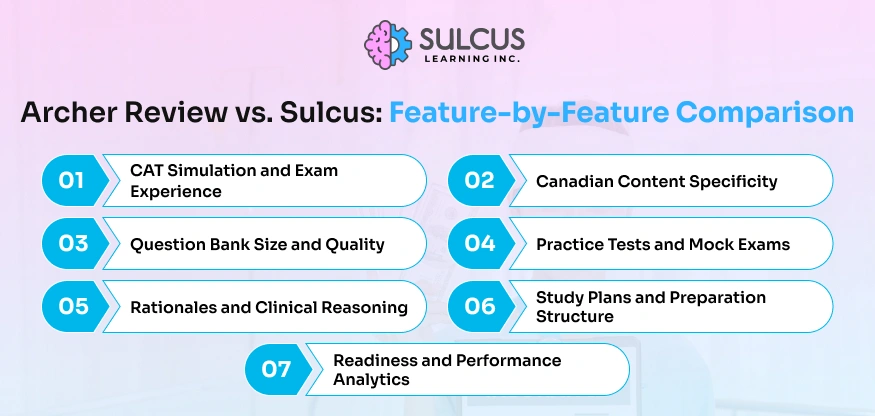
The differences between Archer Review RExPN and Sulcus become clearer when you compare the features that directly shape RExPN preparation, from CAT simulation and Canadian content to question banks, rationales, and readiness analytics.
1. CAT Simulation and Exam Experience
The RExPN uses computer adaptive testing with logit-based scoring, meaning question difficulty adjusts in real time based on your performance, and your final result depends on ability estimation rather than a simple percentage correct. Archer’s CAT simulation is built around NCLEX’s adaptive algorithm, which shares conceptual similarities but isn’t a precise mirror of REx-PN’s scoring logic.
Sulcus models its practice exams directly against REx-PN’s CAT structure, so the experience of taking a mock exam, how difficulty shifts, how the test behaves near your competency threshold, more closely resembles exam day itself. For candidates who want to walk in without surprises, that structural accuracy is worth weighing carefully.
2. Canadian Content Specificity
This is where the two platforms diverge most. Archer’s question writing reflects NCLEX conventions: US drug naming, US-based scope-of-practice assumptions, and regulatory references that don’t apply to Canadian PNs.
Sulcus writes its RExPN content against Canadian nursing standards from the outset, provincial regulatory expectations, Canadian medication naming, and clinical scenarios that reflect how care is actually delivered in Canadian settings.
If you’ve ever hit a practice question referencing a body or process that simply doesn’t exist in your jurisdiction, you already know why this matters.
3. Question Bank Size and Quality
Archer holds an advantage in raw volume, built over years of NCLEX-focused development. Sulcus’s RExPN bank is smaller but purpose-built, with every question mapped to REx-PN blueprint categories rather than adapted from an NCLEX bank after the fact. For candidates prioritizing breadth, Archer’s size is appealing; for candidates prioritizing exam-relevant accuracy, Sulcus’s blueprint alignment tends to matter more in the final weeks of study.
4. Practice Tests and Mock Exams
Both platforms offer timed practice tests, but the framing differs. Archer’s mock exams simulate the NCLEX experience closely, which is useful practice for adaptive testing in general but an imperfect stand-in for RExPN’s specific pacing and scoring behavior. Sulcus’s mock exams are built to mirror REx-PN mechanics directly, giving candidates a more exam-accurate sense of pacing, question exposure, and how competency estimation plays out across a full test session.
5. Rationales and Clinical Reasoning
Archer is well regarded for detailed, well-produced rationales, a genuine strength of the platform. Sulcus’s rationales are written with the same commitment to explaining the “why” behind an answer, but grounded specifically in Canadian PN competencies and clinical judgment models, so the reasoning you build during practice transfers more directly to how REx-PN questions are actually constructed.
6. Study Plans and Preparation Structure
Archer’s RExPN study plans are mature and well-structured for NCLEX study plan. Sulcus offers structured study planning as well, built around RExPN’s specific blueprint categories and competency areas, which helps candidates allocate study time proportionally to how the actual exam weights each domain rather than how NCLEX does.
7. Readiness and Performance Analytics
Sulcus’s Predictometer, Competency Wheel, Student Exam Reports, and Exam Percentage Growth Charts give candidates a granular, ongoing view of readiness mapped to RExPN’s specific competency structure, not a generic percentage score, but a breakdown of strengths and limitations by domain, tracked over time. Archer’s analytics are strong for NCLEX pass-likelihood prediction but aren’t built around REx-PN’s distinct scoring model, which means the readiness signal you get may not translate precisely to your actual exam outcome.
Archer Review vs. Sulcus Learning: Pricing and Value
Archer typically prices at a premium reflecting its broad NCLEX-focused feature set and large question bank. Sulcus’s value proposition centers less on volume and more on precision: candidates pay for content and analytics built specifically around the exam they’re sitting for, which can mean less wasted study time reviewing US-specific scenarios that won’t appear on the RExPN. For Canadian PN candidates working within a defined study budget and timeline, that precision often translates into better return per study hour, even where the sticker price is comparable.
Why Choose Sulcus for RExPN Preparation?
If you’re a Canadian PN candidate, the core question isn’t which platform is “better” in the abstract, it’s which one is built for the exam you’re actually taking.
Sulcus was designed from the ground up around Canadian licensure pathways, which shows up in the details: question content that reflects Canadian scope of practice, CAT simulation modeled on RExPN’s actual scoring logic, and readiness analytics, like the Competency Wheel and Predictometer, calibrated to REx-PN’s competency structure rather than borrowed from an American exam.
Proudly Canadian. Globally Trusted. Universally Successful that positioning isn’t just a tagline; it reflects a platform built specifically to get Canadian PN candidates exam-ready on their terms.
Archer Review Alternatives: Is Sulcus One of Them?
If you’re searching for Archer Review alternatives specifically for RExPN preparation, Sulcus is worth serious consideration, not as a lower-cost substitute, but as a platform built for a different (and for Canadian candidates, more relevant) exam structure. Candidates who’ve used Archer for general adaptive-testing practice and then moved to Sulcus for REx-PN-specific readiness in their final weeks often describe this as the more effective sequencing: broad practice early, exam-accurate precision late.
How to Choose the Best RExPN Prep Course
When comparing the best RExPN prep programs, a few questions cut through the marketing:
- Is the CAT simulation modeled on REx-PN’s actual scoring logic, or adapted from another exam?
- Are the practice questions written against Canadian scope-of-practice standards?
- Do the readiness analytics map to REx-PN’s specific competency categories?
- Are rationales grounded in Canadian clinical judgment models?
- Does the platform’s mock exam pacing reflect what you’ll actually experience at your Pearson VUE test center?
Candidates who answer these questions honestly for each platform they’re considering tend to make better-informed, less regretful study investments.

Final Verdict
Archer Review is a capable and well-established preparation platform, particularly for NCLEX candidates. However, Canadian practical nursing students preparing specifically for the RExPN may benefit from a more targeted approach. Sulcus Learning is designed with a Canada-first focus, offering RExPN-specific content, blueprint-aligned practice questions, clinical rationales, and readiness analytics. This can help students connect their daily practice with the competencies and expectations of the actual exam.
Ultimately, the better choice depends on what you value most in an RExPN preparation program. If you prioritize broad resources and familiarity with an established brand, Archer may be worth considering. If you want preparation built specifically around the Canadian RExPN and more focused performance insights, Sulcus Learning provides a more direct and specialized path toward exam readiness.
FAQ’s
Q1. Is Archer Review good for RExPN preparation?
Ans. Archer can offer useful general adaptive-test practice, but its content is built primarily around NCLEX, so Canadian scope-of-practice and regulatory content won’t always align with RExPN.
Q2. What makes Sulcus different for RExPN?
Ans. Sulcus builds its question banks, CAT simulation, and readiness analytics directly from the RExPN blueprint and Canadian nursing standards, rather than adapting US-focused content.
Q3. Can I use both Archer and Sulcus to prepare?
Ans. Yes, many candidates use Archer for broad adaptive-test practice and Sulcus for RExPN-specific refinement in the final stretch before their exam.
Q4. Does Sulcus offer practice questions and mock exams for REx-PN?
Ans. Yes, Sulcus provides RExPN practice questions and mock exams mapped to blueprint competency categories, alongside readiness tools like the Predictometer and Competency Wheel.
Q5. Which platform better reflects the actual REx-PN exam experience?
Ans. Sulcus’s CAT simulation and mock exams are modeled specifically on REx-PN’s scoring logic and pacing, offering a closer approximation of exam-day conditions than platforms built around a different exam’s adaptive algorithm.

Taran Kaur
As Managing Director and Lead Instructor at Sulcus Learning, Taran supports aspiring nurses in building their knowledge and confidence throughout their learning journey. With qualifications including a B.Sc. (Nursing), MBA (HM), ENCC, and CMSN(C), she is dedicated to helping learners succeed in licensure exams and professional practice. Connect with her on LinkedIn for insights.