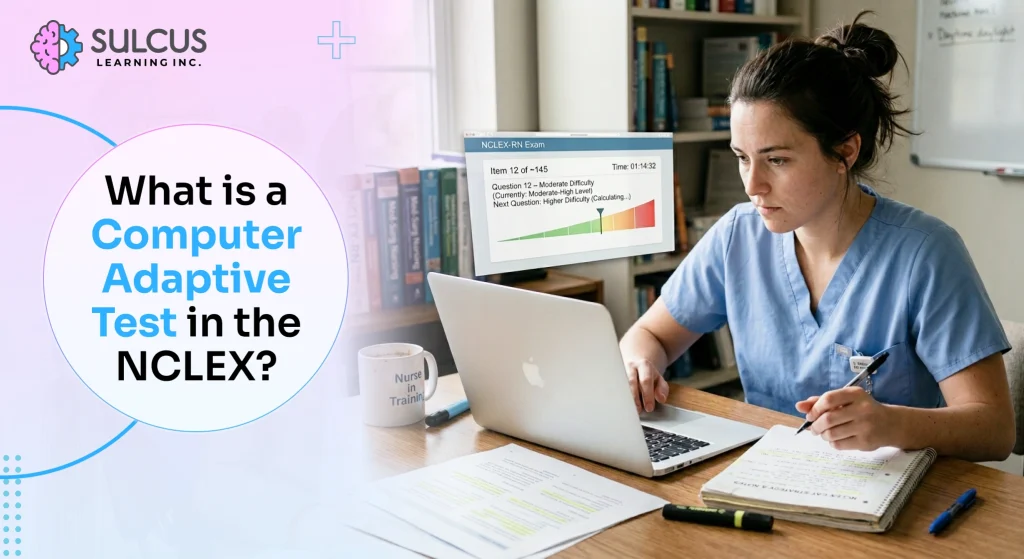
The NCLEX does not follow a fixed-question format where every candidate receives the same set of items. Instead, it uses a computerized adaptive testing (CAT) model that selects each question based on the candidate’s previous response. After each answer, the system estimates the candidate’s ability level and delivers the next question accordingly.
The next question may be simpler or more challenging, depending on the correctness of the prior response. This adaptive process goes on in order to assess the ability of the candidate’s clinical judgment and decision making, as well as the ability to perform safe and effective care to clients in actual situations.
The purpose of CAT on the NCLEX exam is to evaluate if the candidate’s performance has surpassed the level of performance the National Council of State Boards of Nursing has classified as acceptable. The aim is not to achieve a percentage score, but to show competence level at, or above, the specified standard.
Each candidate’s performance is evaluated thoroughly and effectively using CAT. Appreciate how the CAT tool functions to adequately direct your study efforts, concentrating on clinical reasoning and enter the test with full confidence.
What is a Computer Adaptive Test?
A Computerized Adaptive Test is a strategy developed by the National Council of State Boards of Nursing to deliver the NCLEX exam. In this format, each exam item is chosen depending on the test-taker’s answer to the prior question. Therefore, the exam adjusts in real time to the ability level of the test taker.
If a candidate answers a question correctly, the next question is typically more difficult, and vice versa. This constant adjusting allows the exam to more accurately determine the candidate’s level of clinical competence.
For the NCLEX exam, each question is important for determining whether the candidate’s ability is above or below the required standard. It does not simply look for the number of answers that the candidate got right. It looks for patterns in the candidate’s answer in order to gauge whether or not that candidate is exercising safe and effective clinical judgment.
For this reason, the CAT format is used for the NCLEX exam. It measures ability with the least number of targeted questions. Therefore, it evaluates the candidate’s readiness for entry-level nursing practice with a lot of precision.
How Does Computer Adaptive Testing Work?
Learning how computer adaptive testing functions can help diminish your exam anxiety and help you take the NCLEX with a sense of clarity and confidence. The NCLEX does not have a fixed format like the other exams, and it uses a testing model that is responsive and adjusts to your performance as you take the exam.
The exam starts with a question considered to have moderate difficulty. The system then assesses your response and makes the following adjustments:
- If you answer the question correctly, the following question becomes a little more difficult.
- If you answer it incorrectly, that means the exam is going to be a little easier.
This adjustment is designed to quickly determine your level of competence. A very sophisticated algorithm then works in the background and assesses your response relative to the question asked and determines if your answer is above or below the passing standard that is considered to be safe as far as nursing practice is concerned.
In NCLEX computer adaptive testing, the exam does not work with a predetermined number of questions to be asked. Instead, it goes on until the system has reached a very high level of confidence in the performance of the candidate.
Key Features of CAT in NCLEX
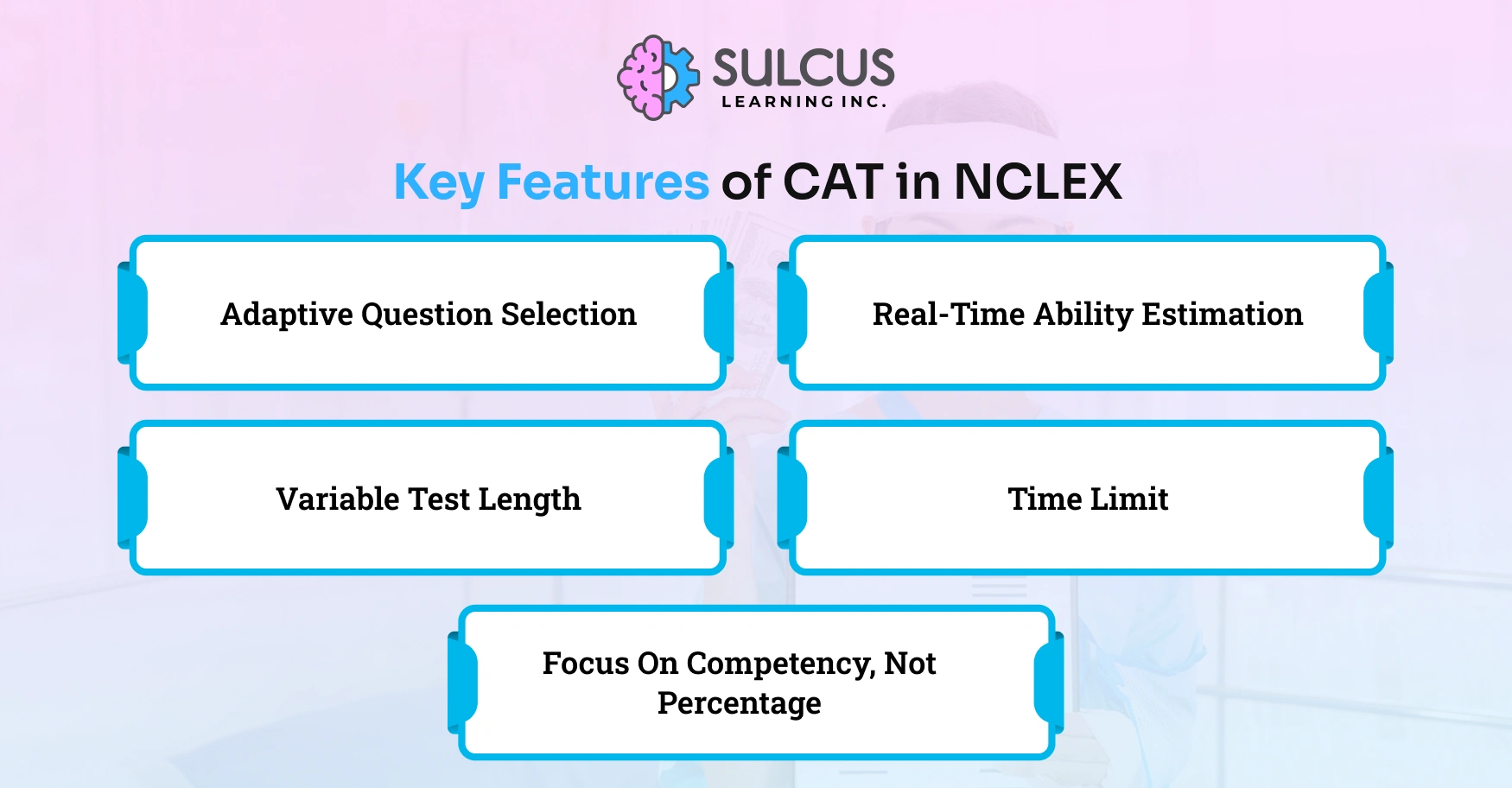
The NCLEX employs the Computerized Adaptive Testing (CAT) model created by the National Council of State Boards of Nursing. It models real-world clinical decision-making while evaluating examinees’ abilities in safe, effective, and competent client care. Knowing the features allows examinees to prepare appropriately, knowing how the exam functions.
- Adaptive Question Selection: Each question is chosen based on the candidate’s estimated ability level. The system adapts to the user’s knowledge with the goal of keeping the exam’s difficulty reasonable.
- Real-Time Ability Estimation: The system updates the user’s ability level with each answer provided. This is meant to adjust the measurement of clinical competence as the user progresses through the exam.
- Variable Test Length: If you’re wondering how many questions are on the NCLEX, each exam varies between 85 and 150 questions. It is determined at 95% confidence level, regarding the candidate’s ability, whether they are above or below the passing standard. If this is not determined quickly, the exam will be extended to the max number of questions.
- Time Limit: All NCLEX candidates are allotted a time of 5 hours to take the exam and answer the allotted questions. If the candidate achieves a pass or fail answer, they will be removed from the exam early.
- Focus on Competency, Not Percentage: The NCLEX exam does not issue a score based on percentage. The NCLEX exam measures whether a candidate reliably exhibits clinical judgment and safe decisions at the threshold or above.
The NCLEX exam uses computerized adaptive testing, which effectively and accurately assesses whether a candidate has the entry-level competencies needed for safe nursing practice.
Computer Adaptive Testing Example
An example of computer adaptive testing is the way the NCLEX exam adjusts the level of questions in response to your performance during the exam.
Think about starting the exam and answering the first question correctly. This will cause the computer to present a question that is of a higher level. If you answer that question incorrectly, the computer will present a question of a lower level to adjust to your ability. This will be the case for each question, and the computer will base the next question to be asked on your response to the current question.
The NCLEX exam uses computer adaptive testing to determine what your ability level is. The computer will not keep asking easy or hard questions. Instead, the computer will keep asking questions in a range that is of similar difficulty based on your ability. This is how the NCLEX exam computer adaptive testing is able to determine if you meet the threshold required for safe nursing practice.
The exam will not present questions that are too easy or too difficult. Instead, the computer will continuously adjust the questions in order to create a unique assessment experience for you, which is something traditional exams do not do.
Why NCLEX Uses Computer Adaptive Testing
Computerized Adaptive Testing (CAT) was designed by the National Council of State Boards of Nursing (NCSBN) and is used by the NCLEX in order to obtain an accurate and reliable assessment of readiness for entry-level nursing practice. CAT is used to measure clinical competence that transcends the use of real questions. It includes the real world responsibilities of nursing as well as clinical judgment, decision-making, and client safety.
This method is also not based on Canadian-specific educational standards. It is based on international, empirically supported, evidence based licensure methodology focusing on safe and effective practice in all levels of healthcare.
Why CAT is Essential in the NCLEX?
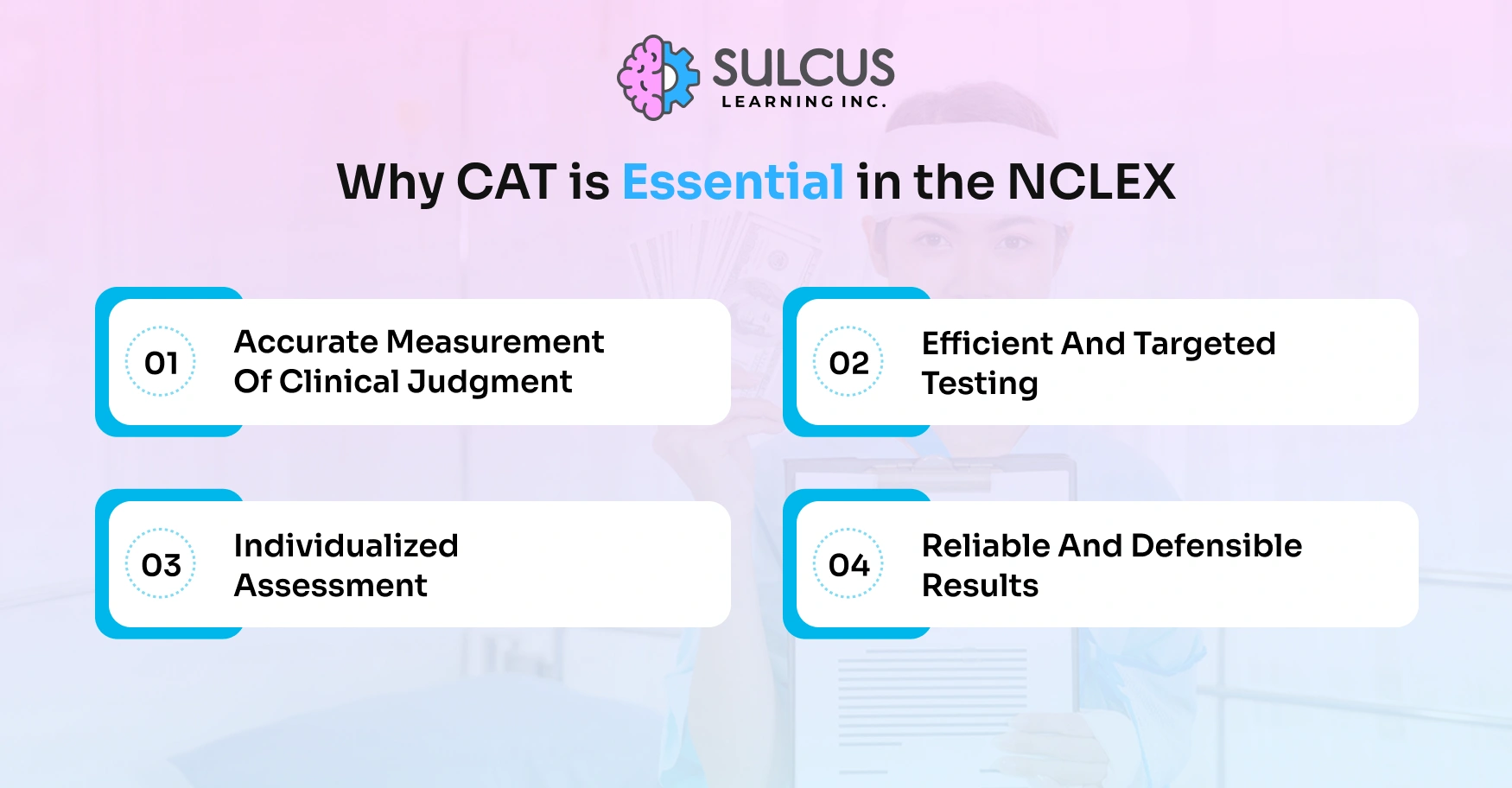
- Accurate Measurement of Clinical Judgment: CAT measures clinical judgment by not simply looking at the candidate’s decision-making abilities, but rather their clinical knowledge application.
- Efficient and Targeted Testing: Testing is effective and efficient because of the system’s ability of the system to choose from the questions that best fit the ability of the candidate.
- Individualized Assessment: Everyone has a completely different exam. The order is personalized to each candidate and based on the candidate’s performance, so that they are fairly evaluated on their individualized competency.
- Reliable and Defensible Results: The use of Computer Adaptive Testing gives a lot of evidence that a candidate is or is not meeting the passing standards, and because of that, the results are consistent and reliable.
Next Generation NCLEX has placed even greater emphasis on the clinical judgment strand. NCLEX NGN includes additional item types and case-study scenarios that measure candidates’ abilities to recognize cues, make data-driven analyses, determine the order of actions, and evaluate the results.
CAT and NGN combined are a modern and evidence-based approach to testing and guarantee that candidates possess the knowledge and skills to provide safe, effective, and client-centered care in practice.
CAT Testing vs Traditional Testing
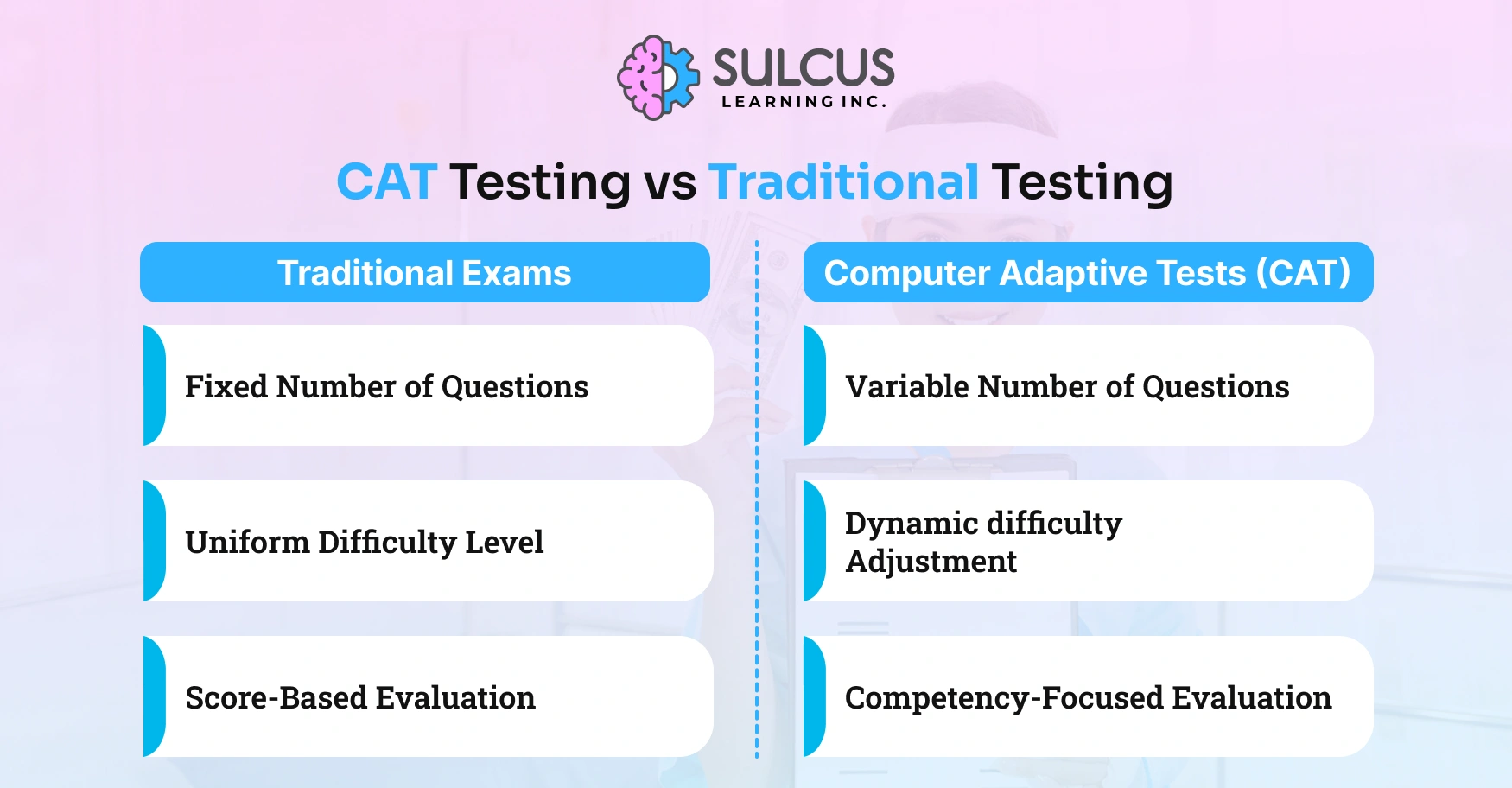
Understanding the difference between CAT (computer adaptive testing) and traditional exams is essential for building the right NCLEX preparation strategy. These two formats assess performance in fundamentally different ways, especially when it comes to measuring clinical competency.
Traditional Exams
- Fixed number of questions: Each candidate has a fixed number of questions and everyone gets the same questions
- Uniform difficulty level: There is no adjustment of the exam based on performance (set difficulty)
- Score-based evaluation: The results are based on the total number of questions answered correctly.
Computer Adaptive Tests (CAT)
- Variable number of questions: The number of questions on the test changes depending on how fast your ability level is determined
- Dynamic difficulty adjustment: Each question changes based on how you answered the previous question
- Competency-focused evaluation: Instead of counting the number of correct answers, the system measures your skill level
This is what differentiates CAT testing. It does not matter how many answers you got correct; what matters is whether you are able to think at the level of clinical judgment that is essential to safe nursing practice.
How CAT Determines Pass or Fail in NCLEX?
Understanding how the NCLEX decides passing and failing results calms test takers. Many test takers feel worried about failing the NCLEX. Learning how the NCLEX decides results will ease some of those worries.
To ease candidate worries about passing or failing, the NCLEX uses Computerized Adaptive Testing (CAT) when deciding whether an NCLEX candidate passes or fails. Testing systems developed by the National Council of State Boards of Nursing make test takers pass or fail based on a test taker’s ability rather than based on the test taker’s correct answers. At each test question, the testing system will estimate a candidate’s ability to pass that question and compare it to a prospect’s ability to practice safe and effective entry-level nursing.
Test takers will receive individualized questions that match their performance. Showing good clinical judgment and decision-making skills at or above the passing standard is key, not answering every question right.
The exam ends when one of the following rules is met. Many candidates experience the NCLEX shut off at 85 questions, which can indicate that the system has reached a confident decision early.
- 95% Confidence Rule: The NCLEX exam ends when the system is at a confidence level of 95% that a test-taker’s ability is at or above the standard. This is the primary decision rule in a CAT test.
- Maximum-Length Rule: If the above factors have not been met, a test will continue until the maximum number of allowed questions (for NCLEX-RN, a maximum of 150 questions). The end estimate of a candidate’s ability will determine the test results.
- Run-Out-of-Time Rule: Candidates have up to 5 hours to complete the NCLEX-PN & NCLEX RN. Once time is up, the system makes an evaluation of the candidate’s performance based on the data available. If there are enough completed responses, the system records a pass/fail decision. If there are insufficient responses, the candidate is recorded as having an unsuccessful result.
Candidates who do not pass receive an NCLEX Candidate Performance Report, highlighting performance areas and guiding future preparation. Each candidate gets a different set of questions based on how he/she answers. For some candidates, fewer questions are asked, while more questions are needed for others. This is a normal occurrence and shows how quickly the system is able to determine ability with enough confidence.
The model NCLEX CAT achieves the goal of providing each candidate an evaluation based on their ability to deliver effective and safe nursing care.
Common Myths About Computer Adaptive Testing
There are different myths surrounding computer adaptive testing that cause unnecessary anxiety for NCLEX test takers. Knowing the truth helps to keep the test in perspective.
- Myth: Hard questions mean you’re passing
Reality: Your questions are controlled by the program depending on how you answer the questions. You might get a difficult question, because you performed well on a previous question. Of course, difficult questions do not mean passing. - Myth: Finishing early means you passed
Reality: The program stops asking questions when it is sure whether you passed or failed. This is not determined by how many questions you get, but rather by the quality of questions you were able to answer. - Myth: You can track your score during the test
Reality: The algorithm behind the computer adaptive testing mechanism is not transparent to the test takers. This means that there are no visible score trackers and no visible progress indicators.
With the facts in place, you can focus on what matters most: applying the judgment and reasoning in the exam to the best of your ability.
How to Pass Computer Adaptive Testing (NCLEX Tips)
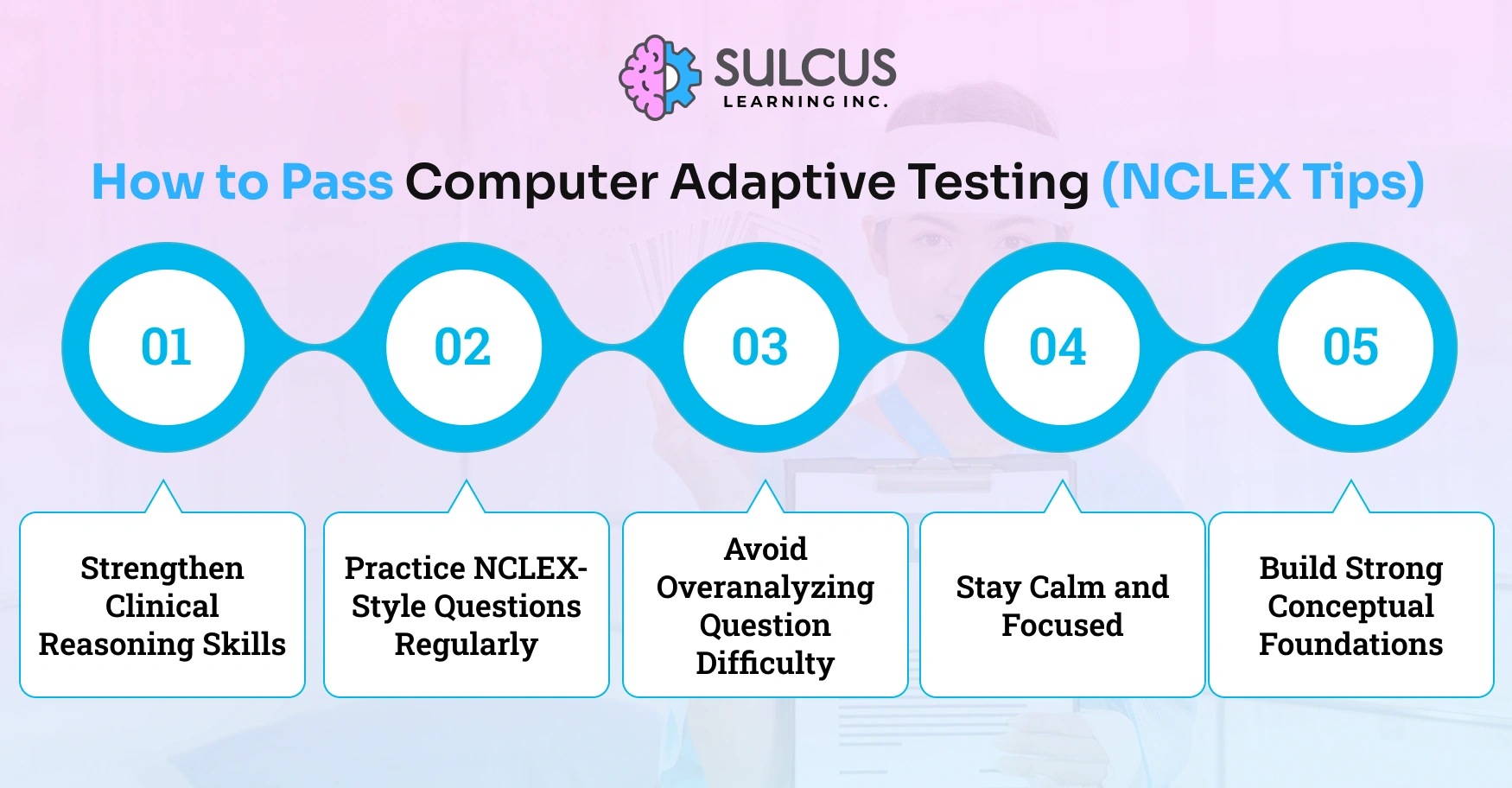
If you want to know how to pass the NCLEX, the best approach is to focus on consistency, rather than aiming for perfection. The NCLEX is a longer exam that assesses your clinical judgement over the longer term, rather than whether you can answer every question correctly.
- Strengthen Clinical Reasoning Skills: Look for weaknesses in understanding client scenarios, clinical prioritization, and making safe clinical decisions.
- Practice NCLEX-Style Questions Regularly: Goal-directed practice can be a useful strategy, but if you don’t have the required knowledge to answer the goal-directed questions, you will limit your practice and your chances of success.
- Avoid Overanalyzing Question Difficulty: The level of difficulty changes constantly, so trying to judge your performance based on question type can increase anxiety and reduce focus.
- Stay Calm and Focused: Your mind does not need to be racing the whole time. In fact, staying calm will stop any small mistakes that may lead you to answer poorly.
- Build Strong Conceptual Foundations: Create an internal question and answer the current question. Is this question an example of knowledge that you would call a high-level question or one that is low and will lead to a bad answer?
Exam-specific preparation is needed for success. You need to approach study preparation that will help you to consistently demonstrate competence under varying testing conditions. This is how you will effectively show examiners how well you understand computer adaptive testing principles.
Advantages of Computer Adaptive Testing
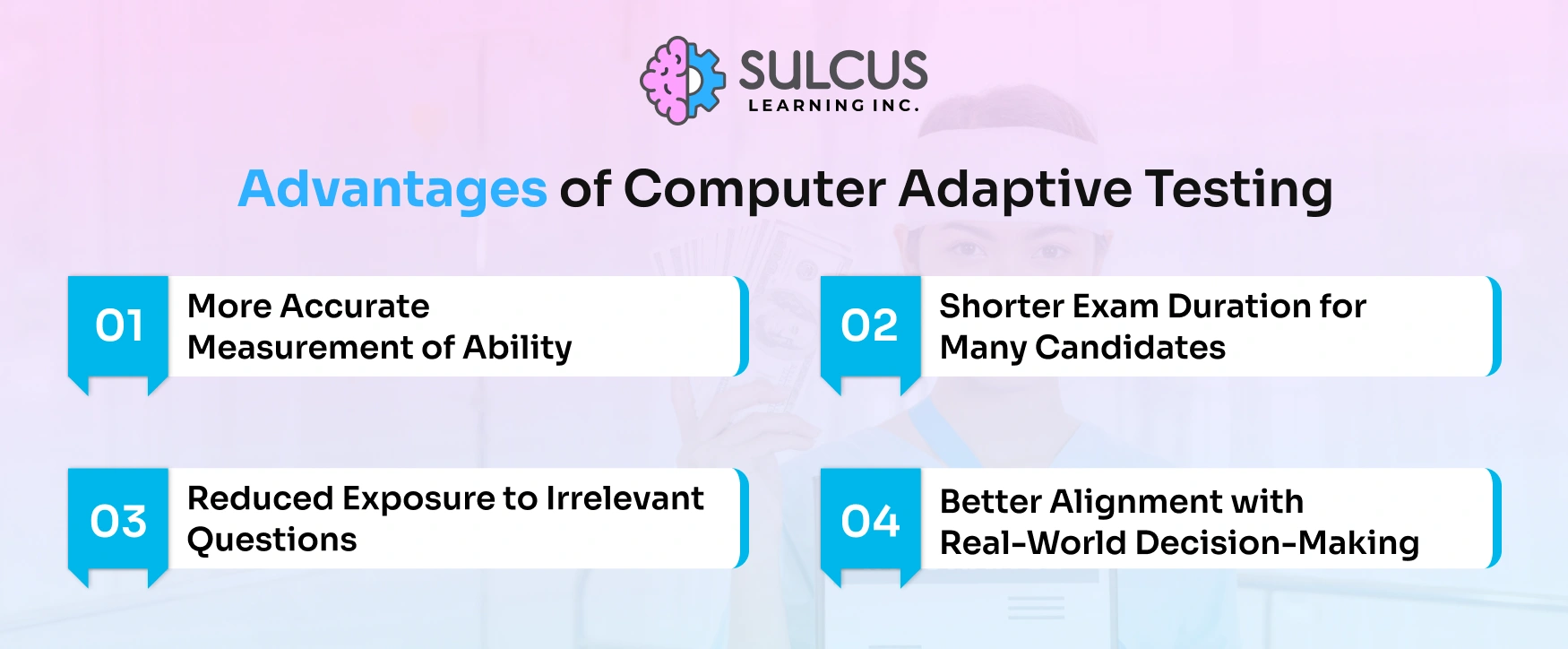
Nursing applicants preparing for the NCLEX can benefit from Computer Adaptive Testing (CAT) in a number of significant ways in regard to the way clinical competence is assessed both quickly and precisely.
- More Accurate Measurement of Ability: With CAT working to continuously adapt to your performance and your clinical judgment and safety as a practitioner.
- Shorter Exam Duration for Many Candidates: Most candidates actually leave the exam with fewer questions than other candidates.
- Reduced Exposure to Irrelevant Questions: The questions posed to you will be confined to your knowledge and competence, resulting in a more direct exam.
- Better Alignment with Real-World Decision-Making: The questions posed to you will be confined to your knowledge and competence, resulting in a more direct exam
Challenges of CAT Exams
More developed as a testing device than traditional methods, CAT exams can also come with challenges, particularly for individuals who are not accustomed to such a system.
- Uncertainty About Performance: Most test takers have no real way to test their performance because they do not have a real way to measure their performance and have a way to evaluate their performance.
- Psychological Pressure: The anxiety and the psychological pressure come from the questions because they are constantly changing.
- Unpredictable Test Experience: Because there is no set time limit on the number of questions, it is likely going to take a lot of time to complete.
Understanding the way Computer Adaptive Testing on the NCLEX works will help you combat the stress presented. Show emotion by knowing the system is working to eliminate your control and is designed to assess you fairly. Demonstrating your clinical judgment is all the system is testing for.
Future of Computer Adaptive Testing in Healthcare Exam
CAT will likely play a very large role in how the healthcare sector will evaluate the competence of nurses. With the continuous development of AI and data analysis technology, future examinations will be tailored to and target the actual needs of the clinicians. With NCLEX Changes 2026, the focus of the exam is on the actual clinical judgment and decision making of a candidate as well as the real-case scenario of the patients.
The ability to analyze the thinking of the participant in the decision making real time about the clinical case, and especially the focus, the safety, and the person-centered approach to the system is very unique. In this sense, NCLEX testing and the likes will be computerized on the very pulse of nursing practice.
It is the reality in the existing advanced practice of nursing that as it pertains to the nursing students in Canada, the methods of preparation are to be radically transformed. The clinical reasoning, application of knowledge, and most importantly, thinking in the fast changing world will be a core. In this case, a paradigm shift will be from a knowledge based to a competency based framework, most fundamentally, and greatly applicable to nursing assessment in practice.
Master Computer Adaptive Testing with Sulcus Learning
When it comes to NCLEX preparation, you need to take into account the way the National Council of State Boards of Nursing (NCSBN) assesses your clinical judgement and decision-making with Computerized Adaptive Testing (CAT) and how they implement real-time decision making. For you to feel ready, your prep must be equally adaptive to the exam.
We believe the practice tests that you take should be as authentic as the real exam. This is why Sulcus Learning has been created for practice tool for Canadian nursing students. Most practice testing platforms have created static question banks, but Sulcus Learning has created practice tests that change for each exam.
What makes Sulcus Learning uniquely Powerful
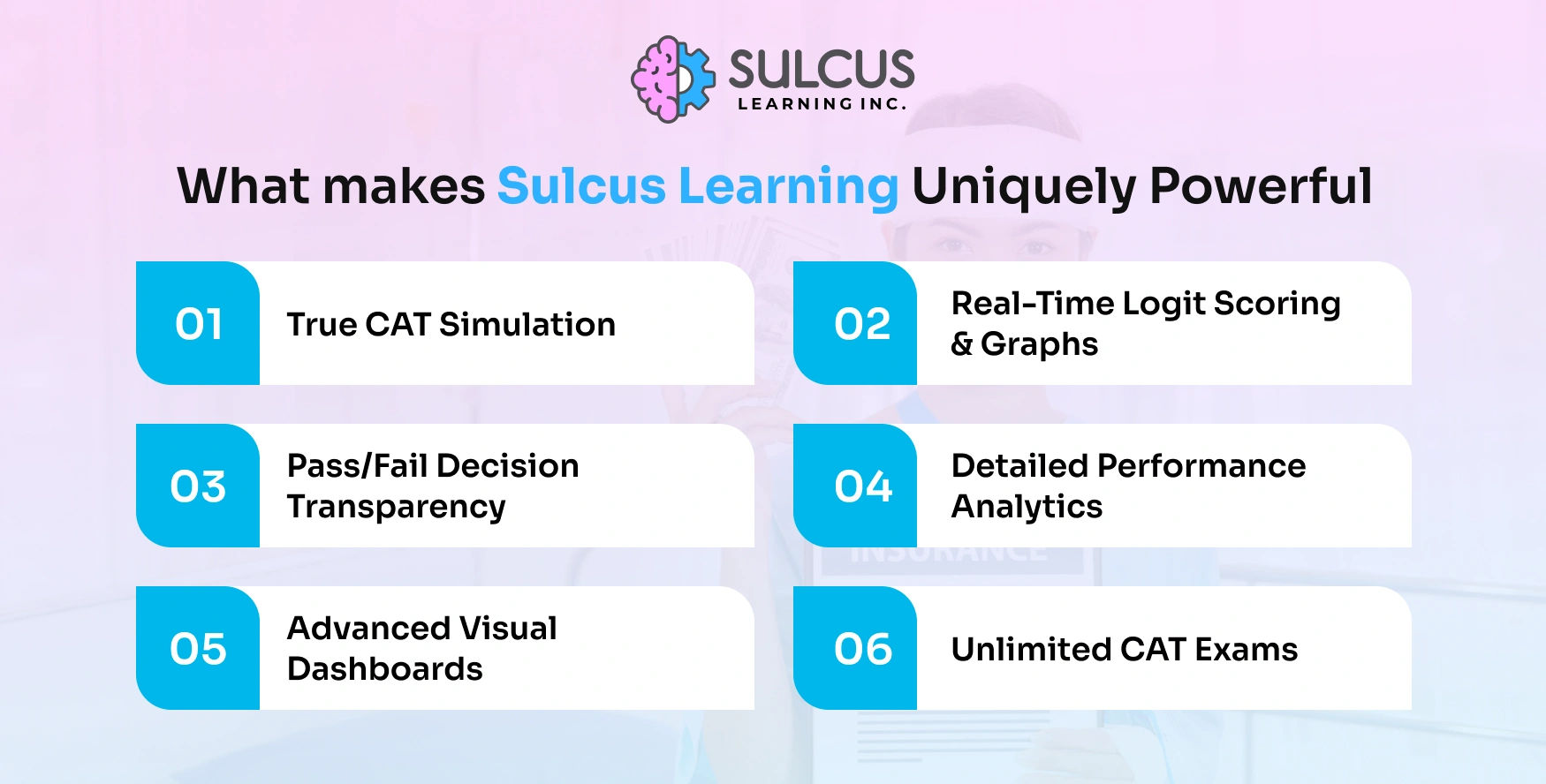
- True CAT Simulation: Unlike most other testing platforms that have adaptive testing, it has a real time testing environment giving you the opportunity to take the exam as a CAT (Computerized Adaptive Testing) exam and experience how it feels to have adaptive testing.
- Real-Time Logit Scoring & Graphs: With Sulcus, you will have a unique ability to see where your ability is at exactly in real time as logit scoring will graphically show you where you are in relation to the passing standard and where your ability falls.
- Pass/Fail Decision Transparency: You will have clear visibility of whether you passed or failed as you will be given the opportunity to see how your results fall within CAT (Computerized Adaptive Testing) criteria. For example, you will be able to see how the 95% confidence rule is applied.
- Detailed Performance Analytics: You will see how other Clients’ Needs sections are questioned and how to improve your weak areas.
- Advanced Visual Dashboards: You will see your progress and the paths to success with the help of clear and colorful charts.
- Unlimited CAT Exams: You will have the ability to create unlimited, realistic practice opportunities. At Sulcus, we have no restrictions on how many practice exams you can create, unlike other systems with a finite number of adaptive tests.
Your practice is focused on evidence and competency-based nursing practice standards for clinical reasoning, decision-making, and client safety. Predictions of readiness and the insights from the analytics explain your strengths and weaknesses and help identify gaps in your exam readiness.
For those who are looking to be successful, Sulcus Learning’s advanced analytics and adaptive testing simulations provide the opportunity to train in the mirror-like NCLEX CAT environment. Beyond analytics, this opportunity increases your confidence and success significantly.

Conclusion
The NCLEX uses computer adaptive testing to determine your knowledge, critical thinking, and clinical judgment skills. When you know what a computer adaptive test is, how it works, and what factors it uses to evaluate your performance, you will be able to take the exam with more confidence and less doubt.
Passing the NCLEX is not about correct answers to every question. You must be able to show safe, competent, and patient-centered nursing practice over and over. You will be able to do well with the exam format with the right preparation. A lot of practice, and understanding the most important concepts. This will also allow you to be closer to beginning your nursing career in Canada.
FAQs
Q1. What is computer adaptive testing in NCLEX?
Ans. Computer adaptive testing in NCLEX is an exam format where each question adapts to your previous answer, allowing the system to accurately measure your clinical judgment and determine competency for safe nursing practice.
Q2. How does CAT testing work?
Ans. CAT testing works by adjusting question difficulty after every response. Correct answers lead to harder questions, while incorrect ones lead to easier questions, helping the system continuously estimate your ability level in real time.
Q3. Is computer adaptive testing harder than traditional exams?
Ans. Computer adaptive testing is not necessarily harder than traditional exams. It feels challenging because questions change dynamically, but it simply focuses on accurately measuring your ability rather than increasing overall exam difficulty.
Q4. How many questions are in NCLEX CAT?
Ans. The number of questions in the NCLEX CAT is not fixed. It varies depending on how quickly the system determines your ability level and reaches a confident decision about your pass or fail result.
Q5. Can you fail quickly in CAT?
Ans. Yes, it is possible to fail quickly in CAT if the system determines early that your performance is consistently below the passing standard. Indicating that required competency for safe nursing practice is not met.

Harry Sagar
Passionate and detail-oriented leader at Sulcus Learning, dedicated to supporting internationally educated nurses in achieving their professional goals. With experience as a general practitioner, smoking cessation consultant, and licensed practical nurse, I combine clinical expertise with mentorship. Guided by the philosophy, “Your Success is Our Ambition,” I help nurses gain confidence, competence, and career-ready success.