
Nursing in Canada offers many opportunities, with options to choose from. The first step of this process is deciding which licensure exam you would like to pursue: the CPNRE or the NCLEX. Your exam choice lays the groundwork for your future nursing career.
The CPNRE focuses on the knowledge and skills required to become an LPN/RPN in Canada. It is intended to assess whether you can provide safe, competent care in a client-centred manner and perform nursing tasks in a practical nursing role.
The NCLEX-RN, however, is the entry-level exam for Registered Nurses in Canada, the US, and Australia. It is globally recognized, and for this reason, it is an excellent option for nurses looking for additional opportunities and for more internationally recognized career options.
To make informed decisions about your education, CPNRE study plan, and longer-term professional goals, you need to understand the differences between CPNRE vs NCLEX.
This blog is directed towards candidates of Canadian nursing. It aims to provide information regarding the structure of available exams, preparation, and career options. Let’s get the process started for you and help you become a nurse.
What is CPNRE?
The licensure examination accepted across Canada for practical nursing is the Canadian Practical Nurse Registration Examination (CPNRE). The CPNRE tests whether candidates can provide safe and ethical nursing care and demonstrates the fundamental competencies required to care for clients effectively.
Purpose
The CPNRE is the only licensure examination for Practical Nurses in most Canadian Provinces and Territories. The CPNRE demonstrates whether candidates meet the identified Canadian professional standards and practice safe entry-level nursing.
Eligibility
To apply, individuals must meet all application criteria of the approved practical nursing program, as well as the regulatory requirements of the provincial and territorial bodies governing the CPNRE. These include:
- College of Licensed Practical Nurses of Alberta (CLPNA)
- Saskatchewan Association of Licensed Practical Nurses (SALPN)
- College of Licensed Practical Nurses of Manitoba (CLPNM)
- College of Licensed Practical Nurses of Nova Scotia (CLPNNS)
- Association of New Brunswick Licensed Practical Nurses (ANBLPN) / Nurses Association of New Brunswick (NANB)
- College of Licensed Practical Nurses of Newfoundland and Labrador (CLPNNL)
- Yukon Government – Professional Licensing & Regulatory Affairs (LPN Licensure)
- Prince Edward Island College of Registered Nurses and Licensed Practical Nurses (PEICRNLPN)
- Northwest Territories & Nunavut – Department of Health (LPN Regulation)
All of the above use the CPNRE to assess the competencies necessary for the practice of nursing in an entry-level practical nursing position in Canada.
Exam Format
The CPNRE consists of multiple-choice questions based on scenarios. It is a fixed-form, computer-based exam designed to measure:
- Clinical reasoning
- Ethical decision-making
- Client safety
- Essential entry-level nursing competencies
Preparing for the CPNRE
Preparing for the CPNRE requires a study schedule. Having a structured schedule will pay off immensely.
Realistic practice tests, comprehensive course materials, and learning pathways are available to help achieve the goals of confidence, improved performance, and a higher likelihood of passing on the first attempt.
Across the country, nursing candidates heading to the CPNRE for the first time and seeking success choose Sulcus Learning.
Sulcus Learning helps you prepare for your licensure exam with confidence and a sense of purpose.
What is the NCLEX?
The National Council Licensure Examination (NCLEX) is the standardized exam for all RNs. It is internationally recognised, making it a popular choice for Canadian nurses who want to work in the US or elsewhere where an RN license is required.
The NCLEX measures a nurse’s ability to provide safe and effective care, including critical thinking, clinical judgment and decision-making across various situations in the healthcare field.
- Purpose: The NCLEX-RN is the licensure exam to attain the position of registered nurse in Canada, the USA, and Australia. This exam ensures that exam attendees have all the competencies and safe-practice skills for entry-level nursing practice.
- Eligibility: You must have completed nursing programs approved by nursing regulatory authorities.
- Exam Format: The NCLEX employs computerized adaptive testing (CAT) and a variety of question types to assess a candidate’s understanding and their ability to apply critical thinking to problem-solving.
Aspiring candidates who wish to maximize their chances of passing the NCLEX exam must start studying early, and the good news is that practice exams and review guides are available, customized to the Canadian nursing system.
Read More:- What do Licensed Practical Nurses Do?
Key Differences Between CPNRE and NCLEX
Understanding the differences between the CPNRE vs NCLEX-RN is essential for choosing the right exam for your nursing career.
| Feature | CPNRE | NCLEX-RN |
| Primary Purpose | Certifies for registration as a practical nurse across Canada. | Certifies for registered nursing licensing in the U.S., Canada, and Australia. |
| Intended Role | Practical Nurse (RPN/LPN). | Registered Nurse (RN). |
| Geographic Scope | Applicable in the Canadian provinces and territories that administer the CPNRE. | International examination with emphasis on the U.S. nursing position; adopted Canada and Australia for RN licensure. |
| Testing Structure | Fixed-form, traditional multiple choice written exam. | Computerized adaptive exam with multiple item formats including NGN (Next Generation)-style questions. |
| Scoring Approach | Minimum competency benchmark set for each examination cycle. | Pass/fail determined based on a testing algorithm that estimates ability and adapts in a computerized manner. |
| Licensure Result | Grants eligibility for practical nursing registration. | Grants eligibility for registered nursing licensure. |
Choosing Between the CPNRE and NCLEX-RN
When deciding whether to pursue the CPNRE or the NCLEX for your nursing license, the “easier” option truly depends on your education, career goals, and the type of nurse you aspire to become.
- If you plan to become a Practical Nurse (LPN/RPN) in Canada, the CPNRE is the correct pathway and aligns directly with the practical nursing role.
- Suppose your goal is to become a Registered Nurse (RN) or you want broader international opportunities. In that case, the NCLEX-RN is the preferred route—opening doors in the United States, Canada, and Australia.
Similarities Between CPNRE and NCLEX
Despite many differences between CPNRE and NCLEX, there are also many similarities between the two exams.
| Similarities | Description |
| Nursing Competence & Clinical Judgment | Assessing a candidate’s capacity to demonstrate safe and effective clinical decision-making is integral to both examinations. |
| Client-Centred Care | A solid comprehension of nursing’s foundational concepts is essential in both. |
| Mandatory for Licensure | These examinations must be passed in one’s respective disciplines to be licensed. |
| Preparatory Resources | Both examinations offer study guides, practice questions, and other preparatory materials to help candidates prepare. |
Even though the exams target different roles, the core nursing principles they test remain the same.
Read More:- Licensed Practical Nurse Salary in Canada
Preparation Strategies
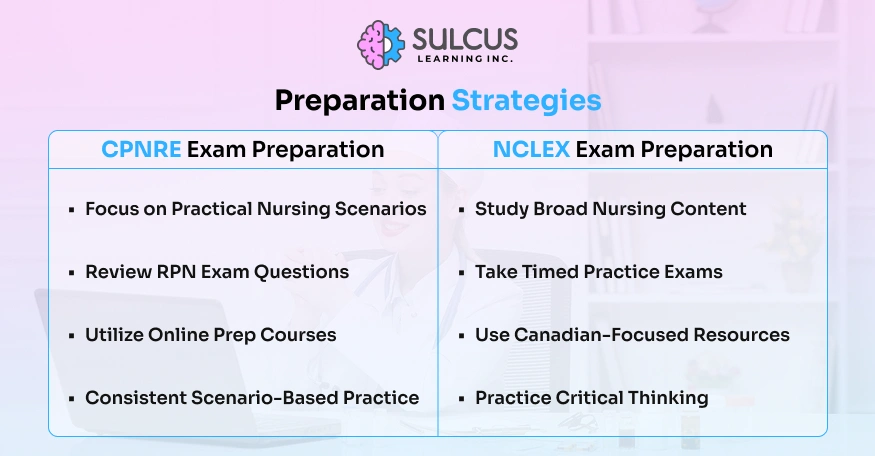
Below are some practical tips to prepare for the CPNRE and NCLEX exams.
CPNRE Exam Preparation
- Focus on Practical Nursing Scenarios: It is oriented towards real-life nursing scenarios.
- Review RPN Exam Questions: Do several practice exams to help build confidence and improve your decision-making process.
- Utilize Online Prep Courses: Courses target your weak areas and provide structured coverage of the exam.
- Consistent Scenario-Based Practice: Consistent practice familiarizes you with the exam format and builds confidence.
NCLEX Preparation
- Study Broad Nursing Content: Review across the adult, pediatric, mental health, maternity, community health, and other relevant areas to the Next Generation NCLEX (NGN) framework.
- Take Timed Practice Exams: Familiarize yourself with the NCSBN Test Plan and understand the Computerized Adaptive Testing (CAT) pass/fail criteria.
- Use Canadian-Focused Resources: Ensure your nursing prep materials align with Canadian and American nursing standards.
- Practice Critical Thinking: Practice NGN scenario-based questions to improve clinical judgment and exam preparedness.
To succeed on the CPNRE and NCLEX exams, you need to incorporate real-life case studies and practice to stimulate critical thinking and knowledge application that will all contribute to your success.
Career Implications
Choosing one of the exams between CPNRE vs NCLEX will not only influence your personal development but will also dictate your professional opportunities for your entire career in nursing.
CPNRE
- It is your gateway to becoming a licensed practical nurse or registered practical nurse in CPNRE practising provinces such as Alberta, Saskatchewan, Manitoba and Newfoundland & Labrador.
- Provides the ability to work in hospitals, clinics, long-term care facilities, and community health settings.
- Confirms practical nursing competencies and upholds the standards of the profession in the country.
NCLEX
- Differentiates you as a licensed registered nurse (RN).
- Grants you registered nurse opportunities in Canada, the USA and internationally.
- Enhances opportunities and career growth.
Overall Benefits
- Both certifications demonstrate skill and knowledge acquisition.
- Improves chances of being hired and increases professional respect.
- Both are foundational to a fulfilling career in Nursing.
Cost and Registration Comparison
Careful planning and timely registration are essential for a nursing exam preparation that can minimize your stress, save you time, and boost your likelihood of success on the nursing exam on the first try.
CPNRE
- Exam Fees: Slightly different between provinces
- Registration: Registration is managed by provincial nursing regulatory authorities, such as the College of Licensed Practical Nurses of Alberta (CLPNA).
NCLEX
- Fees: NCSBN sets the registration-related fees.
- Enrollment: Enrollment is entirely online, and Canadian candidates may interact with the provincial licensure authorities.
Sulcus Learning: Your Partner in Exam Success
Sulcus Learning guides Canadian nursing students throughout their preparation journey for the CPNRE and NCLEX. Our platform streamlines nursing learning by breaking complex concepts into simple lessons.
Students can also engage with our study plans and mock exams, which are designed to emulate the patterns, complexity, and analytical reasoning of certification exams used to determine the level of nursing licensure a candidate can attain.
Distinct from our competitors, Sulcus Learning offers a complete, exam-based learning experience. Students are provided with:
- In-depth rationales to build and strengthen their clinical knowledge
- Adaptive questions to tailor the experience based on the individual’s proficiency
- Comprehensive analytics to assess and report on students’ relative performance and progress
- Custom-built responses to assist students in achieving synthesis and application of clinical judgment.
- Timely materials in accordance with the latest patterns, simulations, and Canadian clinical practice standards.
We believe in our teaching framework, which encourages success through a clear, supportive process that instils confidence and fosters preparedness throughout their entire study journey.
Recognized throughout Canada and among the nursing community, Sulcus Learning offers the most trustworthy and reliable nursing exam prep resources, allowing nursing candidates to study effectively and remain motivated to achieve licensure, either in the RPN/LPN or RN stream.

Conclusion
In comparing the CPNRE vs NCLEX-RN or planning the next step in your nursing career, knowing the differences and nuances of each exam is crucial.
Each pathway leads to a different range of practice, and depending on your education, career aspirations, and vision for your professional practice, the right exam and practice pathway will differ.
With proper exam preparation and assistance from resources such as Sulcus Learning, the pathway to your goal narrows, making it more attainable.
By choosing the CPNRE, you are choosing practical nursing, or by selecting the NCLEX-RN, you are choosing registered nursing; either way, you have a positive career in nursing ahead of you as long as you set your mind to it.

Taran Kaur
As Managing Director and Lead Instructor at Sulcus Learning, Taran helps internationally educated nurses navigate their professional journey with clarity and confidence. With qualifications including a B.Sc. (Nursing), MBA (HM), ENCC, and CMSN(C), she focuses on helping learners succeed in licensure exams and professional practice. Connect with Taran Kaur on LinkedIn.