

If you are aiming to become a licensed practical nurse in Canada, you’ll want to take and pass the RExPN exam as part of that process. But the question is: what exactly is the RExPN, and how can you prepare for it so you can pass it on your first attempt?
This complete RExPN exam preparation guide helps you to understand everything, from eligibility requirements and registration processes to exam structure, content, and scoring methods.
You’ll also discover smart study strategies, test-taking tips and advice on keeping yourself mentally and physically prepared.
Consider this RExPN prep guide as your personal mentor’s handbook, which was crafted to make the process of preparing for your exam easier, also help you to boost your confidence and help clear things up so that you can take on the RExPN with focus and clarity, setting you up for success from day one.
Understanding the Basics of the REx-PN Exam
The REx-PN (Regulatory Exam – Practical Nurse) is a Canadian licensure exam that assesses whether aspiring Practical Nurses possess the entry-level competencies required to provide safe, effective, and compassionate nursing care.
It replaced the CPNRE in provinces Ontario and British Columbia, where it is now the mandatory exam for Practical Nurse registration.
All other Canadian provinces and territories continue to use the CPNRE as their Practical Nurse licensure examination.
Key points about the REx-PN exam:
- Assesses your capacity to offer safe and effective nursing care.
- Evaluates critical thinking, clinical judgement, and practical nursing skills.
- Administered by Canadian Practical Nurse Regulators (BCCNM and CNO).
- The RExPN uses computerized adaptive testing (CAT) to set question difficulty.
- Validates candidates’ ability to meet Canadian licensing standards.
With these basics set in mind, you can prepare effectively and reduce anxiety as exam day approaches.
REx-PN Exam Format and Structure
Knowing the RExPN exam format is key. It is a computerized adaptive test (CAT) that automatically adjusts the difficulty of questions based on your responses.
Here’s what you need to know:
Number of Questions: The REx-PN uses a Computerized Adaptive Test (CAT) format. Candidates receive between 90 and 150 scored and unscored items, including multiple-choice, select-all-that-apply (SATA), and scenario-based exhibit-style questions. The exam adapts in real time based on your performance.
Duration: You have a maximum of 4 hours to complete the exam. This total time includes a short tutorial, the test itself, and optional breaks.
Content Areas (Client Need Categories): The exam blueprint is organized under the NCSBN’s official Client Needs framework:
- Safe and Effective Care Environment
- Management of Care
- Safety and Infection Control
- Health Promotion and Maintenance
- Psychosocial Integrity
- Physiological Integrity
- Basic Care and Comfort
- Pharmacological and Parenteral Therapies
- Reduction of Risk Potential
- Physiological Adaptation
These categories reflect the core responsibilities of an entry-level Practical Nurse across diverse Canadian healthcare settings.
Scoring: The REx-PN uses adaptive logit scoring, the same NCSBN standard employed in high-stakes licensing exams. It does not assign percentages; instead, the system evaluates your ability level and determines whether you meet the passing standard.
Get to know the RExPN exam format before you ever visit the testing center—and give yourself an advantage to plan your nursing preparation.
Breaking Down the REx-PN Exam Content & Blueprint
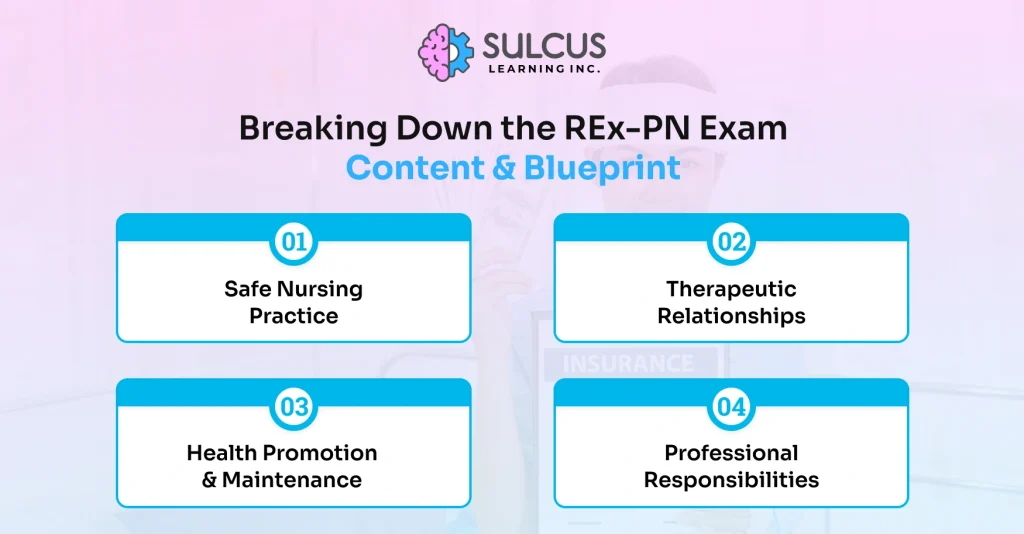
The REx-PN exam blueprint organizes the test into several categories to ensure a comprehensive evaluation.
Safe Nursing Practice:
Plans for client safety, infection control, correct administration of medication and treatment, timely verification or assessment of the client’s vital signs, and implementation of safe nursing practices within individual contexts.
Therapeutic Relationships:
Effective client and family communication, cultural competence, establishing trust and making ethical, client-centered decision-making.
Health Promotion & Maintenance:
It covers health promotion, including disease prevention, client education, promoting wellness, encouraging healthy lifestyle habits, and supporting overall community health.
Professional Responsibilities:
Emphasizes accurate documentation, compliance with legal and regulatory standards, peer relationships, adhering to ethical principles, as well as the responsibilities demonstrated in each nursing practice.
Understanding the number of questions on the REx-PN exam in each domain can also help you focus your study time.
Scoring, Question Types, and Passing Standards
Knowing how the REx-PN is scored and the types of questions you’ll be asked will help reduce test anxiety and enable you to achieve your best.
Scoring
The REx-PN uses a logit-based Computerized Adaptive Testing (CAT) model developed by the NCSBN in collaboration with the Canadian regulators (BCCNM and CNO), who use this system to ensure candidates meet the required standards for practical nurse licensure in their provinces.
A logit is a statistical value that reflects your nursing ability. As you answer questions:
- The system continually updates your ability estimate.
- It then delivers questions tailored to your current performance level—easier or harder depending on how you respond.
- The exam continues until the CAT has enough information to determine whether your ability is above or below the passing standard for safe, entry-level practice.
There is no percentage score. You either meet the standard or you don’t, based entirely on your demonstrated competence.
Question Types
The REx-PN exam consists of multiple-choice questions, as well as other question types described below:
- Clinical scenarios based questions
- Exhibit Questions.
- Questions involving interpretation, decision-making, and problem-solving.
These questions may reflect real-life situations and, as such, require the entry-level Practical Nurse to employ clinical judgment, safety concerns, and critical thinking.
CAT Passing Rules
The REx-PN exam uses three of its official decision-making rules for determining your outcome.
1. 95% Confidence Interval Rule
The exam may be stopped if the computer determines it is 95% confident of your level of ability relative to the established cut score.
- Above = Pass
- Below = Fail
2. Maximum-Length Rule
If you reach the maximum number of questions (150), the CAT may still be undecided. It will then consider your final logit score.
- Above the standard = Pass
- Below the standard = Fail
3. Run-Out-of-Time Rule (ROOT)
If your exam time has expired and no decision has been reached.
- If you have answered enough of the questions, the CAT will close the exam and use your final estimate of ability to determine if you have passed.
- If you have answered too few questions, the exam will be automatically marked as Fail.
Passing Standards
The passing standard is the lowest level of ability required to provide safe and competent Practical Nurse nursing care.
The REx-PN does not assess how much you memorized. Instead, it assesses the ability to:
- Think critically.
- Apply knowledge.
- Prioritize client safety.
- Make sound nursing decisions across varied situations
Eligibility and Registration Process for REx-PN
Before applying for the RExPN exam, it is important to ensure that you have met all RPN exam eligibility requirements.
- Educational Requirement: Graduation from a recognized practical nursing (PN) program at an accredited institution.
- Required Documentation: Prepare all the materials your regulatory body will require in your province, including transcripts, a degree certificate or diploma, and a valid ID.
- Language Proficiency: If there is a language proficiency requirement, make sure you can understand and communicate well during the test.
- Exam Booking: Log in to the online portal of your provincial nursing regulator and book the REx-PN exam on your preferred date at a test center near you.
- Exam Cost: The REx-PN costs CAD $350 per attempt in both Ontario and British Columbia. Testing outside Canada adds a CAD $150 international fee. Some optional administrative changes may include small service charges. Once your payment is approved, you receive an Authorization-to-Test (ATT) to schedule your exam and review test-day instructions. All fees are non-refundable.
Booking for the REx-PN exam is completed through your provincial nursing regulatory body’s website. The cost of the RExPN exam varies slightly by province. Register to receive test dates and locations.
Preparing Efficiently for the RExPN Exam
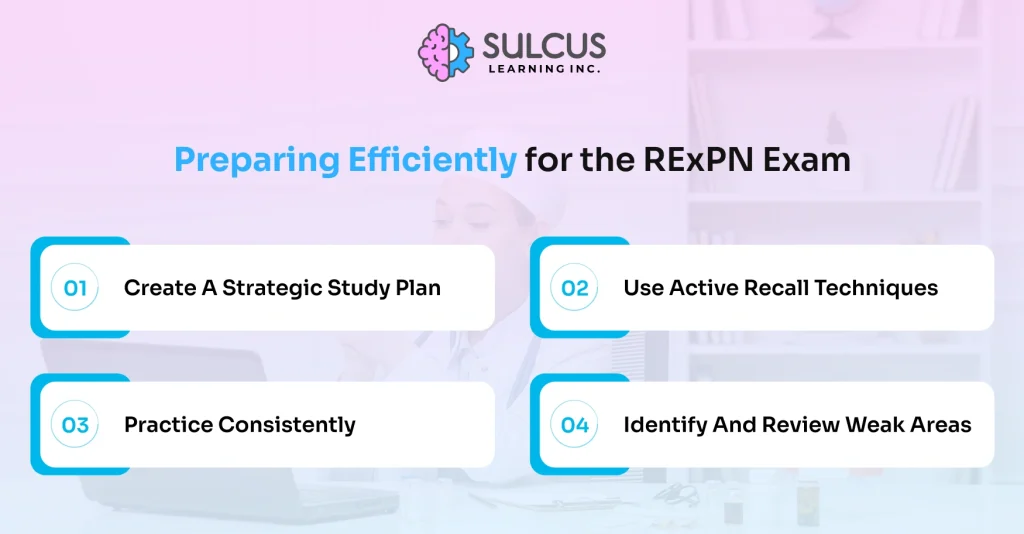
Studying hard is definitely part of it, but studying smart also matters. Here’s how to study smart to pass your RExPN exam on your first attempt:
1. Create a Strategic Study Plan:
Allocate your study time based on the RExPN exam blueprint, prioritizing high-impact topics while ensuring you cover all domains.
2. Use Active Recall Techniques:
Summarize the content in your own words, make flashcards, and discuss the subject out loud to help you remember better and understand more deeply.
3. Practice Consistently:
Solve as many practice questions, mock tests & scenarios as possible to enhance your speed and accuracy for the actual RExPN exam.
4. Identify and Review Weak Areas:
Spend more time in the areas you’re struggling with, go over challenging concepts time and again until you feel like a pro.
Strategizing for how to study for RExPN will significantly increase your confidence and performance.
Top Study Resources and Practice Tests for RExPN
The key to getting high scores is ensuring you are using authentic sources. The best ones are:
- RExPN Study Guide Books: Who offers quick explanations to help you understand the concepts and apply them with rigorous practice?
- Online RExPN Prep Courses: Provide a series of structured learning modules, video demos, and practice exams to simulate the actual test experience as well as review and measure your progress.
- RExPN Questions on Quizlet: Great for rapid reviews, flashcard-style study, and active recall to learn entries effectively.
- Practice Exams and Timed Quizzes: Simulate exam-day experience, improve your time management, and identify areas to boost your confidence.
- Interactive Case Studies: Scenario-based exercises that increase critical thinking and clinical judgment, applying your study to real-life nursing situations.
Reinforce your knowledge with case-based questions for practice in simulated clinical scenarios.
Mastering the Art of Exam Taking
You want to do everything you can to pass the RExPN exam because who wants to re-take this all over again, but everyone’s telling you how hard it is. But no one tells you how to prepare for it.
Begin by reading each question slowly, and keep an eye on key instructions that shape your responses. Secondly, eliminate obviously incorrect options first to narrow your choices and improve accuracy.
Time management is crucial — don’t spend too much time on any one question; practice smart timing to complete the test efficiently. Keeping a cool head is just as critical; stress or anxiety may cloud your judgment, so try to practice some relaxation techniques, such as deep breathing if you are feeling pressured.
Through frequent exposure with timed quizzes and sample exams, you can replicate the test better, build confidence, hasten decision making and be in your zone on test day.
Maintaining Mental and Physical Health During Preparation
Preparing for your nursing exam is not all about focusing on your studies, but also on your healthy mind and body. Your brain works well when your body is well cared for.
- Maintain a Healthy Sleep Schedule: Consistent, high-quality sleep supports memory and attention.
- Take Regular Breaks: A small amount of scheduled time away from studies helps fight burnout and sustain focus.
- Eat Balanced Meals and Stay Hydrated: Your brain and body need a balanced diet for energy and cognitive function.
- Practice Relaxation Techniques: Deep breathing, meditation, and mindfulness can help you reduce stress and improve clarity of thought.
By prioritizing both mental and physical health, you enhance your focus, remember things and can gain the emotional reserves needed to do well on the RExPN exam day.
Exam Day Experience: What to Expect and How to Stay Calm
It’s your RExPN test day. Preparation is not about knowledge; it’s also about how well you can perform:
- Arrive Early: Give yourself plenty of time to settle in and avoid last-minute stress.
- Bring Required Documents: Be sure you bring proper ID and any paperwork required by the test center.
- Familiarize Yourself with the Test Interface: Spend a little time understanding how the computerized test works.
- Stay Calm: If you get nervous, try getting back on track with slow breathing or visualization techniques.
- Focus on What to Expect: Knowing the exam routine reduces stress and helps you concentrate fully, giving you the best chance to perform confidently.
If you know what to expect, it will reduce your stress and help you stay focused on the exam.
After the Exam: Results, Retakes & Next Steps
Once you complete your RExPN exam, your result release may take a few weeks from your provincial nursing regulator.
- If You Pass: Congratulations! If you pass the nursing exam, it’s time to move on to the following stages of obtaining your practical nursing license and starting your professional life. Celebrate your hard work, but also prepare for the responsibilities ahead.
- If You Don’t Pass: You’re not alone. Carefully review your score distribution, determine weaknesses in particular areas, change your study strategies, and plan to retake the test. A focused study would very likely lead to you passing on your next attempt.
When you spend some time thinking about what to do next, whether that means celebrating or preparing for a retake, it helps maintain motivation. It ensures continuous progress toward becoming a competent, licensed practical nurse.
Common Mistakes to Avoid in the RExPN Exam
To give yourself the best chance of passing the RExPN exam on your first attempt, you must know what mistakes other people have made:
- Neglecting the Exam Blueprint: Spending too much time on low-earning topics without covering the heavyweights can leave you behind.
- Relying Solely on Memorization: Understanding concepts deeply is a much more worthwhile use of time than rote learning.
- Skipping Practice Tests: Disregarding timed quizzes and mock exams reduces your exposure to time management and to using the material in stressful situations.
- Overworking and Neglecting Self-Care: Overworking can have a negative impact on focus, memory and performance.
- Ignoring Lessons from Mistakes: Reevaluating errors and adapting strategies leads to stronger preparation and less unneeded stress.
By avoiding these mistakes, you can enhance your confidence and pace the exam well.
Why Choose Sulcus Learning for Your RExPN Prep?
Sulcus Learning has you covered with the RExPN exam prep and helps you to pass your nursing exam on your first attempt.
With a personalized mock exam and the adaptive nature of this learning solution, it creates an environment similar to the real RExPN exam. At the same time, with the help of the structured study plans, you can target your strengths and weaknesses for effective learning, and also get the expert Canadian nurses’ feedback, which helps you not just to memorize the information but also ensures you understand the concept deeply.
We enhance your strength, not replace your hard work, enabling more efficient study sessions that highlight what you need to know for the exam. Many nursing candidates have used it as a confidence booster to pass their Canadian RExPN exam on their first attempt.

Conclusion
Passing the RExPN exam is a challenging but achievable goal. By knowing the format and doing some strategic preparation with good study materials, and maintaining physical and mental health, you can enhance your chances of cracking your Canadian nursing exam as a practical nurse. Nursing exam preparation is a process and if you practice it diligently, there’s a good chance you can walk into the exam confident.
Frequently Asked Questions
Q1. What is RExPN?
Ans. The RExPN complete form is the Regulatory Exam – Practical Nurse, the licensure exam for practical nurses in Canada. Understanding what REx PN is helps you prepare effectively for your nursing career.
Q2. How many questions are in the RExPN exam?
Ans. The exam contains approximately 90-150 adaptive questions. Knowing how many questions are in the REx PN exam helps you plan your time and practice strategically.
Q3. How long does it take to get RExPN results?
Ans. Your provincial regulator typically releases results within a few weeks. Check the RExPN result time to track your progress.
Q4. How to pass the RExPN exam on the first attempt?
Ans. Use a RExPN study guide, practice with mock exams, focus on weak areas, and maintain mental and physical health to pass the RExPN exam confidently.
Q5. What is the cost of the RExPN exam?
Ans. Costs vary by province. Refer to your regulatory body for the RExPN exam cost and registration details.

Harry Sagar
Passionate and detail-oriented leader at Sulcus Learning, dedicated to supporting internationally educated nurses in achieving their professional goals. With experience as a general practitioner, smoking cessation consultant, and licensed practical nurse, I combine clinical expertise with mentorship. Guided by the philosophy, “Your Success is Our Ambition,” I help nurses gain confidence, competence, and career-ready success.