
The RExPN is the entry-to-practice exam for Practical Nurses in Ontario (RPN) and British Columbia (LPN). It assesses your clinical judgement, critical thinking, and your ability to render client-centred care. To understand the broader landscape, you can view our guide on types of nursing exam in Canada.
Passing the REx-PN exam on the first attempt is not only about having your name on the RPN list, but also about having the confidence and competence to offer nursing care in a variety of settings. With the proper RExPN exam tips, study techniques, and mindset, you can transform your exam-day anxiety into a successful and confident performance on the exam.
The following are confidence-building, proven RExPN study tips that will enhance professional performance.
Understanding the RExPN Exam Structure
The exam adjusts the difficulty of questions based on your responses, allowing the system to determine your competency with precision.
You will face 90 to 150 questions with a 4-hour time limit and will be required to respond to questions related to the nursing process, client care needs, and care management within the REx-PN framework.
The exam focuses on your ability to apply nursing knowledge rather than simply recalling facts. Questions typically include multiple-choice and select-all-that-apply (SATA) formats, Exhibit style Questions with clinical scenarios embedded within individual questions rather than long case studies. For a deeper dive into what to expect, read our comprehensive RExPN exam guide.
The RExPN exam reports only the final result as pass/fail, with no additional details. The first step in mastering RExPN preparation is to understand its structure.
Step-by-Step Guide to RExPN Registration
Before you apply for the RExPN exam, you need to ensure that you meet the eligibility criteria for the CNO or the BCCNM. Many candidates starting this process often ask How to Become a Nurse? as their first step toward licensure.
- Submit your RExPN application to your regulatory body (CNO/BCCNM).
- Wait for approval and Authorization to Test (ATT) from Pearson VUE.
- Book your test and pay your RExPN exam fee on the Pearson VUE website.
- Make sure to schedule the exam within the 90-day window of the ATT to avoid having to reapply.
Tip: Feel free to request your ATT only when you are prepared, as this gives you more flexibility in determining your study schedule. Following this guide for RExPN registration helps reduce stress and ensures you are ready for the exam.
REx-PN Exam Content Breakdown (As Per NCSBN)
The exam is developed by the National Council of State Boards of Nursing (NCSBN) for the Regulatory Exam for Practical Nurses (RExPN), which assesses whether an entry-level Registered Practical Nurse (RPN) is competent to provide safe, ethical, and professional nursing care in Canadian health care systems.
The RExPN exam is designed to assess clinical judgement, prioritization, and decision-making, not rote memorization. Each question represents an authentic client experience, in which the candidate must examine the scenario, apply pertinent nursing knowledge, and determine an appropriate response within independent and interdependent professional nursing roles.
This approach ensures the exam measures what truly matters: practice-ready competence, not test-taking tricks.
How the REx-PN Exam Is Organized
The REx-PN exam is organized into specific categories, known as the Client Needs categories. As an important feature, the exam incorporates the nursing process, including assessment, planning, implementation, and evaluation, within each question. This process is not evaluated as a standalone component, nor is it represented as a percentage of the overall exam; it is integrated throughout the entire exam.
Client Needs Categories & Percentage Distribution
1. Safe and Effective Care Environment (28–40%)
Management of Care (18–24%)
- Prioritization of client care
- Collaboration with other professionals in health care
- Delegating tasks within the Practical Nurse scope
- Upholding ethical and legal duties
Safety and Infection Control (10–16%)
- Preventing falls and other injuries
- Responding to emergencies and reporting incidents
- Preventing infections and practicing isolation
- Environmental and equipment safety
2. Physiological Integrity (34–48%)
Basic Care and Comfort (8–14%)
- Pain management
- Activities of daily living (ADLs)
- Support with nutrition and hydration, and mobility and elimination activities
Pharmacological and Parenteral Therapies (14–20%)
- Medication administration
- Dosage calculations
- Monitoring therapeutic and adverse effects
- Intravenous therapy responsibilities
Reduction of Risk Potential (8–14%)
- Monitoring for complications
- Diagnostic tests and follow-up care
- Recognition of abnormal findings
Physiological Adaptation (6–12%)
- Care of clients with acute, chronic, or unstable conditions
- Managing changes in physiological status
3. Psychosocial Integrity (8–14%)
- Mental health assessment
- Therapeutic communication
- Crisis intervention
- Cultural awareness and emotional support
4. Health Promotion and Maintenance (6–12%)
- Growth and development
- Disease prevention
- Immunization principles
- Health teaching and client education
Nursing Process: Fully Integrated (No Separate Percentage)
Questions related to other Client Needs categories in the REx-PN require the application of the nursing process in its different stages:
- Assessing: Collecting and analyzing data related to the client and CPR.
- Planning: Setting objectives and prioritizing goals.
- Implementation: Providing nursing care and teaching.
- Evaluation: Checking results and modifying care.
These steps are embedded in every question, reinforcing real-world clinical decision-making rather than merely disconnected theory.
Why This Matters for Your REx-PN Preparation
Understanding how your official NCSBN REx-PN is configured aids your preparation.
Understanding question structures helps you emphasize clinical reasoning, prioritization, and safe nursing decision-making rather than fact memorization. This strategy fosters genuine confidence in your exam performance and equips you for actual clinical practice.
Study intentionally, think like a nurse, and trust your clinical judgment, because that’s what the REx-PN tests you on.
Top Study Tips for the RExPN Exam
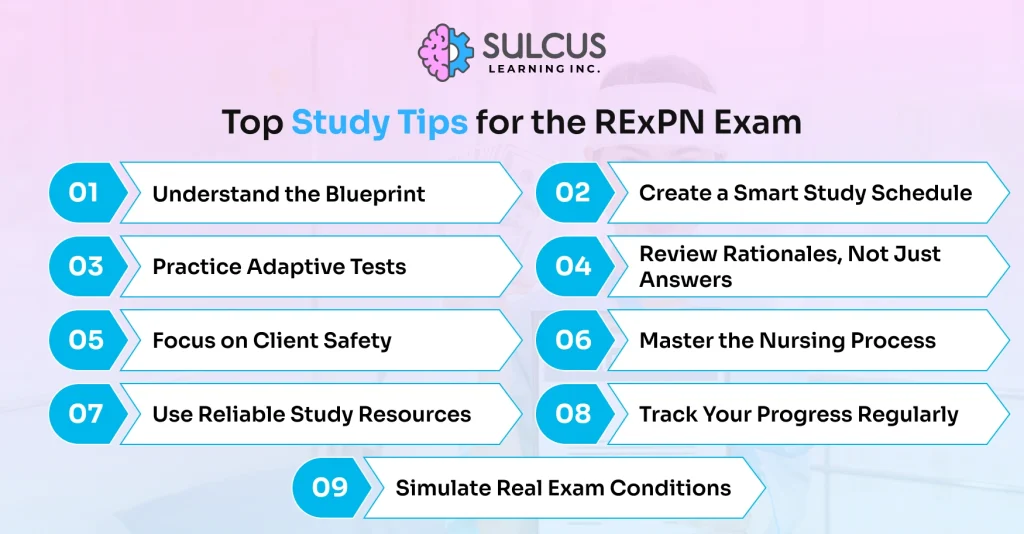
Although preparing for the RExPN exam may seem somewhat overwhelming, developing the right strategies can help you study efficiently and ensure you are ready to take the exam on your first try. These exam tips have been proven effective in assisting candidates in preparing for the RExPN exam. Stay concentrated and retain information to optimize performance on the day of the exam.
1. Understand the Blueprint
The first step in preparing for the RExPN exam is to review the official test plan. This will help you understand which topics are weighted more heavily and allow you to prioritize which sections to study.
This means you will be spending more of your study time on topics like client care needs, safety, and pharmacology. Understanding the test will help you perform better on the adaptive test and help you plan your study sessions more efficiently.
2. Create a Smart Study Schedule
The best way to prepare for the RExPN exam is to practice consistent studying. This is accomplished by crafting a study schedule that spreads your topics throughout the week.
For example, dedicate one day to studying pharmacology, and another day to studying mental health.
Remember that studying is most effective when you dedicate time to the task in 90-minute intervals with breaks in between.
3. Practice Adaptive Tests
To prepare for the RExPN, which is a computerized adaptive test (CAT), you must practice under the same conditions as the key to success. This means you must work with the adaptive mock tests for the RExPN that are available online.
You can use platforms like Sulcus learning, which is the best online prep platform for nursing licensure. It simulates the RExPN exam for you with over 2500+ questions, which are prepared by Canadian Nursing Professors and Clinical Educators. This will help prepare you for the exam in terms of pacing and psychological pressure.
4. Review Rationales, Not Just Answers
Every answer has an explanation; aim to understand each one. Given that the RExPN exam seeks to evaluate your clinical reasoning, which is pivotal to your everyday nursing practice, honing this skill is essential.
5. Focus on Patient Safety
Safety is one of the most heavily tested concepts on the RExPN. Ensure that you are familiar with the principles of infection control, prevention of falls, safe delegation, and client supervision, as these will constitute a huge part of the client care question in the RExPN.
6. Master the Nursing Process
To effectively tackle nursing case studies, you will need to understand and apply the ADPIE model at each step, which consists of Assessment, Diagnosis, Planning, Implementation, and Evaluation.
This will enhance your decision-making as you build your capacity to answer RExPN test questions.
7. Use Reliable Study Resources
When preparing for the RExPN exam, utilize resources that are widely accepted in the nursing field, such as Mosby’s Comprehensive Review and Saunders NCLEX Review.
It’s better to properly utilize one or two sources than to work with an excessive number of resources.
Consistent and thorough reading is crucial for the effective implementation of RExPN preparation strategies.
8. Track Your Progress Regularly
You can utilize the RExPN performance analytics dashboard to track your progress and analyze your performance and growth. It will show you the areas you need to work on. This boosts your readiness and the likelihood of passing the RExPN on your first attempt.
9. Simulate Real Exam Conditions
You will also need to practice under exam conditions. Set aside a distraction-free environment once a week to take a timed mock exam. This will build your mental endurance and help you manage your time so you can go to your exam completely confident.
You will learn the RExPN syllabus and prepare your brain for adaptive testing if you follow the previously mentioned tips. This will ensure that you will have the best possible chance of passing the RExPN on your first attempt.
Exam Day Tips to Stay Calm and Confident
Sleep well, eat light, and stay hydrated before your exam is the key to staying calm and focused. Arrive early at the exam centre with your ID, and trust your preparation. Remember that thought questions do not mean you will fail.
It indicated your skill level. Take a deep breath, take your time, and avoid overthinking. The RExPN rewards clinical reasoning, not panic. Confidence is your secret weapon for success!
After the Exam: Results, Feedback & Retesting
Your RExPN exam result will be available within two business days and will display only “Pass” or “Fail.” If your result is “FAIL”, you will receive the Candidate Performance Report (CPR) outlining your strengths and weak areas. This will help you prepare for the next attempt.
According to the RExPN retake policy, you can retake the exam after 45 days, and there is no limit to the number of attempts. With proper preparation, understanding the RExPN score report will help you achieve your goal promptly.
Lastly, treat every result as feedback to guide your next steps, not a hindrance.
How Sulcus Learning Helps You Pass the RExPN Exam
Preparing for the RExPN exam requires more than hard work, it demands a smart strategy and realistic practice.
Sulcus Learning, the Best Nursing Exam Prep Platform in Canada, makes RExPN preparation smarter and easier with its AI-powered tools and exam simulation platform that mirrors real exam conditions.
Access a comprehensive RExPN question bank with expert-verified rationales, take adaptive mock tests, and track your growth using the RExPN performance analytics dashboard.
Personalized competency reports and a Readiness Predictor help you identify strengths, address weaknesses, and measure exactly how close you are to passing with confidence.

Conclusion
To achieve success and become a Registered Practical Nurse (RPN) in Canada, you need the right mindset, appropriate preparation, and to accept the best RExPN exam tips. Many students compare the RPN vs RN roles before deciding on their final career path.
Analyze the exam, optimize your study strategy, and leverage resources like Sulcus Learning for effective practice and performance metrics. Remember, the goal is not to study longer, but to optimize study methods.
You are not just preparing to pass your nursing exam; you’re preparing to thrive and work as a Registered Practical Nurse in Canada.
FAQs
Q1. How long should I study for the RExPN exam?
Ans. Ideally, dedicate 4–6 weeks of consistent preparation using adaptive mock tests and focused reading.
Q2. How to pass RExPN on the first attempt?
Ans. Follow structured study schedules, practice adaptive tests, and use trusted resources like Sulcus Learning’s RExPN prep tools.
Q3. What happens if I fail the RExPN exam?
Ans. You can retake it after 45 days as per the RExPN retake policy, with no limit on attempts.
Q4. What are the most important topics for the RExPN exam?
Ans. Focus on client care needs, nursing process, pharmacology, and safety and infection control.
Q5. Is Sulcus Learning good for RExPN exam prep?
Ans. Absolutely. It offers adaptive tests, analytics, and a question bank aligned with real RExPN exam standards.

Taran Kaur
As Managing Director and Lead Instructor at Sulcus Learning, Taran helps internationally educated nurses navigate their professional journey with clarity and confidence. With qualifications including a B.Sc. (Nursing), MBA (HM), ENCC, and CMSN(C), she focuses on helping learners succeed in licensure exams and professional practice. Connect with Taran Kaur on LinkedIn.