

Dreaming of saving lives begins with acing the test that gets you there.
The journey to becoming a successful nurse starts before your shift; it all begins with mastering and cracking the nursing exams that prove your skill, judgment, and readiness to heal.
Before you can wear those scrubs with confidence and pride to make a real impact, you will need to pass a nursing exam to demonstrate proficiency in your education. If you are just starting, you may first ask How to Become a Nurse? to understand the full path.
However, no matter if you want to become a Registered Nurse (RN) or a Practical Nurse (PN), knowing the types of nursing exams is crucial for your success!
This guide for the nursing exam will take you through the key nursing exam names, their purposes and what to expect from every test, so that you can save time studying, accelerate your career, and realize your dreams faster than ever before.
Types of Nursing Exams
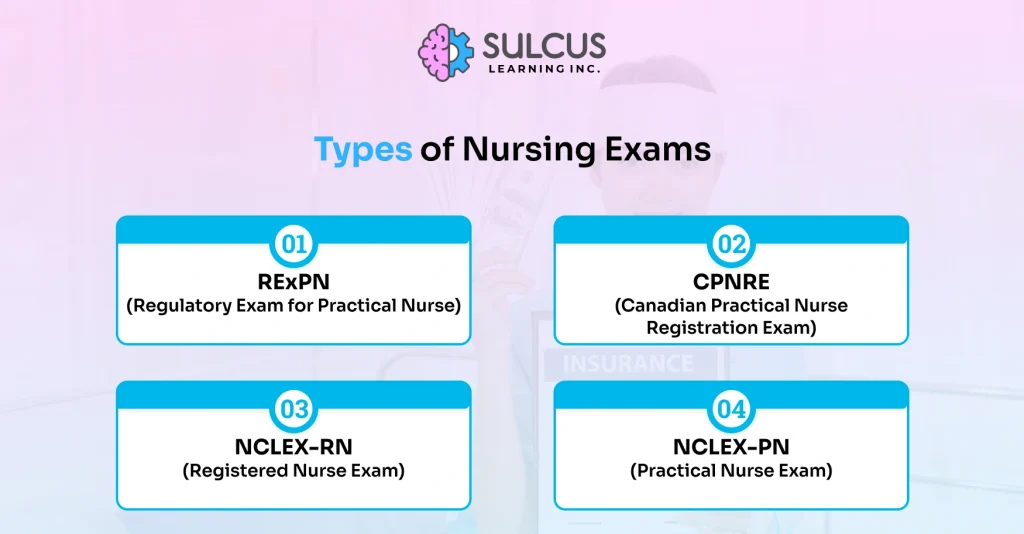
Nursing exams vary depending on your level of qualification and career objectives. From entry-level tests to advanced certification exams, each one measures skills in a specific domain. To decide which path fits your goals, compare the Licensed Practical Nurse vs Registered Nurse roles.
Some of the major nursing licensure tests consist of:
1. RExPN (Regulatory Exam for Practical Nurse):
This nursing exam is designed for individuals who are interested in working as a practical nurse in Ontario and British Columbia.
2. CPNRE (Canadian Practical Nurse Registration Exam):
For Canadian practical nurses who want to become registered and licensed practical nurses all the provinces of Canada except Ontario and British Columbia.
3. NCLEX-RN (Registered Nurse Exam):
It is a standard exam for licensure and practice as a Registered Nurse (RN) in the USA, Canada, and Australia. You should be aware of the NCLEX-RN Passing Score requirements before testing.
4. NCLEX-PN (Practical Nurse Exam):
An exhaustive examination that ensures nursing students are ready and safe to practice as practical nurses in the USA.
However, if you are looking to specialize, there are also Advanced and Speciality Nursing Exams that help raise your skills in the field of nursing.
RExPN (Regulatory Exam for the Practical Nurse)
The RExPN is used in the licensure of practical nurses. This nursing exam is specially designed to measure the minimum competencies. This nursing student exam tests your clinical judgment, decision-making and client care skills to make sure you can handle real-world nursing scenarios. For those in Ontario or BC, a detailed RExPN Exam Guide can help you navigate the specific test structure.
One of the most unique features of the RExPn is its Computerized Adaptive Testing (CAT) format.
Therefore it means the difficulty of each question changes depending on your answer, so it accurately and fairly tests your knowledge, regardless of whether you’re a beginner or an expert.
It’s an effective way to rate both strengths and areas that need improvement.
Preparation Tip: Don’t stress yourself out and be sure to use study materials that you trust, practicing a lot with practice exams that mirror the format of the actual exam. It helps in getting familiarized with the question level, speed and being positive for facing the examination. Following specific RExPN exam tips can significantly improve your performance on the CAT format.
CPNRE (Canadian Practical Nurse Registration Exam)
In Canada, Practical Nurses must complete the CPNRE to obtain licensure. The exam not only assesses nursing knowledge but also evaluates candidates’ critical thinking, clinical judgement, and ability to apply that knowledge in real situations. The exam assesses whether the candidate can provide safe, competent care without supervision. If you are preparing for this, checking the CPNRE exam schedule early is essential for planning.
Who Administers the CPNRE?
In Canada, the CPNRE is the responsibility of the Practical Nurse regulatory bodies, specifically:
- College of Licensed Practical Nurses of Alberta (CLPNA)
- College of Licensed Practical Nurses of Manitoba (CLPNM)
- Saskatchewan Association of Licensed Practical Nurses (SALPN)
- Association of New Brunswick Licensed Practical Nurses (ANBLPN/CLPNNB)
- College of Licensed Practical Nurses of Nova Scotia (CLPNNS)
- Association of Regulated Nurses of Newfoundland and Labrador (ARNNL)
- Yukon Registered Nurses Profession Regulation for LPNs
These regulatory bodies ensure that examinations are uniform across the country in terms of safe and competent practice.
What the CPNRE Evaluates
The CPNRE assesses the competencies required to be a safe and competent entry-level nurse in:
- Client care
- Sound clinical judgment
- Ethical and professional decision-making
This is one of the reasons the CPNRE has to be taken to become a Licensed Practical Nurse in Canada.
NCLEX-RN (National Council Licensure Examination for Registered Nurses)
To secure your entry-level position as a registered nurse, you have to complete the National Council Licensure Examination for Registered Nurses (NCLEX-RN).
This exam assesses your ability to critically analyze a situation, use your nursing knowledge appropriately, and make safe and evidence-based choices that would fit a healthcare scenario that is prone to complications and/or is ever-changing. Many students find it helpful to look at the CPNRE vs NCLEX comparison to see how the difficulty and format differ.
The NCLEX exam is composed of a variety of NGN exam questions and essay types to measure the ability of students to demonstrate a variety of essential nursing skills, including:
- Multiple-choice
- Drag and drop (ordered)
- Multiple select
- Text highlighting
- Cloze/drop items
- Matrix/grid
- Bow-tie
- Complete case studies
Each exam type above has been designed to test students’ clinical skills and their ability to make safe decisions using clinical judgment within the context of a realistic nursing care situation.
The NCLEX exam requires students to understand and apply nursing knowledge to specific patient conditions rather than rote knowledge of facts.
To help you adequately prepare for the NCLEX exam:
- Complete scenario-based question
- Complete case studies styled after NGN
- Use answer rationales
- Work on clinical judgment
Making correct, safe decisions based on the recommendations above will make you more confident and prepare you for the demands of nursing practice.
NCLEX-PN (Practical Nurse Licensure Exam)
The NCLEX-PN aims to determine if an entry-level Practical Nurse or Vocational Nurse has the requisite understanding to give safe, effective, and client-centered care.
Moreover, this exam covers the domains of health care promotion, physiological integrity, and psychosocial adaptation to ensure that test takers acquire all the skills required to assume entry-level nursing duties in practice.
Scope and Purpose
Unlike several other entry-to-practice nursing licensure examinations, the NCLEX-PN assesses if a candidate can render safe and effective nursing care in both autonomous and interdependent roles.
Furthermore, the nursing exam assesses the degree to which Practical Nurses integrate and collaborate with Registered Nurses and other members of the healthcare team while remaining responsible for the client’s safety, ethical practice, and clinical judgment.
Passing the NCLEX-PN is one of the key steps to being regarded as entry-ready in the profession and to complying with regulatory requirements for safe practice at the entry level.
During the NCLEX-PN, candidates can respond to a range of item formats developed by the NCSBN.
Question Types on the NCLEX-PN
These formats include; multiple-choice questions, Select-all-that-apply (SATA) questions, questions that require ordered response (drag-and-drop), highlight text, questions that require a cloze response / drop-down items, questions in matrix/grid formats, questions that utilize graphics or illustrations, and the Next Generation (NGN) which are mini case studies that require interpretation of charts, notes, and a series of interrelated client scenarios.
These item formats are designed to simulate case scenarios and are to be set in such a way that the candidates can demonstrate understanding.
Preparation Tips
Consistent review and practice are most effective on the NCLEX-PN, and memorization hinders success. In your preparation, you are encouraged to:
- Work with adaptive-style tests
- Engage in scenario-based and NGN-format questions
- Analyze various clinical rationales and clinical reasoning
These methods improve critical thinking, reinforce safe-practice principles, and boost confidence on the day of the test.
Advanced Nursing Certification Exams
Once you have gained clinical experience, you can work up to higher-level jobs that need specific certification. It offers career mobility and ladders, strengthens professional credibility, validates expertise, and prepares nurses for leadership positions.
Nurse Practitioner (NP) Exams
Nurse Practitioner (NP) exams assess the advanced clinical competence of experienced Registered Nurses transitioning to an expanded scope of practice. These exams assess a nurse’s ability to perform comprehensive health assessments, establish diagnoses, develop treatment plans, and deliver evidence-based interventions.
NP exams ensure candidates can provide autonomous, client-centred primary or specialized care, additionally, also collaborating effectively with physicians and other healthcare professionals when needed. Successful completion demonstrates readiness for advanced nursing roles that require critical thinking, leadership, and independent clinical decision-making.
Clinical Nurse Specialist (CNS) Exams
CNS exams evaluate advanced nursing skills within specialized practice areas such as critical care, pediatrics, and oncology. Leadership, clinical consultation, and strategies designed to enhance client outcomes are tested in candidates.
Whether you’re pursuing a postgraduate certification or a specialized role, these advanced nursing exams are essential for career growth, establishing professional authority, and delivering high-quality client care.
Registered Nurse (RN) Licensure Exams
The Registered Nurse (RN) licensure exam serves as the key benchmark for professional nursing practice. It ensures that candidates possess the essential knowledge, clinical skills, and judgment required to deliver safe, ethical, and effective client care.
The tests assess a nurse’s knowledge of how to use the theoretical concepts in practical situations, sound clinical reasoning, and provide safe nursing care.
This category primarily includes the NCLEX-RN and other region-specific assessments that adhere to professional standards established by regulatory authorities. Passing these nursing exams successfully on your first attempt is paramount to becoming a licensed nursing professional.
Specialty Nursing Exams
Specialty Nursing Certifications For the nurses who are prepared to specialize, specialty nursing exams open up career advancement and professional recognition.
Key Focus Areas:
- Pediatrics: They have assessed knowledge and skills in caring for infants, children, and adolescents.
- Critical Care: Assess skill in caring for critically ill clients in high-stakes situations.
- Oncology: Test proficiency in cancer care, treatment protocols, and client support.
- Gerontology: Measure the ability to care for older adults with complex health needs.
These types of nursing assessments not only make you grow in your career but also show that you are committed to superior client care and expertise in a specialized clinical area.
Tips for Exam Success
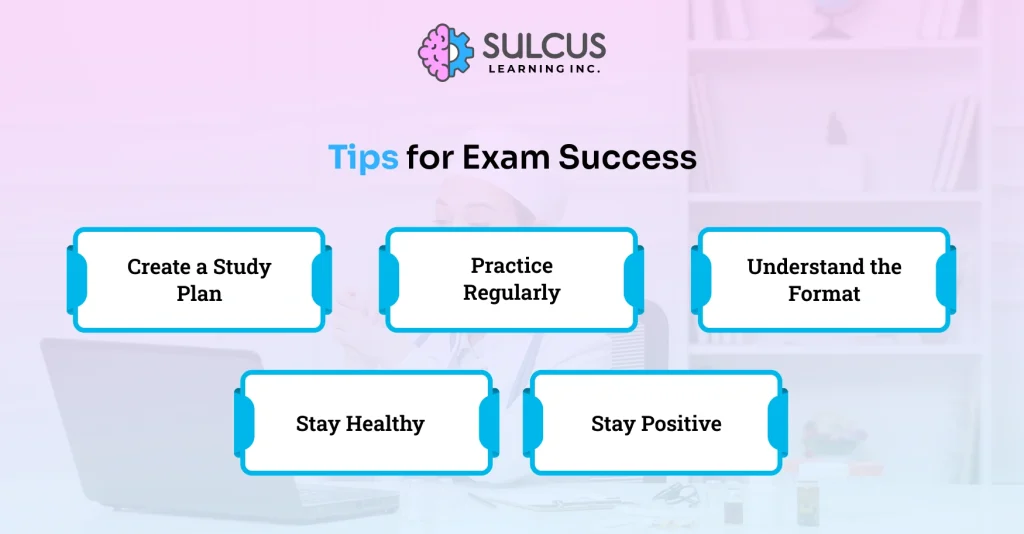
You do not need to memorize anything to pass your nursing licensure exams, it’s all about strategizing and thoughtful preparation to pass your nursing exam on your first attempt.
1. Create a Study Plan:
Schedule topics by week to ensure coverage of all subjects in the most effective manner.
2. Practice Regularly:
Use practice tests to determine your weaknesses and monitor progress.
3. Understand the Format:
Know the question types so that there are no surprises on the test day.
4. Stay Healthy:
Get adequate sleep, stay hydrated, and take brief breaks to boost focus.
5. Stay Positive:
Believing in yourself is the key to better performance and decision-making on the exam.
By following these tips, you will be able to confidently and thoroughly prepare for your nursing examinations.
How Sulcus Learning Helps You Succeed
Your journey to becoming an RN starts with an overwhelming task: passing the nursing licensure exams. However, with the right tools, the journey can be more manageable and yield positive outcomes. Around the world, future nurses are assisted by Sulcus Learning, the world’s most recognized resource for complete nursing exam preparation.
AI-powered personalized study plans, adaptive practice exams, and detailed feedback from specialists work to solidify your command of each nursing exam, whether the NCLEX-RN, REx-PN, international budding licensure exams, or specialty nursing exams.
The innovative learning system replicates real exam conditions, guiding the user to better clinical judgement, improved confidence in test-taking, and accurate self-evaluation of learning gaps.
Nursing candidates across the globe have experienced outstanding success with the evidence-based practices and realistic exam simulations that Sulcus Learning offers.
Sulcus Learning is recognized for providing the correct resources, plans, and transparency for success while working toward your RN’s specialty certifications with customized support and guidance through each practice question.
Conclusion
Every aspiring nurse faces the question, “What tests do nurses have to pass?” The answer depends on your path, but one thing is sure: each exam is a stepping stone to your dream career.
Understanding the types of nursing exams helps you plan smarter, prepare better, and walk confidently toward your licensure.
With the right strategy—and the right prep partner like Sulcus Learning—you’re not just studying for a nurse examination, you’re preparing to save lives and shape the future of healthcare.
FAQ’s
Q1. What tests do nurses have to pass to become licensed?
Ans. To become a licensed nurse, candidates must pass a nursing licensure examination that meets their country or province’s requirements.
For Registered Nurses (RNs), the NCLEX-RN is the official licensure exam used in the United States, Canada, and Australia.
For Practical Nurses, requirements vary:
- In Canada, most provinces and territories use the CPNRE for practical nursing licensure.
- In Ontario and British Columbia, practical nursing candidates must take the REx-PN, the exam specifically designed for these provinces.
- In the United States, practical nursing candidates write the NCLEX-PN, which leads to licensure as a Licensed Practical Nurse (LPN) or Registered Practical Nurse (RPN), depending on the state’s designation.
All these examinations ensure that nurses—whether RN or PN—meet the competency standards required for safe, effective, and ethical nursing practice.
Q2. What is the difference between NCLEX-RN and NCLEX-PN?
Ans. The NCLEX-RN is for those pursuing a Registered Nurse (RN) license, while the NCLEX-PN is for Practical Nurses (PN). Both exams assess nursing knowledge and critical thinking, but the RN exam emphasizes leadership, complex care, and advanced clinical decision-making.
Q3. How can I prepare effectively for nursing licensure exams?
Ans. The best way to prepare for nursing exams is through consistent practice, mock tests, and concept-based study plans. Platforms like Sulcus Learning offer adaptive mock exams and personalized study tools that mirror real test formats—helping you build confidence and improve performance.
Q4. Are there different types of nursing exams for specialization?
Ans. Yes! Beyond general licensure, nurses can take specialty nursing exams such as those for Critical Care, Pediatrics, Oncology, or Geriatrics. Advanced certifications like the Nurse Practitioner (NP) or Clinical Nurse Specialist (CNS) exams allow nurses to specialize and expand their career opportunities.

Harry Sagar
Passionate and detail-oriented leader at Sulcus Learning, dedicated to supporting internationally educated nurses in achieving their professional goals. With experience as a general practitioner, smoking cessation consultant, and licensed practical nurse, I combine clinical expertise with mentorship. Guided by the philosophy, “Your Success is Our Ambition,” I help nurses gain confidence, competence, and career-ready success.