
Dreaming of a nursing career in Canada? Then you’re not alone! Nursing is a highly reputable career and one of Canada’s most potentially rewarding professions, thanks to the opportunity to practice in any province, the licensed practical nurse salary, and the potential for career development.
Whether you’re a local student or an overseas nurse, you need to appreciate the specifics of Canada’s nursing system before entering the field.
Education and licensure, then finding a job and completing further education requirements, can paint an overwhelming picture. But there’s no need to feel overwhelmed because this guide breaks down everything you need to know.
You will understand how to become a nurse, the most appropriate sequence of steps to take, the estimated completion times, and how Sulcus Learning can enhance your exam readiness and overall success.
Who Is a Nurse?
A nurse is a healthcare practitioner who delivers nursing care to clients and educates communities about health and wellness. Nurses are critical to the Canadian nursing system, working in hospitals, clinics, and community health settings.
In the Canadian healthcare system, nurses play key roles that encompass the treatment of illness and client advocacy. If you are ever wondering, “What do Licensed Practical Nurses Do?” Knowing the roles of a nurse is the first step toward making this your career.
Understanding the Canadian Nursing System
Canada has one of the best healthcare systems in the world, and provincial and territorial bodies regulate the nursing profession.
The Canadian nursing system has different types of nursing exams and distinguishes between the level of education and licensure standards. Nurses must comply with these requirements to provide safe, high-quality care.
Knowledge of the Canadian nursing system will help navigate education, licensing, and job opportunities.
Whether an international nurse or a new graduate, understanding how nurses function in Canada’s healthcare system is crucial to career success.
Types of Nurses in Canada
Canada differentiates nurses into multiple categories, each with distinct functions and duties:
- Registered Nurse (RN): They provide comprehensive client care, administer medications, and supervise the implementation of treatment plans.
- Licensed Practical Nurse/Registered Practical Nurse (LPN/RPN): Provide autonomous and collaborative nursing care, including assessments, care planning, medication administration, and evaluation, within their regulated scope of practice. To understand the differences, read our guide on Licensed Practical Nurse vs Registered Nurse.
- Nurse Practitioner (NP): An advanced role in which one can diagnose clients, give prescriptions, and provide advanced care to clients.
- Specialty Nurses: This includes critical care, oncology, paediatrics, and other fields that require additional certifications.
Understanding the differences among nurses surely helps you choose the right path and plan for your Canadian nursing licensing and education.
If you’re asking “How do I become a nurse in Canada?”, identifying what role you want will streamline your education, clinical practice, and overall career path.
Educational Requirements
Before starting a career in Nursing in Canada, a candidate must obtain the appropriate education. To become an RN, you require a Bachelor of Science in Nursing (BScN). To become an LPN, you must complete an approved practical nursing diploma program.
If you are an internationally trained nurse, then you are required to complete bridging programs to meet Canadian nurse education standards.
You need to choose an accredited nursing school in Canada, as this will help ensure your qualification meets the standards required for licensing in the province, providing a smoother licensure pathway.
How to Become a Nurse in Canada
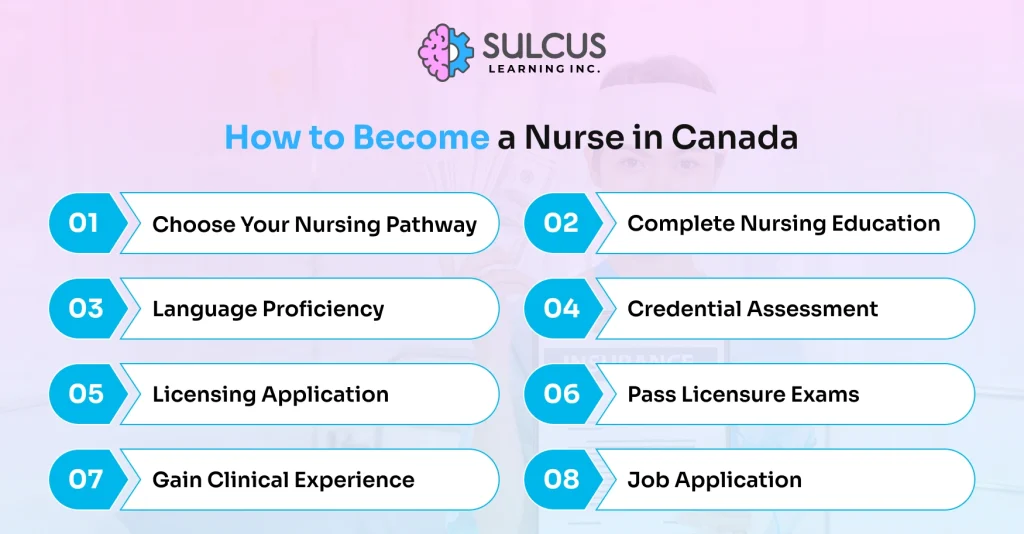
Do you ever find yourself asking, “How can I become a nurse in Canada?” Below is a straightforward way to look at it, step-by-step:
1. Choose Your Nursing Pathway
The first step toward becoming a nurse in Canada is to choose which kind of nurse you want to be. You need to decide if you wish to become an RN, LPN, or NP.
This decision is the first step in your educational path, licensure requirements, and career opportunities.
Choosing the correct pathway will be the first key step on the road to success.
2. Complete Nursing Education
The next step to become a nurse in Canada is for you to enrol on an accredited nursing program.
- To become an RN, you need to earn a Bachelor of Science in Nursing (BScN) degree.
- For Nurse Practitioners (NPs), you need to obtain a master’s degree.
- To become an LPN in Canada, you must complete an approved practical nursing diploma program from a recognized Canadian college. If you are in Ontario or BC, you might ask, “What is a Registered Practical Nurse?”.
Successful completion of the required credential will satisfy the educational requirements for nursing in Canada and will get you ready for your nursing license.
3. Language Proficiency
International nurses are required to take the IELTS or the CELBAN exam to prove their language proficiency.
Effective communication is vital for interacting with clients, colleagues, and the interprofessional healthcare team while ensuring safe, collaborative practice within the Canadian healthcare system.
4. Credential Assessment:
Internationally Educated Nurses (IENs) will need to complete the NNAS and NCAS assessments.
These evaluations verify your credentials, education, and training, and determine whether they are congruent with Canadian standards, as well as prepare you for provincial licensure and nursing practice.
5. Licensing Application:
Now the next step is to apply to your province’s nursing regulatory body.
This must be accompanied by your education and other required documentation, as well as your assessment results and proof of your language proficiency.
Your application begins the formal process toward obtaining legal authorization to practice.
6. Pass Licensure Exams
Taking RExPN, CPNRE, and NCLEX-RN, depending on your nursing category, you will take either the NCLEX-RN (for RNs) or the REx-PN/CPNRE (for practical nurses). Check the CPNRE Exam Schedule before applying.
These exams assess your understanding of core nursing concepts, client safety, and critical thinking skills that ensure you meet all the nursing requirements in Canada for your nursing career.
7. Gain Clinical Experience
Complete your clinical practice hours through internships, hospital placements, and bridging programs. Clinical practice is critical to passing your licensure exams, building your readiness for nursing practice in Canada and strengthening your confidence in client care.
8. Job Application
Apply to hospitals, clinics, and community healthcare centers. Prepare for job applications and interviews by refining your resume and professional presentation.
You can use an online nursing preparation platform like Sulcus Learning to enhance your chances of securing a rewarding position in your nursing career.
Following these steps ensures you meet all nursing requirements in Canada and prepares you for a successful and sustainable nursing career.
How Long Does It Take to Become a Nurse in Canada?
Your preferred pathway determines how long it will take to become a Nurse.
It will take about 1-2 years for LPN (Licensed Practical Nurse) programs, while, on the other hand, to become an RN, you need to complete a BScN (Bachelor of Science in Nursing) degree, which takes around 4 years.
Bridging programs for internationally educated nurses will take an additional 6 to 12 months.
After completing all necessary exams and registration, most nurses become fully licensed within 3–5 years.
If it is a realistic expectation for planning your career, it will be best to use this timeline when asking, “How long does it take to be a nurse?”.
Licensing and Registration Process
Nurse licensing in Canada is undertaken by provincial regulatory bodies such as CNO (Ontario) and BCCNM (British Columbia). If applying there, read our RExPN Exam Guide.
The licensing process requires the submission of documents as well as credential assessments and exams. Bridging programs are offered to international nurses as well.
Nurse registration in Canada is a lawful process that all nurses must comply with to protect patients.
It must be followed correctly to practice legally as an RN (Registered Nurse), LPN (Licensed Practical Nurse), or NP (Nurse Practitioner) in Canada.
Nursing Licensure Exams in Canada
Becoming a nurse in Canada requires passing the relevant licensure examinations.
The key nursing exams in Canada include CPNRE for practical nurses in certain provinces, RExPN for Registered Practical Nurse (RPN) in provinces like Ontario & British Columbia, and NCLEX-RN for Registered Nurses(RN). You can compare them in CPNRE vs NCLEX.
These nursing exams assess the candidate’s clinical knowledge, critical thinking, and patient safety competency areas. In some cases, international nurses may require additional evaluations.
The use of structured study guides, practice tests, and all the nursing prep for Canadian exams, websites like Sulcus Learning, will improve one’s chances of passing the exams.
Nursing licensure examinations may be difficult, but they are necessary to practice nursing in Canada. This will ensure that nurses deliver safe, competent, and professional care to their clients all over the country.
Salary of Different Types of Nurses in Canada
The differences in the salaries of registered nurses in Canada are due to the differences in the role and responsibilities, years of experience, province and specialization.
- Registered Nurses (RNs) Salary: Earn around CAD 70,000–95,000 per year.
- Licensed Practical Nurse Salary: Typically ranges from CAD 50,000–65,000 annually.
- Registered Practical Nurse Salary: Falls within a similar range, depending on province and healthcare setting. Review the registered practical nurse salary here.
- Nurse Practitioners (NPs) Salary: Can earn CAD 90,000–120,000 per year.
- Specialty Nurses Salary: Nurses in specialities such as critical care or oncology often command higher salaries.
The role you choose within nursing and obtaining licensure in Canada influence how much you can earn.
Work Experience and Clinical Practice
Practical experience is a prerequisite for any nursing career in Canada. Clinical placements, internships, and bridging programs enable the nurse to integrate nursing theory with practice in real healthcare environments.
International nurses generally have to wait longer to have their registration completed. Hands-on practice builds the candidate’s confidence and skills and enables adequate preparation for licensure exams.
Nursing candidates with Canadian experience always have an advantage in the job market, and for good reason, as Canadian experience is an excellent predictor of success across various healthcare roles.
Applying for Nursing Jobs in Canada
After you get your nursing license, the next step is to secure your job. You can check online job portals and advertisements by requirement for hospitals, clinics, and long-term care centers.
Make sure your resume is customized, emphasizing your clinical experience relevant to the position. Although jobs can be found online, networking, attending healthcare job fairs, and joining professional associations may increase your chances.
For internationally educated nurses, understanding the various provincial requirements is critical to success, as is the clear presentation of various job requirements. These actions facilitate a smooth transition to employment, laying the groundwork for a nursing career in Canada.
Continuing Education & Career Growth
The nursing career is a field of lifelong learning. Continuing education and obtaining advanced degrees, such as Nurse Practitioner specialty certifications, enhance your skills and open new career opportunities.
You can also attend workshops, online courses, and professional development programs, which are ways for nurses to maintain familiarity with current best practices. This not only boosts career growth but also improves patient care quality.
To achieve success in Canadian nursing, one must strategically forecast and determine ongoing learning requirements. This keeps nurses competitive in an ever-changing healthcare environment.
Challenges & Tips for Success
Beginning a career in nursing can be tough, especially for international nurses in Canada.
Some common challenges that you face at the start of your nursing career include getting a license, adjusting to the Canadian healthcare culture, and finding a balance between work and academics.
Tips for success: stay organized, use trusted exam prep tools like Sulcus Learning, network with fellow nurses, focus on hands-on experience, and avoid common mistakes to avoid in Canadian Nursing Licensure Exams.
Building a career in nursing in Canada requires overcoming a variety of challenges, and can be accomplished with attention to detail, a thoughtful approach to your studies, and strategic planning.
Why Choose Sulcus Learning for Nursing Exam Preparation
Sulcus Learning is the best online prep platform for nursing for aspiring nurses in Canada. It offers interactive courses, mock tests, and personalized study plans tailored to meet nursing requirements in Canada.
Whether you’re preparing for RExPN, CPNRE, or NCLEX-RN, Sulcus Learning’s AI-driven tools identify weak areas, track progress, and boost confidence. International nurses also benefit from guidance on bridging programs and Canadian clinical practices.
With Sulcus Learning, you get structured resources, expert insights, and a proven approach to succeed in exams, helping you fast-track your nursing career in Canada.

Conclusion
Embarking on the journey to become a nurse in Canada comprises an enriching blend of education, licensing, and hands-on experience.
Having a clear grasp of the essentials pertaining to the nursing profession in Canada, coupled with the appropriate steps and resources like Sulcus Learning, makes the transition relatively seamless.
Since the process pertains to all prospective nurses, whether international or local, it is prudent to understand that work and readiness will significantly contribute to the process.
Your efforts will not only allow you to excel in the various nursing examinations but also in the career itself, where you can impact the lives of numerous patients and the community as a whole.
FAQs
Q1. How can I become a nurse in Canada?
Ans. To become a nurse in Canada, complete an accredited nursing program, pass required licensure exams like CPNRE or NCLEX-RN, and register with your provincial regulatory body.
Q2. How long does it take to become a nurse in Canada?
Ans. Becoming a nurse in Canada generally takes 3–5 years, depending on your chosen program, practical experience, and time required to pass licensing exams.
Q3. Can international nurses work in Canada?
Ans. Yes, international nurses can work in Canada by completing credential assessments, participating in bridging programs, taking language proficiency tests, and passing provincial licensing exams to meet Canadian standards.
Q4. What is the salary of nurses in Canada?
Ans. Canadian nurses’ salaries vary: RNs earn CAD 70,000–95,000, LPNs CAD 50,000–65,000, and NPs CAD 90,000–120,000, depending on experience and province.
Q5. How does Sulcus Learning help in nursing exam preparation?
Ans. Sulcus Learning provides interactive courses, mock tests, and personalised study plans to help nurses prepare effectively for the RExPN, CPNRE, and NCLEX-RN exams in Canada.

Harry Sagar
Passionate and detail-oriented leader at Sulcus Learning, dedicated to supporting internationally educated nurses in achieving their professional goals. With experience as a general practitioner, smoking cessation consultant, and licensed practical nurse, I combine clinical expertise with mentorship. Guided by the philosophy, “Your Success is Our Ambition,” I help nurses gain confidence, competence, and career-ready success.