

If you’re pursuing a career in nursing, then you’ve likely come across two major nursing designations in Canada, the Licensed Practical Nurse (LPN) and the Registered Nurse (RN).
Both career paths are crucial for delivering care within the Canadian healthcare framework. Irrespective of the importance of both roles, Canadian nursing students have difficulty determining which path is best for them.
Education, practice scope, compensation, career advancement, and future job stability will all vary across positions and will play a role in the decision.
What are the differences between a Licensed Practical Nurse and a Registered Nurse in modern healthcare? Let’s explore.
What is a Practical Nurse (LPN)?
According to Canadian law, an LPN is a self-regulated healthcare professional. But exactly What is a Licensed Practical Nurse? She provided nursing care to diverse clientele in different clinical environments.
LPNs are required to work autonomously and collaboratively, collaborating with RNs, NPs, physicians, and other healthcare team members in evidence-based practice.
Recording care and communicating pertinent information to the interdisciplinary healthcare team.
Integrating and coordinating the quality and continuity of daily nursing care across various healthcare settings, including hospitals, long-term care facilities, community clinics, and home health.
How to Become a Practical Nurse in Canada?
To become an LPN in Canada, you must:
- Complete an accredited Practical Nursing program, which is usually 2 years from a recognized college.
- Need to pass the CPNRE exam or REx-PN exam, depending on the province or territory.
- Registering with your provincial regulatory body for example, CLPNA, BCCNM, CLPNNS, SALPN.
- Consistently engaging in professional development activities.
Career Tip: Many LPNs later pursue bridging programs to become RN and acquire additional nursing qualifications and a broader scope of practice. If you are in Canada, you should first understand What is a Registered Practical Nurse? before starting.
What is a Registered Nurse (RN)?
A Registered Nurse (RN) is a self-regulated professional with more responsibilities, autonomy, and complexity in practice. An RPN vs RN comparison shows that the RN integrates higher-level clinical thinking, utilizes research, and employs leadership skills to coordinate and assess nursing care within a unit.
The core responsibilities of a Registered Nurse include:
- Detailed clinical assessments and care planning for the individuals in their charge.
- Providing clinical leadership and coordinating interprofessional teams.
- Need advanced decision-making and clinical judgment.
- Health promotion, chronic disease management, and illness prevention.
- Administering complex treatments and critical interventions.
RNs can function in various areas including emergency care, pediatrics, oncology, psychiatry, primary care, and community health.
How to Become a Registered Nurse in Canada?
In Canada, to be an RN, you need to complete these steps:
- Earn a 4-year Bachelor of Science in Nursing (BScN) or its equivalent from an accredited institution.
- You need to pass the National Council Licensure Examination for Registered Nurses (NCLEX-RN)
- Register with your provincial nursing regulator.
- Engage in nursing programs and activities to maintenance and engage your nursing professional skills.
Once you get your license, you can pursue advanced nursing roles as a Nurse Practitioner (NP), Clinical Nurse Specialist (CNS), or Nurse Educator.
LPN vs RN: Key Differences Explained
So when it comes to comparing a Licensed Practical Nurse vs a Registered Nurse, both nursing roles are essential to the medical field. They differ in education, duties, salary, and career advancement opportunities.
Here’s a clear breakdown of the difference between an RN and an LPN:
| Criteria | Licensed Practical Nurse (LPN) | Registered Nurse (RN) |
| Education | 2-year diploma program in Practical Nursing. Focused on foundational and clinical nursing competencies. | 4 years of Bachelor of Science in Nursing (BScN), including advanced medical theory, leadership, and specialized care. |
| Scope of Practice | Provides nursing care for clients with stable, predictable, or less complex health conditions. Collaborates and consults when client situations become complex. | Conducts client evaluations, builds care plans, and supervises teams in complex procedures. |
| Licensing Exam | Must pass the CPNRE or REx-PN (province-dependent). | Must pass the NCLEX-RN, the national licensing exam for Registered Nurses in Canada. |
| Average Salary (Canada) | $55,000 – $70,000 annually, depending on province and experience. | $80,000 – $100,000 annually, with potential for higher earnings in specialized fields. |
| Career Opportunities | Roles in long-term care, clinics, and community health with limited specialization. | Opportunities in hospitals, research, leadership and advanced nursing practice. |
| Autonomy | Practices autonomously within a defined scope; collaborates and consults with RNs or other providers for complex cases. | Practices autonomously across all client conditions; provides clinical leadership and direction for care teams. |
While both professions are beneficial, Registered Nurses (RNs) often have more autonomy, earn higher salaries, and have more opportunities to advance in their profession than Licensed Practical Nurses (LPNs).
However, LPNs provide accelerated entry into the workforce and direct client care experience to understand their day-to-day, see What do Licensed Practical Nurses Do? So both are highly valuable in Canada’s healthcare system.
What are the Differences Between a Registered Nurse and a Practical Nurse?
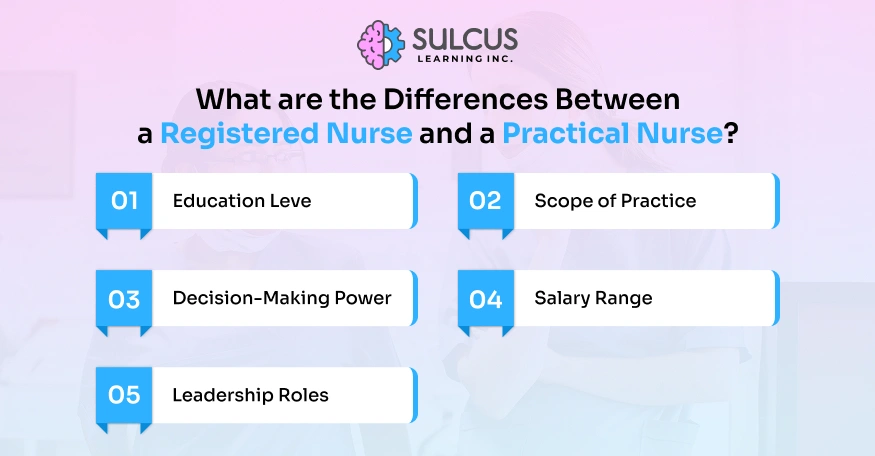
If you’ve ever wondered about the difference between a Licensed Practical Nurse and a Registered Nurse, the secret lies in their education, job roles, and degree of clinical involvement. Both positions are crucial to health care, but each one serves a distinct purpose and requires different skills.
Education Level:
The difference mainly comes down to the amount of preparation required for each role. LPN programs concentrate on basic nursing theory and practical, hands-on clinical training, while RN programs incorporate advanced health assessments, nursing leadership, pathophysiology, research, and more. This allows graduates to take on more complex roles and responsibilities, including critical thinking and decision-making.
Scope of Practice:
LPNs provide bedside care, administer medications, and assist clients under the supervision of a Registered Nurse. At the same time, RNs conduct complex assessments, manage client care plans, and perform critical interventions autonomously.
Decision-Making Power:
An LPN’s clinical judgment hinges on a stipulated framework and they must approach an RN or a doctor when a situation gets unpredictable or advanced care is needed. RNs can conduct their assessments and make complex decisions. Each role needs ethical judgment, prioritization, and safe practice.
Salary Range:
There are wage discrepancies with registered nurses tending to make $80–100K and practical ones averaging between $55–70K because of the level of education, what they can be responsible for and what they are allowed to handle.
Leadership Roles:
RNs also frequently serve in leadership roles, overseeing LPNs, orienting new employees, coordinating client care, and ensuring clinical requirements are met across teams of health care staff members and departments.
Ultimately, Registered Nurse vs Licensed Practical Nurse depends on how advanced you want your nursing career to be.
Skills and Competencies: What RNs and LPNs Need
Registered Nurses (RNs) and Licensed Practical Nurses (LPNs) both demonstrate compassion, collaboration, and perseverance — major cornerstones in promoting client health. However, their responsibilities are not the same.
LPNs are great with hands-on care, providing bedside manners, completing routine tasks and observing clients closely for signs of health in terms of the client’s condition. They are an indispensable part of daily comfort and medical care.
RNs, on the other hand, concentrate on clinical assessment, leadership and critical thinking. They evaluate clients’ information, plan the client’s care, and supervise nursing teams for the best results.
And although LPNs focus on “doing,” RNs specialize in “planning and evaluating” care, underscoring how both professions are crucial to keeping the healthcare system running efficiently.
LPN or RN: Which Nursing Career Path is Right for You?
Choosing between RN and LPN, what is the difference that truly matters? It’s your career vision.
If you want to start working quickly, value client interaction, and prefer shorter study periods, the LPN route is ideal.
For anyone who wants to go on to leadership positions, specializing in a particular area, and has their eye on long-term earning potential. The RN path offers more opportunities and financial rewards.
Here’s the way to think about it: LPNs are the building blocks of client care, and RNs are the architects who build, coordinate, and lead that care.
How Sulcus Learning Supports Future Nurses
At Sulcus Learning, we help nursing students prepare by providing the best online prep platform for Nursing licensure exams by providing expertly developed question banks and study tools created by experienced Canadian nursing educators.
Our platform includes:
- CPNRE, REx-PN, and NCLEX-RN exam prep and question banks that align with the current exam frameworks. Where we provide CPNRE Exam Tips and RExPN Exam Tips for practical nurses.
- Detailed rationales and evidence-based explanations for every question.
- Customized study plans built around performance.
- Mock Tests & Practice Exams for Canadian nursing licensure that simulate real exam conditions.
- Interactive learning modules and progress analytics to guide efficient preparation.
Sulcus Learning is Canada’s leading online nursing exam prep platform, guiding you in honing critical thinking skills, gaining a complete understanding of the exam content, and boosting self-confidence with the support of nurse educators, whether you are gearing up for the CPNRE, REx-PN, or NCLEX-RN.

Conclusion
When it comes to Licensed Practical Nurse vs Registered Nurse, there’s no “one-size-fits-all” answer.
Both roles are meaningful and rewarding; it’s all about where you see yourself in the healthcare journey.
If you’re ready to begin your path, start with clarity, commitment, and the right learning tools, because the future of nursing is brighter than ever in 2026.

Taran Kaur
As Managing Director and Lead Instructor at Sulcus Learning, Taran helps internationally educated nurses navigate their professional journey with clarity and confidence. With qualifications including a B.Sc. (Nursing), MBA (HM), ENCC, and CMSN(C), she focuses on helping learners succeed in licensure exams and professional practice. Connect with Taran Kaur on LinkedIn.