

Nursing is one of the most in-demand professions in Canada, from British Columbia to Newfoundland, due to major openings in your province’s healthcare system. According to the Canadian Institute for Health Information, within the next 10 years Canada will need tens of thousands of newly registered nurses and practical nurses, and newly registered nurses and practical nurses will need to take the NCLEX.
For many Canadian nursing graduates, the NCLEX is the last step between school and their first nursing job. If you’ve been turning to the internet to find answers to your next burning question, ” Is the NCLEX hard?” The answer is yes, and there is no real way to sugarcoat it. It is hard to understand why it is difficult, how it has changed over the years, and how today’s strongest learners are preparing.
In this guide, the NCLEX expert will share their 2026 predictions on NCLEX difficulty and give Canadian nurses insight into how they compare to others globally.
What Actually Makes the NCLEX Difficult?
I have more than 15 years of experience in the Canadian nursing profession, with a focus on new graduates and on nursing education. The truth is that the NCLEX is not really hard in the sense of having obscure content. It is a difficult exam because of the nuances that the test really brings.
The emphasis of NCLEX preparation and study is on recall. Student nurses are trained to remember facts, names, protocols, and procedures. The NCLEX tests something different. It tests your ability to reason. Every question is centered around what safe, competent, professional nursing actions to take in your assessment of the patient in your given scenario at that time.
That shift from memorization to judgment is what catches so many candidates off guard. Here are the core factors that drive NCLEX exam difficulty.
- Computer Adaptive Testing (CAT): Questions adapt based on your performance, meaning the exam gets harder when you answer correctly.
- Next Generation NCLEX (NGN): Introduced to reflect real-world clinical complexity, NGN questions include case studies, extended drag-and-drop, bow-tie items, and trend questions.
- Clinical Judgment Focus: The NCLEX expects you to think like a practising nurse, not a student reciting textbook answers.
- No Partial Credit On Most Formats: Either your reasoning is right, or it isn’t.
- Variable Length: The test can end between 85 and 150 questions, creating psychological pressure throughout.
Clinical Insight: The NCLEX tests your ability to prioritize patient safety and recognize deteriorating clinical conditions, skills that can’t be crammed overnight. This is deliberate by design.
NCLEX-RN vs. NCLEX-PN: Is One Harder Than the Other?
This is one of the most common questions Canadian nursing students ask, and the answer is more nuanced than a simple yes or no.
| Factor | NCLEX-RN | NCLEX-PN |
|---|---|---|
| Scope of Practice | Full registered nurse licensure focused on comprehensive patient care and independent clinical decision-making | Practical or vocational nurse licensure focuses on supervised and supportive patient care |
| Question Range | 85–150 questions, depending on the candidate’s performance in the CAT exam format | 85–150 questions, depending on the candidate’s performance in the CAT exam format |
| Clinical Complexity | Includes higher-acuity clinical judgment, advanced prioritization, and complex patient management scenarios | Focuses on foundational nursing care, safety, and supervised clinical responsibilities |
| CAT Difficulty Ceiling | Higher adaptive difficulty threshold with more advanced clinical reasoning questions | Moderate adaptive difficulty threshold with less complex patient care scenarios |
| NGN Integration | Fully aligned with the Next Generation NCLEX clinical judgment framework and advanced case studies | Partially aligned with NGN concepts and practical nursing competencies |
| Canadian Equivalent | NCLEX-RN replaced the CRNE for registered nurse licensure in Canada | REx-PN replaced the CPNRE in most Canadian provinces for practical nursing licensure |
For RN candidates, the NCLEX-RN demands a higher level of independent clinical reasoning. You’re expected to make autonomous decisions, manage complex patient scenarios, and delegate appropriately. For PN candidates, the focus shifts toward understanding supervised practice within a care team.
Neither exam is easy, but both are fair when you’re properly prepared.
How Computer Adaptive Testing Makes the NCLEX Feel Harder
Did you feel like each question was the most difficult question when you finished the NCLEX? That’s a good thing: it indicates you may have been successful.
One of the main components of the NCLEX is the Computer Adaptive Testing (CAT) system. With this system, the test monitors your responses to questions and calibrates the following question’s level of difficulty. When you answer a question correctly, a more difficult question is asked. If you answer a question incorrectly, your performance is adjusted accordingly. The test is continually attempting to answer the question of whether your level of demonstrated competence is at a passing level.
This is the reason two candidates are able to take the NCLEX on the same day and experience two completely different tests. This is also the reason a shorter test (fewer than 85 questions) doesn’t actually mean you failed the test, but rather the test reached sufficient confidence in your level of demonstrated competence.
Key takeaway: The NCLEX doesn’t measure what you know, it measures whether you consistently demonstrate safe, entry-level nursing competency. Understanding CAT reduces anxiety and helps you approach each question with the right mindset.
The NGN Update: Is the NCLEX Harder in 2026?
Yes, and it’s important to understand why.
The NGN introduced a new era for testing nursing competency. What was once a test predominantly using traditional multiple-choice questions, the NGN will now utilize question formats that are designed to be more reflective of clinical scenarios.
By 2026, the NGN will be incorporated throughout both versions of the NCLEX, the NCLEX-RN and NCLEX-PN, and this is what it means for you.
- Case-based clusters: This includes a single patient scenario that is broken down into multiple questions. This format assesses your ability to recognize patterns and how you interpret data to determine and modify your response as a nurse.
- Bow-tie questions: You will be tested on the ability to assess a situation, the key factors contributing to the situation, and the appropriate nursing actions
- Extended drag-and-drop and matrix grids: This format includes prioritizing a series of steps as opposed to a single question requiring a single answer.
- Trend questions: These involve data, patient assessment, and determination of clinical improvement or deterioration. Assessment conclusions are based on the patient’s vital signs, lab observations, and assessment results.
This new format is the most favorable to Canadian nursing graduates who trained in simulation-based programs. Their training and clinical education align with NGN. The candidates who struggle the most with NGN are those who are traditionally trained and practice only passive content review with little clinical reasoning.
NCLEX Pass Rates: What the Numbers Tell Us
Understanding NCLEX pass rate data is crucial for calibrating your own preparation. Here’s what the landscape looked like leading into 2026:
| Candidate Group | First-Attempt Pass Rate (Approx.) |
|---|---|
| U.S.-Educated RN First-Time Candidates | Approximately 83–85% first-attempt NCLEX pass rate, reflecting strong alignment between accredited nursing programs and NCLEX competency requirements |
| Internationally Educated Nurses (IENs) – First Attempt | Approximately 40–45% first-attempt pass rate due to differences in healthcare systems, clinical expectations, and NCLEX testing frameworks |
| Canadian-Educated RN Candidates | Approximately 75–82% first-attempt pass rate, supported by strong clinical education and growing familiarity with NCLEX-RN standards in Canada |
| Repeat NCLEX Candidates (All Categories) | Approximately 45–55% pass rate, highlighting the importance of targeted remediation, clinical judgment training, and adaptive exam preparation strategies |
The Data Tells A Clear Story: Preparation quality and clinical reasoning practice directly correlate with first-attempt success. Internationally educated nurses face a steeper curve largely because of unfamiliarity with CAT-based formats and the specific framing of North American clinical decision-making.
Is the NCLEX Harder for International Nurses in Canada?
This is complicated, but from the perspective of someone who’s seen thousands of IENs walk these steps, I can answer.
If you are an internationally educated nurse (IEN), the knowledge and skills you bring from your home country are critical. The NCLEX assesses your ability to use that knowledge within the context of the North American nursing system.
This requires an understanding of the U.S. and Canadian nursing roles, knowing when to elevate the care and when to act independently, and being able to apply the NCSBN definitions of patient safety within the context of the scenarios.
The most common challenges faced by IENs are:
- Unfamiliarity with the CAT format and adaptive difficulty
- Language and phrasing differences in clinical terminology
- Different prioritization frameworks (ABC, Maslow’s hierarchy in NCLEX framing)
- Limited access to NGN-specific practice questions
The great news is that with the right resources for preparation, these challenges can be overcome. IENs who engage in structured and competency-based NCLEX preparation are able to bridge the gap and obtain excellent results in their first attempts.
How Long Should You Study for the NCLEX?
There is no universal answer, but here is what the evidence and experience consistently show:
- Recent nursing school graduates: 4 to 8 weeks of focused, daily preparation is typically sufficient if you maintained strong academic performance.
- Graduates who took time off: 8 to 12 weeks allows you to re-activate clinical reasoning and cover content gaps.
- Internationally educated nurses: 10 to 16 weeks is often more realistic, especially if this is your first exposure to CAT and NGN question formats.
- Repeat candidates: A minimum of 8 to 10 weeks of structured remediation focused specifically on weak clinical areas.
Quality of study matters more than quantity of hours. Three focused hours a day, consistently applied through active practice questions and clinical reasoning exercises, outperform eight unfocused hours of passive review every single time.
Best Ways to Prepare for the NCLEX in 2026
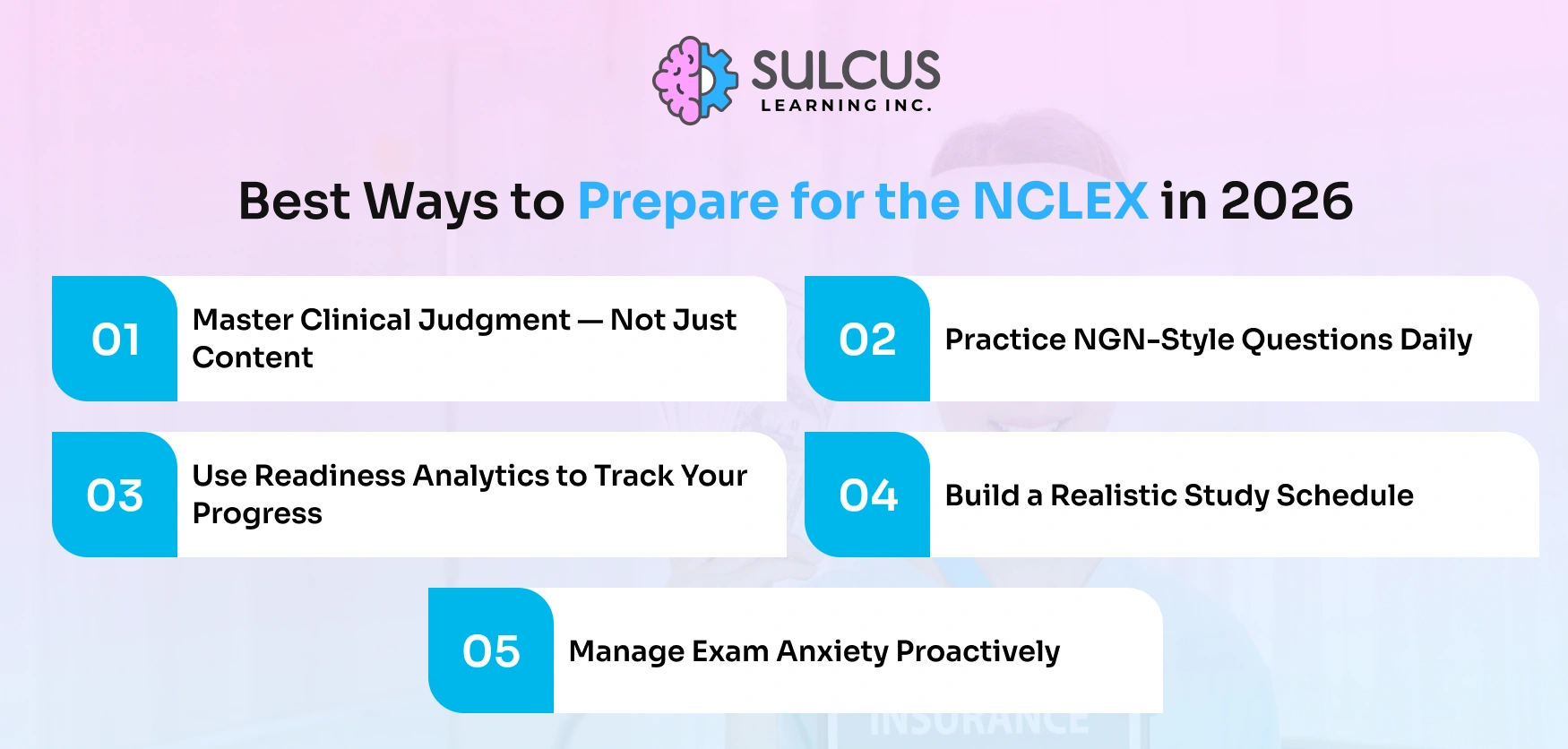
After working with nursing candidates across Canada, I have compiled preparation strategies that lead to consistent success.
1. Master Clinical Judgment — Not Just Content
Memorization is not going to cut it on the NCLEX. Focus more on studying for and understanding clinical scenarios. Ask yourself what takes priority, what would put the patient most at risk, and what needs to be done first.
2. Practice NGN-Style Questions Daily
If the study materials do not include case studies, bowtie items, matrix grids, and trend questions, change your study materials. NGN formats are not a small addition; they are the majority changes of NCLEX 2026 exam.
3. Use Readiness Analytics to Track Your Progress
Do not just move on to the next question. Find your performance patterns. In what ways do you still have gaps in knowledge? Do your mistakes focus on pharmacology, prioritizing, or the safety of the patient?
4. Build a Realistic Study Schedule
Draw your preparation timeline from your desired exam date backwards. Assign specific topics to each preparation week, and include off days for review. Lastly, schedule practice exams to prepare for test-day conditions.
5. Manage Exam Anxiety Proactively
NCLEX-related anxiety is real and clinically noticeable. Stress causes a lapse in thinking. Apply a lot of practice to prepare your body for the exam and mentally prepare yourself as you practice answering questions, create a sleep schedule, and definitely practice controlled breathing.
Prepare Smarter with Sulcus Learning Inc. — Built for Canadian Nurses
To successfully achieve your goal of passing the NCLEX on your first attempt, you need to join Smarter with Sulcus Learning Services. It is a Canadian Company, Trusted Globally and Successful in all Countries.
Smarter with Sulcus is the only dedicated nursing examination preparation software that has been developed with the entire Canadian nursing licensure in mind. This includes NCLEX-RN, NCLEX-PN, REx-PN, and the CPNRE with the utmost accuracy. Each question rests upon the NGN and CAT-based clinical reasoning. Hence, practicing Smarter with Sulcus prepares you for the exam in the most accurate manner.
What makes Smarter with Sulcus unique is the highly sophisticated performance analytics. The Predictometer scores your exam readiness in real time. The Competency Wheel maps your strengths and gaps across all clinical competency areas. Detailed Candidate Performance Report and Exam Percentage Growth Charts let you track your improvement with precision. You don’t just study, you study with direction.
Be it first-timers, an internationally educated nurse, or a repeat candidate, Smarter with Sulcus is here to help you launch your journey towards achieving your goal of passing the NCLEX-RN and PN. Start your free trial today and experience Canada’s most trusted NCLEX preparation platform.

Conclusion
Is the NCLEX hard? Yes! But just because something is hard doesn’t mean it’s impossible, out of reach for a prepared, motivated nursing candidate.
The purpose of the NCLEX is to evaluate the understanding and skills of nursing graduates in a way that helps determine if they are qualified and prepared to work in a safe and controlled environment. We shouldn’t have a negative viewpoint on this, instead, we should have a positive view of the NCLEX and prepare ourselves accordingly.
Passing the NCLEX on the first attempt is not about being the smartest in the class. The successful candidates are the ones who figured out the meaning of the NCLEX and the principles it was designed to evaluate. They practiced critical thinking and strategic clinical reasoning most effectively. They also used the statistics and analysis of their clinical reasoning to prepare for the NCLEX.
For nursing students in 2026 learning the NGN, the CAT, and the requirements of clinical practice, the effort you put into preparation is just as crucial as the intensity of the preparation. Make smart choices and use the resources that are integrated with the exam to create an analytics-based approach.
The moment you know you pass the NCLEX is the moment you step into the domain of nursing. Prepare for it.
FAQ’s
Q1. Is the NCLEX harder than nursing school?
Ans. In many cases, yes. The NCLEX emphasizes clinical judgment, prioritization, and adaptive testing performance, requiring candidates to apply nursing knowledge under pressure rather than simply memorize concepts from traditional classroom-based examinations.
Q2. How many students fail the NCLEX?
Ans. Around 15–20% of first-time U.S.-educated RN candidates fail the NCLEX initially, while internationally educated nurses experience significantly lower pass rates, making structured preparation, adaptive practice, and clinical judgment training increasingly important.
Q3. Is the NGN NCLEX harder than the previous version?
Ans. The NGN NCLEX introduces advanced clinical judgment scenarios and case-based questions that many candidates find more challenging. However, it better reflects real-world nursing practice and rewards practical decision-making abilities over memorization.
Q4. How difficult is the NCLEX for international nurses in Canada?
Ans. Internationally educated nurses often face challenges adapting to CAT testing formats, North American clinical frameworks, language expectations, and prioritization strategies. However, focused preparation significantly improves confidence, readiness, and first-attempt success rates.
Q5. What is the passing score for the NCLEX?
Ans. The NCLEX uses a logit-based competency measurement system instead of percentage scoring. Candidates pass when their demonstrated nursing competency consistently exceeds the minimum standard established by the NCSBN throughout adaptive testing.
Q6. Can you pass the NCLEX without a study plan?
Ans. Although possible, attempting the NCLEX without a structured NCLEX study plan significantly increases failure risk. Organized preparation improves content retention, clinical judgment development, confidence, time management, and overall exam readiness for candidates.
Q7. How long should I study for the NCLEX in 2026?
Ans. Most candidates should study between four and sixteen weeks, depending on educational background, clinical experience, graduation timeline, and familiarity with NGN question formats, adaptive testing strategies, and clinical judgment-based nursing scenarios.

Harry Sagar
Harry is a strategic leader at Sulcus Learning, developing exam-aligned learning solutions. With expertise in adaptive testing and clinical education, he supports learners in achieving confidence, competence, and readiness.