

Creating a study plan for the NCLEX can be overwhelming for many nursing graduates, and understandably so. Most nursing graduates take the NCLEX with the hope of passing on the first attempt. While there is no hurry to take this exam, there is also no easy way to pass the NCLEX. Motivation alone will not help you; a strategic focus aligned with the exam is necessary to succeed on the NCLEX.
An NCLEX study plan is not just about scheduling topics and content review. Because the NCLEX, developed by the NCSBN, is a Computerized Adaptive Test, it assesses the candidate’s clinical reasoning and judgment. This means the most successful candidates make connections between content and knowledge, so they also practice questions and learn to assess the rationale and reasoning behind clinical judgment and critical thinking.
This guide is for nursing graduates of both Canada and the United States who would like to take and pass the NCLEX. It does not matter if you have one week of prep time or three months; a well-structured strategy and plan are necessary for exam success. Consistency and critical thinking ar
e the focus.
What Is an NCLEX Study Plan?
An NCLEX study plan helps candidates assess their readiness for the NCLEX-RN and sets time-based goals to meet competency standards for safe nursing practice. The exam is not meant to take into account the individual state or provincial specifications, it is based on a standardized test plan formulated by the National Council of State Boards of Nursing. This plan serves as a guide for the knowledge, skills, and clinical judgment expected of an entry-level nurse.
An NCLEX study plan focuses on setting a goal to develop the various skills, with the end product being that goal. The study plan offers the following:
- Development of clinical judgment and decision-making skills
- Practice with NCLEX-style questions, including case-based scenarios
- Ongoing performance tracking to identify strengths and areas for improvement
The study plan relies on developing a stronger impact goal. The study plan is designed to represent the NCLEX goals. A study guide based solely on the content review will push the candidate further away from the goal. Content-based review study guides would deprive the candidate of the ability to make judgments and apply knowledge. In the lack of rest, content-based review is more proficient.
Why Most NCLEX Study Plans Fall Short
Nursing school strategies don’t always help with NCLEX prep. Many students mark their textbooks and review their notes. These strategies may help build foundational knowledge, but aren’t always effective for NCLEX prep. The NCLEX-RN and PN measures the ability to apply knowledge and make effective, safe clinical decisions, not the ability to recall facts.
As the NCLEX-RN is designed and distributed by the National Council of State Boards of Nursing, it is a computerized adaptive test (CAT). In a computer-adaptive test, question difficulty depends on test performance. The test continues until the computer is confident that the participant is or is not a safe, entry-level nursing professional.
This adaptive structure makes an NCLEX study plan fall short, as it is typically inflexible and does not account for the test-taker’s strengths and weaknesses, as well as past performance. Because the test is adaptive, a study plan must be flexible and take into account the ongoing performance of the participant. In these plans, practice questions and performance-based preparation must be prioritized over a static study schedule.
Considering the NCLEX’s adaptive structure and the unpredictable nature of the test, a flexible NCLEX study plan based on preparation centered around a study framework is prioritized and creates a strong study plan. There is no study plan greater than a test-taker’s framework, study, flexibility, and preparation based on performance.
How to Create an NCLEX Study Plan (Step-by-Step)
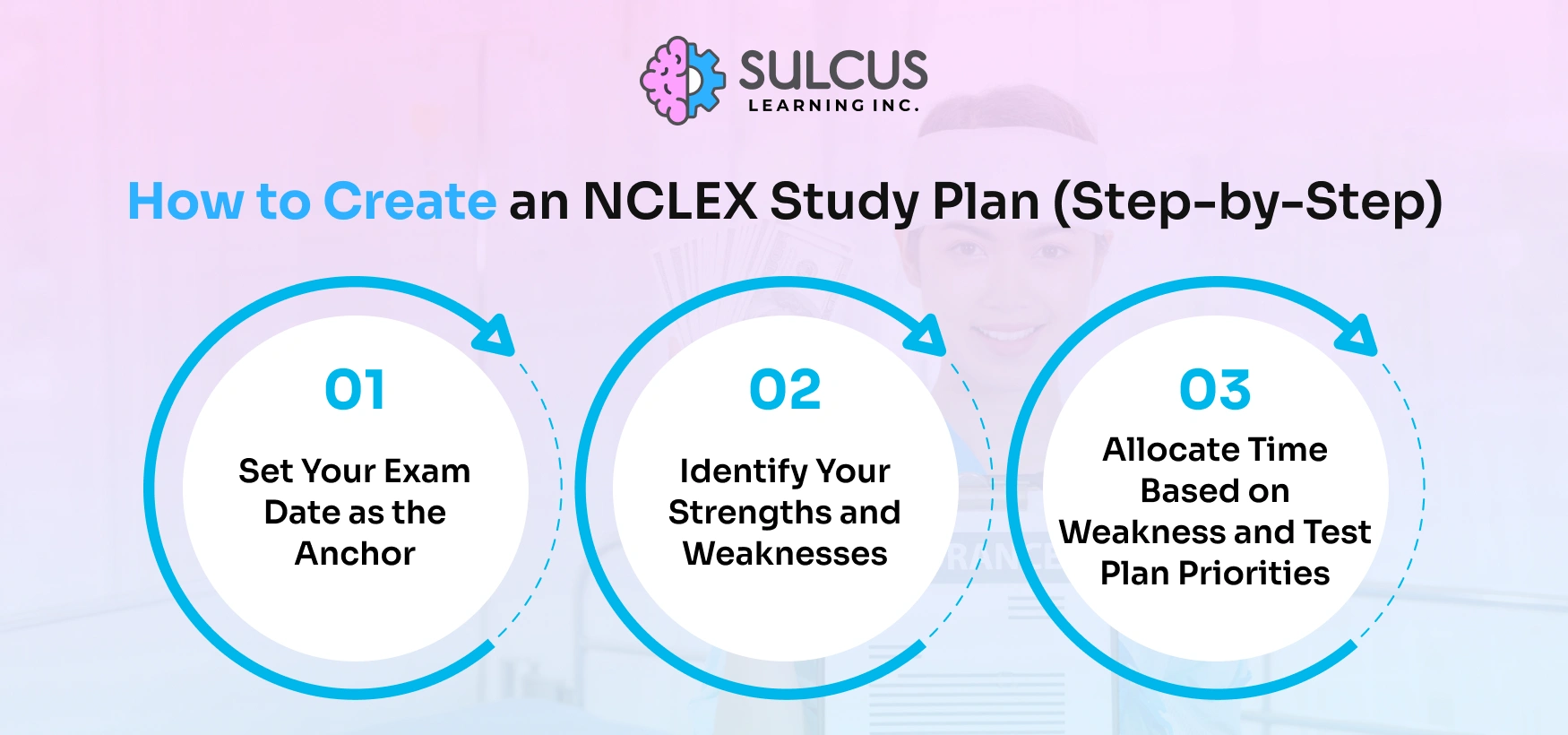
A good study plan for NCLEX preparation incorporates structure with the proper level of flexibility and parallel preparation with the clinical judgment aspect of the test. Also, it is about properly integrating self-reflectiveness and tracking of your performance over time. Keep these three aspects in mind: your readiness for the test, the time you have before your test, and the volume of your study time.
Step 1: Set Your Exam Date as the Anchor
Your NCLEX study plan begins with the exam date. Or more specifically, your Authorization to Test (ATT). When you receive your ATT from the NCSBN, you start your preparation. You want to create your plan and study backward from this date.
When you set a study plan with deadlines, it helps create a realistic, goal-worthy plan. Candidates lacking a static exam date often struggle
Step 2: Identify Your Strengths and Weaknesses
One of the early steps in NCLEX preparation is completing a diagnostic assessment that includes NCLEX-style questions. This will provide you with clear exposure to your position on the performance continuum and which areas, based on your results, you should spend time improving.
Your performance can be categorized into the major NCLEX Client Needs and subject areas, such as:
- Pharmacological and parenteral therapies
- Maternal-newborn health
- Mental health
- Management of care
Knowing the extent of your gaps helps you understand where your focus should be and what you can study less, saving time.
Step 3: Allocate Time Based on Weakness and Test Plan Priorities
Though the NCLEX test plan provides a framework of the relative importance of the different content categories, your study plan should reflect your own data. For instance, even if Management of Care has a higher percentage on the exam, it should not automatically take a greater amount of time on your study plan if it is not a personal weakness.
An effective plan balances:
- Individual knowledge gaps
- NCLEX test plan distribution
- Ongoing performance trends from practice questions
The result will be a sustained, strategic approach to preparation that optimally balances effort in your weaker knowledge areas with performance in areas where you have previously demonstrated mastery.
Choosing the Best NCLEX Study Plan for Your Timeline
Selecting the right NCLEX study plan depends on three key variables:
- Time Available: Short time constraints mean more focused, intensive study, whereas a longer study schedule allows for more thorough content reviews.
- Current Knowledge Level: An applicant with a stronger knowledge base would study more through application and questions, whereas someone with various knowledge gaps would need to spend time on purposeful content reviews.
- Attempt Type: First time test takers would need a more structured guide, whereas more experienced test takers would only need to address the previous weaknesses.
As a general rule, someone who has only a few weeks to study for the exam and is focused solely on test-taking strategies (maybe only 1-2 weeks) would get a different study plan than an internationally educated nurse focused on preparation for an 8-12 week period.
A poor NCLEX study schedule can easily lead to the applicant burning out or not being adequately focused to gain anything from it. An NCLEX study schedule that strikes the right balance at the right level of readiness for the applicant is imperative.
NCLEX Study Plan Schedules: From 1 Week to 3 Months
There is no single “best” NCLEX study plan. Each plan is customized based on the initial starting place and performance trends. The goal of the study plan is to understand the NCLEX framework, designed by the National Council of State Boards of Nursing, and to develop a clinical judgment and decision-making study approach, rather than a rote memorization approach.
1-Week NCLEX Study Plan: Rapid, High-Impact Revision
An ideal plan would span more than one week, but a one-week plan can work as a last-minute review for study plans that have a solid base of knowledge.
The plan for the week should pivot away from memorization by typing and reading study notes, and instead focus on active learning through questions. A high volume of questions is necessary to be understood in terms of reasoning rather than memorized clinical decision-making.
Key focus areas include:
- Safety and infection control
- Prioritization and delegation
- Pharmacology
- High-frequency clinical scenarios
In the final 1 to 2 days before the candidates retake the exam, they should identify and review the gaps in their learning. At this time, candidates should perform 1 full-length practice assessment to demonstrate growth. Test-taking strategies and consistency are more important than content knowledge at this time.
| Week | Monday (Day 1) | Tuesday (Day 2) | Wednesday (Day 3) | Thursday (Day 4) | Friday (Day 5) | Saturday (Final Review) | Sunday (Exam Simulation) |
|---|---|---|---|---|---|---|---|
| Week 1 | Priority & Safety Focus | Pharmacology Safety | Infection Control | Mixed Clinical Judgment | Weak Areas Targeting | Final Prep & Light Review | Full-Length Practice Timed Mock Test |
2-Week NCLEX Study Plan: Focused Content + Practice Balance
In a 2-week NCLEX study plan, you’ll be able to allot time for exam content to be lectured and incorporated into practice questions. For Days 1-3, do a rapid content review of your weakest areas. Starting Day 4, integrate 100+ daily practice questions and rational practice. Leave the final 48 hours for practice exams. Be sure to rest before taking your exam.
| Week | Monday | tuesday | wednesday | Thursday | Friday | Saturday | Sunday |
|---|---|---|---|---|---|---|---|
| Week 1 | Content Review (Weak Areas) | Content Review | Content Review | Start Practice Mode | Practice + Weak Areas | Clinical Judgment (NGN) | Performance Review |
| Week 2 | Full Practice Mode | Target Weak Areas | Mixed High-Yield Practice | Exam Strategy Focus | Light Practice + Review | Full-Length Mock Test | Final Mock + Rest |
4-Week / 1-Month NCLEX Study Plan: The Most Common Approach
The most widely used study approach is a 4-week NCLEX study plan, and for good reason. It can help build your stamina for answering exam questions, and allows you time to study the content.
- Week 1: Foundational content safety, derived care, and pharmacology.
- Week 2: 75+ daily practice questions; management of care, safety, and infection control.
- Week 3: practice questions; psych-social, maternal, newborn, pediatrics, and mental health.
- Week 4: Perform a simulated full-length exam and review your weakest areas. Include a rest period and prepare for exam day.
| week | monday | Tuesday | Wednesday | Thursday | Friday | Saturday | Sunday (Practice/Rest) |
|---|---|---|---|---|---|---|---|
| Week 1 | Foundations of Care | Physiological Integrity | Pharmacology Basics | Fundamentals Practice | Mixed Review | Practice + Recall | Light Review / Rest |
| Week 2 | Management of Care | Safety & Infection Control | High-Yield Review | Practice Mode Begins | Target Weak Areas | Mixed Practice | Practice Test |
| Week 3 | Psychosocial Integrity | Maternal-Newborn | Pediatrics | Mental Health Practice | Intensive Practice | NGN Case Practice | Practice Test + Review |
| Week 4 | Full-Length Mock Exam | Weak Area Review | Targeted Practice | Final Mock Exam | Light Review | Rest + Mental Prep | Exam Readiness / Optional Test |
6-Week NCLEX Study Plan: Balanced Intermediate Preparation
The 6-week NCLEX study plan gives you 2 more weeks to improve on your weakest areas and increase question volume. Steps 1-4 are the same as the 1-month plan. Steps 5 and 6 are for full-length practice, analysis of your performance and enhancement of weaker areas. This is a good option if you got a borderline score on your diagnostic.
| Week | Monday | Tuesday | Wednesday | Thursday | Friday | Saturday | Sunday (Practice/Rest) |
|---|---|---|---|---|---|---|---|
| Week 1 | Foundations of Care | Physiological Integrity | Pharmacology Basics | Fundamentals Practice | Concept Review | Practice + Recall | Light Review / Rest |
| Week 2 | Management of Care | Safety & Infection Control | Core Topic Review | Practice Mode | Weak Area Focus | Mixed Practice | Practice Test |
| Week 3 | Psychosocial Integrity | Maternal-Newborn | Pediatrics | Mental Health Practice | Intensive Practice | NGN Case Practice | Practice + Review |
| Week 4 | Full Mock Exam | Weak Area Analysis | Targeted Practice | Mock Exam | Light Review | Rest + Prep | Optional Test |
| Week 5 | Full-Length Simulation | Performance Analysis | Targeted Reinforcement | High-Volume Practice | Strategy Refinement | Mock Exam | Review + Reset |
| Week 6 | Final Simulation | Weak Area Fixing | Light Practice | Final Mock Test | Quick Revision | Rest + Mental Prep | Exam Readiness |
8-Week and 12-Week / 3-Month NCLEX Study Plans: Deep Preparation
An 8-week NCLEX study plan is suited for candidates who want a comprehensive plan that allows in-depth practice and theory. The 12-week NCLEX study plan or the 3-month NCLEX study plan is especially ideal for Internationally Educated Nurses (IENs) looking to obtain their Canadian licenses. The extended timeline allows for a full content pass, question practice, multiple simulation cycles, and adequate time to address performance gaps.
| Plan Duration | Phase 1 (Foundation) | Phase 2 (Concept Building) | Phase 3 (Practice Intensification) | Phase 4 (Simulation & Analysis) | Final Phase (Readiness & Exam Prep) |
|---|---|---|---|---|---|
| 8-Week Plan | Weeks 1–2 Core content reviewFundamentals, pharmacology basicsLow-volume practice |
Weeks 3–4 System-based learningInfection control, management of care |
Weeks 5–6 High-volume practiceNGN case sets |
Week 7 Full-length mock examsPerformance analysisWeak area targeting |
Week 8 Final revisionLight practiceExam readiness + rest |
| 12-Week Plan (3-Month) | Weeks 1–4 Full content rebuildStrong conceptual base |
Weeks 5–8 Advanced topics + integrationClinical judgment focus |
Weeks 9–10 Intensive practiceMixed topics |
Week 11 Multiple mock examsDeep analytics reviewFix performance gaps |
Week 12 Final simulationsLight revisionMental prep + exam strategy |
Get full access to structured, exam-aligned NCLEX study plans designed to maximize your first-attempt success. Sign up on Sulcus Learning today.
NCLEX-RN vs NCLEX-PN Study Plans
NCLEX RN study plans and NCLEX PN study plans are similar in structure. The difference lies in the content and the emphasis it receives. The RN exam emphasizes clinical judgment and higher-level management of delegating and balancing the ongoing care of multiple clients. The PN exam emphasizes the nursing assistant role and the aide’s collaboration with the nurse in charge to collect data and supervise patients.
If you are preparing your NCLEX RN or PN study plan, the time allotted for exams should be geared significantly more toward delegating, setting, and judgment with the more difficult graduate pharmacology questions. The RN NCLEX study plan will also need to address the overall increased complexity of the NGN-format questions.
Next Generation NCLEX (NGN) Study Plan Strategy
The NGN format focuses on evaluating clinical judgment across six cognitive skills: cue recognition, cue analysis, hypothesis prioritization, solution generation, action taking, and outcome evaluation. It is the NGN model that introduces the evaluation of clinical judgment. In combination with the case study question and the drag-and-drop and hotspot questions, the NGN model will complete the clinical component of the examination.
In addition to including NGN-style questions, preparation should include clinical case studies and unfolding simulations that allow the candidate to alter the patient’s clinical state and assess the outcome of the clinical action within a typical time frame.
Candidates who limit their study to a standard multiple-choice format question are setting themselves up for failure on NCLEX exam questions that are totally different from the questions for which they have prepared. The NCLEX next-gen study plan time should be included to encompass the NGN format.
How to Structure Your Daily NCLEX Study Plan Schedule
Getting your NCLEX study plan right is more important than the hours you put in. This is what they generally look like:
- Morning (60–90 min): Content for a single topic should be structured in your plan. Use active recall, not passive recall, in this session.
- Midday (90–120 min): Practice questions from a question bank. Use exam conditions and do 75-100 questions.
- Afternoon (45–60 min): Review the practice questions for rationale. Understanding the reasoning, not just checking answers, is key for this session.
- Evening (30 min): Take note of the areas you struggled on so you can review those before going to the exam.
Common Mistakes in NCLEX Study Plans
The construction of an NCLEX template leaves you at just that, a blank canvas. Each template should be a true representation of the individual NCLEX, rather than a work-in-progress.
- Practicing NCLEX-related questions without any post-practice rationale leads to blind spots. Answering practice questions should be FCNC-related, rather than NCLEX-related.
- Focus on only the NCLEX’s introductory curricula. Your NCLEX-related template, and especially the NCLEX, doesn’t leave you much to focus on, especially the start-related items.
- During the exam, you should build yourself a temporary cognitive standard, relating to the fatigue and pacing you would use to cross the finish line.
- Over the final 24 hours, your cognitive focus should be on the light rather than on the lack of a light–to be, or not to be, post-practice rationale.
How Sulcus Learning Enhances Your NCLEX Exam Preparation?
Standard study programs are often precise in their schedules but not in their approach to NCLEX success. Sulcus Learning transcends basic preparation by adhering closely to the National Council of State Boards of Nursing exam construction guidelines and the theory of computerized adaptive testing (CAT).
Using performance analytics and adaptive testing, Sulcus Learning personalizes the study experience. The NCLEX experience occurs as the platform captures learner performance and adjusts testing difficulty in real time, identifying areas for improvement and strengths.
Sulcus Learning eliminates guesswork and offers data-driven study strategies. The platform captures learner performance and informs users about the high-impact areas they focus on and the low-impact areas they don’t.
For internationally educated nurses who want to practice in Canada or the United States, Sulcus Learning offers a structured study path that includes an 8 to 12-week guided study, practice questions from the Next Generation NCLEX (NGN), and integrated analytics to further develop clinical judgment and exam readiness.
Moving from the practice of studying to the science of studying provides more preparation and greater confidence and meets NCLEX standards. Sulcus Learning has data to guide and support learner practice, and allows them to focus on studying for preparation.
Final Week NCLEX Study Strategy
The last week of your NCLEX exam study plan should be all about confidence and consolidation, not the introduction of new material. Here’s what to focus on:
- Days 1–3: Full-length timed simulation exams. Review rationales for every incorrect answer.
- Days 4–5: Targeted review of your weakest content areas based on simulation performance.
- Day 6: Light review only, high-yield pharmacology mnemonics, priority-setting frameworks. No new topics.
- Day 7 (Exam day): Rest, a solid meal, and confidence. You have prepared. Trust the process.
Focus on:
- Weak areas
- High-yield concepts
- Full-length practice tests
Avoid:
- Learning new topics
- Overloading content

Conclusion
Creating a study plan for the NCLEX exam is the most important factor in determining your exam results. A study plan tells exam takers when and what to study, how to practice and how to adjust the course of study to adapt to their performance.
A study plan for the NCLEX exam is only valuable when exam takers use their personal results as a guide and place greater emphasis on the relative priority of clinical judgment and practice.
Nursing students preparing to take the NCLEX exam in Canada are the most fortunate and have the most resources available to them. Understanding the NCLEX passing score requirements is only one part of the equation. It is only through study plans that they determine their value. A positive study plan, the most appropriate learning tools, and the right combination of the two enhance their chances of passing the exam.
FAQ’s
Q1. How do I create an NCLEX study plan?
Ans. Start by setting your exam date, taking a diagnostic practice test to identify weak areas, and then building a daily schedule that balances content review with high-volume practice questions. Adjust weekly based on your performance data.
Q2. What is the best NCLEX study plan?
Ans. The best study plan for the NCLEX is the one built around your specific timeline, your individual knowledge gaps, and the current exam format, including NGN item types. A personalized, data-driven plan consistently outperforms generic templates.
Q3. Is a 2-week NCLEX study plan enough?
Ans. A 2-week NCLEX study plan can be sufficient for candidates with strong foundational knowledge and who scored well on diagnostic assessments. For those with significant content gaps, a longer preparation window is strongly recommended.
Q4. How long should I study for the NCLEX?
Ans. Most candidates benefit from 4 to 8 weeks of structured preparation. Internationally educated nurses or those who have been out of clinical practice may benefit from 10 to 12 weeks. The quality and structure of your study time matter more than the total number of hours.
Q5. What is the best study plan for the NCLEX-RN?
Ans. An effective NCLEX RN study plan emphasizes management of care, complex pharmacology, and clinical judgment, especially in NGN case studies. It should include daily practice questions (75–100+), weekly performance reviews, and at least two full-length simulated exams in the final weeks of preparation.

Harry Sagar
Harry is a strategic leader at Sulcus Learning, developing exam-aligned learning solutions. With expertise in adaptive testing and clinical education, he supports learners in achieving confidence, competence, and readiness.