

Nursing licensure in Canada is more competitive and more important than ever. Healthcare systems from British Columbia to Ontario are dealing with workforce shortages and complicated patients. The registered practical nurse position is more essential than ever. For aspiring RPNs, the most important part of the licensure process is the REx-PN exam.
The REx-PN is a registered licensure exam in most Canadian provinces. It will be the licensure exam in all provinces, as the Canadian Practical Nurse Registration Exam (CPNRE) will be retired in a phased transition happening in 2023 and 2024. The REx-PN is a product of collaboration between the Canadian Council for Practical Nurse Regulators (CCPNR) and the National Council of State Boards of Nursing (NCSBN). The REx-PN is a form of computer-adaptive testing (CAT).
This new form of test has spawned a myriad of questions among nursing students. Most notably, the anxiety-inducing ‘what is the REx-PN passing score? Others include: ‘Why do some candidates’ tests end after 90 questions while others are required to answer 150 questions? And, ‘How does a candidate know if they have passed a CAT, considering there is no score?’
This guide is designed to give you the answers to these questions. In this guide, we will describe the REx-PN passing standard, provide an explanation of computer-adaptive technology and its scoring logic, discuss the subject area scoring, and provide a practical roadmap based on evidence for passing the REx-PN exam on the first try in 2026.
What Is the REx-PN Passing Score — and Why It’s Different From What You Expect
Rather than providing a specific number, such as a passing score of 75 %, the REx-PN is going to make scoring assumptions much more difficult. The REx-PN is going to score examinations based on logit scoring versus a score based on a percentage.
In the REx-PN, the passing score is set at -0.32 logits. This is a measurement of the lowest score of a practical nurse candidate who is able to practice safely. You will be scored in relation to this line of measurement throughout the REx-PN.
Important Fact. In the REx-PN, the passing score is a logit score. In the REx-PN, the passing score of -0.32 logits represents the entry-level score of a practical nurse. You either meet this score or you do not.
The REx-PN uses a Computer Adaptive Test (CAT) model to deliver the examination. In this model, the examination consists of an adaptive set of questions intended to measure the competency of the examinee, as compared with the passing standard. When the test is 95% sure that the examinee’s competency is either above or below the passing standard (after a sufficient set of questions has been posed), the test ends.
This is why some candidates have the REx-PN stop at 90 questions, whereas other candidates have the REx-PN continue to the maximum of 150 questions. The length of the exam is not a determining factor for passing or failing. Rather, the speed at which the system has achieved a level of statistical certainty regarding your competency level is the determining factor.
How Many Questions Are on the REx-PN Exam?
The REx-PN includes between 90 and 150 multiple-choice questions. There is no partial credit, no written component, and no calculation-based questions. The exam is delivered via computer at an authorized Pearson VUE exam centre.
| Exam Feature | Details |
|---|---|
| Minimum Questions | 90 |
| Maximum Questions | 150 |
| Question Format | Multiple Choice Questions (MCQs) |
| Passing Standard | -0.32 Logits |
| Testing Format | Computerized Adaptive Testing (CAT) |
| Test Administrator | Pearson VUE |
| Developer | National Council of State Boards of Nursing (on behalf of Canadian Council for Practical Nurse Regulators) |
| Time Limit | 5 Hours |
Before scheduling your exam, it’s important to check the latest REx PN exam cost, as fees may vary depending on the province and registration requirements. If you’re searching for REx PN exam dates Ontario, the exam is offered year-round through Pearson VUE once you receive your Authorization to Test (ATT).
Can You Pass the REx-PN with 90 Questions?
Yes, and understanding this fact about the REx-PN exam is very important. It is even fair to say that passing the REx PN exam with 90 questions is something to be proud of. It means that the exam ascertained that you demonstrated high and consistent levels of competency throughout the exam.
The exam will typically stop after you have answered 90 questions, when the CAT engine reaches its 95% statistical confidence that your performance has consistently been above the passing level and the exam is confident about your ability beyond the -0.32 logit.
The most common myth is that the RExPN exam ending at 90 questions means that you have failed because the “exam has given up on you”. The truth is that the exam has actually been stopped. The system has developed a great amount of statistical evidence for either of the two possible outcomes. The most common of those is that you have performed consistently enough above the level of the passing standard for the exam to have been stopped.
On the other hand, a total of 150 questions does not equate to a failed exam. It just means that the system needed more evidence to distinguish your performance level from the level of the passing standard, and most likely, your performance was borderline, inconsistent, or even concentrated in a few content areas relatively early in the exam.
The only thing that actually matters is the official notification from your provincial regulatory college on whether you have passed or failed the exam, which will be received on average in one or two working days after you sit the exam.
REx-PN Subject Breakdown: What the Exam Actually Tests
Knowing the structure of the REx-PN exam helps in devising RExPN exam study tips. This exam comprises eight subject areas and categories under Safe and Effective Care Environment and Physiological Integrity. It also has stand-alone assessments for Psychosocial Integrity and Health Promotion and Maintenance.
Each subject area has a weight range on the exam blueprint. The ranges show how many of your total 90–150 questions will come from each domain:
| Content Area | Percentage Weight |
|---|---|
| Safe and Effective Care Environment | |
|
18–24% |
|
9–16% |
| Physiological Integrity | |
|
6–12% |
|
8–14% |
|
14–20% |
|
11–17% |
| Psychosocial Integrity | 8–14% |
| Health Promotion and Maintenance | 6–12% |
| Total | 100% |
The largest sections of the exam are Pharmacological and Parenteral Therapies (14–20%) and Management of Care (18–24%). Therefore, they should be the cornerstone of your preparation. The remaining high-weight sections are Physiological Adaptation (11–17%) and Reduction of Risk Potential (8–14%).
A frequent error that candidates make is an equal, if not total, focus on the sections. The RExPN exam prep provides a focus order, starting with the high-weight sections, incorporating the mid-range sections, and utilizing the low-weight sections for reinforcement.
How CAT Scoring Works — The Engine Behind Every REx-PN Result
The REx-PN’s Computerized Adaptive Testing engine is similar to the technology used in the NCLEX-PN and NCLEX-RN. Unlike random question selectors, this engine is designed to be precise.
How the Algorithm Selects Questions
Each REx-PN question has been assigned a difficulty level measured in logits. If you select the correct answer, a more difficult question is presented. If you select an incorrect answer, an easier question is presented. This process repeats, adjusting your ability level estimate with each answered question.
When Does the Exam Stop?
The REx-PN exam stops when one of three conditions is met:
- The system reaches 95% confidence that your estimated ability is above the -0.32 logit passing standard (pass stop)
- The system reaches 95% confidence that your estimated ability is below the -0.32 logit passing standard (fail stop)
- You reach the maximum of 150 questions, at which point your final estimated ability level determines the result
What “Passing” Looks Like in CAT
With traditional testing methods, you will be made aware of your score right after you complete the exam. With CAT, this is very different. The nature of the system will keep you on edge and questioning the result. The system has determined your ability level, and you will only be presented with questions that are difficult relative to that level. If you are finding it difficult, you have not failed. You are simply taking an adaptive exam, and it is operating as intended.
Study Tip: If the exam is hard the whole way through, that’s a good sign! The CAT engine promises to give you hard questions the whole way through if it is working to the best of its ability. If you are given easy questions the entire way through, the CAT engine is working with very limited data. It is safe to say the algorithm is efficiently tracking your level of competency if the questions are of consistent difficulty.
REx-PN vs. CPNRE: Key Differences Canadian Nursing Students Should Know
The REx-PN has now replaced the CPNRE as the standard licensure exam in most Canadian provinces. If you trained under a curriculum that referenced the CPNRE, there are several structural differences worth understanding:
| Feature | REx PN | CPNRE |
|---|---|---|
| Exam Format | Computerized Adaptive Testing (CAT) | Linear (Fixed-Form) Examination |
| Number of Questions | 90–150 MCQs | 165–175 MCQs |
| Passing Standard | -0.32 Logit | Criterion-Referenced Cut Score |
| Exam Availability | Year-Round | Six times a year |
| Developer | National Council of State Boards of Nursing / Canadian Council for Practical Nurse Regulators | Canadian Council for Practical Nurse Regulators |
| Exam Length | Variable (Up to 5 Hours) | Fixed (4 Hours) |
The shift to adaptive testing has significant implications for how you prepare. Unlike the CPNRE exam, where question exposure was fixed and predictable, the REx-PN dynamically adjusts. This means rote memorization of content is less effective than developing clinical reasoning and applying nursing judgment across complex, scenario-based questions.
How to Pass the REx-PN Exam: A Strategic Preparation Framework
If you’re wondering how to study for REx PN, focus on understanding the exam blueprint, practicing CAT-style questions, and strengthening clinical judgment rather than memorizing facts.
Memorizing content alone is not sufficient for passing the REx-PN Exam. Success on this exam requires the application of REx-PN Exam standards, an understanding of CAT mechanisms, clinical judgment, and analytics.
As candidates identify and target their competency gaps, the REx-PN Exam domains that utilize CAT, and the domains that carry the greatest weight, their competency and confidence to sit for the exam will also increase.
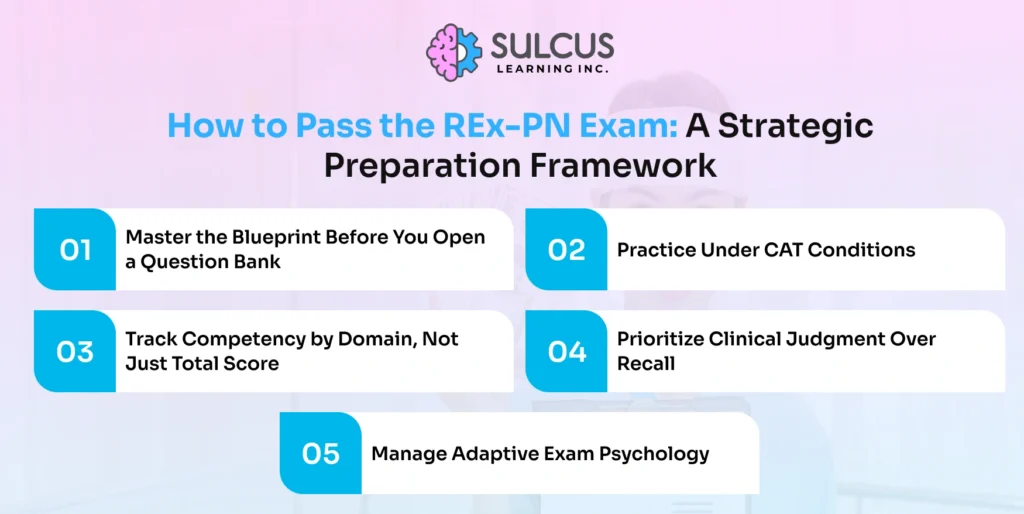
1. Master the Blueprint Before You Open a Question Bank
The first step to prepare for the REx-PN Exam is understanding the content weighting. The areas of greatest relevance are Therapeutic Communications and the Management of Care. In these areas, your potential for improvement is the greatest. Construct your study schedule in accordance with the REx-PN Exam standards, not what you prefer.
2. Practice Under CAT Conditions
You cannot train for an adaptive system by using a question bank that is static and linear. The challenging nature of the exam is a result of the system working correctly. To understand that the exam system is working correctly, you need to train your body to perform in a CAT environment.
3. Track Competency by Domain, Not Just Total Score
A total score of 70% out of 100 practice questions offers limited insight. Your competency level for each content domain related to the REx-PN blueprint is of greater concern. For example, an overall score may show that you are above average in Health Promotion but below average in Pharmacological Therapies, showing that the overall score is masking a significant gap. Studying at the domain level is the only way to accomplish this.
4. Prioritize Clinical Judgment Over Recall
The REx-PN is not an exam about the recall of nursing knowledge. Rather, it is an exam that tests clinical judgment. You must be able to understand the nursing knowledge necessary to cope with a deteriorating patient, order and prioritize nursing interventions, and participate in team communication and patient advocacy. One of the best study strategies you can follow is reading the answer rationales for all questions, especially for those you got correct.
5. Manage Adaptive Exam Psychology
Psychological preparation may be one of the most undervalued but incredibly important areas of focus while preparing for the REx-PN. The exam inevitably leads to a high level of questioning of the preparation of candidates due to the perception of the exam questions being either “too easy” or “too hard.” A real competitive advantage is gained by understanding the psychology of CAT and trusting the exam. Candidates who are calm and answer the questions without losing focus consistently perform better than their competitors.
What Happens If You Don’t Pass the REx-PN?
If you fail, your next opportunity to take the REx-PN is after a 45-day waiting period, and there is no limit to the number of attempts for most provinces, however, policies of certain regulatory colleges may differ, so double-check with your provincial regulator.
After a failure, you will not receive a conventional score breakdown. Your regulatory college will send you a Candidate Performance Report instead. This report will outline your performance in each of the content areas relative to other candidates who have also completed the exam. This report should be the focus of your study plan for the subsequent attempt and should be the basis of a new study plan.
You can use the other sections of the REx-PN Exam Guide for information on study plans and strategies for other things you may encounter from the regulatory college during the exam attempts.
Preparing for the REx-PN? Start Smart with Sulcus Learning
Thousands of nursing candidates across Canada use Sulcus Learning to build exam confidence from day one. The platform is built specifically for Canadian nursing exams, including REx-PN, and far surpasses the limitations of a traditional question bank.
What makes Sulcus different:
- Predictometer: A real-time readiness scoring engine that assesses your exam readiness
- Competency Wheel: Details your performance in all REx-PN content areas to promote smarter studying
- A CAT-Aligned Adaptive Engine: Replicates the adaptive nature of the exam so you won’t encounter any surprises on test day
- Student Exam Reports and Performance Rankings: Monitor your progress in detail for each practice session
- Complete Coverage for REx-PN, NCLEX-RN, NCLEX-PN, and CPNRE: All on one, Canadian-based nursing prep platform
Proudly Canadian. Globally Trusted. Universally Successful.
Start your free trial at Sulcus Learning and find out exactly where you stand before exam day decides for you.
Conclusion
The REx-PN exam does not have a score reporting system. You either pass or do not pass based on your ability to meet a threshold. That ability is assessed by a real-time adaptive engine that works behind each of the exam questions. Strategic preparation is based on your understanding of the adaptive engine, the significance of the -0.32 logit benchmark, and the rationale for the exam terminating after 90 questions.
The candidates who successfully pass the REx-PN exam on their first attempt do not study the most out of all candidates. They study in the most realistic adaptive environment with the best understanding of their competency gaps.
The best strategies to pass the exam are to practice adaptive clinical judgment and practice in a controlled environment. From that, candidates will have the most certainty when it comes to exam day, the most challenging questions will be the most gratifying.

FAQ’s
Q. What is the passing score for the REx-PN exam?
Ans. The REx-PN does not use a percentage-based passing score. The passing standard is set at -0.32 logits, a psychometric benchmark representing entry-level nursing competency. Candidates who meet or exceed this standard pass, those who fall below it do not. You will receive a pass or fail result, not a numerical score.
Q. Can you pass the REx-PN with 90 questions?
Ans. Yes. Ending the exam at the minimum of 90 questions is a strong indicator of consistent performance. The CAT engine stops the exam early when it reaches 95% statistical confidence about your competency level. A pass stop at 90 questions means the algorithm had sufficient evidence, without needing additional questions, to determine that your ability clearly exceeds the passing standard.
Q. How many questions are on the REx-PN exam?
Ans. The REx-PN exam consists of between 90 and 150 multiple-choice questions. The exact number depends on when the CAT algorithm reaches statistical confidence about your performance. Exam time is limited to 5 hours total.
Q. What is the hardest section of the REx-PN?
Ans. Based on content area weights, Pharmacological and Parenteral Therapies (14–20%) and Management of Care (18–24%) are the most heavily weighted domains and are typically reported by candidates as the most demanding. These two areas combined can account for up to 44% of your total exam questions.
Q. How long does it take to get REx-PN results?
Ans. REx-PN results are typically available within one to two business days of completing the exam. Results are delivered through your provincial regulatory college, not directly by Pearson VUE or NCSBN.
Q. Is REx PN and NCLEX PN Same?
Ans. No. If you’re wondering, “Is REx PN and NCLEX PN Same?”, the answer is no. While both exams use Computerized Adaptive Testing (CAT) and are developed by the National Council of State Boards of Nursing (NCSBN), the REx-PN is designed for practical nurse licensure in Canada, whereas the NCLEX-PN is used for practical nurse licensure in the United States. Although they share a similar testing format, they follow different nursing practice standards and regulatory requirements.

Harry Sagar
Harry is a strategic leader at Sulcus Learning, developing exam-aligned learning solutions. With expertise in adaptive testing and clinical education, he supports learners in achieving confidence, competence, and readiness.