

You sat and answered as instructed. Then, all of a sudden, the screen went blank. The Exam ended at exactly 90 questions. There was no explanation. Just you, heart racing, sitting in silence. Hundreds of practical nursing candidates all over Canada find themselves in the same predicament at least one time during their training. Their confusion is completely justified.
The REx-PN (Regulatory Exam for Practical Nurses) is an exam that is very necessary for the career of every practical Nurse in Canada. It is a competency entrance exam for the licensing of Registered Practical Nurses (RPN) and Licensed Practical Nurses (LPN) in Canada. It is offered by the National Council of State Boards of Nursing (NCSBN). Unlike the conventional paper-based examination, the REx-PN employs a sophisticated adaptive algorithm, meaning that not every candidate will get the same total number of questions.
Before registering, candidates should also review the latest REx PN exam cost, as fees may vary by province and registration requirements. If you’re looking for REx PN exam dates Ontario, the exam is available year-round through Pearson VUE after you receive your Authorization to Test (ATT). Understanding how to book REx PN exam appointments is equally important, as candidates must schedule their test through Pearson VUE after receiving their ATT.
So, what does it mean when your REx-PN exam stops you at 90 questions? Does it mean you failed the exam? Or does it mean you passed the exam? This blog is aimed to inform you of the REx-PN exam, its algorithm, and the extent of your prep once you arrive on exam day. This RExPN guide explains how the adaptive algorithm works, what stopping at 90 questions means, and how you can prepare more effectively for exam day.
Understanding How the REx-PN Adaptive Algorithm Works
To begin interpreting the significance of stopping at 90 questions, it is important to know the rationale of the exam.
The REx-PN is a Computer Adaptive Test (CAT). A traditional fixed-length exam consists of a fixed number of questions, which is not the case for a CAT. Instead, the system uses your prior responses to create an estimation of your competency level, and selects each subsequent question based on that.
Unlike the traditional CPNRE, the REx-PN uses Computerized Adaptive Testing. Understanding the differences between CPNRE vs REx PN helps candidates prepare using the right study strategy and exam format.
Correct responses lead to the system to select a more difficult question, while an incorrect response leads the system to select an easier question. The exam is not designed to measure how many questions you can correctly answer, but rather how your competency level is positioned relative to the exam’s passing standard.
The REx-PN has a flexible question range of 85 to 150 questions. The exam can end at any point within this range, as long as one of three conditions is met:
- The algorithm has established with 95% statistical confidence that you are above the passing standard (you pass)
- The algorithm has established with 95% statistical confidence that you are below the passing standard (you fail)
- You have reached the maximum of 150 questions and the algorithm determines your final competency level
The most important idea to understand to be successful on the REx-PN is that you did not run out of questions. Instead, the exam stopped because the algorithm reached a conclusion about your competency level at 90 questions.
The algorithm continually evaluates your performance against the REx-PN exam passing score, which is measured using a logit-based competency standard rather than a percentage.
Why the REx-PN Stopped at 90 Questions Specifically
The REx-PN uses an adaptive algorithm, and the 90-question mark is where the algorithm is confident enough to make a call about your competency, based on the data it has analyzed. This can lead to two conclusions, and both are equally possible.
You demonstrated consistent competency above the passing standard.
If you answered questions above the standard with strong clinical judgment and sound nursing knowledge and consistent decisions, the algorithm may have determined with 95% certainty that you are a competent and safe practitioner at 90 questions. As a result, the test was passed at 90 questions.
Your performance consistently fell below the passing standard.
On the contrary, if the algorithm observed a consistent pattern of responses that placed your level of competency above the required threshold, it could have ended the test at the 90th question, also with 95% statistical confidence, but in the opposite direction.
The number 90 does not contain any sort of special or negative statistical significance. It was simply the point at which the data were conclusive. The algorithm does not concern itself with your nerves, your test-taking pace, or how confident you were. It works based on the competency signals contained in your responses.
Common Myths About the REx-PN Stopping Early
The confusion surrounding early exam termination is largely fuelled by myths passed between nursing students. Let’s address the most common ones directly.
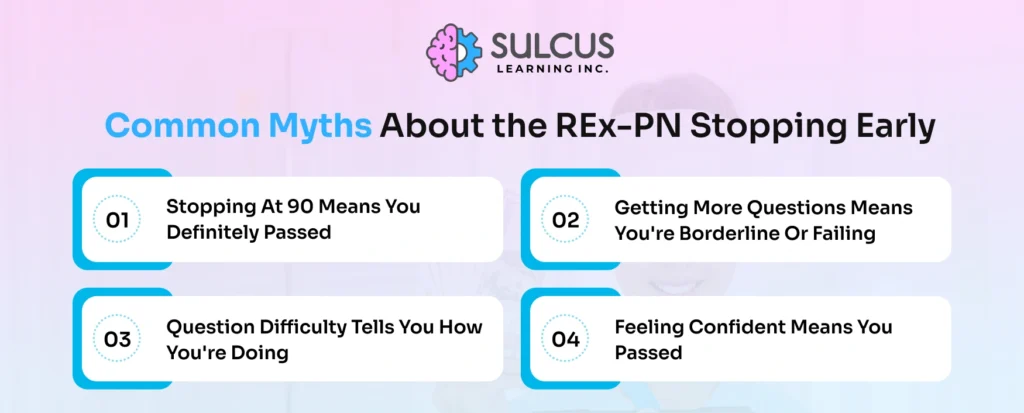
Myth 1: Stopping at 90 means you definitely passed.
False. An exam stopping at 90 questions means the algorithm determined a result, which can be positive or negative. Both scenarios are possible given this question count.
Myth 2: Getting more questions means you’re borderline or failing.
Also false. A longer exam means the algorithm required more information for a 95% confidence level. An increased number of questions can indicate borderline performance in either direction. It doesn’t necessarily mean a trend toward failure.
Myth 3: Question difficulty tells you how you’re doing.
Partially correct. As the algorithm works harder to assess your competency level, the questions may get more difficult. However, in the middle of an exam, you cannot assess your performance from the difficulty of the questions. This kind of performance self-assessment is unreliable due to various factors including anxiety, fatigue, and selective memory.
Myth 4: Feeling confident means you passed.
Clinical exams measure competency, not confidence. Many candidates who felt positive about their performance did not pass, while others who felt uncertain did. The algorithm measures what you demonstrated, not what you felt.
What Happens After the Exam Stops at 90?
After the exam stops, regardless of the number of questions, the REx-PN exam uses the Next Generation NCLEX (NGN) to assess clinical knowledge. Your results are calculated after performance has been assessed at the level of clinical competency with a logit score that uses a passing threshold.
Many candidates ask, “Is REx PN and NCLEX PN Same?” The answer is no. While both exams use Computerized Adaptive Testing (CAT) and are developed by NCSBN, the REx-PN is designed for Canadian practical nurse licensure, whereas the NCLEX-PN is used for practical nurse licensure in the United States.
Your results are usually sent to your nursing regulatory body within a few business days. Depending on your province, the results may be sent to you electronically through your regulatory body’s candidate portal or through a formal written letter. In some jurisdictions, candidates have access to a preliminary indicator or early result service. However, access to early result services is not consistent among Canadian regulatory bodies.
If you did not pass, you will receive a Candidate Performance Report (CPR). This report will detail the content areas where your performance did not meet the benchmark. This report will guide your study plan for your next attempt.
How to Prepare So 90 Questions is Enough — and Enough to Pass
The most important thing to do, whether you passed the exam or you are waiting to retake it, is to do preparation that acts as a mirror to the real examination. REx-PN puts you through the test of clinical judgment for eight client need categories. There are no shortcuts in the use of flash cards or theory alone. You will be unprepared for the way REx-PN weights, frames, and layers questions.
Real preparation for the REx-PN involves the use of adaptive question banks to the real logic of CAT, working with case and exhibit questions, and the continuous analysis of performance data to disclose gaps in competence that the exam will not.
The candidates who have the most success at REx-PN and are most likely to finish with the target of 90 questions are those who are in a position to pass the exam and have used tools that best reflect the exam structure, not just its content, most accurately.
Preparing Smarter with Sulcus Learning
If you are preparing for the REx-PN and want a platform that has been purpose-built for the Canadian nursing exam, Sulcus Learning is worth a look. Sulcus Learning is a Canadian platform for practical nursing exam prep for those who want more than just a question bank, to those who want to know if they are exam-ready.
Effective REx-PN exam prep involves more than completing practice questions. It also requires tracking your progress, improving weak areas, and becoming familiar with the adaptive testing format.
Sulcus contains a Predictometer giving a real-time readiness score based on practice performance, a Competency Wheel identifying strengths and limits in each client need category, and Exam Percentage Growth Charts tracking performance over time. The platform uses REx-PN-aligned questions with MCQs, SATA, Fill in the Blank, and Exhibit questions that reflect the clinical judgment for the actual exam.
Whether this is your first try at the exam or you are developing a retake strategy, Sulcus gives the performance data and exam-accurate practice space to enter the exam confident, leaving the exam with a score of 90, having demonstrated exactly what is needed.

Conclusion
Some of the most effective RExPN exam tips include practicing under CAT conditions, reviewing answer rationales, strengthening weak content areas, and maintaining confidence throughout the exam.
Your REx-PN stopping at 90 questions does not show whether you were successful or unsuccessful. Rather, it shows that the test’s adaptive algorithm was able to, with statistical confidence, determine your level of competency based on the 90 questions the algorithm selected. What really matters is the answer you gave, not the number of questions you answered.
You have control over a number of things. You have the ability to modify your preparation based on your understanding of how the exam is going to adapt. You need to prepare with tools to practice with the actual question formats. If you have to take the exam again, revamp your CPR. You have a data-based decision-making approach, not a guessing approach, for your next exam attempt.
The REx-PN is designed with your safety and the safety of the public in mind, to be a fair and precise measure of your readiness to practice. Respect the process, prepare thoroughly, and give the algorithm 90 reasons to say you are ready.
FAQ’s
Q. Is it good or bad if the REx-PN stops at 90 questions?
Ans. It is neither inherently good nor bad. Stopping at 90 means the algorithm reached a high-confidence conclusion about your competency level. That conclusion could be a pass or a fail, you will know when results are released.
Q. Does the REx-PN always stop at 90?
Ans. No. The REx-PN can end anywhere between 85 and 150 questions, depending on when the algorithm achieves 95% statistical confidence in its competency assessment.
Q. Can I predict my result based on how many questions I received?
Ans. No. The number of questions does not reliably predict the result. Passing and failing candidates can finish at the same question count.
Q. When will I receive my REx-PN results?
Ans. Results are typically delivered to your provincial regulatory body within a few business days. Timelines and delivery methods vary by jurisdiction.
Q. If I fail, how soon can I retake the REx-PN?
Ans. Retake policies are set by your nursing regulatory body. In most Canadian provinces, there is a mandatory waiting period between attempts. Review your CPR and check with your regulatory body for specific guidelines.

Harry Sagar
Harry is a strategic leader at Sulcus Learning, developing exam-aligned learning solutions. With expertise in adaptive testing and clinical education, he supports learners in achieving confidence, competence, and readiness.