
The need for nurses is huge right now in all parts of Canada, pushing the need for nursing graduates and international nurses to take the NCLEX-RN, NCLEX-PN, REx-PN, and CPNRE. For graduates and international nurses, these exams allow one to enter a new profession, gain new job opportunities, and increase job security in nursing.
Unfortunately, the days of simply memorizing content to pass the nursing licensure exams are long gone. Now, exams focus more on clinical judgment, prioritization, and decision-making regarding client safety. Because of this, good candidates find themselves in the unfortunate reality of having inadequate methods of preparing for what exams and current clinical standards expect of them.
This is where the gap closes, as a Canada-based company, Sulcus Learning Inc. supports both international and Canadian nursing candidates by providing CAT-style, NGN, clinical judgment questions, and the adaptive analytics, competency tracking, and readiness prediction tools designed in order to help them in a strategic, safe, and effective way to prepare for modern nursing licensure.
A Platform Built With Canadian Nursing in Mind
Not every nursing preparation platform accounts for the specific standards and licensing processes in Canadian nursing. Additionally, many standard exam prep resources focus on memorization or the creation of a standard question bank, lacking an understanding of the differences between the Canadian system and international nursing licensure systems.
Sulcus Learning Inc. is a Canadian company that considers all aspects of Canadian nursing education. The platform is aimed at helping both Canadian nursing graduates and internationally trained nurses preparing for licensure in Canada and the United States.
For nursing candidates, the diverse licensure requirements and the several pathways offered by Canadian provinces can be confusing. Which include:
- The province or territory where they are applying.
- Their nursing designation and scope of practice.
- Whether they are domestic graduates or internationally educated nurses.
- The examination is required for their registration pathway.
Depending on these factors, candidates may be preparing for different types of nursing exams, including:
- NCLEX-RN.
- NCLEX-PN.
- REx-PN.
- CPNRE.
All of these exams differ significantly in structure, competency focus, scoring models, question styles, and regulatory standards. Sulcus Learning is intended to provide preparation for all four pathways, focusing on exam-specific rather than generalized exam prep.
Sulcus Learning aims to support Canadian nursing while reaching a global audience, and as such, utilizes a unique perspective that integrates clinical standards of Canadian nursing:
- Canadian nursing standards and clinical expectations.
- Competency-based exam preparation.
- Adaptive testing technology.
- Clinical judgment development.
- Detailed performance analytics and readiness tracking.
The development of critical skills is the primary focus of content beyond the platform. Sulcus specifically targets the cultivation of important, critical, contemporary, and clinical reasoning skills in candidates for licensure.
Candidates evaluating various preparation options will note that aligning content with relevant Canadian nursing competencies and adaptive test formats will enhance exam preparedness and build self-assurance.
Understanding the Exams: Why Coverage Matters
A primary complaint from nursing students after taking their licensing exam is that the exam was not at all like the practice exams. In truth, many study platforms ask students to focus on rote memorization and do not allow for the development of clinical reasoning, prioritization, or the type of ‘adaptive test’ logic indicative of many modern nursing licensure exams.
There is more to nursing exam study than content and pure memorization. Particularly for exam candidates, one must understand:
- How questions are structured.
- How clinical judgment is evaluated.
- How adaptive testing systems function.
- How competencies are applied in realistic client-care situations.
The vision of Sulcus Learning Inc. is to support students’ preparation for the four dominant North American and Canadian nursing licensure exams.
- NCLEX-RN: The Registered Nurse licensing examination is used across the United States and most Canadian provinces and territories. The exam uses Computerized Adaptive Testing (CAT) and emphasizes clinical judgment and nursing decision-making.
- NCLEX-PN: The practical/vocational nursing licensure exam is given in the US and in some of the practical nursing pathways. Similar to the NCLEX-RN, this exam is also adaptive.
- REx-PN: Canada’s competency based practical nursing regulatory exam that is founded on the principles of modern nursing judgment, prioritization, and safe clinical decision-making.
- CPNRE (Canadian Practical Nurse Registration Examination): Non-adaptive Canadian practical nursing exam that uses multiple choice questions, scenario case based questions, and Canadian practical nursing competencies.
Sulcus Learning stands out by allowing students to prepare for both CAT-adaptive and non-adaptive exams on the same platform. Students can tailor their preparation to their specific licensing goals.
Sulcus supports the CPNRE by having a testing interface that mimics the true exam experience. This helps candidates learn the particulars of the testing screen and layout, the different question formats and how to answer them, and how to navigate the various facets of the testing process.
The platform also includes:
- CAT-adaptive exam simulations for NCLEX-RN, NCLEX-PN, and REx-PN.
- Non-adaptive exam simulations for CPNRE preparation.
- AI-integrated performance analysis and readiness tracking.
- Visual performance graphs and competency analytics.
- Exam-style scoring approaches modeled closely after real testing systems.
- Detailed breakdowns of strengths, weaknesses, and performance trends.
Sulcus Learning created its CAT Simulator to incorporate new methods for designing adaptive tests that leverage logit-based scoring and the ability to add or remove questions at varying difficulty levels. The platform shows students some key adaptive test-taking strategies that are prevalent with new CAT-style tests, such as:
- Confidence-based pass determination.
- Performance consistency analysis.
- Variable exam length behavior.
Additionally, the question banks and item response theory scoring are tailored to the Canadian nursing competencies, scope of practice, the expectations of real world clinical judgment, and clinical reasoning. Questions are structured to emphasize:
- Prioritization.
- Clinical reasoning.
- Client safety.
- Delegation.
- Communication.
- Nursing judgment within Canadian healthcare settings.
The fundamental principle behind our prep platform is to help students shift their mindset to that of a nurse and begin thinking in real clinical environments, rather than rote memorization of answers to questions. By combining our adaptive technology and competency prep with AI-informed analytics and the Canadian nursing standards, we aim to provide realistic, clinically relevant exam prep for nursing candidates.
What Makes Sulcus Genuinely Different: Features That Mirror Real Exams
There are many nursing prep programs that have massive question banks and simple rationales. But there are hardly any that replicate how the nursing licensure exams work today.
The nursing exams of today, including but not limited to the NCLEX-RN, NCLEX-PN, and REx-PN, test much more than knowledge recall. These exams measure clinical judgment, decision-making, prioritization, and how the test taker deals with demands.
What we do at Sulcus Learning, Inc. is build out exam prep that better simulates the real exams and what is expected of the test taker in terms of competency.
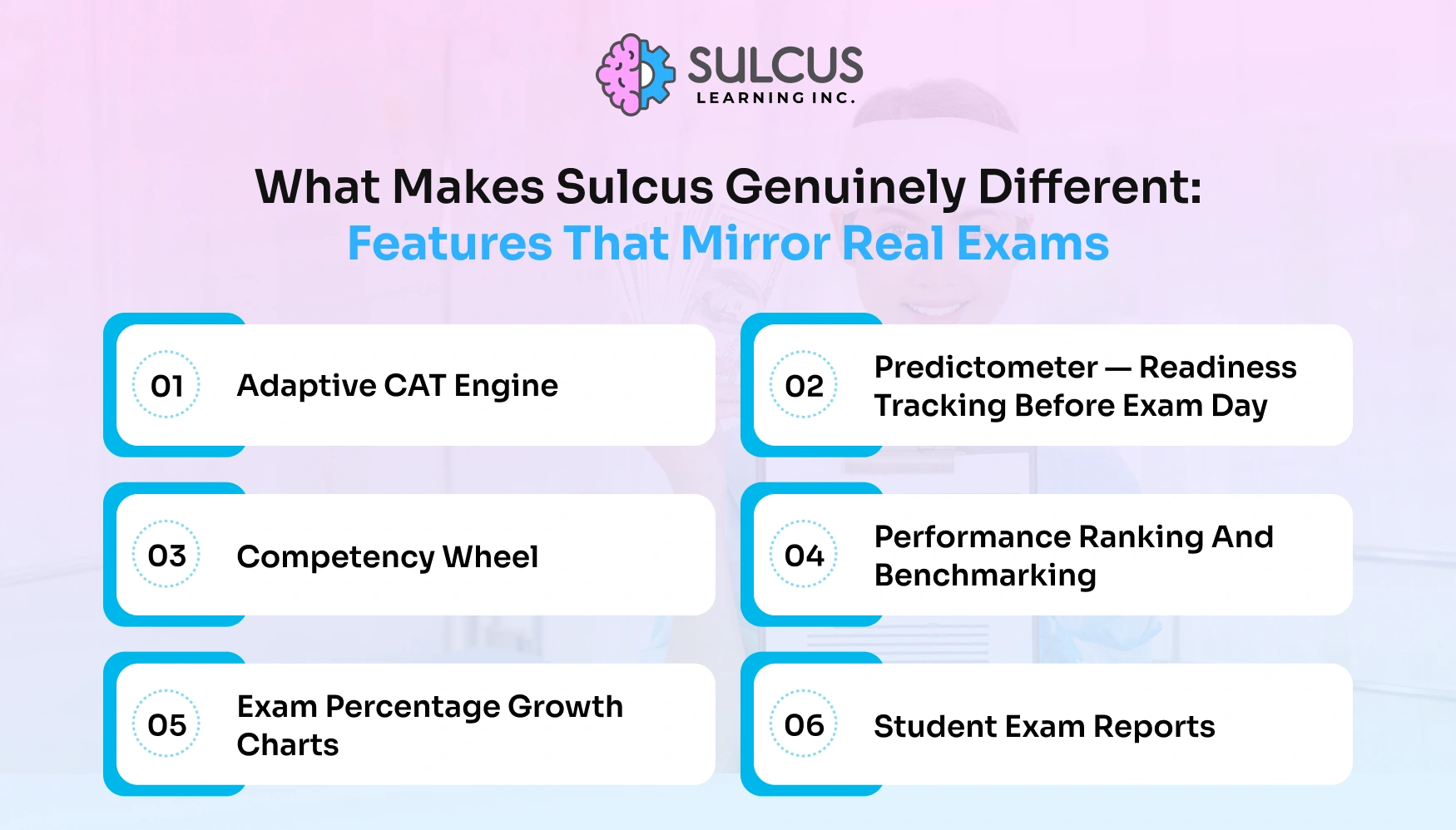
1. Adaptive CAT Engine
Sulcus Learning invests heavily in its Computerized Adaptive Testing (CAT) engine. Our goal is to replicate the adaptive implementation of testing devices such as the NCLEX-RN, NCLEX-PN, and REx-PN.
Instead of throwing the candidate random questions of the same difficulty, the program adjusts them to better match the candidate’s performance throughout the exam. This helps the test taker realize:
- Progressive difficulty adjustment.
- Competency-based evaluation patterns.
- Variable exam progression similar to adaptive testing environments.
- Performance fluctuations associated with real CAT exams.
This system was designed to ensure that students are confident and comfortable with CAT testing on the day of their exams, thereby increasing their comfort and confidence on the actual licensure exams.
Sulcus Learning also enhances visual performance analytics that are modeled after the principles of adaptive testing. This includes:
- Logit-style competency progression concepts.
- CAT confidence progression behavior.
- Exam-length variation patterns associated with adaptive testing systems.
- Visual graphs representing performance trends and competency movement.
A feature that sets the platform apart is its integration of both CAT-adaptive and non-adaptive exam preparation. Although NCLEX-RN, NCLEX-PN, and REx-PN simulations use adaptive structures, the CPNRE preparation tool is non-adaptive in order to accurately mimic the format of that exam.
2. Predictometer — Readiness Tracking Before Exam Day
Predictometer tracks students’ improvement and displays their readiness trend before a big exam.
Without reports of readiness, candidates often rely on separate mock exam results, which oftentimes are not reflective of their performance. Predictometer addresses:
- Performance consistency.
- Competency growth trends.
- Weakness identification.
- Readiness progression across repeated testing sessions.
Candidates can map out more effective study plans by understanding the depth of their weaknesses.
3. Competency Wheel
The Competency Wheel is a visual representation of a candidate’s performance in clinical judgment and basic nursing competencies.
Instead of viewing only a final percentage score, students can identify:
- Which competencies are strongest?
- Which clinical judgment areas require improvement?
- How does performance change across question difficulty levels?
- Which nursing domains require additional review?
Competency is a key aspect of modern nursing exams, in contrast to traditional exams that focus solely on factual knowledge.
4. Performance Ranking and Benchmarking
National-style performance rankings and benchmarking from Sulcus help candidates see their progress compared to other candidates preparing for the same exams.
These analytics can help students:
- Understand how they are progressing relative to peers.
- Identify whether preparation intensity needs adjustment.
- Maintain motivation and study consistency.
- Build strategic awareness of exam-readiness levels.
Additionally, the platform presents performance rankings on a leaderboard to increase motivation and engagement.
5. Exam Percentage Growth Charts
At Sulcus Learning, we understand the value of tracking your progress in your exam prep over a longer-term period. To assist you, we provide Exam Percentage Growth Charts, which help our users to identify:
- Score progression over time.
- Improvement in consistency.
- Strength and weakness trends.
- Long-term readiness development.
Real-time progress indicators allow students to see which preparation strategies are working and to stay motivated to keep preparing.
6. Student Exam Reports
After each practice exam or each testing session, Sulcus provides users with a Student Exam Report with detailed breakdowns of exam performance, categorized by:
- Question types.
- Competency domains.
- Subject areas.
- Clinical judgment performance.
- Difficulty levels.
- Testing trends.
The Student Exam Report also demonstrates how Sulcus’s Performance Analytics Dashboard shows competency trends, strengths, and preparation gaps more effectively than generalized study methods.
The team at Sulcus Learning has integrated adaptive test simulation, readiness tracking, the Canadian Nursing Counter, competency analytics, and performance reporting to enhance the exam-preparation experience and ultimately help candidates understand the reasoning and techniques behind the real Nursing Licensure exam.
Sulcus vs. Generic Nursing Prep Platforms: A Quick Comparison
Choosing the best online nursing prep platform can directly impact your confidence, readiness, and results. Here’s how Sulcus Learning compares to generic prep providers.
| Feature / Platform | Sulcus Learning Inc. |
|---|---|
| Country of Origin | Canada |
| Exams Covered | NCLEX-RN, NCLEX-PN, REx-PN, CPNRE |
| Adaptive CAT Engine | Yes: mirrors real exam logic |
| NGN-Aligned Questions | Yes: updated through 2026+ |
| Predictometer Readiness Score | Yes: proprietary feature |
| Competency Wheel | Yes: CNPI-aligned |
| Performance Ranking | Yes: national benchmarking |
| Canadian Regulatory Focus | Yes: provincial context included |
| Clinical Judgment Mapping | Yes: all question types covered |
Canadian vs. U.S. Nursing Exams: Why the Distinction Matters
One major concern for nursing candidates is whether the resources they use for exam prep are relevant to the exam they are taking. The majority of sites that function as nursing exam prep tools are designed for U.S. learners and are only adapted for Canadian learners. This doesn’t account for the fact that Canadian nursing examinations have different competency requirements, as well as clinical practice standards and regulatory frameworks.
These differences become important for Canadian practical nursing exams, such as the CPNRE and REx-PN, which are determined by the standards set by the Canadian Nursing Practice Frameworks and the practical nursing scopes of practice.
The NCLEX-RN and NCLEX-PN are licensure tests administered by the National Council of State Boards of Nursing (NCSBN) and used in the U.S. for licensure and in most of Canada. These tests use Computerized Adaptive Testing (CAT) and are designed to measure the highest-priority clinical judgment and competency.
The structure and competency expectations of Canadian practical nursing exams differ:
- The CPNRE (Canadian Practical Nurse Registration Examination) assesses Canadian practical nursing competencies and is a non-adaptive multiple choice and case-based model.
- The REx-PN (Regulatory Exam for Practical Nurses) is Canada’s newest practical nursing exam, with a competency-based design, that assesses candidates’ readiness for the practice of practical nursing.
One of the biggest mistakes to avoid in Canadian Nursing Licensure Exams is preparing for one exam using strategies designed for another licensing framework. Canadian practical nursing candidates require resources that accurately reflect:
- Canadian healthcare systems and terminology.
- Canadian practical nursing scope of practice.
- Provincial competency frameworks.
- Canadian documentation and client-care standards.
- Exam structures specific to REx-PN or CPNRE.
Keeping these distinctions in mind, Sulcus Learning Inc. was founded. The intent was not to view Canadian nursing preparation as another offshoot of U.S. content, but to create pathways towards exam-specific preparation for Canadian nursing candidates in both adaptive and non-adaptive exam contexts.
It is crucial to appreciate the nuances of Canadian nursing exams compared to American ones. Success in preparation depends not only on content mastery but also on practice that incorporates the clinical reasoning, competency framework, and exam structure of the licensing exam.
The Role of Clinical Judgment in Modern Nursing Exams
Modern nursing board exams no longer test your ability to simply memorize textbook definitions and recite them on command. There has been, and continues to be, significant testing of the ability to use clinical judgment, make decisions, prioritize, and reason about the safety of the client and other team members.
Modern nursing practice necessitates the understanding and interpretation of the following:
- Recognize changes in client conditions.
- Analyze clinical cues.
- Prioritize interventions.
- Make safe decisions under pressure.
- Apply evidence-based nursing judgment in complex situations.
Today’s licensure nursing exams evaluate nursing practice by covering all of the above points. However, they do so in a clinical sign-and-symptom scenario rather than in a traditional recall-the-knowledge nursing test.
Sulcus Learning Inc. was created in response to the specialty and pivots heavily on clinical judgment skills and modern exam reasoning, rather than practice focused on memorization.
Sulcus aligns with today’s licensure exam standards by incorporating new NCLEX (NGN) question types that reflect current competencies and the NCSBN’s current testing style.
These question types include:
- Extended multiple-response questions.
- Matrix/grid questions.
- Cloze/drop-down questions.
- Bow-tie clinical judgment questions.
- Ordered response and prioritization items.
- Case-study-based NGN scenarios.
- Enhanced hot-spot questions.
- Trend analysis questions.
- Multiple-response grouping questions.
- Stand-alone clinical judgment items.
- Unfolding case studies with evolving client conditions.
- Traditional multiple-choice questions are integrated into clinical scenarios.
These formats assess candidates’ ability to think through client situations, identify cues, and prioritize care safely, critical aspects of real clinical practice.
For the REx-PN, this type of preparation holds more weight as the exam is heavily focused on competency-based nursing judgment and practical clinical reasoning. Question banks that consist of generic questions that emphasize rote memorization or questions that cover facts in a vacuum will likely fall short of preparing candidates for the style and complexity of today’s nursing licensure exams.
Our aim is to weave the concepts of clinical judgment throughout the learning experience, which ensures NGN-style questions are a key component of the preparation. This enables candidates to practice nursing reasoning in exam-like environments and competency-driven situations.
As nursing licensure exams modernize in both Canada and the United States, preparation strategies that emphasize clinical judgment and competency-based rationale will become increasingly important for safe nursing practice.
Why Internationally Educated Nurses Trust Sulcus
As healthcare systems across Canada continue to address nursing shortages, internationally educated nurses (IENs) are increasingly playing an important role in strengthening the healthcare workforce. However, transitioning into Canadian or North American nursing practice often involves significant challenges beyond simply passing a licensing examination.
Many internationally educated nurses must adapt to:
- Canadian nursing competencies and standards.
- Different healthcare documentation systems.
- Client-centered communication expectations.
- Clinical judgment-focused testing models.
- Adaptive exam formats such as CAT testing.
- Provincial and national regulatory requirements.
For many candidates, the transition is not only academic but also professional and cultural. Preparing for examinations such as the NCLEX-RN, NCLEX-PN, REx-PN, or CPNRE can feel very different from the nursing education and licensing systems used in other countries.
Sulcus Learning Inc. was designed with these realities in mind. The platform’s preparation structure focuses heavily on helping internationally educated nurses bridge the gap between their prior nursing experience and the expectations of Canadian or U.S. licensure.
Some of the key areas that make Sulcus especially valuable for internationally educated nurses include:
- Canadian competency-based question design.
- Adaptive exam simulation aligned with modern CAT testing principles.
- NGN-style clinical judgment practice.
- Detailed analytics and readiness tracking.
- Visual performance reports and competency mapping.
- Exam environments designed to mirror real testing experiences.
Rather than relying only on generic memorization-based question banks, Sulcus emphasizes:
- Clinical reasoning.
- Prioritization and delegation.
- Safe nursing judgment.
- Canadian nursing scope of practice expectations.
- Realistic case-based decision-making.
The platform has been used by nursing candidates from multiple regions around the world, including:
- Canada
- United Kingdom
- India
- Nigeria
- Philippines
- Countries across Southeast Asia and other international regions.
This is one of the biggest reasons why nurses worldwide choose Sulcus Learning to prepare for modern Canadian and North American nursing licensure exams.
Whether candidates are preparing for Registered Nurse or Practical Nurse pathways, understanding the differences between nursing designations, licensing systems, and scopes of practice is an important first step toward successful licensure and long-term career planning in Canada or the United States.
The Science Behind Exam Readiness: Why Mock Tests Matter
In clinical practice, new nurses are not expected to manage complex client situations independently without first receiving guided preparation and supervised experience. The same principle applies to preparing for the nursing licensure exam. Effective exam readiness requires more than reviewing notes or memorizing content, it requires repeated exposure to realistic testing conditions and clinical decision-making under pressure.
The Importance of Mock Tests goes far beyond simple review tools, especially in modern nursing licensure preparation. They help candidates develop:
- Clinical reasoning under timed conditions.
- Decision-making confidence.
- Familiarity with adaptive testing behavior.
- Mental endurance and concentration.
- Comfort with exam structure and pacing.
Educational research has consistently shown that retrieval-based learning — actively practicing information through testing and application — is significantly more effective for long-term retention than passive review methods alone. Practicing under realistic exam conditions helps strengthen memory recall, clinical reasoning pathways, and performance consistency.
Sulcus Learning Inc. incorporates full-length mock examinations designed to reflect the structure and behavior of modern nursing licensure exams, including:
- NCLEX-RN.
- NCLEX-PN.
- REx-PN.
- CPNRE.
This is exactly why sulcus mock tests are the closest thing to sitting the real Canadian Nursing Exam, as the platform’s mock testing environments are designed to simulate:
- Real exam timing structures.
- CAT-adaptive testing behavior for NCLEX and REx-PN style preparation.
- Non-adaptive exam experiences for CPNRE preparation.
- NGN-style clinical judgment question formats.
- Competency-based progression and performance evaluation.
The platform demonstrates how Sulcus turns time pressure into a competitive advantage by encouraging candidates to develop:
- Exam-day stamina.
- Time management skills.
- Consistent clinical judgment performance.
- Confidence working under pressure.
Sulcus also integrates detailed analytics and performance reporting after mock exams, allowing students to identify:
- Weak competency areas.
- Patterns of decision-making errors.
- Clinical judgment gaps.
- Performance trends over time.
This type of feedback helps transform mock testing into an active readiness-building process rather than a passive content review.
As nursing licensure exams continue to evolve toward competency-based, clinical judgment-focused testing models, realistic mock exam practice becomes increasingly important for helping candidates feel prepared, confident, and familiar with the demands of the actual testing environment.
Building a Nursing Career in Canada: The Bigger Picture
It’s important to know that taking the licensure exam is not the endpoint but the beginning. Nursing careers in Canada are highly secure, well-regarded, and well-paying compared to many other healthcare professions. Opportunities in nursing are truly endless, ranging from acute care in hospitals to community health, long-term care, and specialized fields.
Having qualitative knowledge on the transition from being a student to a registered nurse and understanding the provincial admission guidelines, bridging programs for internationally educated nurses (IENs), and the differences in the scopes of practice between registered nurses (RN) and registered practical nurses (RPNs) are likely to be the foundations of a successful and satisfying career.
Our full guide on how to become a nurse? walks you through the complete pathway, from education to licensure to practice.
Final Thoughts
After working in Canadian healthcare for 15 years, mentoring nursing students, and working with licensed nurses in hospitals and community settings, I have come to this conclusion: preparation tools matter more than most people realize, as I have witnessed firsthand the impact of exam quality on nurses’ clinical readiness.
“They have Canadian Nursing background knowledge from the outside?” is one of the many comments that were used to develop Sulcus Learning, Inc. Their adaptive engine, clinical judgment framework, and in-house analytics, and multi-exam coverage are all features that come from purposeful innovation that reflects the nitty-gritty of Canadian Nursing Licensure.
Whether you are a Canadian nursing graduate taking the exam for the first time, an internationally educated nurse who is working their way through Canadian regulations, or a practical nursing student attempting the REx-PN or CPNRE, Sulcus is the preparation platform that makes you feel ready to own the exam when you walk in to write it.
Trusted globally. Built in Canada. Proven by outcomes.
Frequently Asked Questions
Q1. Is Sulcus Learning only for Canadian nursing students?
Ans. No. While Sulcus is built on Canadian nursing standards and regulatory frameworks, its platform serves nursing students globally. Internationally educated nurses preparing for Canadian licensure, particularly those targeting the NCLEX, REx-PN, or CPNRE, use Sulcus as their primary preparation platform.
Q2. How does the Predictometer work?
Ans. The Predictometer is Sulcus’s proprietary readiness scoring tool. It analyzes your cumulative performance across practice sessions and provides a data-driven readiness indicator, helping you determine whether you are exam-ready before booking your actual licensure exam.
Q3. Does Sulcus cover Next-Generation NCLEX (NGN) question types?
Ans. Yes. Sulcus includes NGN-aligned question types, including case studies, extended drag-and-drop, and enhanced hot-spot questions, across its question bank, keeping preparation aligned with current and upcoming exam standards through 2026 and beyond.
Q4. What is the difference between CPNRE and REx-PN?
Ans. The CPNRE is the Canadian Practical Nurse Registration Examination, administered provincially and featuring case studies and MCQs. The REx-PN is Canada’s newer, nationally standardized practical nurse exam, designed around competency-based clinical judgment. Sulcus prepares students for both.
Q5. Can Sulcus help me prepare for both NCLEX-RN and REx-PN at the same time?
Ans. Sulcus supports multiple exam formats on a single platform. However, we recommend focusing your preparation on the specific exam required by your provincial regulator. Use the Competency Wheel and Student Exam Reports to align your study plan accordingly.

Harry Sagar
Harry is a strategic leader at Sulcus Learning, developing exam-aligned learning solutions. With expertise in adaptive testing and clinical education, he supports learners in achieving confidence, competence, and readiness.