

The REx-PN is the entry-to-practice examination used for practical nurse applicants in Ontario and British Columbia. It is administered as a computer-adaptive test, which means each applicant takes a test of varying duration that meets the standards of the official REx-PN test plan while adjusting to their assessed aptitude. The purpose of the test is to evaluate the clinical judgment, decision-making skills, knowledge, and competencies needed for safe and efficient entry-level practical nursing practice.
Many nursing candidates prepare for the RExPN as they would for a traditional nursing-school examination by memorizing large amounts of information. However, most REx-PN questions are prepared at the application level or above. Candidates must be able to recognize clinical priorities, identify safety concerns, interpret client information, and select the most appropriate nursing action, not simply recall isolated facts.
Understanding the examination’s adaptive format, scoring process, content categories, question types, time limit, and variable number of questions can make preparation more focused and reduce test-day anxiety. This guide explains how the REx-PN works and provides a practical, step-by-step study approach based on the competencies and Client Needs categories measured on the examination.
How REx-PN Is Scored and Why That Changes How You Should Study
The REx-PN incorporates computerized adaptive testing (CAT). The next question’s difficulty is not based solely on whether the last answer was right or wrong. After every answer, the computer updates the candidate’s estimated ability based on all previously answered questions and the difficulty of those questions. It will choose another question based on the candidate’s estimated ability, while also balancing the content outlined in the REx-PN Test Plan.
Typically, the system stops when it is 95% certain that the candidate’s ability estimate is significantly above or below the passing threshold. For candidates who reach the maximum number of questions, the estimated ability is assessed, and the REx-PN passing score is set at −0.32 logits for the year 2026. The assessment is based on a candidate’s ability estimation and not the proportion of questions answered correctly.
Starting in January 2026, single-select, multiple-choice questions will continue to be scored as either correct or incorrect, and multiple-response “select all that apply” questions will be eligible for partial credit, depending on the responses.
Candidates will not be able to gain a scoring advantage over the CAT, and candidates are also discouraged from preparing by rote memorization. Consistent competence in all Client Needs categories will be critical for success, especially in judgment and prioritization, as well as in safety, pharmacology, and infection prevention, and in the ability to adapt to the client’s condition and incorporate nursing interventions and knowledge.
How Many Questions Are in the REx-PN Exam?
The REx-PN examination is a variable-length examination consisting of approximately 90 to 150 total questions. All candidates will receive 30 embedded, unscored pretest items, randomly placed throughout the examination and presented in the same format as the scored items. Since candidates will not know which items are scored, all items should be answered.
Candidates will have a total of 4 hours to complete the examination, including time to answer all sample items, view the tutorial, and take any optional breaks. Candidates should prepare to receive 150 total test items and should aim to spend 1 to 2 minutes to respond to each test item.
The examination may be terminated, at the discretion of the computer, when the test has enough data to reach a confident, pass-or-fail determination, and may be allowed to continue to the maximum number of items when the candidate’s test performance is determined to be at the passing level.
Candidates should not assume that the initial test items have greater weight. For each test item that is answered, the computer will adjust the candidate’s test score based on their overall test performance. Therefore, the best approach is to answer each test item in a measured, consistent, and careful manner, and not in haste.
REx-PN Exam Format: Question Types You’ll Encounter
A modern REx-PN study guide has to prepare you for more than multiple-choice. Expect a mix of:
- Multiple Choice Questions (MCQs): Single best-answer items testing core nursing knowledge
- Select All That Apply (SATA): Items with multiple correct answers, where partial credit typically isn’t given
- Fill-in-the-Blank: Calculation-based items, often medication dosages or fluid balance
- Exhibit-based questions: scenario items requiring you to review charts, lab values, or orders before answering
Each format tests a different cognitive skill, which is exactly why studying with flashcards alone leaves gaps. Strong candidates train deliberately across all four formats.
A Step-by-Step REx-PN Study Guide
Success on the REx-PN exam requires more than memorization. A focused study plan, adaptive practice, and strong clinical judgment can significantly improve your readiness and confidence.
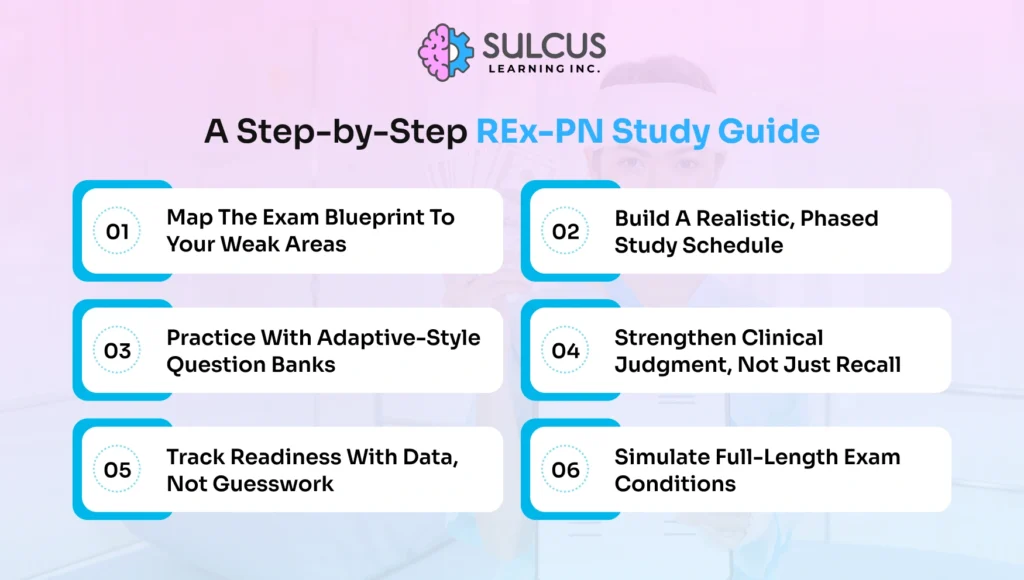
Step 1: Map the Exam Blueprint to Your Weak Areas
Before opening a single practice question, review the official client needs categories and competency framework. Most candidates skip this and study everything equally, wasting time on areas they’ve already mastered.
Step 2: Build a Realistic, Phased Study Schedule
Break preparation into phases: content review, practice-question immersion, and full-length simulation. Cramming everything into the final two weeks is one of the most avoidable mistakes candidates make.
Step 3: Practice With Adaptive-Style Question Banks
Static question sets don’t replicate how CAT behaves. Adaptive-style banks train you to stay accurate under shifting difficulty, mirroring real exam conditions far better than linear practice tests.
Step 4: Strengthen Clinical Judgment, Not Just Recall
Next-generation question formats increasingly test how you prioritize, recognize cues, and analyze client data, not just whether you memorized a fact. Practice questions that ask “what would you do next,” not only “what is true.”
Step 5: Track Readiness With Data, Not Guesswork
Generic confidence isn’t a reliable predictor of readiness. Candidates who track performance by competency area, identifying specific strengths and limitations rather than one overall percentage, walk into the exam with a clearer sense of where they stand.
Step 6: Simulate Full-Length Exam Conditions
In your final two weeks, take timed, full-length practice exams under realistic conditions: no pausing, no notes, same time limit as test day. By question 100, endurance matters just as much as knowledge.
Common REx-PN Study Mistakes to Avoid
Many well-prepared candidates still lose points to avoidable habits: over-relying on memorization apps without practicing clinical scenarios, skipping calculation and exhibit-based questions because they feel intimidating, ignoring time management until the final week, and treating practice exam scores as pass/fail predictions rather than diagnostic tools.
Studying With the Right Data Behind You
This is exactly where having the right preparation ecosystem makes a measurable difference. Sulcus Learning, a Canadian-built nursing exam-prep platform, is designed around the same competency-driven logic the REx-PN exam itself uses to score candidates.
Tools like the Predictometer give candidates a readiness score grounded in actual performance data rather than guesswork, while the Competency Wheel maps strengths and limitations across each client needs category so study time goes exactly where it’s needed.
Exam Percentage Growth Charts and Performance Ranking let candidates track improvement over time and benchmark themselves against peers preparing for the same exam. Proudly Canadian. Globally trusted. Built for candidates who want to study smarter, not just longer.

Final Thoughts
The REx-PN exam rewards preparation that reflects real-world nursing decision-making, not endless memorization. By aligning your study plan with the exam blueprint, practicing adaptive-style questions, strengthening clinical judgment, and monitoring performance data, you can build both competence and confidence.
Focus on understanding why answers are correct, identifying patterns in your mistakes, and improving weak areas systematically. Consistent, targeted preparation is far more effective than last-minute cramming.
As exam day approaches, use full-length simulations to sharpen endurance and time management. With the right strategy and disciplined practice, you can approach the REx-PN knowing you’re prepared to perform at your best.
FAQ’s
Q. What Is the REx-PN Exam Passing Score?
Ans. REx-PN uses a criterion-referenced logit score rather than a fixed percentage, your pass/fail outcome reflects whether the CAT algorithm determines your competency sits above the established standard, not how many questions you answered correctly out of a total.
Q. How Much Does the REx-PN Exam Cost?
Ans. REx-PN exam cost varies by registration body and any rescheduling or international fees that may apply. Always confirm current fees directly with your provincial regulatory body before booking.
Q. When Are REx-PN Exam Dates in Ontario?
Ans. REx-PN exam dates in Ontario are scheduled on a rolling basis through approved testing centers rather than fixed sitting dates, so check availability as soon as you’re approved to test.
Q. How Do I Book the REx-PN Exam?
Ans. Booking the RExPN exam involves receiving authorization from your regulatory body, then scheduling a seat at an approved testing center. Processing times vary, so start the process well ahead of your target test window.
Q. What Is a Registered Practical Nurse?
Ans. A Registered Practical Nurse (RPN) is a regulated healthcare professional who provides direct patient care under a defined scope of practice, typically working alongside RNs and physicians in hospitals, long-term care, and community health settings.
Q. RPN vs RN: What’s the Difference?
Ans. RNs generally complete a four-year degree and manage more complex clinical cases, while RPNs complete a shorter diploma program (2 Years) and focus on stable, lower-acuity patient care, though both roles overlap significantly in day-to-day practice.
Q. What Are the Best REx-PN Exam Tips for Test Day?
Ans. Arrive early, pace yourself within the time limit instead of rushing, read exhibit-based questions twice before answering, and trust your first instinct on SATA items rather than second-guessing repeatedly.

Harry Sagar
Harry is a strategic leader at Sulcus Learning, developing exam-aligned learning solutions. With expertise in adaptive testing and clinical education, he supports learners in achieving confidence, competence, and readiness.